In defence of boredom



Do we all need to be more bored? As summer approaches, writer Madelynne Flack draws on cinema to make the case that by doing nothing we might get more in return.
Almost half a century ago the French philosopher Blaise Pascal attributed the blame of all humanity’s problems onto “a man’s inability to sit quietly in a room alone”.
While it’s hard to imagine exactly what Pascal would assign the world’s problems to nowadays, the endless stream of noise coming from our portable screens is a good guess. In this way, his hyperbole translates to the contemporary through every digital-detox, preachy self-help book, and the angry words uttered by parents who want their children to spend less time on their phone: we need to be more comfortable with doing nothing.
Anyone who knows me, knows that I find it very difficult to be bored. By this, I mean I simply can’t resist the urge to do things, whenever and wherever I can. I’m one of those annoying people that flaunts my busyness as if it’s some symptom of a more fulfilled existence. Haunted by the possibility of being asked questions like “are you working on anything interesting right now?” and not having a sufficient answer, I play the role of both victim and perpetrator of society’s compulsive relationship with productivity.
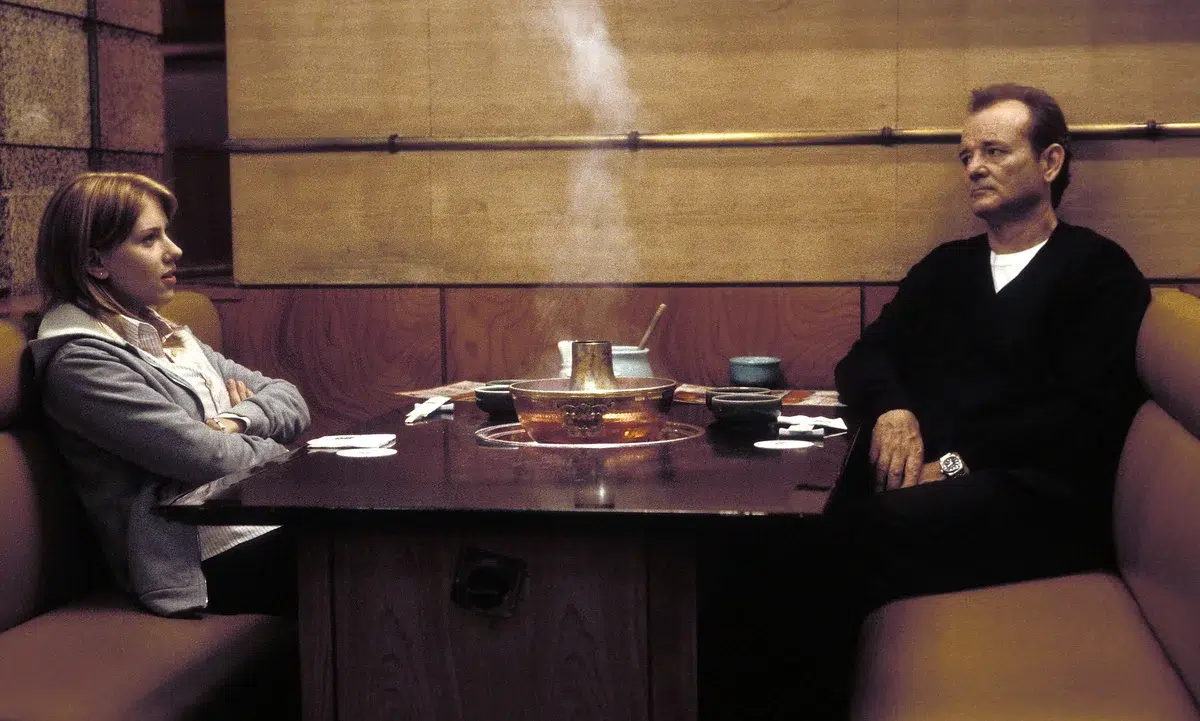
Lost in Translation (2003), directed by Sofia Coppola
The one benefit of my aversion to boredom is that most people feel the same-way. In fact, our hatred for it can be linked to our most primitive instincts: artists, writers and poets have endured it for centuries as a means of torture to make their work more insightful, and Buddhists practice the phenomenon because of its similarities to suffering. For Existentialists, boredom wears a similar coat. Jean-Paul Sartre called it a “leprosy of the soul”, and Søren Kierkegaard cites it as the reason for Adam and Eve’s original sin. Some studies show that, in certain cases, people would even prefer to be in physical pain than be bored: a 2014 study from the University of Virginia sat participants in an empty room for just 15 minutes, accompanied only by a buzzer which would give them a mild electric shock to their ankle should they press it. In the absence of any stimulation, almost half of participants chose to shock themselves at least once.
The difficult thing is that however unpleasant it may be, boredom is also essential. According to psychologists, people who experience it more frequently find a greater sense of meaning in life, and without it we are more likely to suffer from mental health issues like depression and anxiety. It can help us to reduce our consumption of digital content, provide a break from AI slop, and, for a certain subsection of young people—according to a study of participants who documented their attempts to sit still without any screens, food, sleep or other stimuli— boredom is even an unexpected antidote to our worsening attention spans.
However unpleasant it may be, boredom is also essential.
Over the years my relationship with boredom has been far from asymptomatic. In my need to constantly be doing things, I have faced periods of chronic burn out, a lack of creativity, and the inability to feel present in my own life. Earlier this year, my problem even became the topic of playful contention between me and my best friend, someone who is a long-standing champion of finding the beauty in doing nothing. We were visiting a quiet surf town in Morocco—a place comedically aligned with inner workings of a slower-lifestyle—when, in response to a chaotic schedule of markets, hiking and surfing, her strict philosophy was presented to me loud and clear: I need to find more satisfaction in life’s moments of nothingness.
This conversation has played in my mind over and over again in the months following our trip, and has forced me to, at the risk of sounding like the start of some didactic self-help guide, become more at ease with the prospect of doing nothing. I can’t sit here and say that I still don’t do things like pick up my phone first thing in the morning, or call friends whenever I go on a long walk. What I can say however, is that I was pleasantly surprised to find that being bored is not as bad as I thought. And, can actually be quite romantic if you allow it to be.
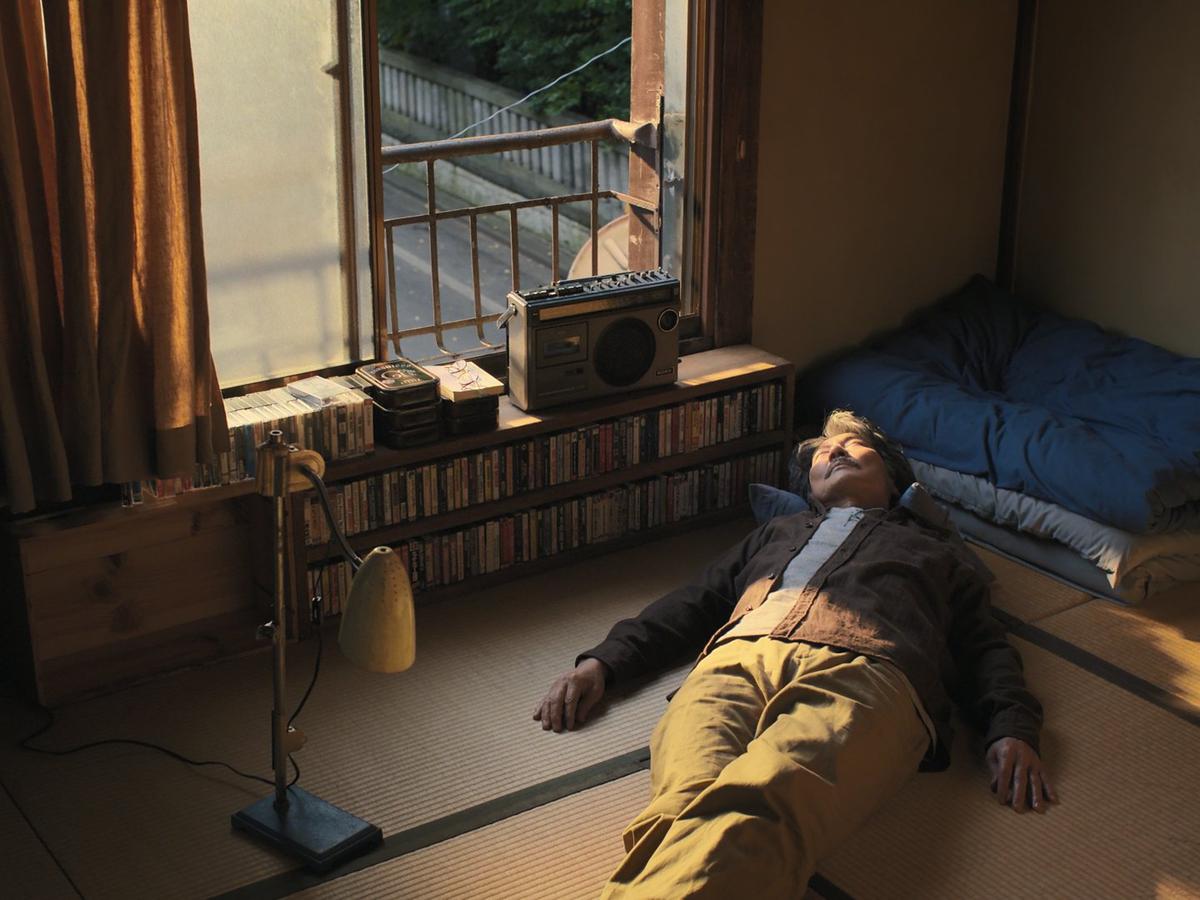
Perfect Days (2023), directed by Wim Wenders
In cinema, the aesthetics of tedium teach us a lot about the beauty that can be found in mundaneness. Wim Wenders’ Perfect Days (2023) uses boredom as a canvas in the life of the protagonist Hirayama, a Japanese toilet cleaner, who exists in a state of inner peace, satisfied in his simple rituals of working, reading, listening to cassettes, and watching light fall through the gaps of trees. In the 2016 animated short film Pussy, writer and director Renata Gasiorowska shows us an unrefined version of what exploring life’s simple pleasures can lead to, as a young woman sets out on an evening of desire, pleasure and sexual-self discovery, in the absence of anything else to do. And, in Chantal Akerman’s groundbreaking debut feature, Je, tu, il, Elle (1974), we see mental isolation as an introspective tool. The protagonist, ‘Julie’, who’s played by the Belgian director herself, doesn’t leave her flat for 28 days—the entire first half of the film—yet, despite being isolated from the world, Julie’s mind is free; she explores the luxury of imagination without the temptation of stimulation.
While it’s easier to feel a sense of ardence around boredom when it’s explored in these more gratifying contexts, it’s also important to understand how it can help us learn more about ourselves, and others. In Jeanne Dielman, 23 quai du Commerce, 1080 Brussels (1975), widely regarded as Akerman’s magnum opus, isolation and boredom work in tandem to foster a sense of intimacy between character and viewer. The film follows three days in the life of a widowed housewife, watching closely as the protagonist tediously cooks, cleans, cares for her teenage son, and, to help make ends meet, acts as a prostitute to three loyal clients.
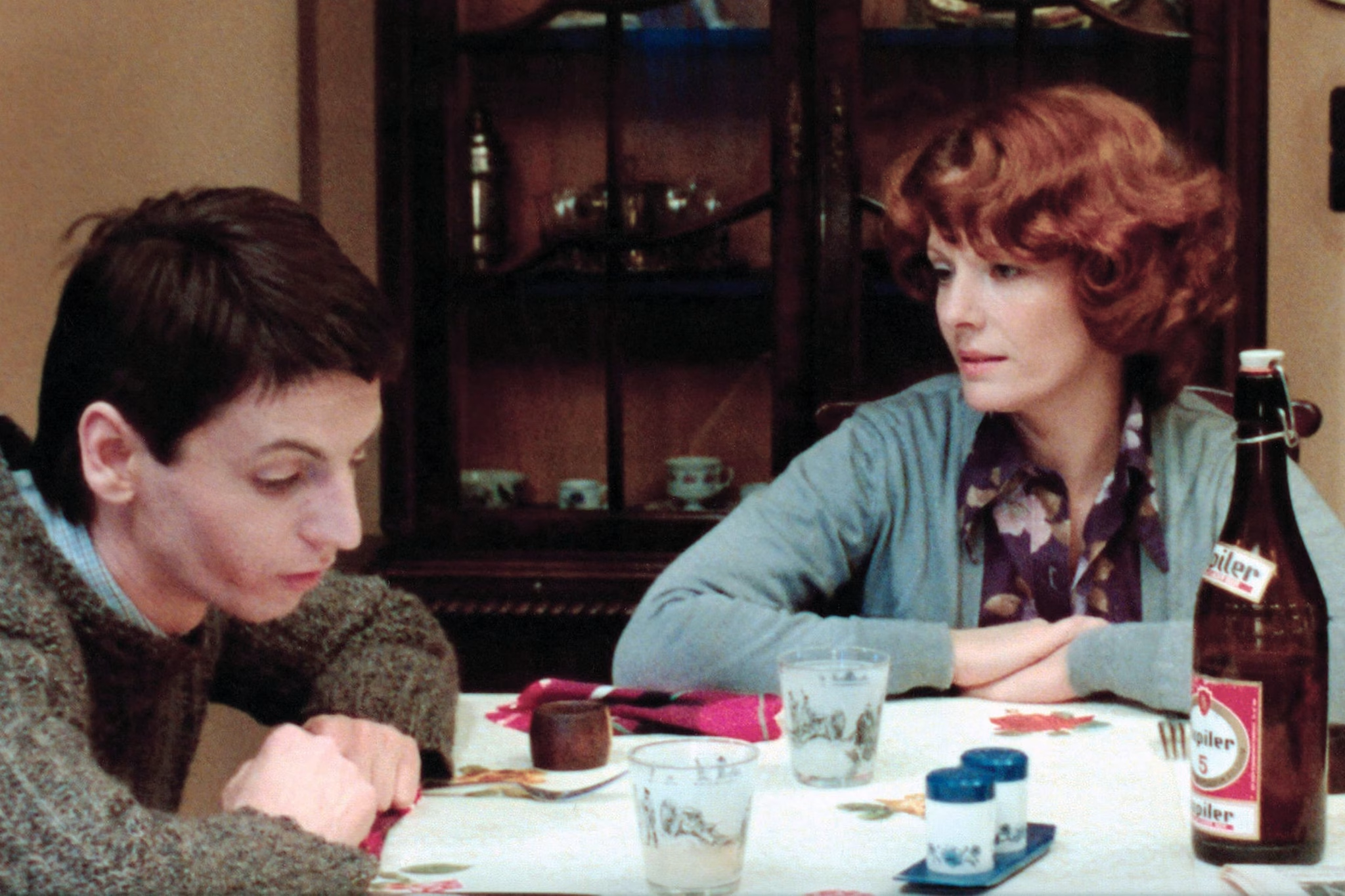
Jeanne Dielman, 23 quai du Commerce, 1080 Brussels (1975) by Chantal Akerman.
Boredom is a soft act of rebellion against our growing dissonance towards each other and ourselves
By the end of those three and a half hours, we are sufficiently familiar with Dielman’s formulaic daily routine; we know that every morning, she starts the day by turning on the gas to boil her coffee, we know that, after her coffee, she cleans her son’s shoes, and that she spends the rest of her day washing dishes, making beds and peeling potatoes, before meeting one of her nightly clients. There’s an intimacy that forms from this relationship. While we don’t truly know anything about the defining parts of Dielman’s life—much less the key markers of her person, like her favourite food, or even her favourite colour—understanding her in these dull moments, as she grazes along in time, makes us feel closer to her than we would knowing the alternative.
It is in these intimate moments that boredom rears itself as a hidden triumph, rather than an act of failure. While its uneasiness only expands in the face of society’s problem with digital overconsumption—where reality sometimes feels like the plot of one of Aldous Huxley’s roman à thèse—boredom is a soft act of rebellion against our growing dissonance towards each other and ourselves; exposing an inner contentment where excessive productivity acts as a veneer for unfulfillment.