


Look closely and filmmakers have been using graffiti and typography to hint at their dystopian futures. Ramzi De Coster examines a number of films who do this strikingly well.
There’s a scene early on in Alfonso Cuarón’s dystopian film Children of Men (2006) where Theo, the protagonist, visits his cousin Nigel, a government minister living in a penthouse in Battersea Power Station, which deliberately resembles Pink Floyd’s Animals album cover (1977). “Couldn’t save La Pietà. Smashed up before we got there,” Nigel informs Theo on his approach, but Cuarón simultaneously shows us what Nigel has evidently succeeded in saving from the ruins of the fallen world that surrounds the autocratic but “stable” Britain of the film: Picasso’s Guernica, a Banksy mural parked in a driveway (filmed in the turbine hall of Tate Modern, as it happens), and, of course, Michelangelo’s David, towering behind him in the way the sculpture does.
At one point, the two men are talking, silhouetted against the penthouse view of a giant inflatable pig floating between two turbines, with Theo looking, as he persistently does throughout the film, like the half- drunk, depressed, and resigned personification of a world treading slowly towards its end (the film’s premise is that women have become infertile and no children have been born for 18 years). Smirking, Theo says: “You kill me! A hundred years from now there won’t be one sad fuck to look at any of this. What keeps you going?” Nigel, also ostensibly resigned to his fate or the fate of the world but in a different way, replies: “You know what it is, Theo? I just don’t think about it.”
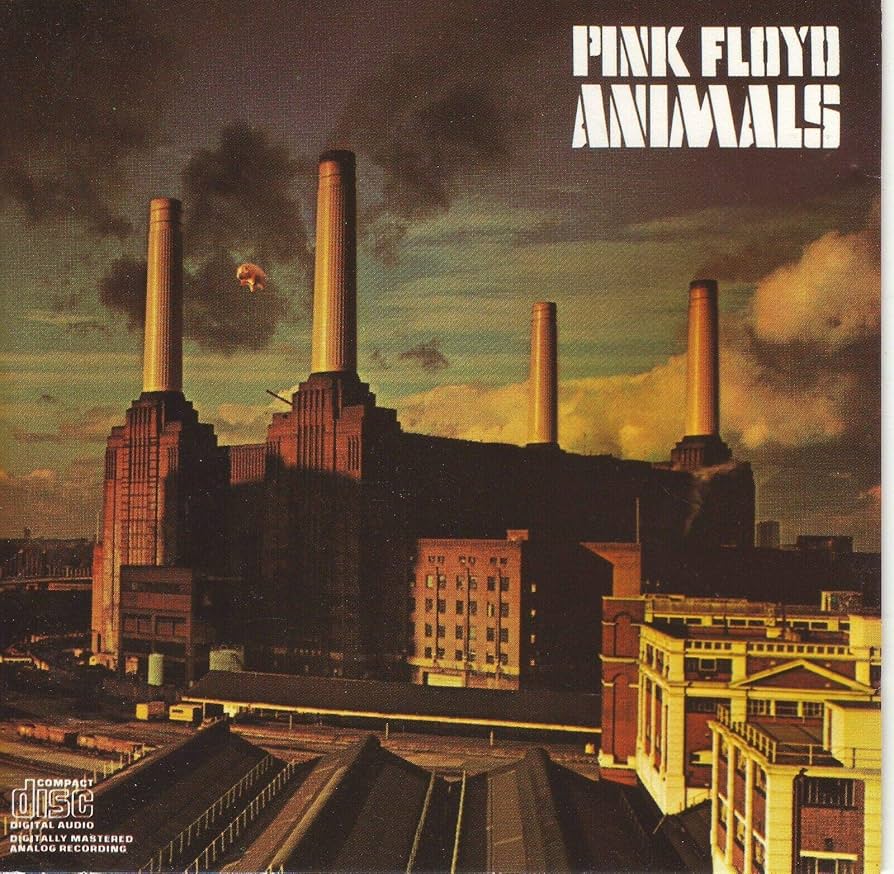
Cover of Animals (1977). By Pink Floyd.
Cuarón does want us to think about it, though. Because what is amplified, just as David emerges from the background into the foreground in that earlier essential shot, is a question that seems unmistakable, unavoidable, and haunting throughout the film, because there is no good answer to it or, much worse, no good counterargument. What does it mean to make, keep, and preserve art in a world in which everything is knowingly finite? And not in the obvious way that all things are, but in the much more harrowing sense that, in this case, it has a predictable and calculable end date. Children of Men is flanked, crowded, tattooed, and plastered, literally, in a different kind of art, in the posters and spray-painted and handwritten messages that tell a more pertinent story, maybe, than the one actually being told on the screen.
In one scene, old yellowed newspapers, glued onto the walls of a hideout in an apocalyptic collage to block out the sun (and the state), are emblazoned with public anxiety. “Age doesn’t matter”, one headline reads—perhaps the most simple, timeless yet timely of them all. Others summarise the events that clearly produced those anxieties: “Africa devastated by nuclear fallout”, “Armageddon begins: Russia detonates nuclear bomb”. Slightly newer, less faded copies, tell of the state and non-state reactions that perpetuate further violence: “Enforce fertility tests”, “Extremist explosion”, and “Raid nabs refugee weapons cache”. Some of the headlines are, of course, just acts of narrative foreshadowing, priming us for the climax of the film, which takes place in a refugee camp on the English coast and includes both the most action-thriller-esque and moving episodes of the film. Imbued in them, however, is also something slightly less easy to detect: the subversion of the role art plays in society by elevating the type of art that is traditionally temporal, such as graffiti, spray-painted on the wall one day then washed off or painted over the next.
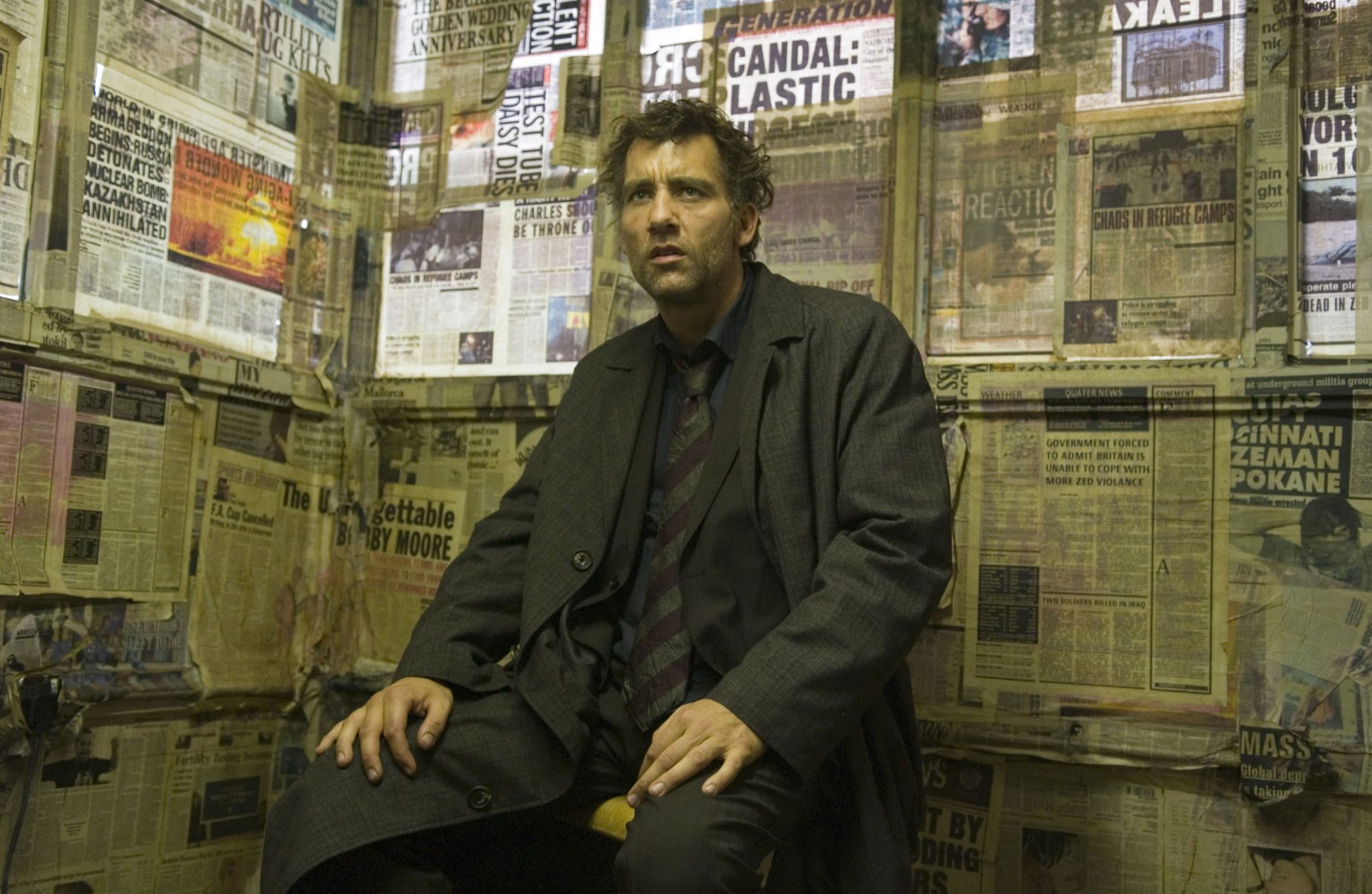
Clive Owen in dystopian London for Alfonso Cuarо́n’s Children of Men (2006)
In the world presented to us in Children of Men, the visual representations that matter most are the temporary and immediate ones that surround us, and that Cuarón regularly trains his camera on, rather than Guernica hanging on a wall behind a dining room table for no one to see, whispering the same still horror in its contorted forms and in every letter of its name. If Children of Men, however, pays tribute to the great works of art that populate our imagination (and the films that have influenced it), there’s no doubt that the role graffiti and writing play in the film—wherever they’re found, on alley walls and newspapers, on protest placards and billboards— can similarly be found in the sci-fi and dystopian movies that came before it. Using written cues to convey context is nothing new for filmmakers.
Newspaper headlines come into frame to tell us something we need to know as audience members and radios built into car dashboards or sitting on kitchen counters spit audible context without the use of contrived dialogue between characters. In other sci-fi movies, however, these visual cues, these works of urban and uncontrolled art, are used in a different way, to convey not context but a feeling that is the marrow of so many sci-fi films: loneliness and anxiety in and about the future.
This feeling notably (and quietly) underpins Blade Runner 2049 (2017), its predecessor Blade Runner (1982), and the inspiration for both, the 1968 Philip K Dick novel Do Androids Dream of Electric Sheep? In Blade Runner 2049, two scenes towards the beginning and end of the film illustrate this. In the first, an apathetic K pushes buttons on a vending machine stocked with everything and nothing at the same time, where menu items are base categories stripped of specificity: Meal, Instant Fix, Experience, Liquor. In the latter scene, a defeated, bruised K looks up at a giant neon hologram of a woman leaning over him. “You look lonely, I can fix that,” she promises, accompanied by multi-coloured words that turn and switch like destinations on an airport departure board: “Everything you want to hear. Everything you want to see,” they read.
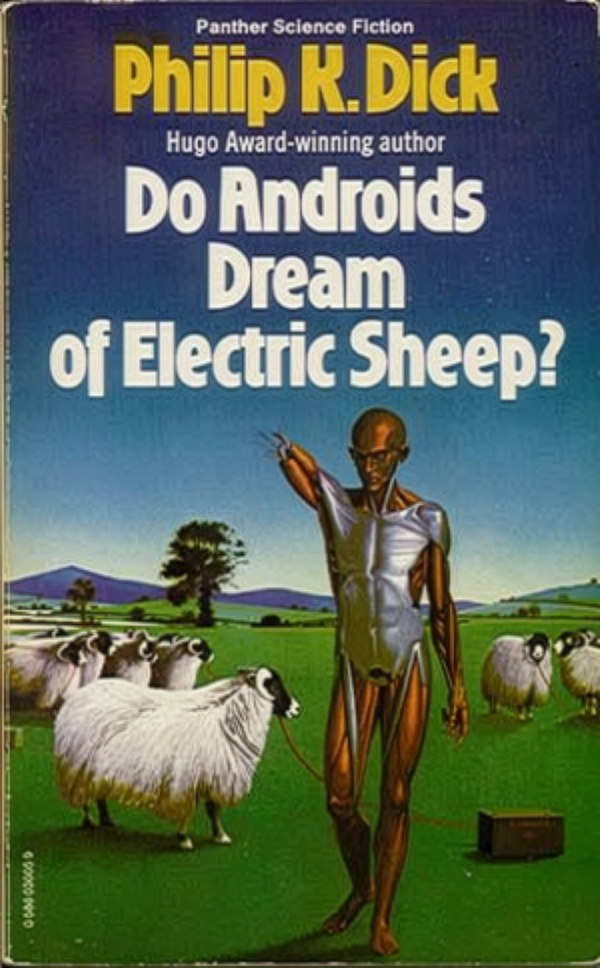
The cover for Philip K Dick’s Do Androids Dream of Electric Sheep? (1968). Inspiration for Blade Runner.
Even the original Blade Runner—which predates Blade Runner 2049 by 35 years but clearly read the same writing on the wall—emphasises this form of self-aware advertising, where the advertising itself is the point. “A New Life Awaits You in the Off-World Colony,” Los Angeles’s megaphone howls between skyscrapers with Pan Am and Coca-Cola billboards. Then the narration that accompanies them: “They don’t advertise for killers in the newspaper. That was my profession. Ex-cop. Ex-blade runner. Ex-killer.” What both Blade Runners successfully communicate to us, as passive spectators, is how crowded sci-fi futures are further crowded with deliberate but empty messaging; messaging that has been rendered empty by its transactional, overabundant, and commodified nature.
In contrast, within the first minute or so of Jean-Luc Godard’s Alphaville (1965), just as we’re being pulled into the sci-fi city from which the film derives its name—a place swallowed in such deep, constant darkness that lone streetlamps, passing headlights, and lit cigarettes serve as the city’s electrical grid—a city limit sign appears for no more than a couple seconds. It reads: “Alphaville. Silence. Logic. Safety. Prudence.” It’s ironic in intention, of course. The sombre music and celestial darkness, the shots of tower blocks and hollowed-out squares, the protagonist’s hard exterior, and the cold, almost battle-hardened narration, suggest anything other than what the sign promises. Godard shows us a square ablaze with the bold letters of the American Express logo, and we realise that the world of is one in which everything is reduced to its contours, to the sharp yellow light cast on its empty spaces—clearly in abundance—and the shadows that form and shift on the walls.
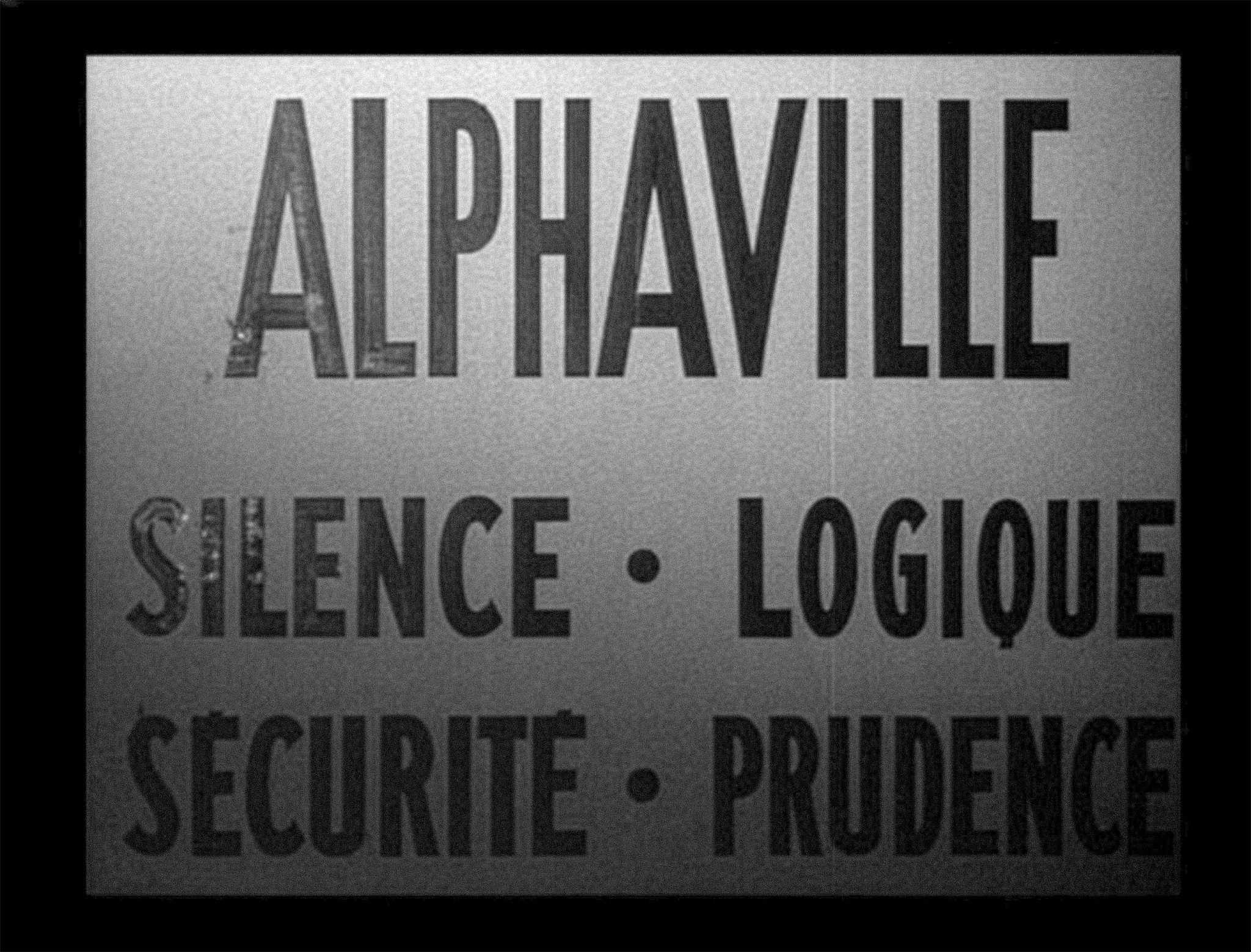
The walls in Alphaville (1965). By Jean-Luc Godard.
Unlike Children of Men, there’s a kind of silence in every word, as though they’re meaningless, like their letters above are misfit parts in a machine that can’t switch on, and we’re left with a world in which language can’t tell us what’s real or not. There’s another scene in Children of Men, just before the climax, that takes place in a long-abandoned school where the walls seem, at first, covered with graffiti. The camera zooms in to reveal that the pictures are, in fact, paintings and drawings created by children who have long since grown up. We’re confronted with them the way we might be by a series of ancient paintings and engravings on the walls of a cave. In them, one sees a reminder of what art looks like in its infancy, unconcerned or preoccupied with the predilections of adulthood, of form, style, and medium, or of realism and accuracy and truth.
They act, simply, as beautiful manifestations of an abstract, spontaneous, and malleable world, one in which people are bigger than the houses they live in, the sun melts, and everything, in stark contrast to the pale, battleship-grey world of Children of Men, is entirely awash in colour. The point of noticing this, or of acknowledging it in any sense, is really to make a simple but salient point: sci-fi stories captivate us, in part, because the worlds they present tell their own stories about the human mind, about every facet of the way in which we deal with a world, emotionally, that is too substantially altered for us to cope with it; a world in which houses may in fact be smaller than the people who live in them and the sun has long melted away.