

Taking home the top prize at Cannes Film Festival, Cristian Mungiu’s Fjord tells the story of a Christian couple—brilliantly played by Renate Reinsve and Sebastian Stan—who are accused of child abuse by the Norwegian social services. Aiming for absolute neutrality in its exposition, Fjord‘s ethical waters are more murky than they initially appear. Maxime Toscan du Plantier dives in.
Fjord by Christian Mungiu is set in a small Norwegian community, but its ambition reaches far beyond the snowy slopes and icy cold waters that border it. Romanian director Cristian Mungiu’s tale of a Christian family’s conflictual encounter with Norway’s liberal society functions as a case-study of the woes that affect our contemporary societies. In this, it follows Mungiu’s previous work in 4 Months, 3 Weeks and 2 Days (2007) and R.M.N. (2022), which similarly tackled major subjects, abortion and the rising xenophobia in Europe, through local case-studies inspired by real events. In Fjord the subject is political polarisation, or people’s increasing tendency to believe that they are right, and that those who oppose them are wrong and evil—as Mungiu put it at the end of the gala screening in Cannes. Such universal ambition is signalled by the choice to cast two of the most in-demand actors of the past years, Sebastian Stan and Renate Reinsve, to play the protagonists. Beyond the film’s undeniable cinematographic qualities and the cast’s impeccable acting, it is also that political message that the Cannes jury decided to reward with the Palme d’Or last Saturday, with its president Park Chan-wook praising the movie’s commitment to “respecting the diversities of the world in an artistically magnificent manner”.
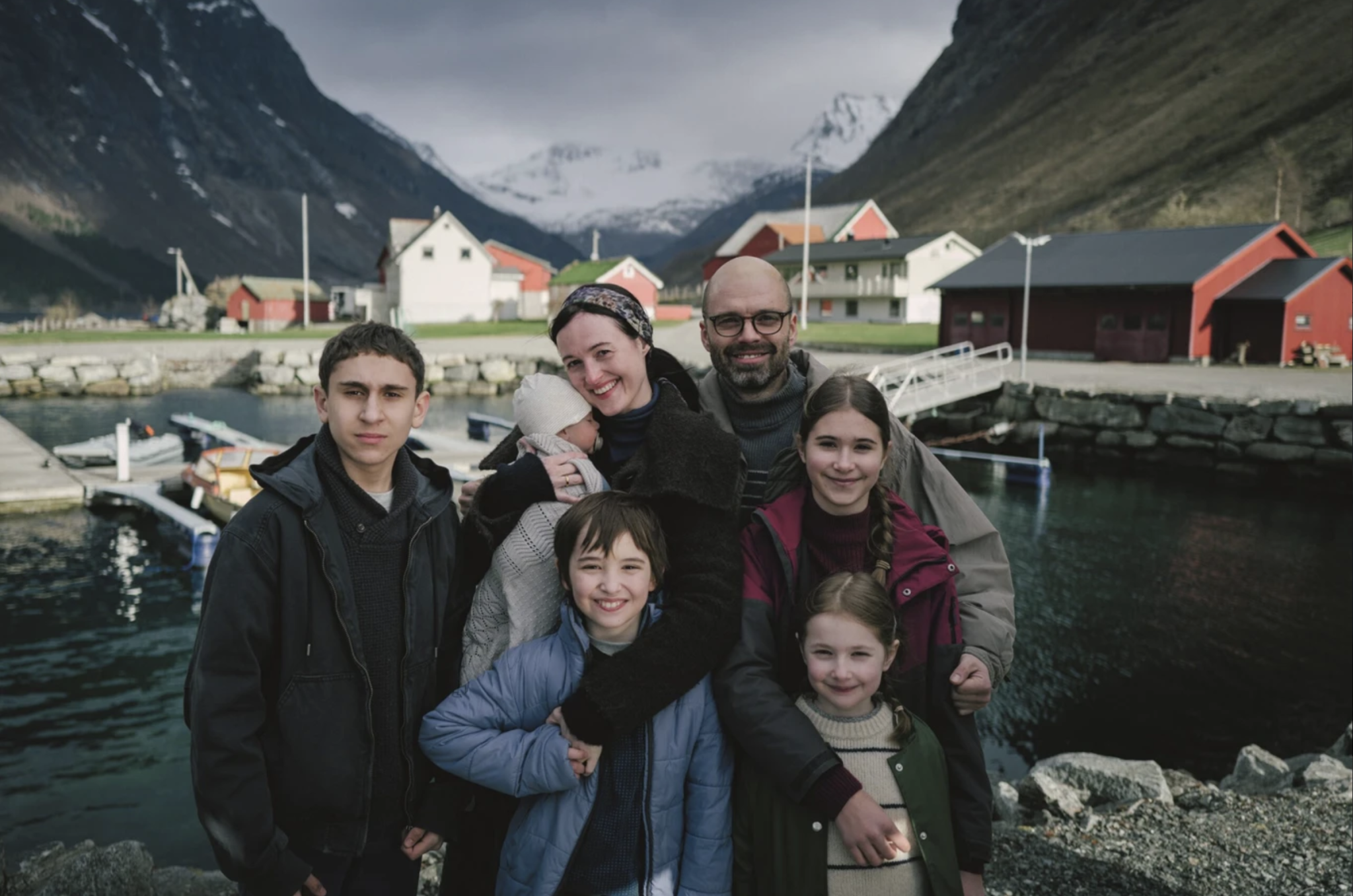
Let us, then, delve into Mungiu’s cautionary tale. We meet Mihai (Sebastian Stan), his wife, Lisbet (Renate Reinsve), and their five children, recently arrived from Romania, where she met her husband during a mission for the unnamed Evangelical Christian Church they are both members of. The Gheorghius, we quickly learn, are animated by their religious values, which shape every aspect of their lives. He dresses like a pastor, with the mandatory button-down shirt, round-collared jumper and jacket, whilst Lisbet sports a tradwife look with dresses, skirts, headbands, and the occasional trousers. Their children all join the local public school, whose schoolmaster is their next-door neighbour. One day, the eldest Gheorghiu daughter attends school with deep blue bruises across her shoulders and back and a staff member overhears her telling her brother and her new best friend (also the schoolmaster’s daughter) Noora, that she got these from her parents. School staff flag this as potential child abuse to social services, who remove all five children from their parents’ custody whilst they inquire into these allegations.
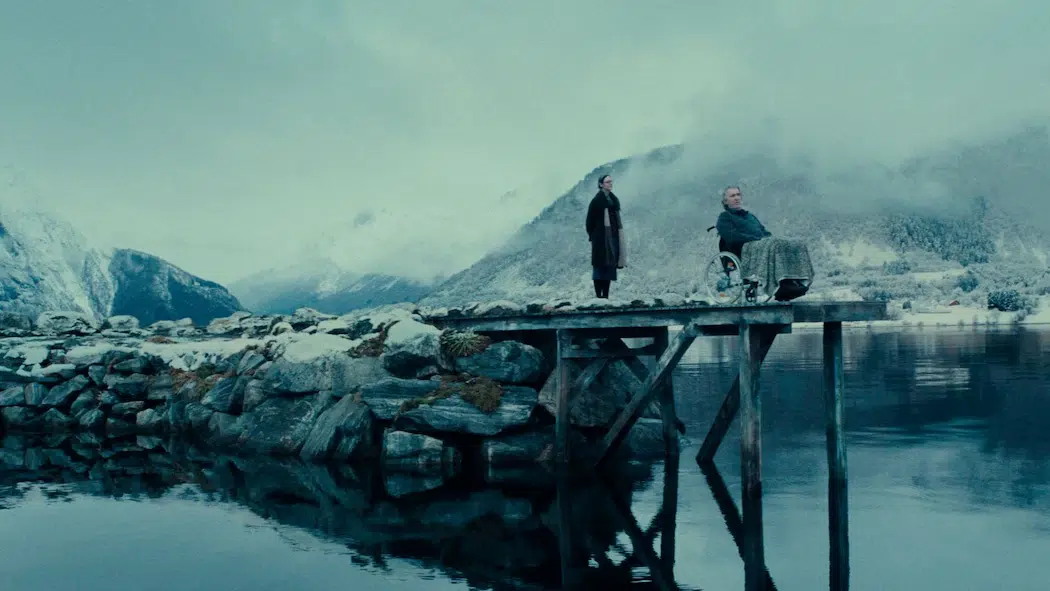
A still from Fjord (2026) directed by Cristian Mungiu
From this initial spark, the Gheorghius are led into a series of police interviews, administrative hearings, and court cases which provide the setting for Mungiu’s reflection on our contemporary so-called culture wars. On one hand, the social services and their lawyer represent secular progressivism: they take issue, sometimes caricaturally, with various aspects of the Gheorghius’ education, from their homophobic beliefs to their refusal to let their children have a phone, go on Youtube (horror!) or dance to “modern” music. On the other hand, Mihai, dissatisfied with his wife’s strictly legal approach to the case, starts a media campaign through his Church, which organises demonstrations throughout the world and daily protests in front of the court where their civil case is adjudicated. The entire case, he claims, is not about the child abuse accusations, it is an attack by short-haired, childless, liberal women against the traditional family values he is a proud incarnation of.
The political discourse of the film relies on the idea of an ideological disagreement between two groups, and that there is a neutral position from which the director’s camera can film this debate. In doing so, Fjord exposes our own biases. Without a scene in which we would see whether the girl’s bruises come from being beaten by her parents, we are left guessing at what could have happened and end up relying, like the film’s characters, on our preexisting opinions to judge the people in the courtroom and the veracity of their testimony. This confrontation with our own political biases may well be Mungiu’s goal, as it was in his other films, and this is where Fjord is at its most thought-provoking. It highlights that our views on mediatised court cases often rely more on vibes and biases than on us taking the time to seriously consider the legal and material arguments of the case.
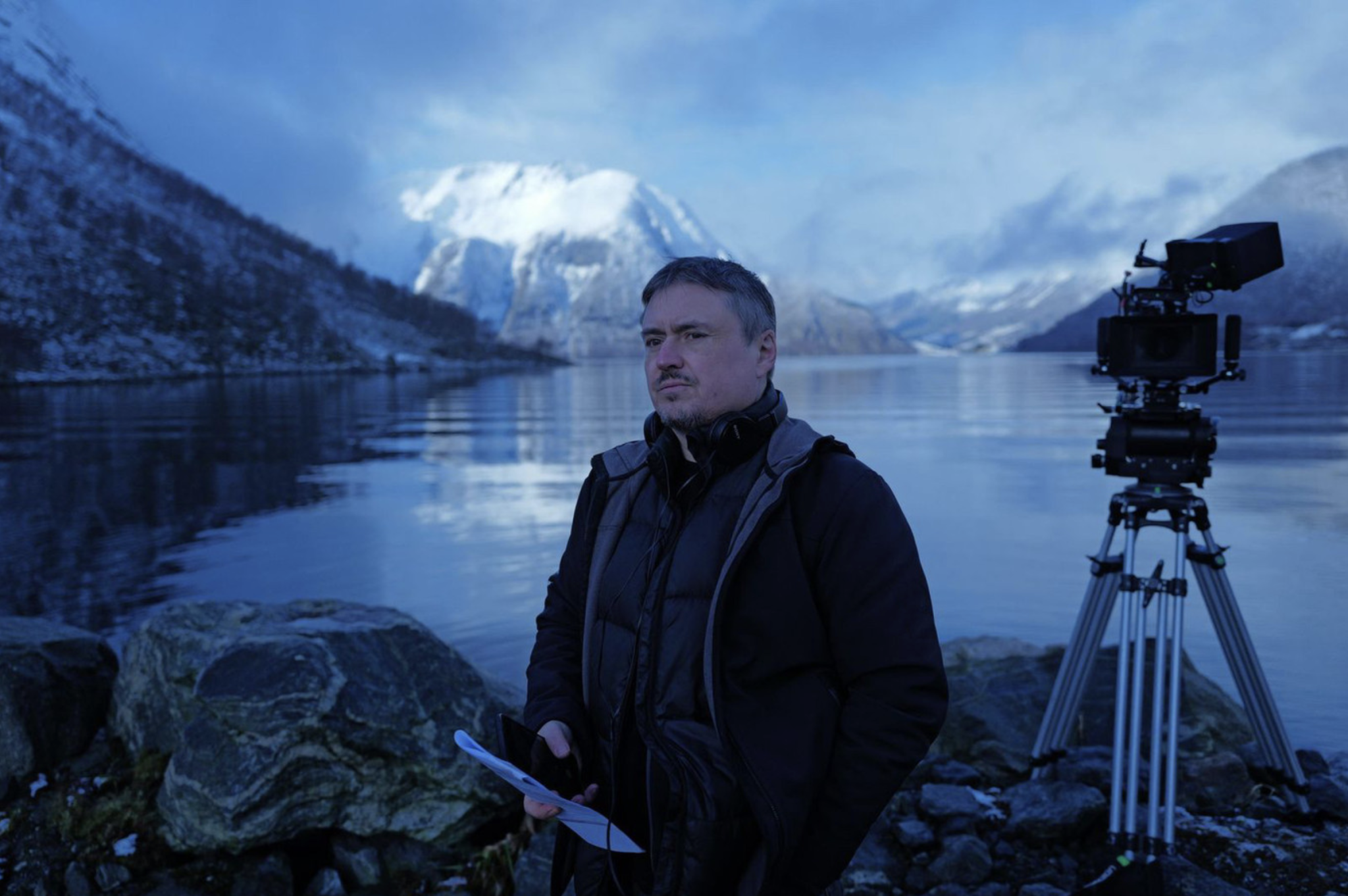
Cristian Mungiu on the set of Fjord
This political thought-experiment is predicated on the unknowability of the facts. However, this lack of information does not come from the situation being objectively impossible to assess, but from directorial decisions. This is where Fjord differs from Justine Triet’s Anatomy of a Fall, the otherwise very similar 2023 Palme d’Or-winner. In the latter, we do not know whether Sandra Hüller killed her husband or if he fell (accidentally or with a suicidal intent) whilst she was asleep, as she claims. Triet and Arthur Harari’s brilliantly written script allows room for a situation in which no living character actually knows what happened, raising philosophical questions on the impossibility of judging someone in the absence of material proof. Unlike Anatomy of a Fall, Fjord leaves no room for an authorless crime. The unknowability of guilt is less a metaphysical problem and more an artificially created silence, a director’s trick.
To create the mirage of an ideological debate, the film actively withholds information, and seeds doubt on what little material it gives us. We hear parts of the children’s testimony in the civil case (which does state that Mihai has been physically violent) but it comes in short extracts read by the social services lawyer, whose strong anti-religious sentiment is made apparent throughout the film; the children’s testimony have not been recorded, allowing the Gheorghius’ defence to suggest that they could have been manipulated; Mihai does confess to “spanking, not hitting” them, but there are doubts as to what was lost in translation; we do not see on-screen what happened that night, but we see the kids doing wrestling at school, giving a plausible explanation for the bruises. Crucially, we never get to see the criminal case, which would have only been about the facts themselves. Therefore, in seeding doubt on the testimonies to make room for his political polarisation drama, the movie ends up reproducing the media strategy devised by Mihai: transforming a factual question (were the kids beaten or not?) into an ideological debate. That is why, ultimately, its claims to being a disinterested observer are not as clearcut as they initially appear.

“Fjord is a binary movie. Either the parents did it, or they didn’t. Either it is a story about manipulative and lying conservative child-beaters, or it is about innocent doves unjustly attacked by intolerant liberals.”
Maxime Toscan du Plantier
Fjord is a binary movie. Either the parents did it, or they didn’t. Either it is a story about manipulative and lying conservative child-beaters, or it is about innocent doves unjustly attacked by intolerant liberals. By going one way or another, Mungiu would be forced to show his cards, and his whole construction, the whole premise of the film—an ideological divide on which one can have a neutral position—would fall apart. A cinematic trompe-l’oeil, its illusion only works from a very specific perspective. This applies, of course, to all films, and especially thrillers and courtroom dramas. But here, the seeding of doubt and withholding of information necessary for storytelling take on a political meaning because they rely, maybe unconsciously, on treating child abuse as a matter of mere debate, rather than a crime. To put us in a state of indecision and reach its goal of interrogating our biases, the film manufactures doubt on child abuse, and does so by echoing the same tropes which are used to disqualify victims of physical (or sexual) abuse (“Kids always have bruises, right?”; “Surely the testimonies were manipulated by the social services anyway!”; “The more children they put in foster care, the more money they make!” etc.).
There could have been other ways of treating that complicated theme. Had the film shown the parents actually beating their children, it could, paradoxically, have been less binary. It would have complicated our understanding of the scenes in which it shows Mihai and Lisbet being supportive, thoughtful, and caring parents. Similarly, the scenes in which the Gheorghiu children say they want to get back under their parents’ custody would then have created a truly challenging situation for us as spectators, raising questions as to whether children can judge what is good for them, and how we, as a society, can deal with such situations. Here, child abuse is just the quickly-dismissed occasion for a courtroom drama on political polarisation. It deserves better than that.
Ultimately, Fjord can be the political tale it is supposed to be, but only if one is willing to pay the price required to adopt its rigid perspective. The film’s avowed search for neutrality is undone by its implicit endorsement of the father’s framing of the story as an ideological debate. I thought that mirages only appeared in deserts; now, I know they can be found in fjords.