

Walt Disney’s imagination extended beyond animation to the city itself: from Disneyland to his unrealised Epcot, he envisioned a meticulously planned world where innovation, spectacle, and everyday life intertwined. It was a passion Disney sustained until his death, writes Amelia Stevens, on this lesser-known chapter in his life.
“We have always tried to be guided by the basic idea that, in the discovery of knowledge, there is great entertainment—as, conversely, in all good entertainment, there is always some grain of wisdom, humanity or enlightenment to be gained.” — Walt Disney
On the surface, science fiction and fairy tales appear paradoxical, yet they share an underlying unity. If science fiction is defined as a narrative involving real or imagined science—whether space travel, distant planets, or technological possibilities—projected into speculative futures, what then is the meaningful difference between science fiction and fairy tale? Between scientist and animator?
Like scientists, animators hypothesise. Less constrained by the mundanities of empirical reality, they imagine fantastical beings, forces, and worlds that meditate, often subconsciously, upon both real and imagined science. For what is imagined science, if not a kind of magic? A wooden marionette who is brought to life by Gepetto, an elephant calf whose oversized ears enable it to fly, an enchanted forest of talking woodland creatures, a boy who refuses to grow old, or a nanny who bends gravity, space, and time… When truly convincing, fairy tales possess a wonder that inhabits a dimension beyond the reach of time altogether. But what happens when their creator attempts to transpose such visions into the real world? While the cultural trope of the “mad scientist” is widely recognised—originating in 19th-century Gothic literature and Mary Shelley’s Frankenstein (1818), and sustained by 20th-century fears of irresponsible science—why does the notion of the “mad animator” scarcely exist in the collective imagination?
Born in 1901, Walter Elias Disney showed an early aptitude for drawing and watercolour painting, selling his sketches to friends and neighbours by the age of seven. Moving throughout the American Midwest during his childhood, he soon began to study cartooning and took classes at the Kansas City Art Institute and School of Design, and later the Chicago Academy of Fine Arts. After World War I, he began work as a draughtsman and inker in commercial advertising studios, where he met animator Ub Iwerks. Together, they founded a small animation studio, although this venture was short-lived as they were defrauded by a film distributor and forced into bankruptcy.
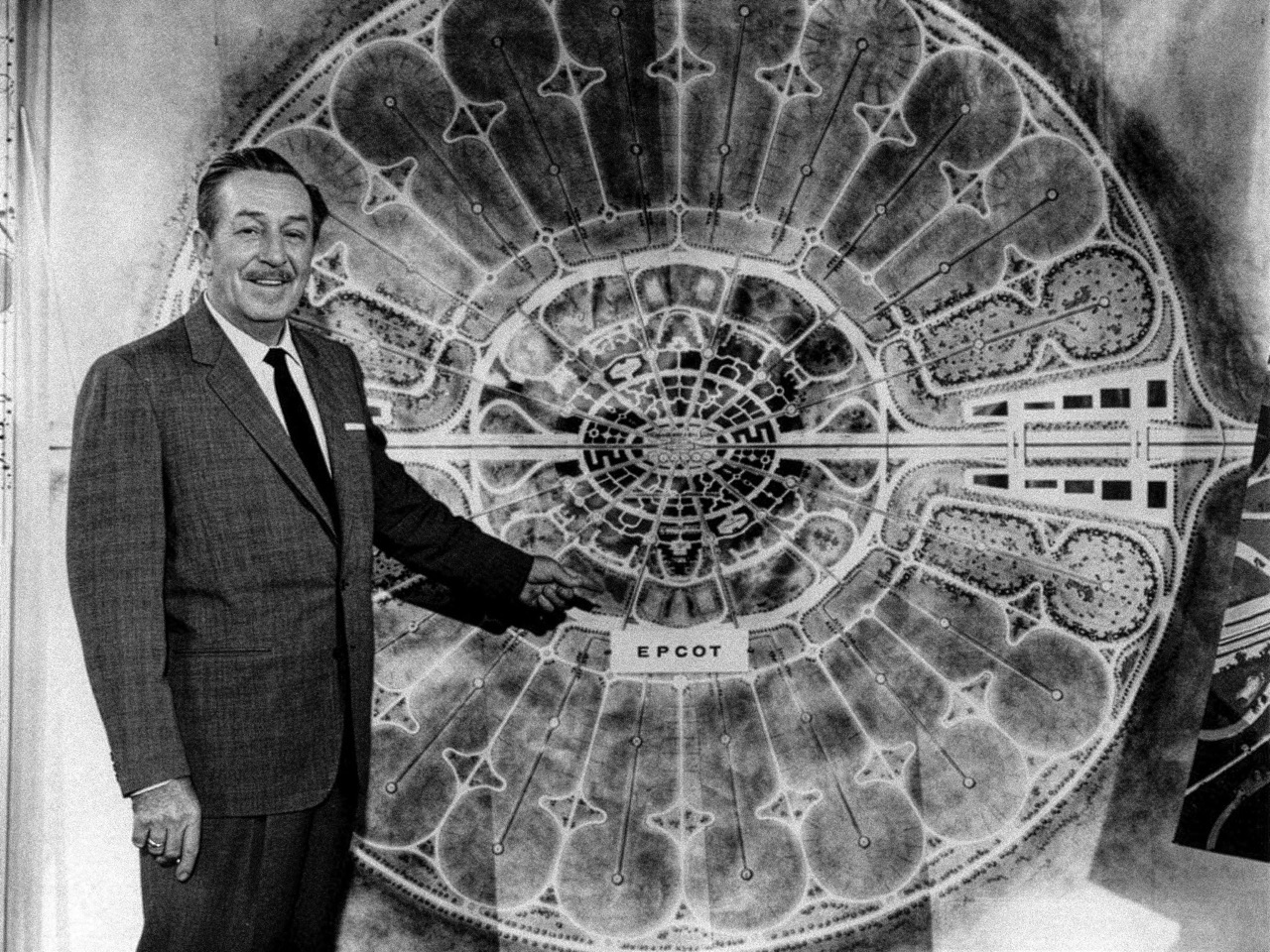
Walt Disney displays his plans for Epcot, 1966. Aspects of his vision were later realised in Florida Disneyland.
Undeterred, Disney moved to Hollywood in 1923. With his brother Roy O Disney, he established Disney Brothers Studio (later renamed Walt Disney Studios) in a small, makeshift studio at the back of a real estate office on Kingswell Avenue. Hiring Iwerks a year later, the studio soon expanded, relocating first to a neighbouring unit and later to a purpose-built studio on Hyperion Avenue. Driven by Disney’s relentless pursuit to perfect the art of animation, the studio pioneered several major technological innovations in the following decades, including the production of the first animated films using synchronised sound, three-strip Technicolor, and multiplane camera techniques. When the Academy of Motion Picture Arts and Sciences introduced the Best Short Subject (Cartoon) category in 1932, a Disney production won the inaugural award—and continued to do so each year for the remainder of the decade. Yet increasingly complex animation demanded ever greater financial and organisational expansion. While his brother increased revenue through licensing and merchandising, Disney expanded his ambitions towards feature-length animations, hybrid live-action films, and television. By 1940, the company had grown to over 1,000 animators, writers, and technicians, relocating to a new studio in Burbank that had been rigorously designed under Disney’s supervision. Tensions soon surfaced, however, culminating in the animators’ strike of 1941, which exposed their deep frustrations with Disney’s demanding business practices and managerial style, as well as the early signs of a more totalising vision. Indeed, in its aftermath Disney testified before the House of Un-American Activities Committee, accusing union organisers of communist agitation. Nevertheless, within a few years the studio recovered and rose to unprecedented heights, producing 81 feature films and receiving 48 Academy Awards in Disney’s lifetime.
Yet even this level of recognition did not satisfy Disney, who remained restless. Resenting the limitations of his own imagination, he increasingly began to envision a place where the animated worlds he had once dreamed of might be realised. In 1955, Disneyland opened in Anaheim, California. As Disney once remarked, “Why be a governor or a senator when you can be king of Disneyland?” Organised into five themed “lands”, the theme park translated animation into architecture through scenic illusion and audio-animatronics, which Disney described as a “space-age electronic method of making inanimate things move on cue, hour after hour, show after show”. Attracting one million visitors in its first 10 weeks, Disneyland was an immediate success. Yet despite Disney’s insistence that it would never be complete as long as there was imagination left in the world, it was soon constrained by uncontrolled surrounding development, limiting the outward expansion Disney had envisioned—even as regular additions, including the Monsanto House of the Future in 1957 and the monorail in 1959, were introduced.
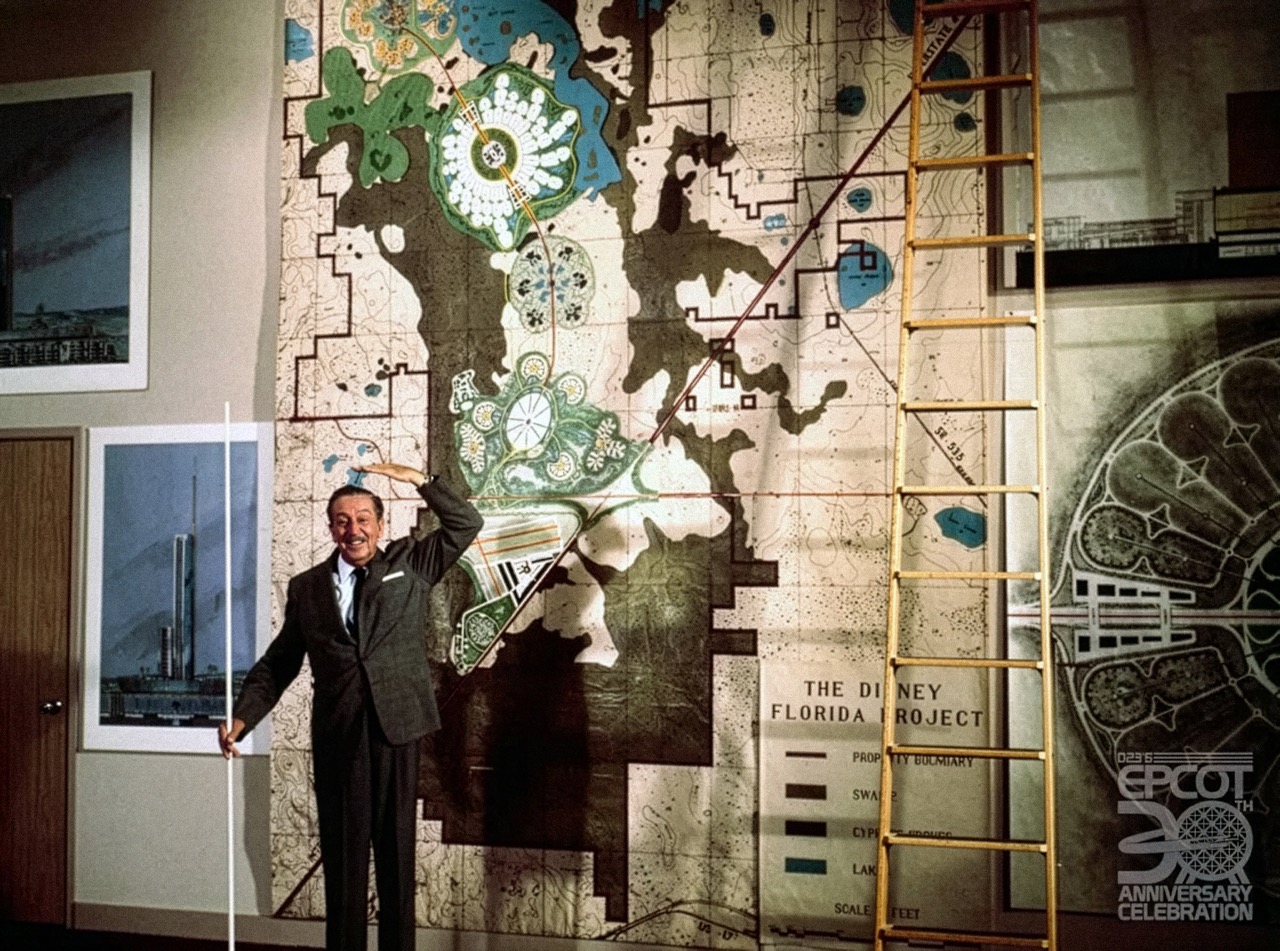
In the mid-to-late 1950s, Disney began contemplating projects of even greater magnitude. After failed proposals for a City of the Arts—later modestly realised as the California Institute of the Arts (CalArts) in 1961—he conceived his most ambitious idea. Developed in secrecy with designers and engineers at WED Enterprises (later renamed Walt Disney Imagineering), the Experimental Prototype Community of Tomorrow, or Epcot, was envisioned as a fully functioning city that would “bring together the technical know-how of American industry and the creative imagination of the Disney organisation [as] a showcase to the world of the American free enterprise system”. Convinced this required starting from scratch on undeveloped land, in 1964 the company quietly purchased 28,000 acres of swampland in central Florida. Drawing on modernist urban planning ideals, from Daniel Burnham’s City Beautiful movement to Ebenezer Howard’s Garden Cities of To-morrow, Disney sketched an initial masterplan on a piece of tissue paper, with a planned community of 20,000 residents at its centre, an airport to the south, and a theme park-resort to the north, all connected by a futuristic transportation system.
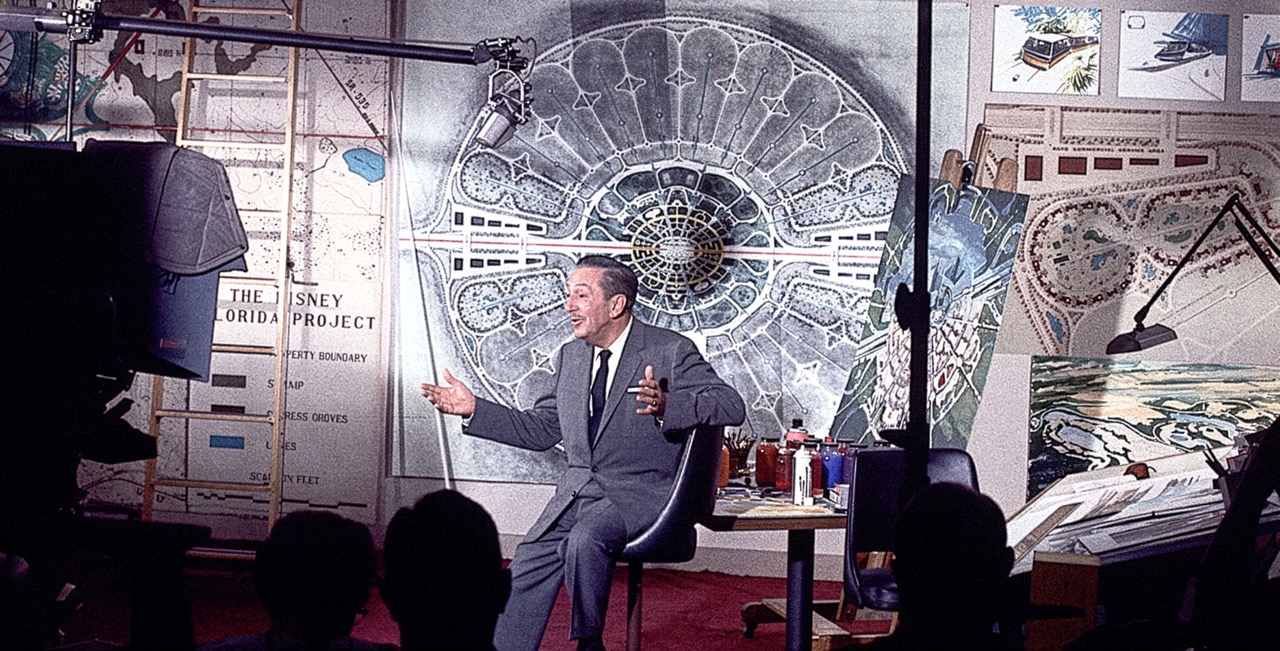


Invigorated by its ambition and scale, Disney dedicated a vast room at WED Enterprises to the project where “Imagineers” could plot the constantly developing masterplans, which covered the walls from floor to ceiling. Much like Disney’s initial sketch, Epcot took the form of a radial plan. At its centre was a vast business and commerce district, crowned by a 30-storey Cosmopolitan Hotel and Convention Center, containing within it all the excitement and variety of a major metropolitan city. Immediately surrounding this was a ring of high-density apartment blocks and civic infrastructure (administrative buildings, hospitals, libraries, and sporting facilities), then a ring of green-belt land (parks, playgrounds, and schools), and finally an outermost ring of low-density suburban housing, with automated services and communal gardens. Drawing on Victor Gruen’s pedestrian city models, vehicular traffic would be relegated to underground tunnels, while elevated monorails and PeopleMovers would carry residents and visitors above ground level, eliminating congestion and accidents. This system extended to surrounding infrastructure, including an Airport of Tomorrow, a Welcome Center, and an Industrial Park that would host state-of-the-art facilities by major American corporations, as well as a theme park-resort that increasingly became little more than a means of attracting funding for the wider project.
Most radically, the entirety of the masterplan would be monitored and optimised by a central communications network, known as Wedcomm. Seamlessly integrated into homes, institutions, and infrastructure, it would manage utilities, monitor services, and continually introduce experimental technologies—whether residents consented or not. Though Disney saw this as progress, it depended on autocratic control. Concerned by the absence of basic democratic freedoms, his advisors proposed a temporary rotating population to preserve central authority. But Disney, already courting the Florida legislature to create the Reedy Creek Improvement District to secure unprecedented autonomy, resisted such compromises.

“Within the organisation, Disney came to be seen as a visionary who increasingly blurred the line between creative ambition and autocratic control. Yet, unlike the stereotype of the “mad scientist”, his public image was softened by the perceived innocence of his animations and the carefully cultivated persona of “Uncle Walt”.”
Amelia Stevens
In 1965, Epcot was publicly announced. However, the following year Disney’s health began to decline. After lamenting the time it would take him away from his work, he finally went in for surgery at the hospital across from the Burbank studio, where doctors diagnosed him with lung cancer after a lifetime of heavy chain-smoking. Disney continued to work obsessively from his hospital bed. Roy Disney later recalled how, on his final visit, his brother used the ceiling tiles—each representing one square mile—as a grid on which to continue refining the masterplan. He died the following day, 15 December 1966, before the plans for Epcot could be fully realised.
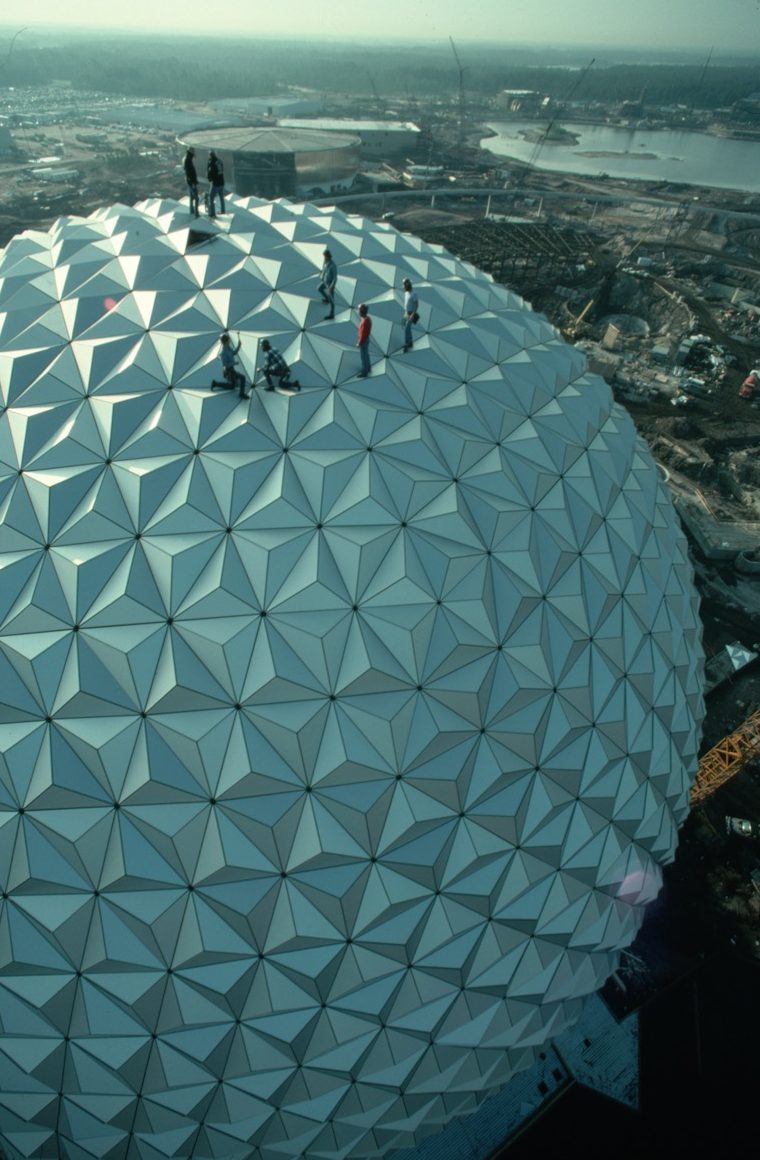
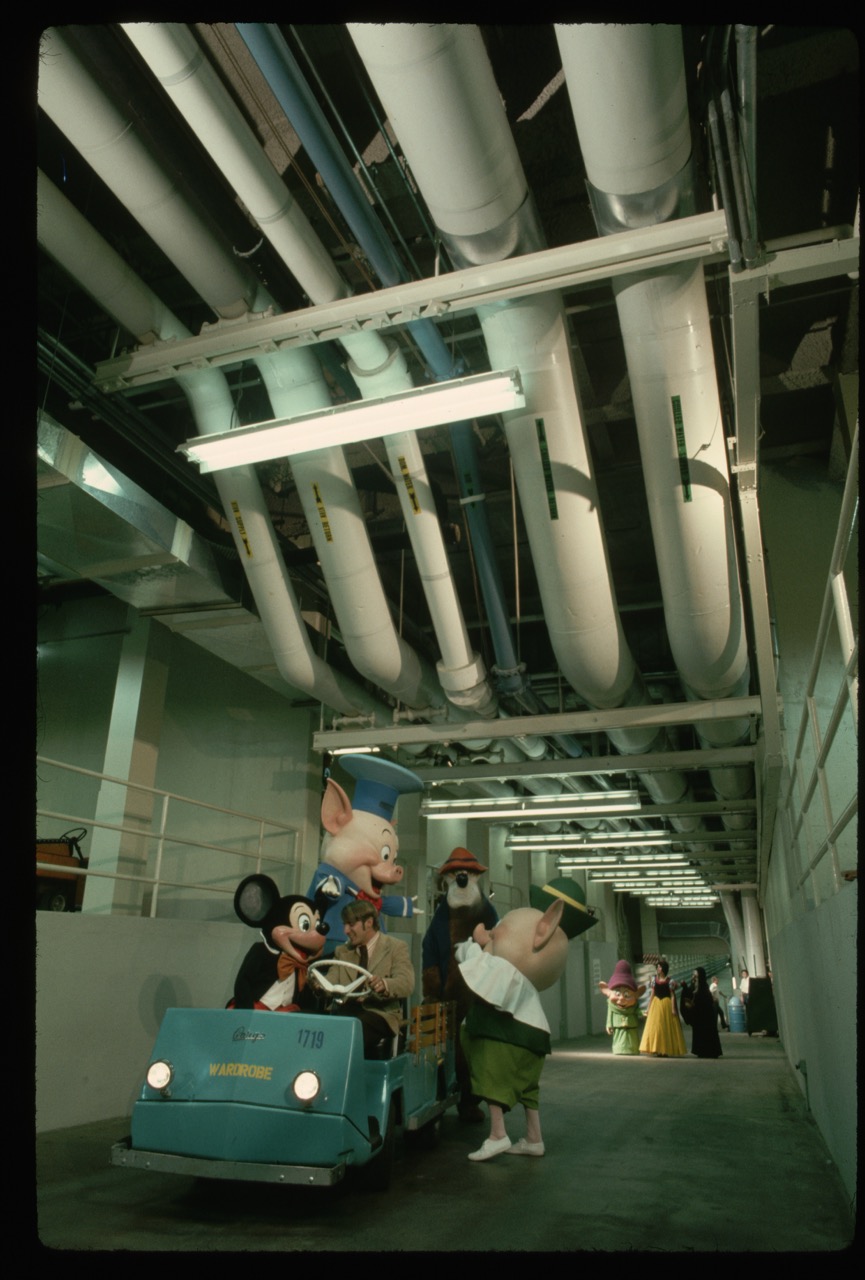
After Disney’s death, while some of his most loyal Imagineers pushed to move his plans for Epcot forwards, Roy remained cautious. In 1971, he opened Walt Disney World in honour of his brother, a theme park-resort that retained fragments of Disney’s vision, including the monorail and underground service systems, while forgoing its civic ambitions. Later developments once again gestured towards elements of the masterplan, while continuing to avoid its more radical implications. In 1982, Epcot Center opened at Walt Disney World as an exposition of Disney’s ideas, divided into Future World and World Showcase, with Spaceship Earth—a symbolic geodesic sphere attraction, designed in collaboration with science-fiction writer Ray Bradbury—at its entrance. In 1996, the radial planned community of Celebration welcomed its first residents near Walt Disney World; the population reached around 2,700 in 2000. Although ambitious, it similarly represented a commercialised and controlled interpretation of Disney’s masterplan.
Within the organisation, Disney came to be seen as a visionary who increasingly blurred the line between creative ambition and autocratic control. Yet, unlike the stereotype of the “mad scientist”, his public image was softened by the perceived innocence of his animations and the carefully cultivated persona of “Uncle Walt”. While he idolised industrialists and feared being remembered merely as a storyteller, it may be Disney himself who most underestimated the legacy of the imaginary worlds he developed and directed—which, unconstrained by reality and accessible to adults and children across the planet and future generations, have transcended further than any city he might have hoped to build.