

How did California become California? Maxime Toscan du Plantier plots a brief history of the artists, writers and thinkers—from Charlie Chaplin to Jack Kerouac—who helped to shape the cultural image of the Golden State.
“LA is probably the most mediated town in America, nearly unviewable save through the fictive scrim of its mythologisers,” wrote critic and architect Michael Sorkin in 1990. Being in Los Angeles entails existing in two dimensions simultaneously: the actual city, and its cultural representation. Embodying this is the Hollywood sign, which overlooks the vast expanse of the city, a real estate advertisement turned movie trope and regional landmark. This is not a new phenomenon, nor is it limited to Los Angeles. In historian Kevin Starr’s words, “The California of fact and the California of imagination shape and reshape each other”, as they’ve always done.
California’s very name entered the European imagination through a novel. In the 1510 Spanish bestseller The Exploits of Esplandián, Garci Rodríguez de Montalvo described a mythical island laden with gold, inhabited by a people of Black Amazons and named after its queen, Calafia. When the first Europeans set foot on the Baja California peninsula in the 1530s, they believed they had reached the fabled place and named it accordingly. The riches were never found, and California disappeared from the European gaze for a century and a half.
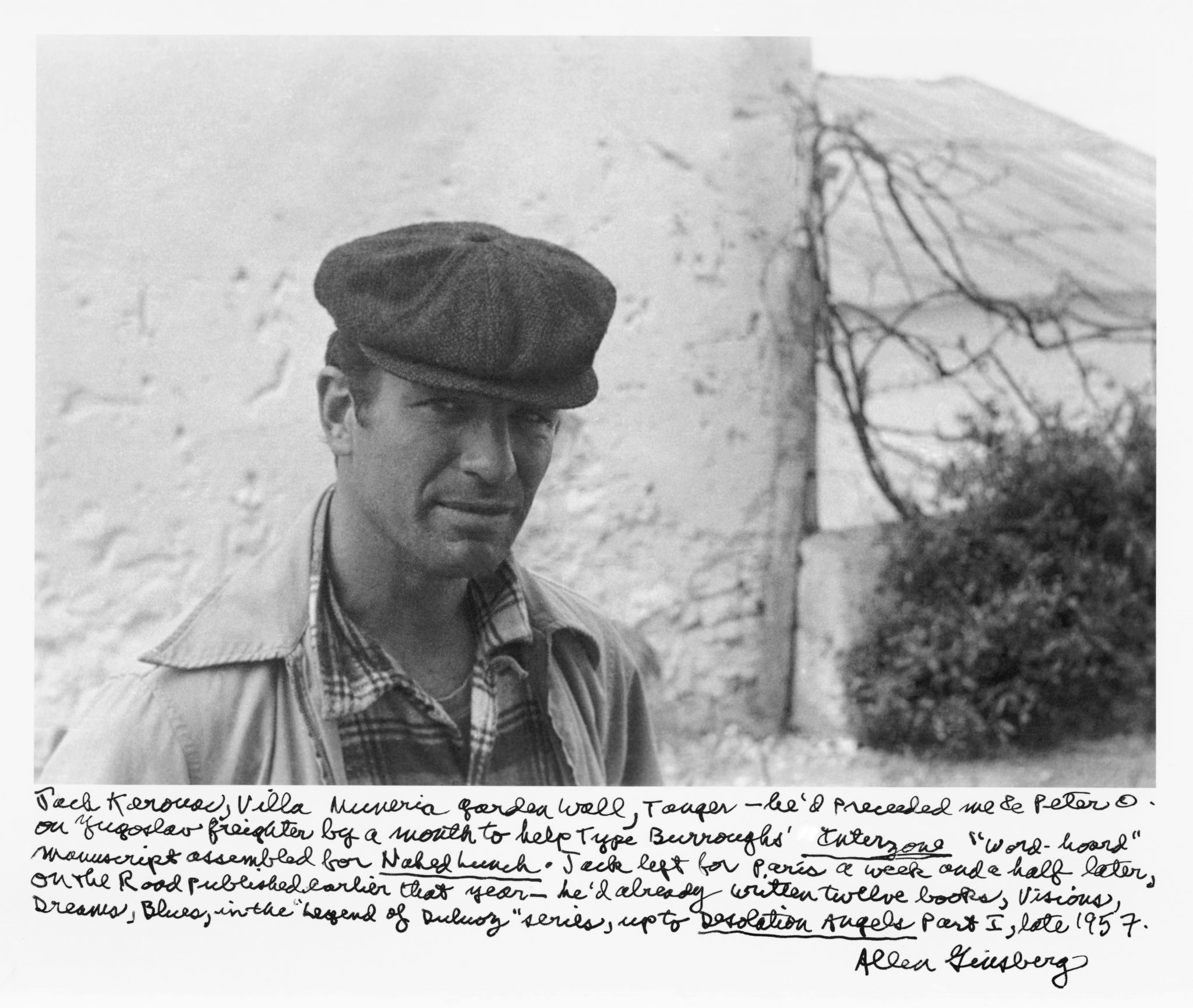
Jack Kerouac, 1957. Photo and text by Allen Ginsberg.
From 1769 to 1821, the region was governed by Spanish Franciscan missions, which, under the guise of ‘civilising’ Native Americans, brutalised them and reduced their population by half. In 1821, California joined the newly established Mexican state. Only names on maps truly remain from this time; most Spanish California landmarks are retrospective creations by real estate developers and novelists. Layers of fiction and advertising built on top of each other have effectively replaced the Spanish past.
After the Mexican-American war of 1846-48, the newly American California barely reached 10,000 non-Indigenous inhabitants. All of this changed in January 1848, when James Marshall discovered gold at Sutter’s Mill. The rumour of his discovery spread throughout the US and then the world, triggering the Gold Rush. Hundreds of thousands used all they had to buy passage, with the hope of finding a better life. All they knew of California came from books. It was the land described in Richard Henry Dana’s memoirs Two Years Before the Mast (1840), in autobiographies, and immigrants’ guides, in which facts and fiction intertwined. Reality proved different, and the era left us grim stories of violence, hunger, and hardship, on which Charlie Chaplin based The Gold Rush (1925).
During the 1880s, the spotlight definitively moved towards Southern California. An ensemble of writers, journalists, industrialists and railway-and land-owners transformed Los Angeles under the patronage of Charles Lemmis, editor of the LA Times, and his publisher, Harrison Otis. Together, they marketed the city by mythologising its Spanish past, building on the resounding success of Helen Hunt Jackson’s novel, Ramona (1884), and advertised its healthy climate to the East Coast elites on the model of the French Riviera. Ramona follows a mixed-race orphan raised on a Californian ranch after the Mexican–American War. It is a romantic, tragic book (written as protest fiction) that exposed early on just how brutal the treatment of Native Americans was. But it also conjured a sentimental portrayal of Mexican elite colonial life that influenced the image of Southern California in its own time. Then, the immense popularity of Zorro, coined in a 1919 novel and adapted for cinema the following year, inspired a second wave of mythologisation. This gave birth to Spanish revival architecture, favoured by real estate developers for its aura of ‘authenticity’. The style defined Southern Californian suburban landscapes with its terracotta roofs, arches, and stucco.
At the same time, Cecil B DeMille and DW Griffith were inventing and developing Hollywood. This new land of opportunities, where the rules of regular society seemed temporarily suspended, evoked the Gold Rush. The lawless ideal of early Hollywood is well shown in Damien Chazelle’s Babylon (2022) although, for all its nods at its own meta-textual nature and attempts at showing the behind-the-scene of the industry, the movie ultimately falls for Hollywood’s self-mythologisation instead of questioning it.
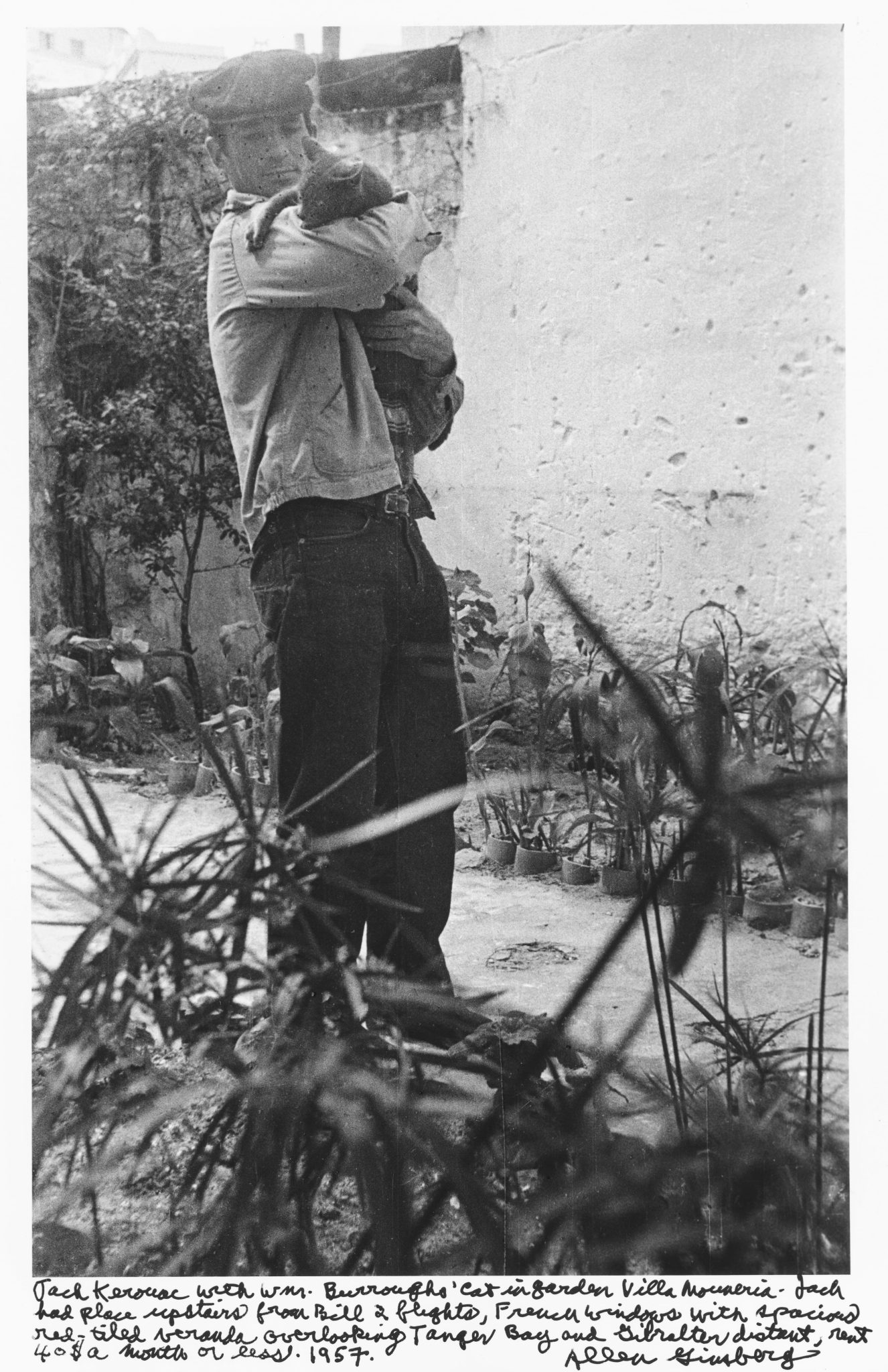
Jack Kerouac holding William S Burroughs’ cat, 1957. Photo and text by Allen Ginsberg.
California has also always been “the fashionable dwelling place of despair”, as UCLA professor Blake Allmendinger put it. Precisely because it emerged as a land of dreams, it abounds with stories of disenchantment, from Jack London’s novel Martin Eden (1909) and John Steinbeck’s The Grapes of Wrath (1939) to 24-year-old actress Peg Entwistle’s tragic death, caused by her jumping from the ‘H’ of the Hollywoodland sign in 1932. Despondent over a struggling career and lack of roles, her body was found in a ravine on September 18, 1932, with a note reading, “I am afraid, I am a coward. I am sorry for everything.” In the 1930s writers exploited by the studio system created noir, a genre devoted to the flip-side of the dream, the ugliness behind California’s glamour.
After the war, the Beat Generation expressed a similar angst in the works of William Burroughs, Jack Kerouac, and Allen Ginsberg. Ginsberg’s poem Howl, which became legendary when the author performed it in a San Francisco art gallery in 1955, starts: “I saw the best minds of my generation destroyed by madness.” Aldous Huxley’s novel Ape and Essence (1948) made Los Angeles the model for all future dystopian or post-apocalyptic cities, as it appears most notably in Blade Runner (1982). Any following attempt at mythologising California has been met with an opposite force. Indeed, the city “has come to play the double role of utopia and dystopia for advanced capitalism”, urban sociologist Mike Davis aptly summarised. The Mamas & the Papas’ naïve hit California Dreamin’ (1965) would soon be undercut by Joan Didion’s disillusioned essay Some Dreamers of the Golden Dream (1968), and parodied by Tupac Shakur rapping, “Out on bail, fresh out of jail, California dreamin’” in California Love (1996).
Yet this critical literature’s very existence is predicated on the power of the Californian dream. Thus, the question is not whether representations of California are most accurate when depicting the dream, or its ugly backside, but rather, could one exist without the other? California’s enduring appeal is undoubtedly its duality. It is both place and myth, nightmare and dream, land of abundance and destruction.