

In a rare interview, the Star Wars creator and cinema technology pioneer opens up about what could prove to be his most personal and grandest legacy of all, the Lucas Museum of Narrative Art.
On a mild morning in Cannes, not long after receiving an honorary Palme d’Or from Francis Ford Coppola, George Lucas is thinking about a patio. “I remember one of the times I was here,” he says, gesturing vaguely toward La Croisette. “I got to sit next to Fellini at the hotel on the patio there. It was a big thrill.” The memory makes him smile, but Lucas, now 81, does not linger in it. His attention moves elsewhere, towards a project that has consumed him for more than a decade and that, unlike any of his films, cannot be revised in post production.
In Los Angeles, in Exposition Park, The Lucas Museum of Narrative Art has reached its final stages of construction. A vast, curving structure resembling a sand-blasted spaceship, the director’s colossal institution is a billion dollar wager that the most disposable art of the twentieth century—comic panels, pulp covers, film concept illustrations—belongs at the centre of its culture. “I always thought art is in the eye of the beholder,” Lucas says. “You can’t have people deciding what is and isn’t art.” It is a familiar sentiment, though here it is less as a defence of artistic freedom than as the organising principle that will attempt to make that argument at scale.
The building itself is enormous. Three hundred-thousand square feet, 35 galleries, and a collection that now exceeds 100,000 paintings, illustrations, photographs, and artefacts from cinema history. It has taken years to arrive at this point.
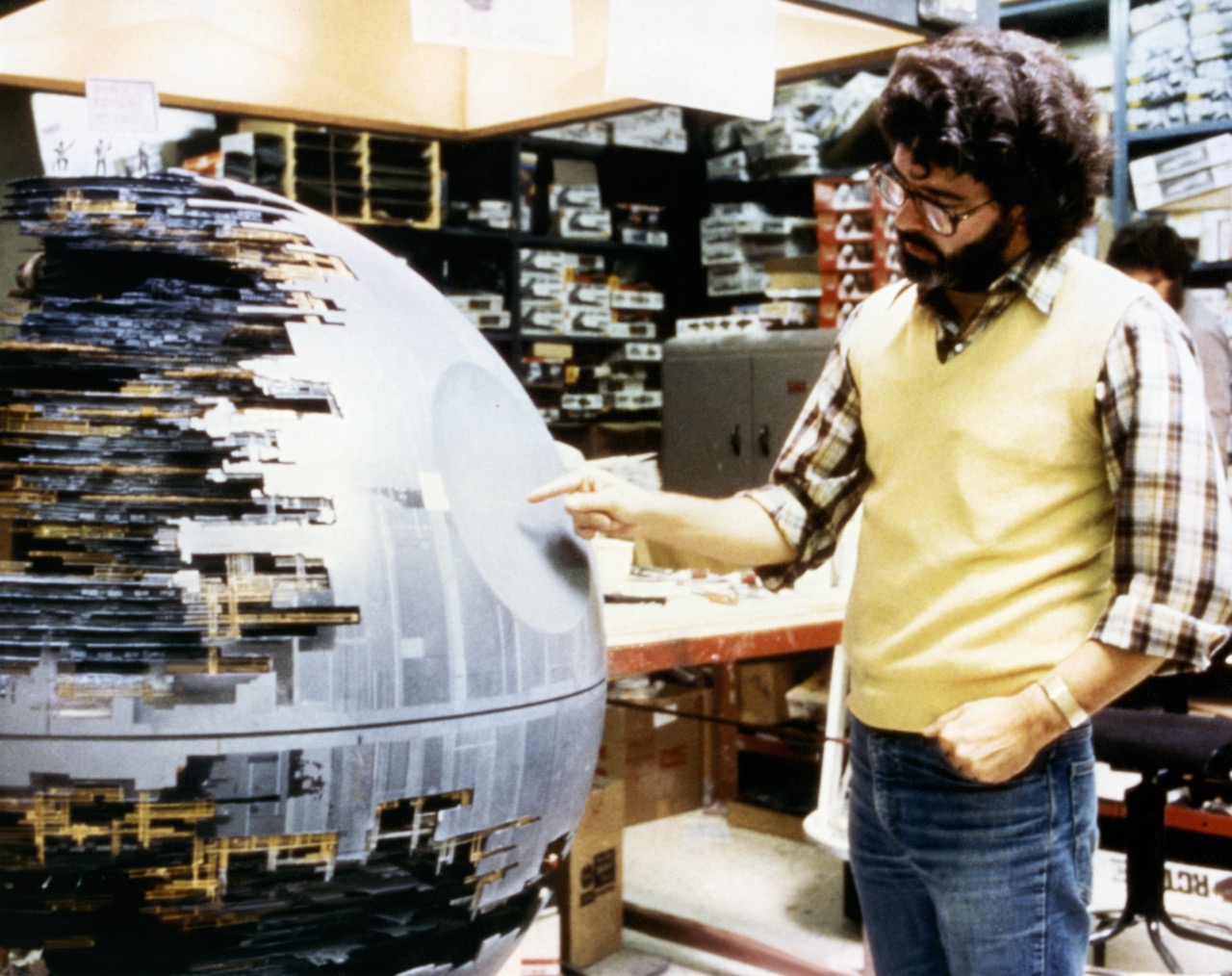
George Lucas inspecting a model of the Death Star for Star Wars: A New Hope (1977).
Earlier iterations faltered in Chicago and San Francisco, undone by a mix of civic resistance, political pressure, and, at times, Lucas’s own inflexibility. Los Angeles, with its long accommodation of spectacle and patronage, proved more receptive. Yet as the date approaches, a different kind of uncertainty has emerged. In recent months, two of the museum’s senior curators departed abruptly, and Lucas installed himself as lead curator. Their exits have put the focus on how a museum built on a singular vision will accommodate other voices
After all, Lucas’s success, and that of his heroes, relies on an almost ruthless faith in their own judgement. “I’m a stubborn man,” he told the Cannes audience. “I didn’t like people telling me how to make my movies.” The line, delivered as an anecdote, is also an insight into his methods. When Lucas encounters institutional resistance, his response is to invent his way out of it. Faced with studio pressure over Star Wars (1977), he insisted on retaining the merchandising rights to his characters, a decision that reshaped modern filmmaking.
Unable to achieve the visual effects he imagined within existing systems, he founded Industrial Light & Magic. Later, constrained by the limits of analogue editing, he pioneered its digital equivalent. “I didn’t want to run equipment companies,” he says. “I just wanted the equipment.”
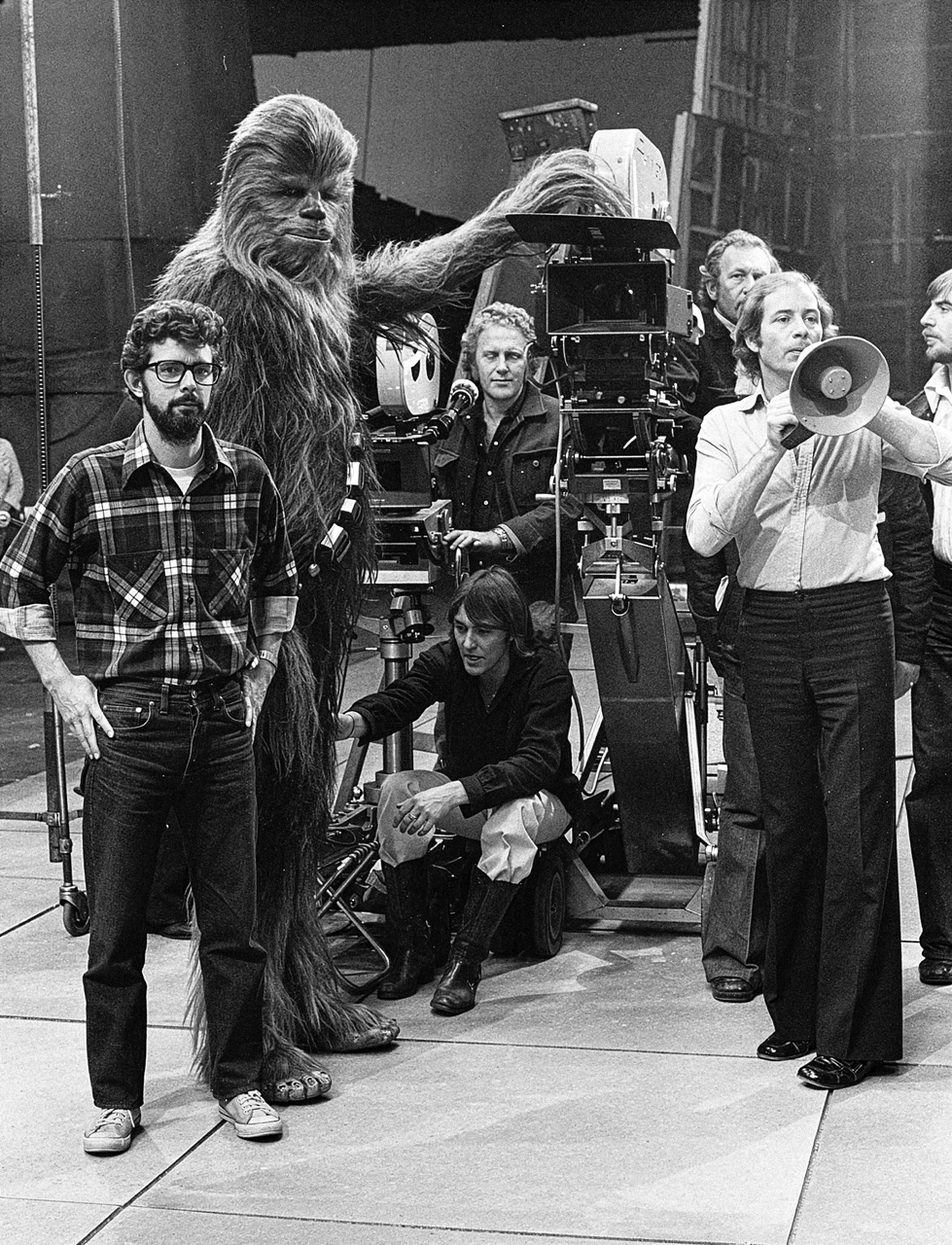
George Lucas directing at Elstree Studios, 1976, London for Star Wars: A New Hope (1976).
Growing up in Modesto, California, a small city he later immortalised in American Graffiti (1973), Lucas wanted to be a racing driver. A near-fatal accident ended that ambition but gave him more time to explore his other passions, photography and the study of other cultures. Modesto was an agricultural town with two movie theatres, one for A films, one for B films.
“B films were all the Roger Corman films cheap films,” Lucas recalls. “Once I could drive, I could sneak into San Francisco and see films that were very different, like Fellini’s. Sometimes these films were seriously experimental, and I liked that. I said, ‘This is great. I can do this.’” Before he considered filmmaking, Lucas thought he might become an anthropologist, a student of how societies organise meaning. The museum, in this sense, returns him to that earlier fascination, albeit with different tools.
“What I found I was really interested in,” he says, “is making movies about primitive societies.” To do this, Lucas moved to Los Angeles to study at the University of Southern California, not far from where his museum will stand. Los Angeles is also where Lucas began buying the first pieces that he will soon share with the public. “When I was in college, I started collecting what I could afford, which was comic art,” Lucas says. “I could get a great piece for $35; it was kind of an underground thing.”
As his fortunes changed, so did the scale of his acquisitions. After American Graffiti, then Star Wars, the collection expanded outward, absorbing paintings, illustrations, photographs, and artefacts from cinema history. Lucas also kept sketches, models, costumes, and other by products of his own productions. “After a while, I had something like 30,000 pieces,” he says.

“I don’t like focus groups. The audience doesn’t know what they want to see…
you make a movie by finding someone that knows how to make movies and is passionate about it.”
George Lucas
Since deciding to build the museum, Lucas and his wife, the museum’s co-founder Mellody Hobson—who watches the interview attentively—have steadily acquired works by artists including Norman Rockwell and Frida Kahlo, illustrators such as Kadir Nelson and Beatrix Potter, and comic artists R Crumb and Alison Bechdel. When the pair acquired the Separate Cinema Archive, a collection of around 40,000 artefacts from African American cinema, there was a burst of optimism that the museum might be more than the vanity project some critics in Chicago and San Francisco had feared.
“I’d like people to know that this is actual art,” Lucas says. “Because a lot of it had never been considered art.” Lucas’s attempt to turn a private logic into a public institution is emerging as the museum’s most interesting tension. It could give the place a thrillingly singular vision—as David Walsh’s did in Hobart’s Museum of Old and New Art— or invite criticism of artistic myopia. Either way, the recent curatorial departures are difficult to ignore. Museums, even those founded on singular vision, rely on curators who can interpret, contextualise, and, at times, resist the founder’s instincts.
Reports of the departures describe tensions over direction and decision making as the museum moves from construction into programming. With the opening less than a year away, the institution is shifting from accumulation to articulation—from what it owns to what it means.
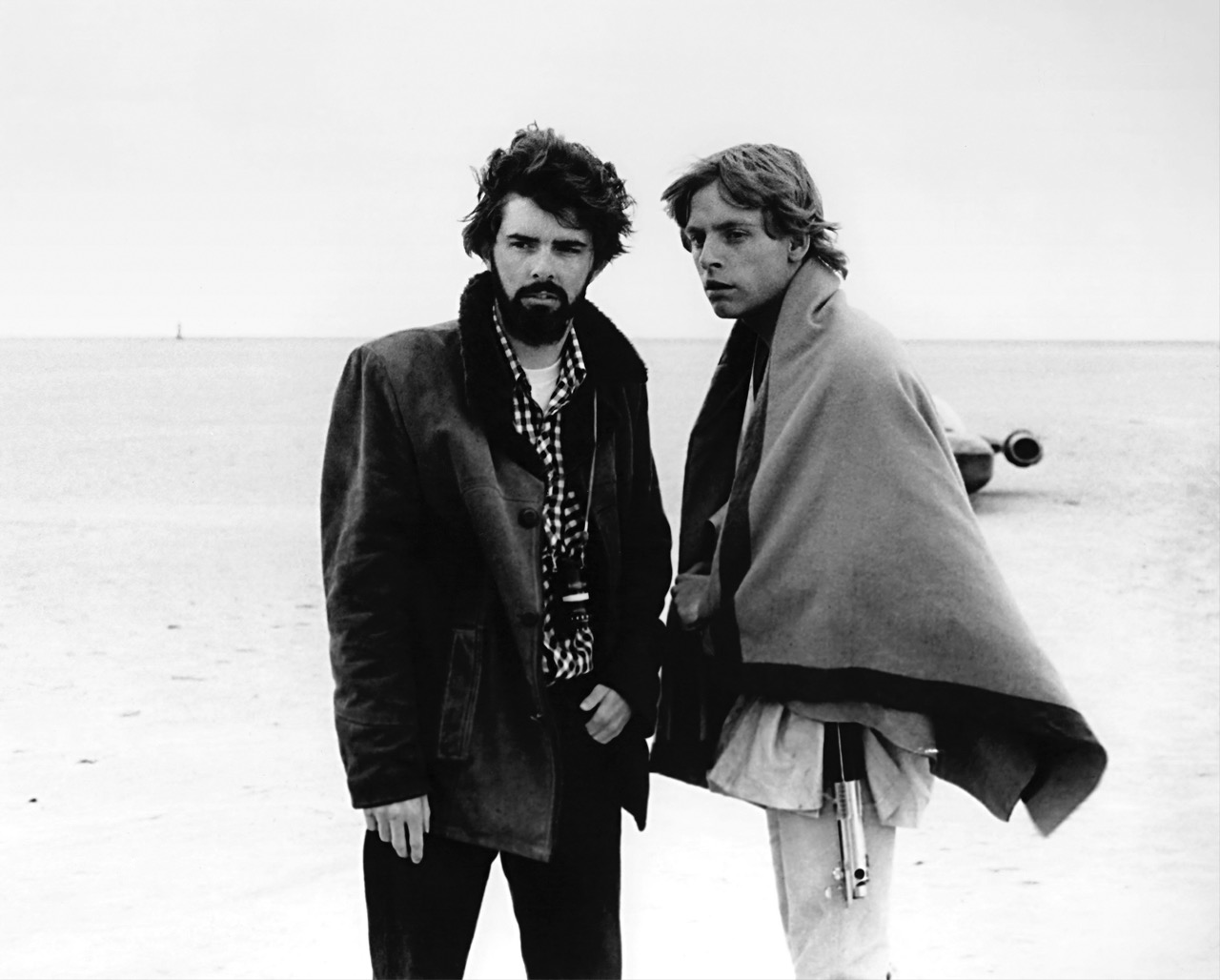
George Lucas and Mark Hamill on the set of Star Wars: A New Hope (1977).
“I had a group of friends I went to school with: Marty Scorsese, Francis [Ford Coppola], Steven [Spielberg]. We were all students at the same time, and we all know each other really well. I know what their prejudices are. When I show them a movie and they make comments, I know where they’re coming from.” That kind of feedback, he believes, is useful. Other feedback is not. “I don’t like focus groups,” Lucas says. “The audience doesn’t know what they want to see.
If they don’t like a character, that’s interesting, and as a filmmaker I want to find out why. But when the studios hear that, they take the wrong message. They let the audience actually make the movie. Of course, now they go crazy with that. Now, it’s all about what the fans think. That isn’t how you make the movie. You make a movie by finding someone that knows how to make movies, that has a story to tell and is passionate about it.”
Lucas’s solution is to return to first principles. “You go to the movies because the stories move you emotionally,” he says. “Art is an emotional medium.” This emphasis on emotional response aligns with Lucas’s resistance to the hierarchies that separate “high” and “low” culture, a distinction familiar to anyone who has ever wondered why the Star Wars prequels aren’t, in their view, better.
“The critics and the fans who were 10 years old when they saw the first one and 13 when they saw the second one complained that they didn’t want to see a children’s film,” Lucas says, briefly adopting a high-pitched whine—“Oh, that’s terrible. Jar Jar Binks is terrible!”—before returning to his usual honeyed register. “Everyone said the same thing about R2-D2 and C-3PO. At the beginning there was a huge push for me to get rid of C-3PO, and then in the third one [Return of the Jedi (1983)] people said the same thing about Ewoks. ‘What are you thinking? Get rid of these teddy bears, we want to see an adult movie!’” When asked whether he is bothered by his later films failing to connect with adults in the way his earlier films did, Lucas returns to fundamentals. “Well, it’s a kid’s movie,” he says. “It’s always been a kid’s movie.”
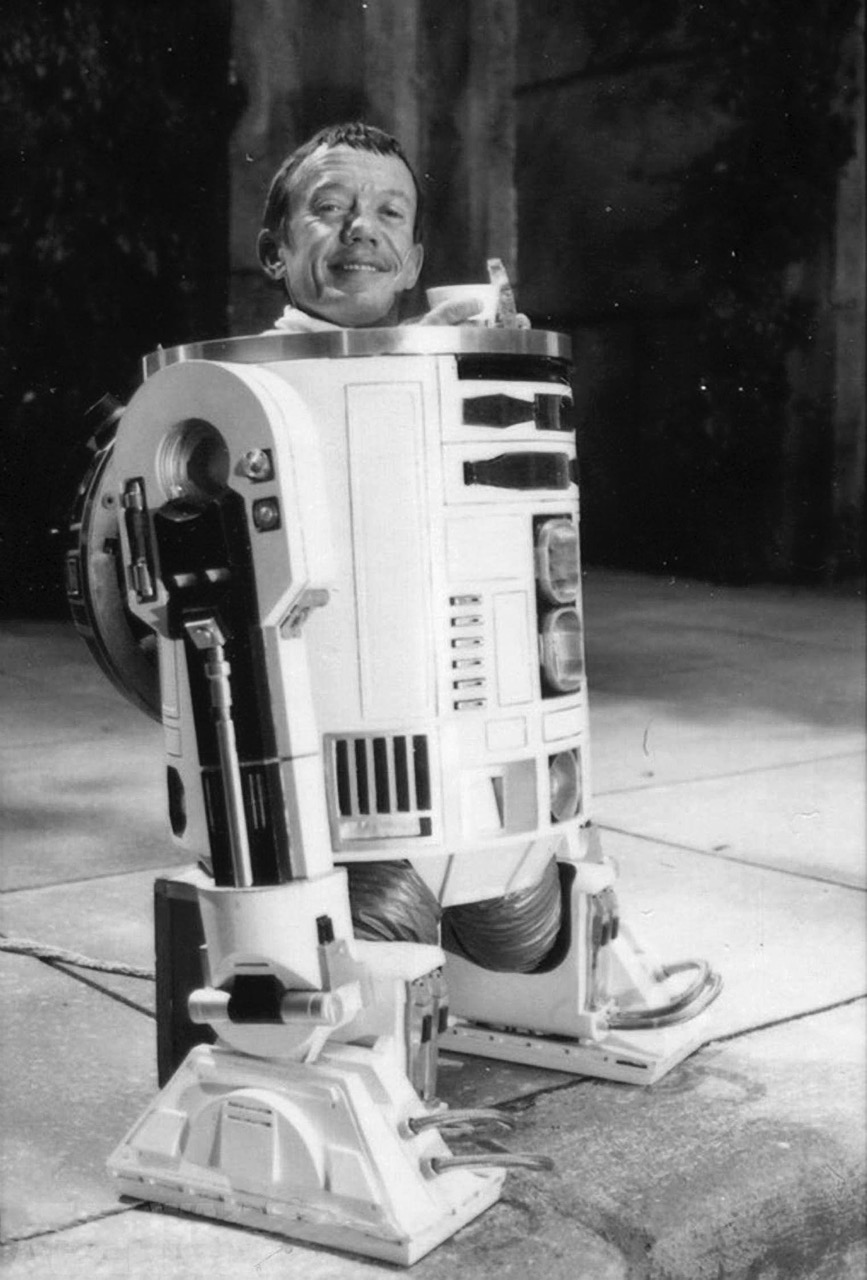
Kenny Baker poses in his R2-D2 costume for Star Wars: A New Hope (1977). By George Lucas.
Lucas’s view that popular storytelling is not compromised by being accessible is one that predates his interest in filmmaking and seems set to outlive it with his museum. Lucas’s first creations were short experimental films which quickly began winning awards. Then came his first feature, THX 1138 (1971), “which the studios hated”, and American Graffiti, “which they tried to dump on late-night TV”. “With American Graffiti, they said, ‘Well, nothing happens,’” Lucas says, still sounding faintly irritated.
The studio underestimated the film, at one point planning to release it directly to television under the title Another Quiet Night in Modesto, until Francis Ford Coppola intervened. Lucas, meanwhile, was already pitching his next idea: “A 1920–1930s soap opera set in space. Dogs flying spaceships, crazy stuff.” Once Alan Ladd Jr., then head of 20th Century Fox, agreed to back him, Star Wars found a home. “He invested in me, not in the movie,” Lucas says.
When American Graffiti became one of the most profitable films in history, Lucas renegotiated his deal to retain licensing and sequel rights. “At the time, all I wanted licensing for was to make T-shirts and posters,” he says. “I wanted to go to Star Trek conventions and sell these things to fans. I kept the sequel rights because I had more story to tell and I didn’t want a studio sitting on it. They had no faith in Star Wars whatsoever. When the board of directors saw it, they said, ‘This is terrible. Let’s sell it.’ That’s what Hollywood was like then.”
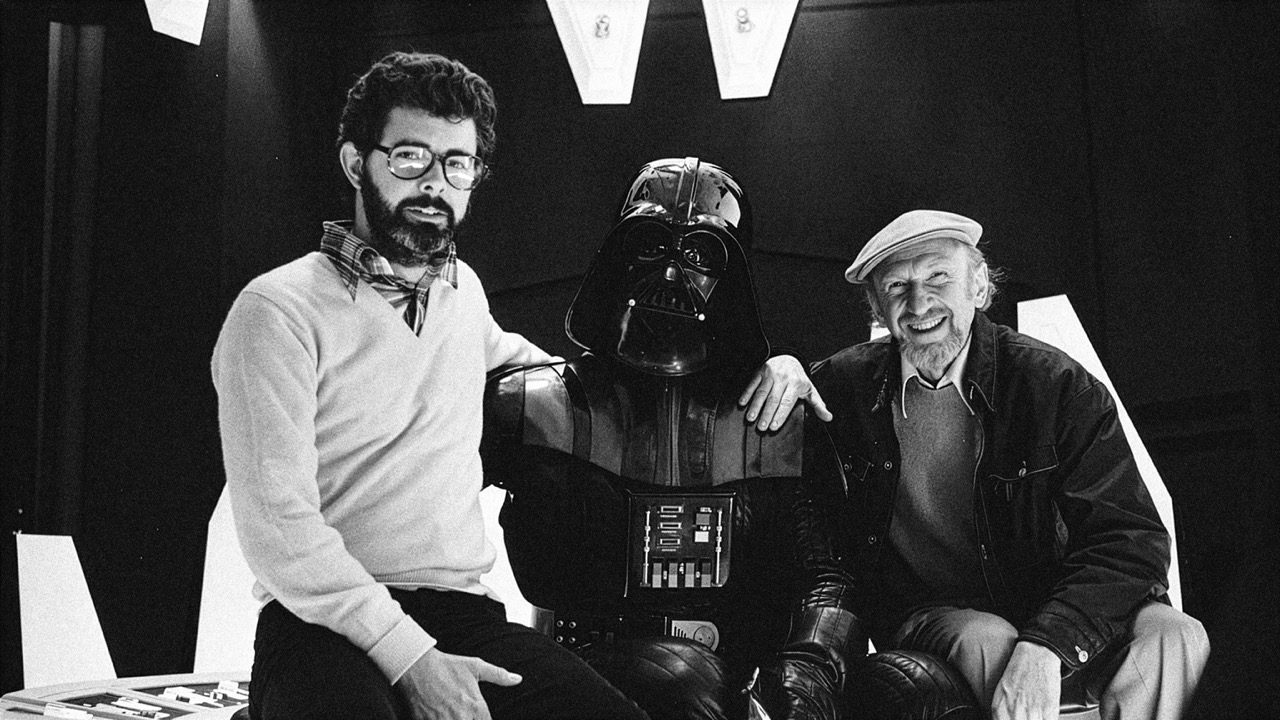
George Lucas and Irvin Kershner beside Darth Vader’s costume, on the set of Star Wars: The Empire Strikes Back (1980).
With the success of Star Wars and its sequels, Lucas spent the 1980s developing new technologies and backing the visions of other filmmakers: Akira Kurosawa’s Kagemusha (1980), Steven Spielberg’s Indiana Jones and the Temple of Doom (1984), Paul Schrader’s Mishima: A Life in Four Chapters (1985), and Francis Ford Coppola’s Tucker: The Man and His Dream (1988). Many of these films, and most of Lucas’s other productions are drawn to characters who defy authority and trust their instincts, even when the consequences are severe. “When I was in college I got into a big fight with my script professor,” Lucas says. “I told him, ‘I’m not going to do theatrical films. Film is an organic medium. We don’t need scripts.’ He got very angry about this.
He laughs softly. “I liked experimental films. I was into, and I still am into, the fact that moving pictures are moving and that makes them different from paintings. So the mystery of it, and the art of it is in the movement. But it needs to have emotion in it. You go to the movies because the stories move you emotionally.” The same belief helps explain how Lucas thinks about technology. Many filmmakers see digital tools as a rupture, but Lucas sees it as part of the natural evolution of an artform. “I have a lot of friends who are on the Film Foundation with me, that’s dedicated to saving old movies, and some of them say,” he pauses to adopt a gravelly tone, “‘I’ll never do digital. Lawrence of Arabia (1962) was shot with film.’” He smiles. “And I say, ‘No, it’s cinema. It’s the moving image. That’s what it is. It’s not a technology, it’s an idea.’”
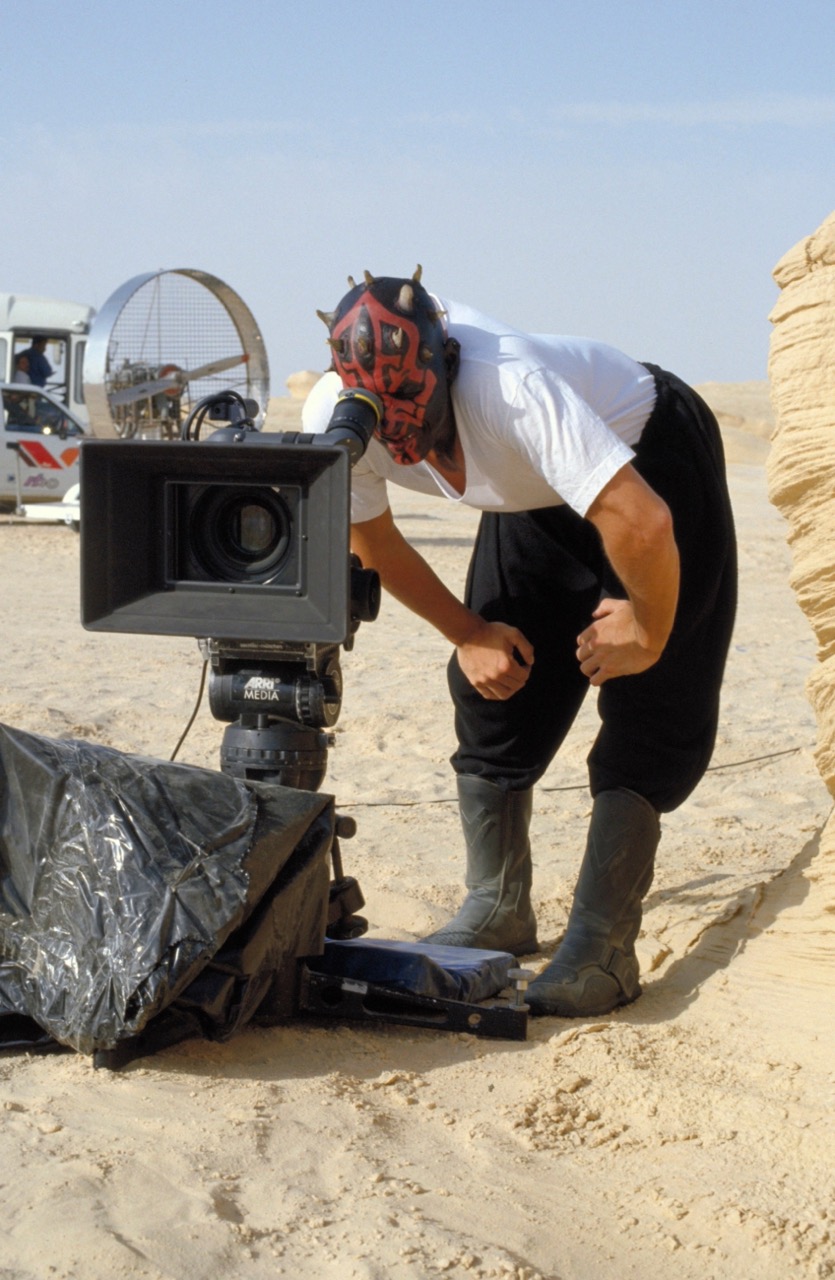
Ray Park as Darth Maul on the set of Star Wars: The Phantom Menace (1999). By George Lucas.
The argument extends to artificial intelligence (AI), a subject that immediately animates Lucas. “Artificial intelligence means it’s much easier for us to make movies,” he says. “It’s very much like sitting here saying, ‘Well, I believe the horse and the buggy is really where it’s at. These cars, they break down, they need gas, there’s all kinds of problems with them and pretty soon they’ll be making them into tanks, and then they’ll be killing people. It’s terrible.’ There’s nothing you can do about it,” he says, raising his hands. “That’s progress, it’s the future.”
When pushed, he acknowledges the risks but insists that AI can provide its own solutions. “If you want AI that tells you when something is fake and where it came from, AI can do that,” he says. “Humans can’t, we’re not that smart. The whole idea is you’re a human being, you’re responsible for what you say and what you do, and if you’re doing something that’s illegal you should be punished for that. Whatever you do, you should be recognised. It’s just like real life.”
The museum can be read as a continuation of the same argument. Lucas is no longer directing films or inventing new machinery to bend the medium to his will. Instead, he is putting his name to an institution that, like every institution, will inevitably take on more meaning than its founder intended. “If you like it, it’s good,” he says with a gentle smile and a shrug. “If you don’t, it’s bad. That’s all there is to it. There’s no, ‘Well, I’ve studied this and I am an expert.’ Art is an emotional medium, whether it’s movies or plays or paintings. Steven and I always agreed on that: what you’re selling, in the end, is emotion.