

David Hockney is one of Britain’s greatest artists, who has never shied away from using technology in his art — including, famously, iPads. But technology is a means, not the point, finds Geordie Greig, as he sits with Hockney, his long-time friend.
On a FaceTime call, David Hockney holds up a paint brush. “This, actually, is a tool of technology,” explains Britain’s favourite painter. Always the professor-philosopher artist, he adds in his California-tinged Yorkshire burr that brushes were used in the 14th century, “and will be still used in the next century. They allow marks to be made guided by the human hand and that is what I have always done. No matter what technology I have used.”
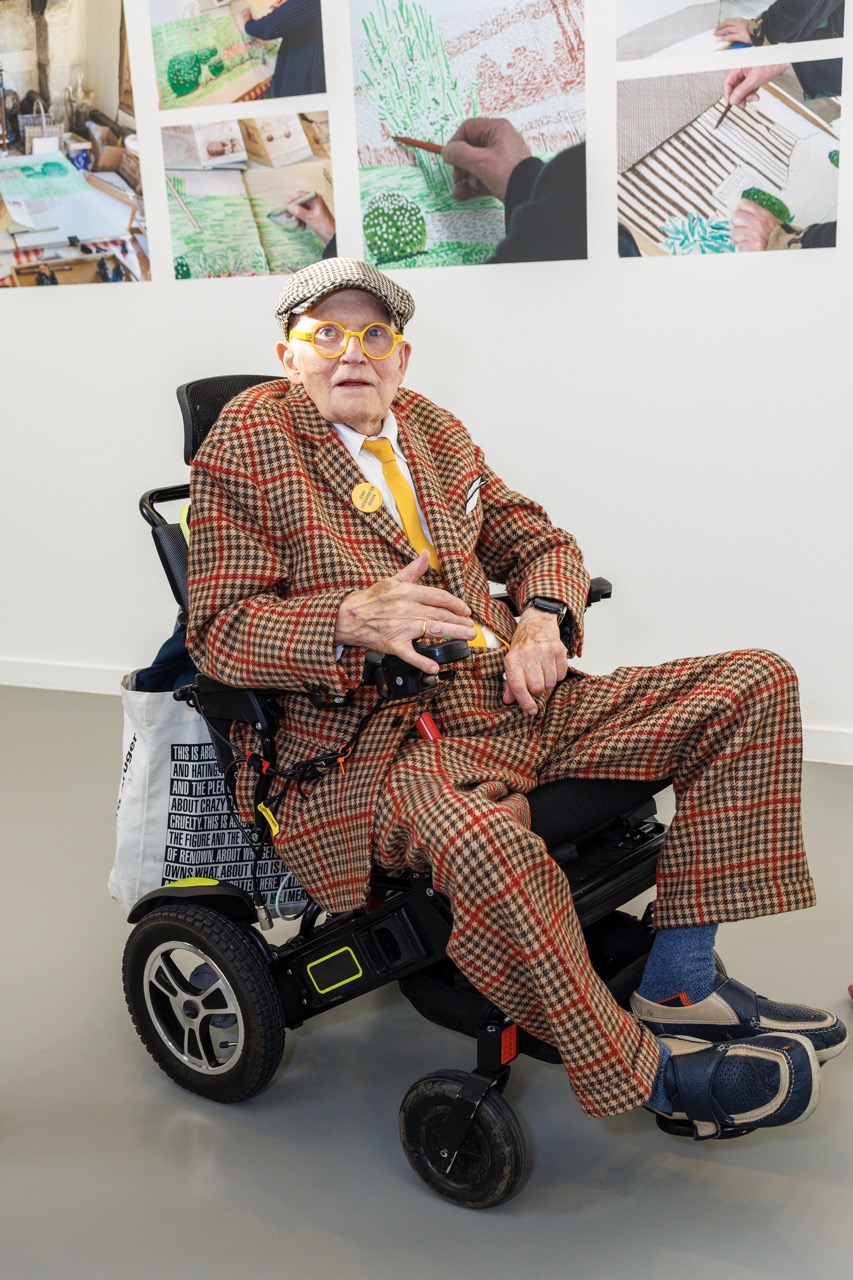
Sitting in his London studio, aged 88, Hockney defies gravity as he tackles a new portrait, using acrylic paint with a brush, on a 5×4 foot canvas. It is a portrait of his great-nephew Richard, lying on a stool with an abstract landscape background. Dressed in a vividly bright tweed suit, slightly paint-flecked, and tie and yellow spectacles, Hockney is as colourful as his paintings.
Ever the dandy, he recently had six new suits made by a French tailor in Normandy where he has a house and studio. And he has been parading his sartorial elan in London ever since. Another piece of kit which has entered his life is a wheelchair. Frail in body but as quick-witted as ever, he wheels across the floor in his studio making new portraits, some of which were shown in London at the Serpentine Gallery Spring Show.
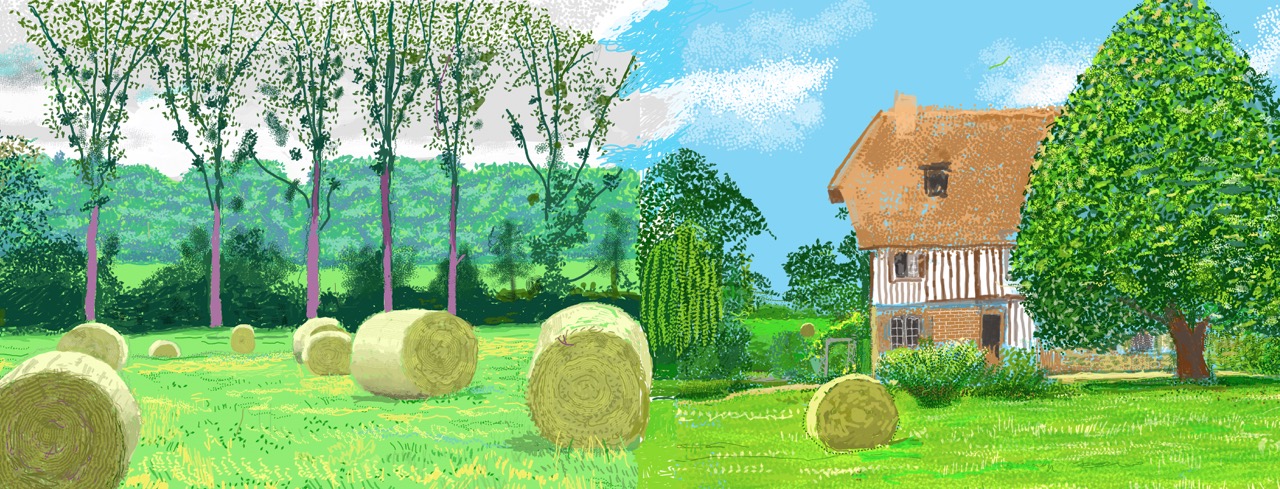
David Hockney, A Year in Normandie (detail), 2020–2021. Composite iPad painting © David Hockney
The technology in his art has always played an important part in his development as an artist. His digital version of the Bayeux Tapestry (A Year in Normandie, 2020-21), now on display at the Serpentine North Gallery, was made entirely on his computer. An obsession has long been to research the different devices artists used over the centuries, leading him to embrace new methods and technologies. The first was the camera obscura, the oldest piece of visual technology, which he argued for in his now landmark book Secret Knowledge: Rediscovering the Lost Techniques of the Old Masters (2001). Cameras, Polaroids, printers, fax machines, iPhones, iPads, and TV screens have been tools to enhance what he sees and what he finds beautiful around him. But most often, his favoured technical aids are simply the brush or pencil.
For Hockney, human observation is the core of art, something AI cannot replicate. “It’s not the tool that matters—it’s the eye,” he says. “A good painting is still a good painting, whether it’s made with a brush or a stylus. It is about sharing experiences. Machines don’t have experiences.” This is central to his scepticism of the recent developments in AI art: no lived experience means no true expression. As ever, Hockney embraces the pursuit of beauty through observation.
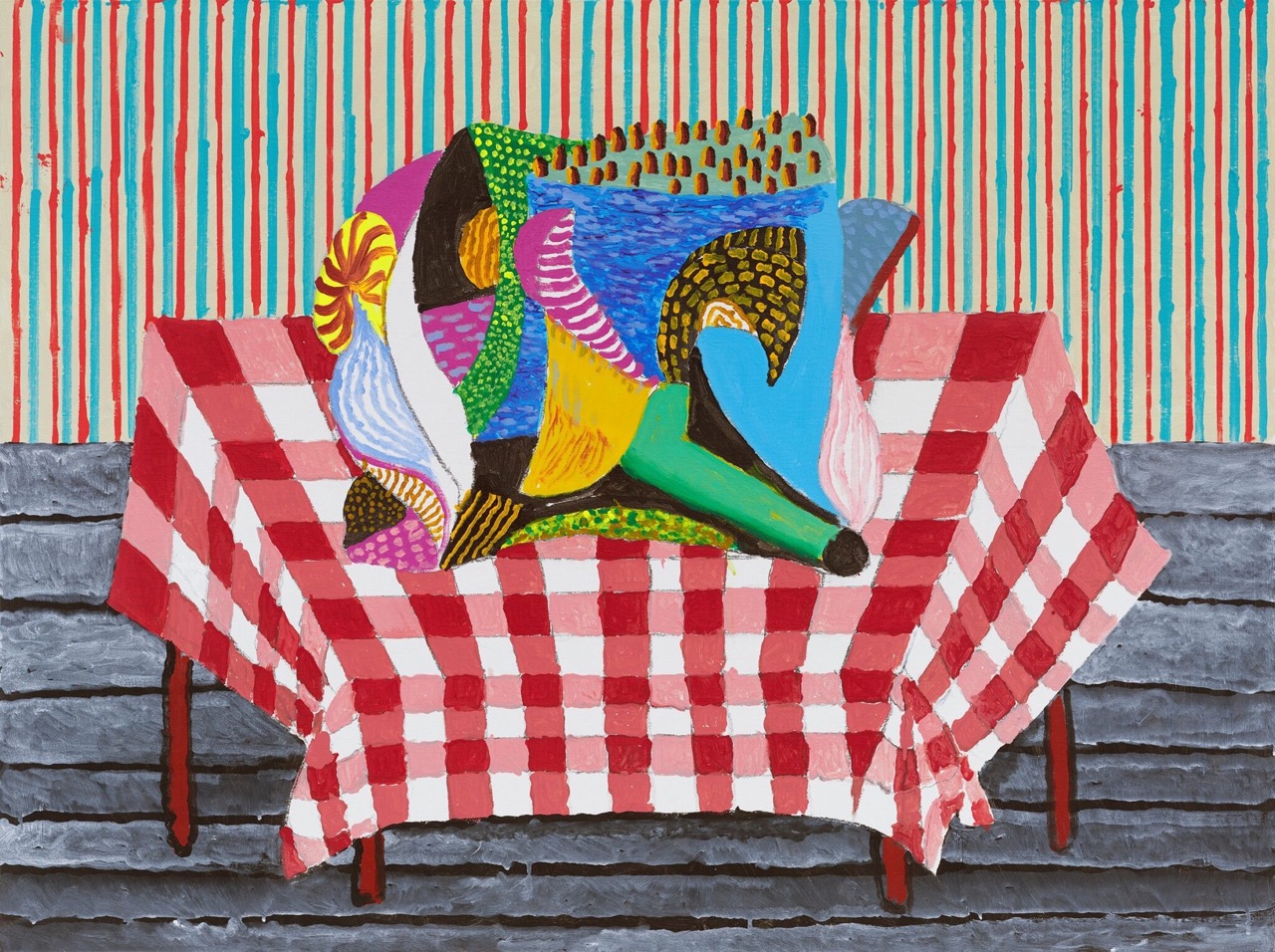
Abstraction Resting on a Red and White Checkered Tablecloth. Acrylic on canvas, 91.4 x 121.9cm, 2025. By David Hockney.
I have sat in an open-top car whizzing through the Hollywood Hills with the artist as he drove fast to a timed tape of a Wagner opera, whereby the curves and gradations of the road coincide with the high and low notes and rhythms. I have sat for a pencil portrait with him using the camera obscura. I have been snapped during his Polaroid phase and also sat for a double portrait painting. Tech’s season, and Hockney’s techniques, may change, yet his curiosity for technology does not fade—from his paintings being lit up across the sky to multi-screens on buildings and a drone display in his native Bradford. In the time I have known him, he will happily talk about technology, but he is more profoundly interested and anchored in images of art and the history of art.
A Year in Normandie is a long visual narrative, like a film strip, based on the 90-metre-long original tapestry, which will be displayed at the British Museum in September. Drawing straight onto an iPad allows him to work at scale without physical canvas limits. His constant idea is that technology does not change imagery, artists do. He uses technology not as a gimmick, but to explore and expand how he can make images: “How we actually see things and how time and movement are represented through visual storytelling.”
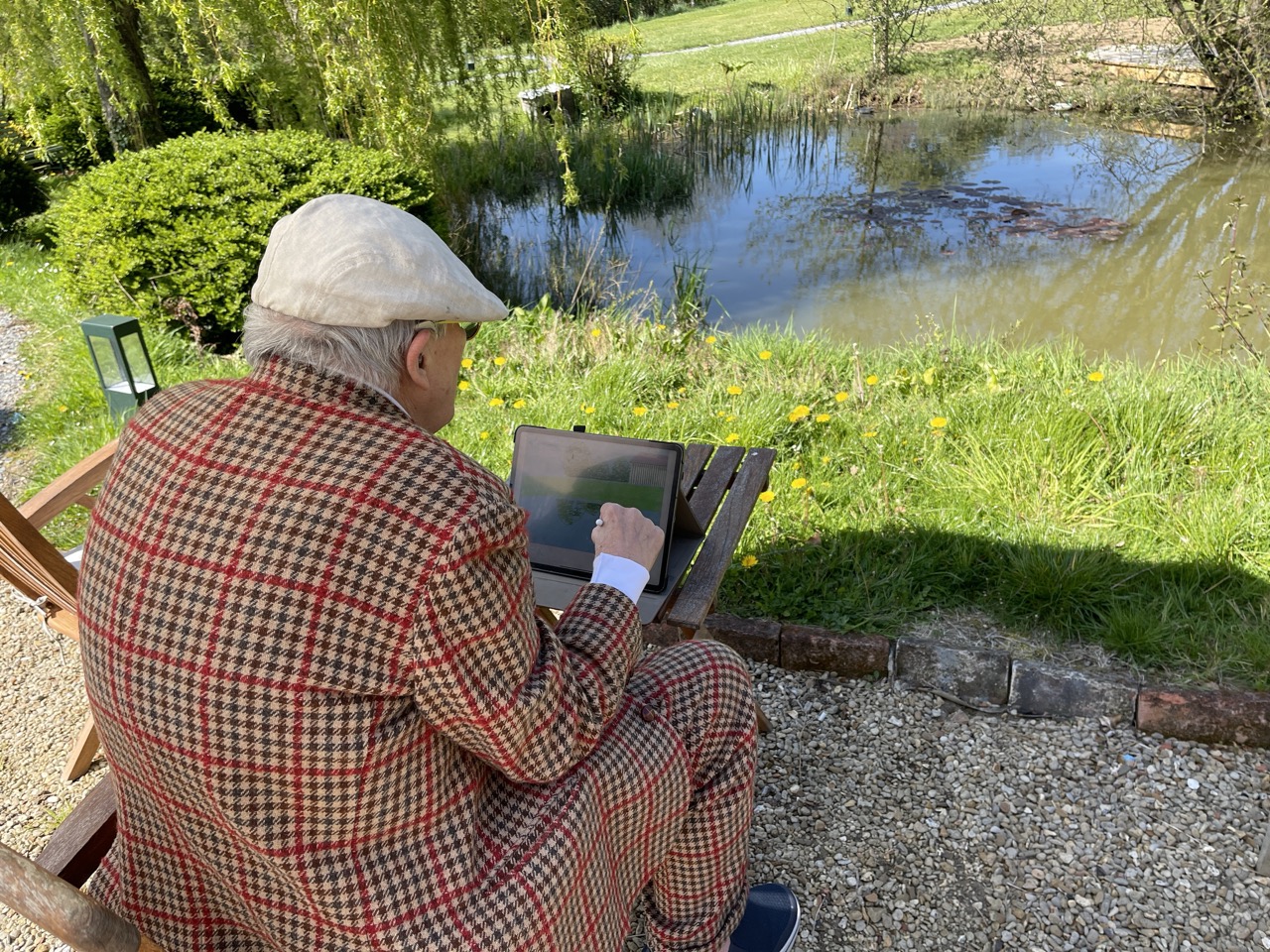
“It’s not the tool that matters—it’s the eye. A good painting is still a good painting, whether it’s made with a brush or a stylus.”
David Hockney
More than 10 years ago he made images created on an iPad. He sent me 170 of them to look over, none of which he had made with paint or water but simply the tablet. He pinged them over to me on my phone. They were stunning digital paintings of views from his bedroom in Bridlington, Yorkshire. They were intimate and also furthered a profound insight into his life and his art, from flowers to ashtrays to sun rises.
Hockney has used iPads for painting and drawing over a long period of time. It came after his experience with cameras for multi-view composition, digital printing for large work and other technological aids to rethink perspective and space, and the user experience for both artist and viewer. He has a pragmatic approach but is decidedly not a tech advocate and would never call himself a digital artist, but “simply an artist”. He likes experimenting and has flirted with many mediums but he’s adamant about the image always trumping technique and technology. “The iPad is like an endless piece of paper,” he tells me, noting its flexibility. It has “no drying time, easy availability of every colour, and easy portability.” Even now, at this point in his 70-year career, he still experiments with different devices. I am reminded of when the Covid-19 pandemic was at its height, he told the simple truth from his Normandy home: “Do remember they can’t cancel spring!”
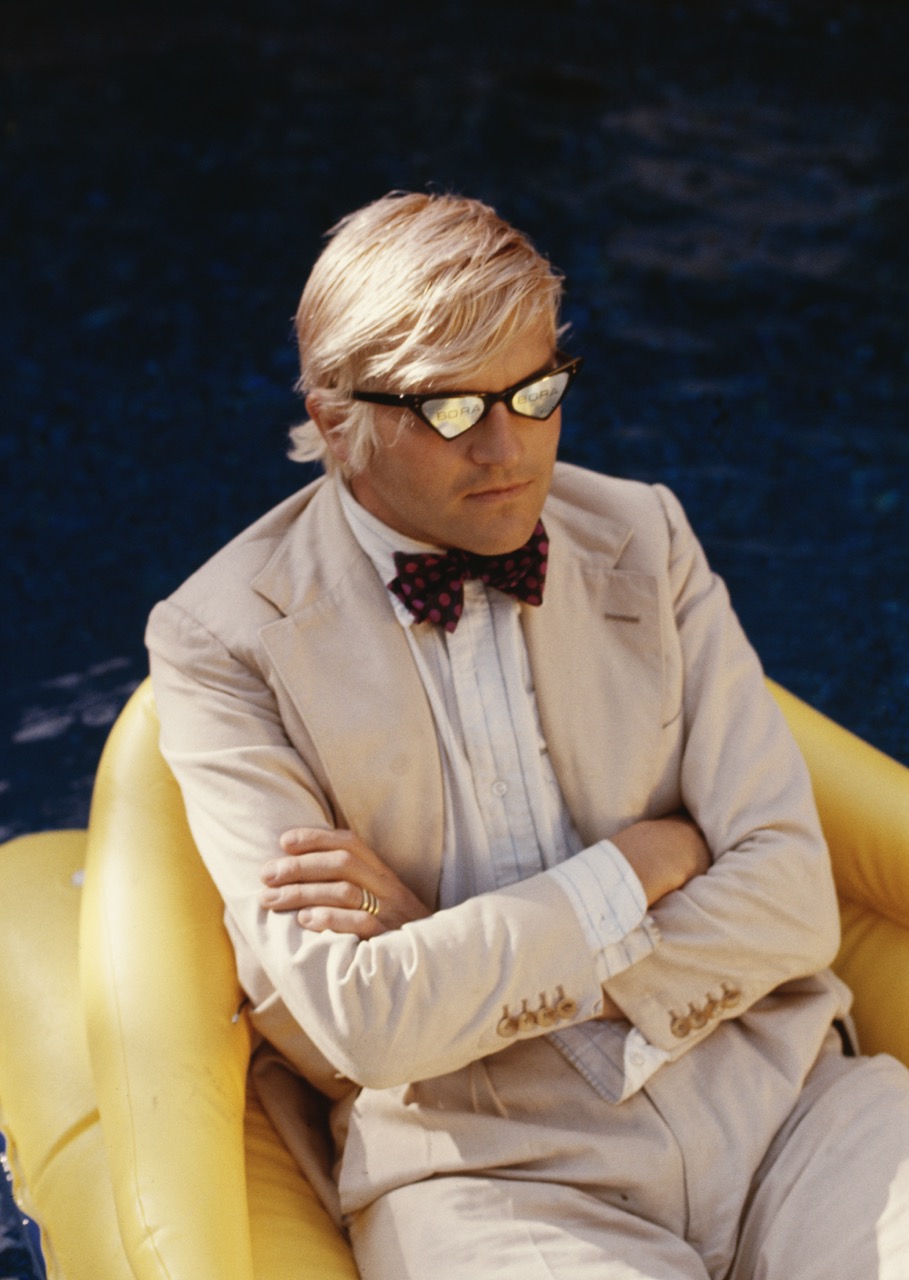
David Hockney in California, 1978. By Michael Childers.
Hockney is always optimistic. He subjugates technology to his vision and argues that traditional photography flattens reality, while human vision is dynamic and multi-layered. “The camera can’t see space. It sees surfaces. We see space.”
He believes technology such as cameras gives a misleading idea of vision—too fixed and mechanical compared to human perception. “We don’t see like a camera; we see by moving our eyes and our body,” he explains. He has contrasted the instant capture of cameras with the slower, more interpretive process of drawing. “Photography is all about time,” he tells me. “Drawing is about time in a different way.”
While Hockney isn’t anti-technology, he’s very selective. He embraces tools that expand perception (such as digital drawing) and critiques those that narrow it (including conventional photography). Quiet wisdom and deep research form his thoughts on what art is and should be. It has been this way throughout his career. “People are fascinated by machines—but machines don’t see,” he says finally. “They calculate. An image made without a human looking isn’t very interesting to me.” It reflects his simple mantra, with which he signs off on all his emails and letters: Love Life.
David Hockney: A Year in Normandie and Some Other Thoughts about Painting is on at the Serpentine Gallery until August 23rd