

In the first of a summer series exploring hotels in literature and art, Ramzi De Coster examines how two very different writers approached the nondescript motels and hotels of America. He contrasts Maya Angelou’s preference for writing in a “tiny, mean room with just a bed,”–a non-space where she could explore and shape her own identity, with Vladimir Nabokov’s fascination with the transient motels and highways of America, transforming their repetitive landscapes into the setting of Lolita.
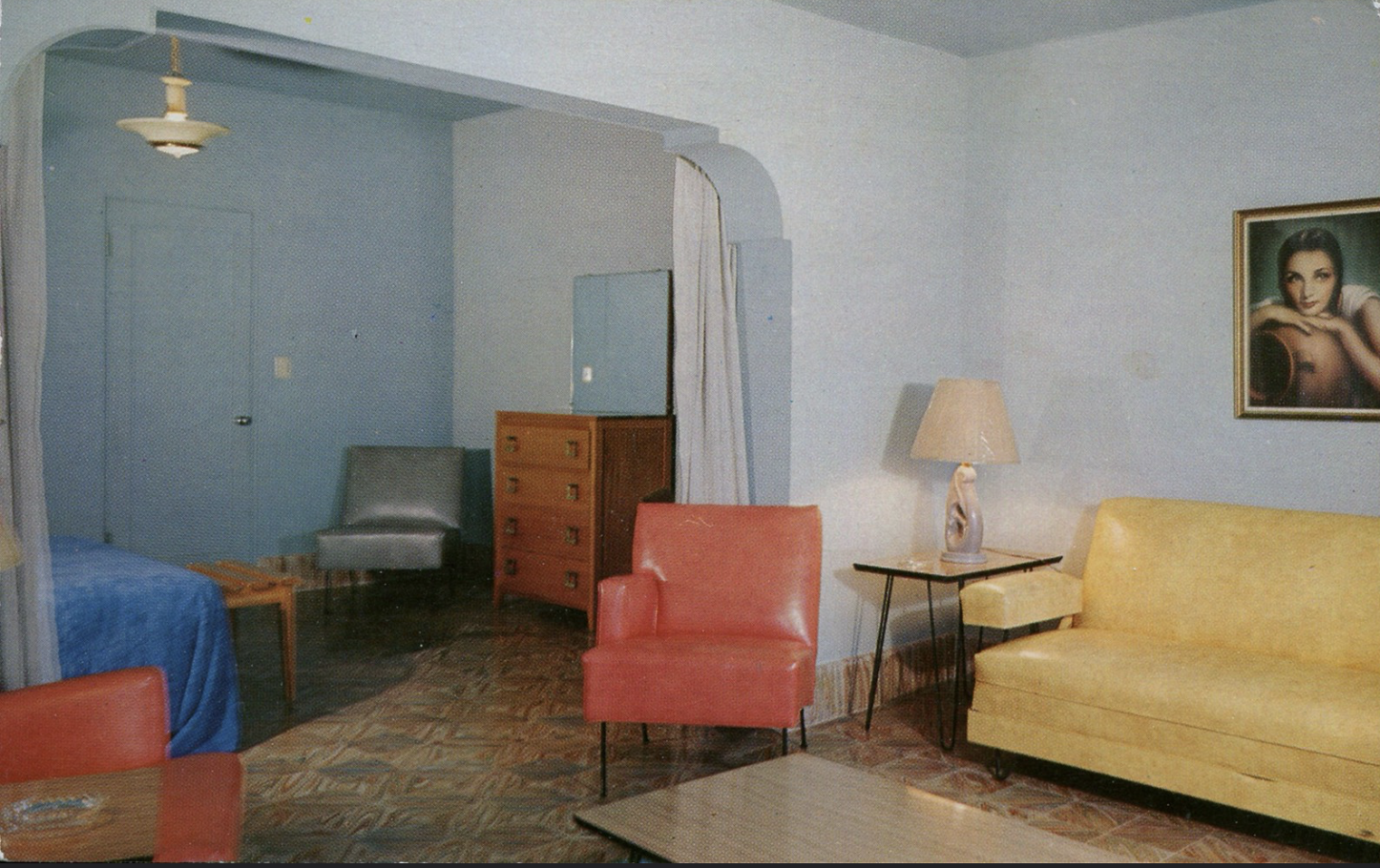
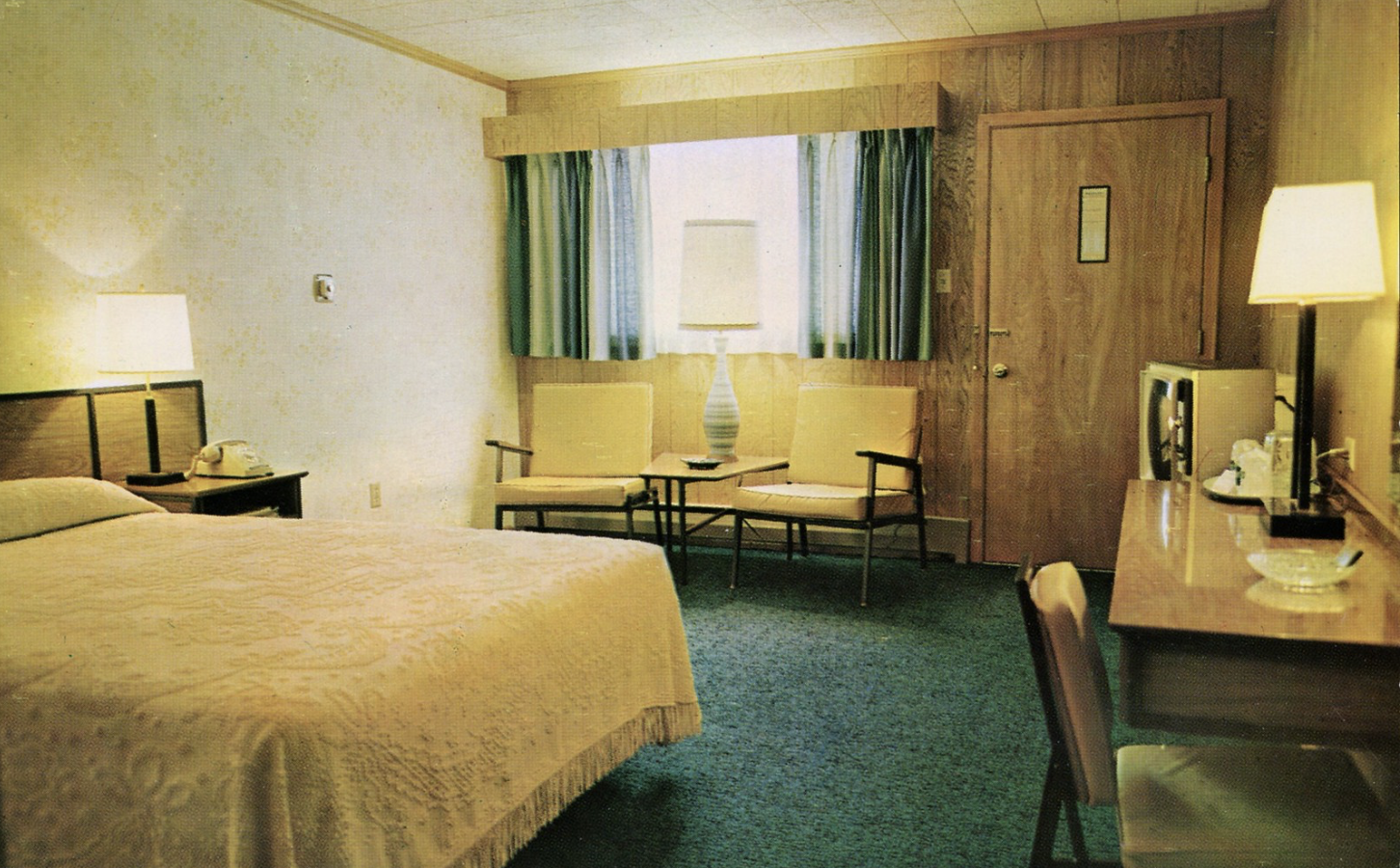
There’s a type of hotel that lives in everybody’s mind. Not the kind formed in the imagination, where chandeliers hang over big ballrooms with long, whiskey-colored martini bars that never shut. Not haunted by those characters that writers harvest for plot or “inspiration,” that get called “strange” and “eccentric” on novel jackets. Not romanticized like Wes Anderson’s Grand Budapest Hotel, where the halls are full of stories. A different type of hotel entirely, in which everything looks the same and nothing seems to happen. Less the Arcade Hotel in Jim Jarmusch’s Mystery Train, and more the kind whose rooms–like in Lost in Translation and Anomalisa–somehow look both spotless and lived-in at the same time. The stationery on the bedside table may have a different name or logo but that doesn’t matter. Everything in this type of room feels identical. The flatscreen mounted on the wall hosts the same dull channels and the walls traffic in that familiar stock photo landscape we all know from a hospital waiting room or an office building lobby.
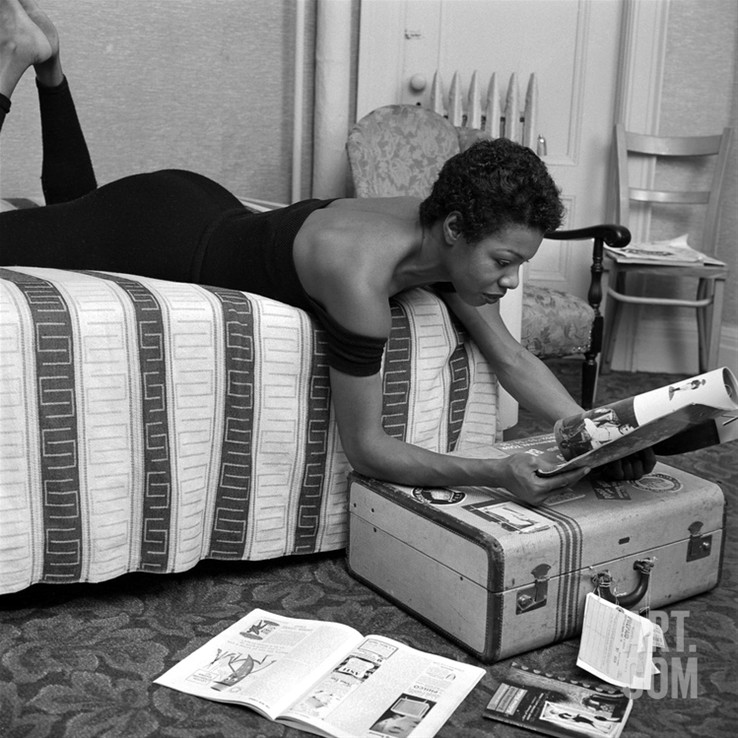
Maya Angelou in 1957, taken by photographer G. Marshall Wilson
That’s the kind of room the late Maya Angelou might’ve called the right place to work. Interviewed in the fall of 1990 by George Plimpton, who asked her about her writing routine, she described how she “kept a hotel room in every town (she) ever lived in.” Unsurprisingly, she doesn’t name one or describe a single room or hotel with any kind of specificity. There are no favourite hotels or memorable rooms for Angelou. None of her books are named after the Grand this or the Royal that. That was intentional. “I don’t want anything in there,” she declared on the stage of the 92nd Street Y cultural centre in New York. “I go into the room and I feel as if all my beliefs are suspended. Nothing holds me to anything. No milkmaids, no flowers, nothing. I just want to feel and then when I start to work I’ll remember.” This suspended state, or blank canvas, speaks directly to the writer’s thought process more than to any specific place. In order to write, Angelou needed to feel as though she was somewhere that was neither here nor there, or both here and there at the same time. The physical contours of her writing space had to reflect the walls of her mind which needed to be cleared of both character and distraction.
Elaborating on these non-spaces in a separate interview, Angelou described the room she rented as essentially just a “tiny, mean room with just a bed, and sometimes, if I can find it, a face basin. I keep a dictionary, a Bible, a deck of cards and a bottle of sherry in the room.” Nothing else was necessary, because her pursuit whenever she entered that hotel room was simply the development of herself as a person and artist. The suspended, a-thousand-others-like-it room supplied the ideal structure within which to shape her identity. “What I represent in fact, what I’m trying like hell to represent every time I go into that hotel room, is myself,” Angelou told journalist Judith Rich in 1977. There’s an impressive stasis to Angelou’s process and her views on it, which appear to have remained unchanged over the decades. Without intending it, she celebrates a space that is the antithesis of the room we think of when we imagine the settings in which great works of literature are produced.
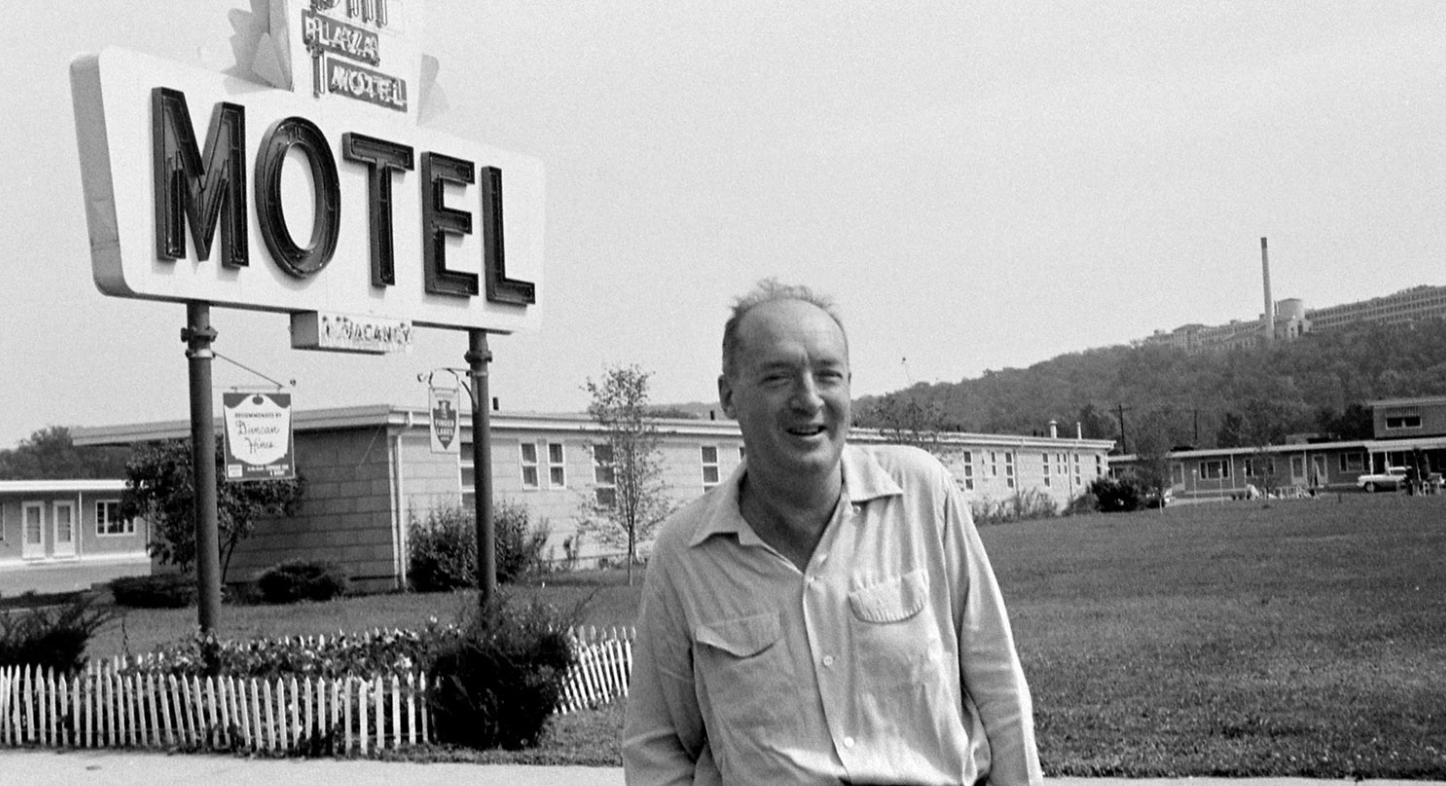
Vladimir Nabokov in Ithaca, New York, around 1958.
Some of the hotel or motel rooms Vladimir Nabokov stayed in might’ve been equally unimportant to him, though not in the same way. If Angelou treated her hotel rooms as non-descript office space, as a source for and not of inspiration, the same cannot be said of Nabokov. Nabokov’s hotel rooms were imbued with movement, restless, changing constantly and observed by him so closely that they would feature extensively in Lolita (1955), which was partly written and researched on the road. Between 1948 and 1953, Nabokov and his wife Vera took several trips from Ithaca, N.Y. through the Midwest to chase butterflies in Wyoming and elsewhere, flitting from one place to the next. (Nabokov was an avid butterfly hunter and once claimed that had it not been for the Russian Revolution he would’ve likely remained in Russia to become a lepidopterologist).
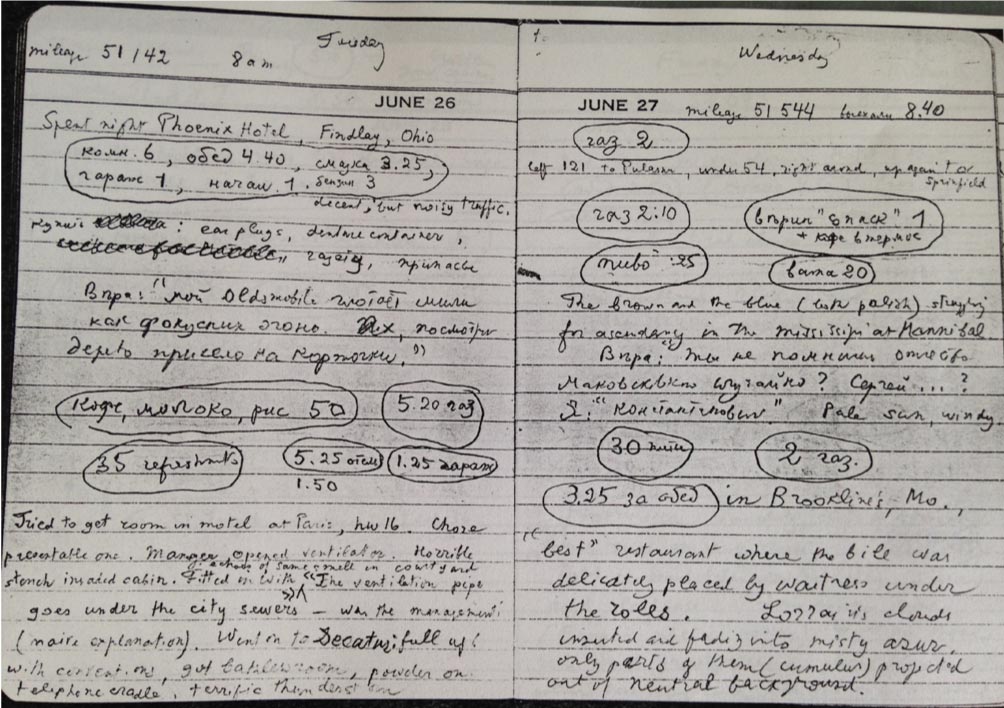
Nabokov’s notebook pages.
It was along interstate America, turning in the windows as they drove on and on, where Nabokov filled his stack of 5-by-7 index cards with notes on the small-town, motel-and-diner America of Lolita. Nabokov was known to work like this, writing on index cards and assembling them the way film editors thread shots into a narrative. On these cards was a lived experience of the America of the backroads, vast and endless, rendered in Lolita as a place of “countless motor courts (proclaiming) their vacancy in neon lights, ready to accommodate salesmen, escaped convicts, impotents, family groups, as well as the most corrupt and vigorous couples.” That’s not to say that there was any love lost between Nabokov and the motels he visited. He described Lolita as a novel that “condemns bitterly the American system of motels.” This system, to him, was defined by so much sameness that it could be reduced in the novel itself to its “repetitious names—all those Sunset Motels, U-Beam Cottages, Hillcrest Courts, Pine View Courts, Mountain View Courts, Skyline Courts, Park Plaza Courts, Green Acres, Mac’s Courts.”

“Does an old hotel full of history make it any easier to write words, if what’s really happening—the important thing—is already happening on the road or in the mind?”
Ironically, when Nabokov was interviewed by Herbert Gold in 1967–a conversation in which he talked about Lolita, delivered his trademark bashing of other writers and critics, and said, with pride, that he was “as American as April in Arizona”–it took place at his home in the Montreux Palace Hotel, in Switzerland. Not the “tiny, mean room,” Angelou worked in or the Sunset Motels and Pineview Courts of the novel. The Montreux Palace Hotel is a big, turn-of-the-century statement of the Belle-Époque with a ballroom on the shores of Lake Geneva. It has hosted aristocrats, leaders, actors, writers, artists, and on July 20, 1936, the political fate of the Bosphorus Strait was decided there. It might be more like those hotels that are richer in our imagination, that get turned into books and whose strange and eccentric characters find their way onto novel jackets. But does that really matter? Does an old hotel full of history make it any easier to write words, if what’s really happening–the important thing–is already happening on the road or in the mind?
Continue Reading