

Has Christopher Nolan finally beaten the ‘he can’t write women’ allegations? The Odyssey suggests he has. After years of female characters existing largely to motivate male heroes, Nolan’s adaptation of Homer gives its women emotional complexity, political agency and moral ambiguity, making them some of the film’s most memorable figures, writes Michaela Makusha.
Adapting Homer’s epic The Odyssey— which dates back 3,000 years—is a tricky task, but after taking on the story of Oppenheimer who built one of humanity’s most destructive weapons, he would no doubt feel confident enough to take on one of the oldest tales of another man struggling with the unforeseen consequences of his actions.
Matt Damon delivers an Oscar-worthy performance as Odysseus; however, critics and the audience have said the women of the film have widely been praised for their performances. “Though their time on screen is limited,” Taryn Finely wrote for Refinery29 “the women of The Odyssey deliver magnificently.”
Throughout his career, there has been criticism of how Christopher Nolan writes women in his films. “Christopher Nolan’s genius ends when a woman enters the frame”, Anjelica Jade Bastien, film critic for Vulture, said on the Sam Sanders podcast. A common critique for Nolan is that his female characters are often one-dimensional or femme fatales. The women tend to die, mainly for the development of his male characters’ arcs. Bruce Wayne loses Rachel Dawes in the Dark Knight trilogy; Leonard’s arc is structured around the loss of his wife in Memento. If we treat his Batman trilogy as one singular cinematic event, then in his twelve feature films, half of them have storylines which are explicitly built around the death of a woman.
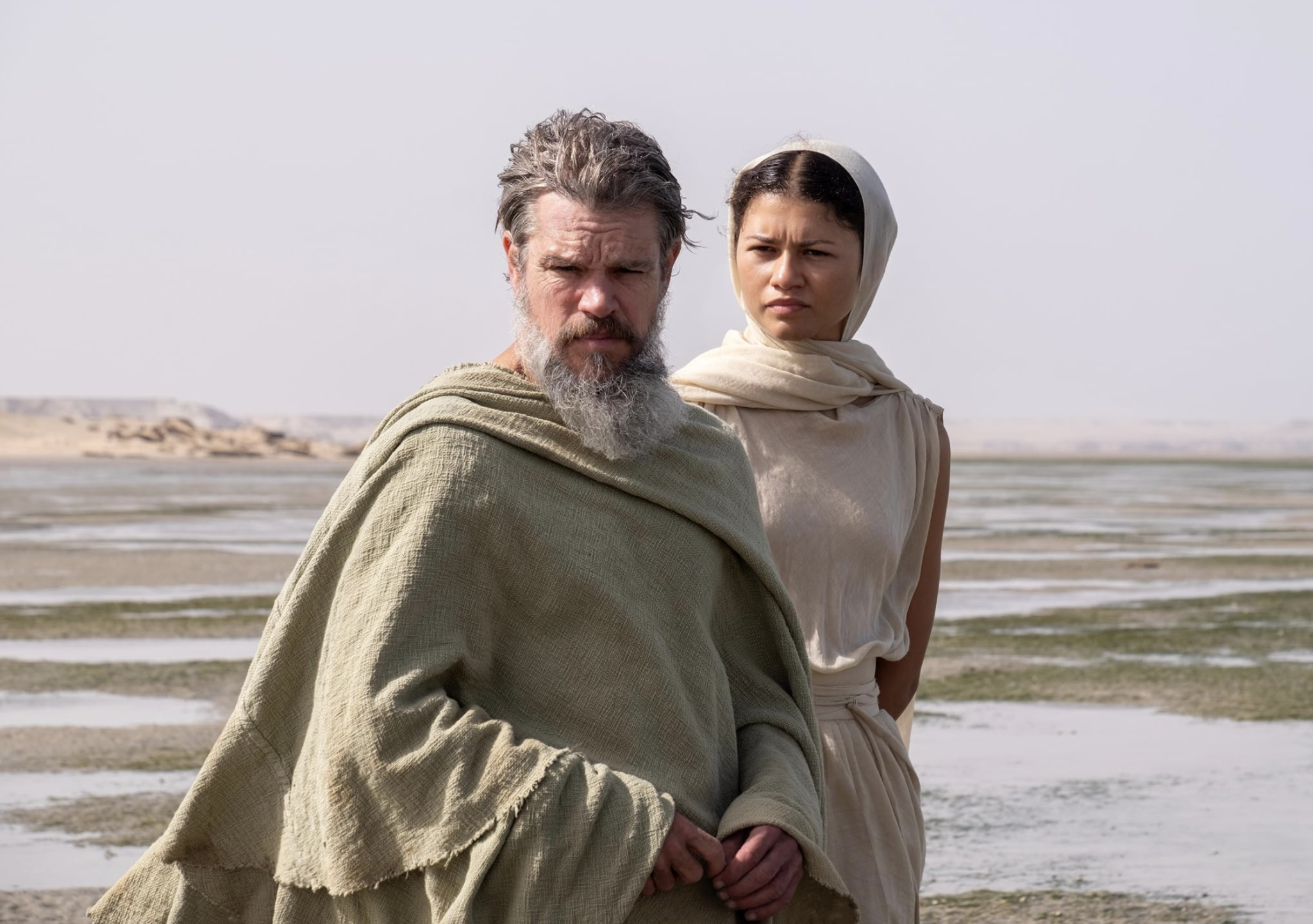
Matt Damon and Zendaya in The Odyssey (2026), directed by Chrisopher Nolan.
This is not a criticism unique to Nolan, but rather a symptom throughout male-dominated blockbuster cinema. A blockbuster film is typically seen as a film that you cannot do without a strong masculine hero and a couple of women thrown in. From the hypermasculine films of the 1980s and 90s to franchises like James Bond and Mission: Impossible, and even the entire Marvel and DC universes, men are front and centre and masculinity is shown through physical and mental dominance.
Over the last twenty years, there have been efforts to rectify this, not only with the inclusion of women as secondary protagonists, but also a rise of well-written heroines who are leads in their own right. The Hunger Games, Wonder Woman, and even Greta Gerwig’s Barbie demonstrate that well-written, interesting women are enjoyable and can make a lot of money at the box office. Still, Nolan’s filmography remains male-centric, out of choice or historical necessity, like in Dunkirk (2017), for example.
A good representation of women on screen means that women are shown in a range of roles. Not always as heroic characters but also three-dimensional and well-written, outside of outdated tropes and given space to explore the complexities of their lives and decisions they have to make. Marvel films are the biggest example of this. Scarlett Johansson’s Black Widow was subject to misogynistic tropes in the Avengers films, died in Endgame for Hawkeye’s emotional arc and is only given decent writing and depth in her feature film that came a decade too late. It certainly demonstrates that we are in a different Hollywood, and the conversations around women in blockbuster films have changed for the better.
Most characters in The Odyssey who are not Odysseus are a ‘plot device’ regardless of their gender. Their job is to be foils, omens, and warnings to our hero as he tries to get home. His crew and closest friend Eurylochus (Himesh Patel) all perish on the journey home, as a result of not listening to Odysseus’ warnings. Sinon (Elliot Page) serves to remind Odysseus of the good young men sacrificed in a needless war, and even the intimidating Agamemnon (Benny Safdie) is there to warn Odysseus not to be too proud when he returns home.
But what Nolan gets right in the Odyssey is not necessarily the screen time or the number of women in the film, but rather how he expands on their narratives and characterisation. Helen of Troy (or rather, she’s actually Helen of Sparta, a pedantic correction on my part), portrayed by Lupita Nyong’o, stands out in what little time we see her. We never really know what happens to Helen after the Trojan War. Some ancient sources say she was killed by her husband, exiled and then killed, or worshipped as a goddess. But through Nolan we see Helen, her fraught relationship with Menelaus, the guilt and anger she feels over the war and massacre her name is forever associated with.
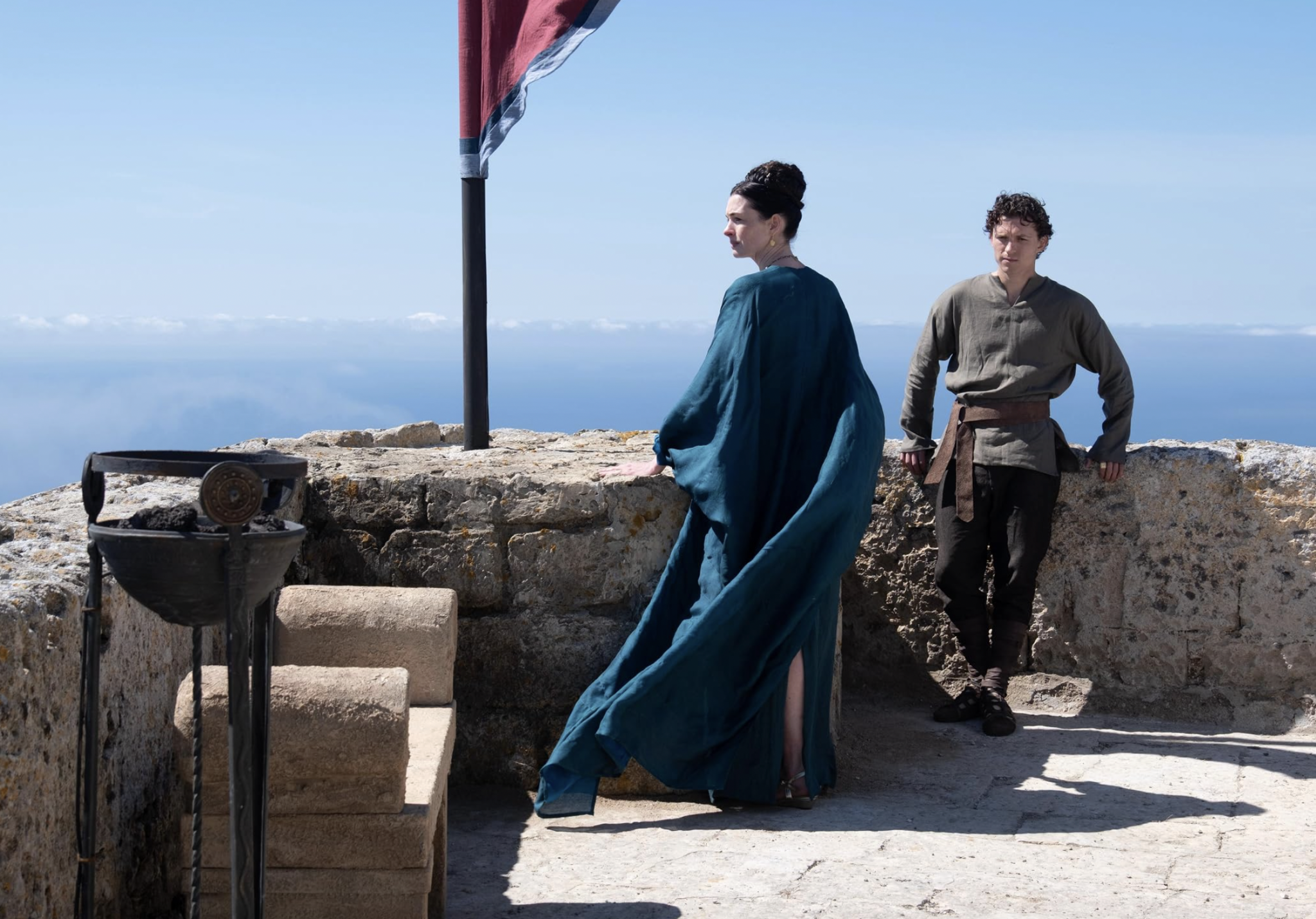
Anne Hathaway and Tom Holland in The Odyssey (2026), directed by Chrisopher Nolan.
I do wish we could have seen more of Clytemnestra, wife of Agamemnon, twin sister to Helen (also portrayed by Nyong’o), because she is a fascinating woman and Queen, often overshadowed by her infamous sister. We get the scene in which she kills her husband upon his return home, a glimpse of her grief and vengeance. It is more than enough to gauge how the Trojan war affected her and the difference in the sisters – Helen is browbeaten yet still maintains her spirit, but Clytemnestra is the embodiment of maternal rage.
Calypso (Charlize Theron) and Circe (Samantha Morton) are our witches in the film. Through them, we see two sides of the monstrous feminine – the theory that women in film are often framed as monstrous is not because of their appearance but because their power, sexuality and independence threaten patriarchal norms. They both strip the heroes – Odysseus and his crew of their agency and glory and twist notions of domesticity and the typical relationships between men and women in an ancient setting.
Calypso’s island is a deceptive paradise where she holds all the power, keeping Odysseus, the clever and cunning warrior, as a sedated consort. Calypso’s loneliness is clear, not only because of the large island she inhabits but also in the way she wishes to keep Odysseus under her thrall. Theron’s obvious beauty is a reason to cast her as an alluring, powerful nymph, but she is able to subtly portray Calypso’s controlling nature.
Circe’s island is not a paradise, as we can all feel the off-ness of the island with its oddly obedient and cowed wild animals (her former victims). She is cunning but also a woman who is responding to a group of violent men, led by Odysseus, invading her home, probably having heard about what happened at Troy and traumatised by the men who had come before. Morton told Variety about her and Nolan’s choice to portray Circe as a rustic witch and war-hardened woman rather than a temptress, which emphasises the complexity and fear that comes with war: “War is complicated. Men are complicated. Our relationships with men as wives, sisters, daughters are complicated. I drew on that. And there are people in my family that have been sexually assaulted and raped, and I thought of that as well.”
Circe is not evil for turning Odysseus’ crew into pigs – a chilling response for sure, but her reasoning with Odysseus through Morton’s superb and pensive monologue gives us more than a mere witch. She represents the cynicism that every woman and especially women who have been victims of assault, rightly have.
Athena (portrayed by Zendaya), Goddess of War and Wisdom, acts as Odysseus’ tutor and guide throughout the film, and in the original myth is more direct in her involvement in his journey home, using divine powers to intercede when he needs help.
I do not think we need to see Athena’s power so explicitly in order to feel it. As Athena tells Odysseus, ‘who does not understand thunder? Fire? A child’s smile? A good harvest? Athena is not cryptic at all when you sit and think about it. When it is revealed in the third act that Athena has been using the face of her priestess, slain in the sacking of Troy, it is a powerful statement more than any direct intervention. She uses her power to continue to remind Odysseus of what he did, what he allowed to be done, with the wisdom that she admired in him and that she does see him worthy of redemption and returning home because of his guilt and remorse.

“With The Odyssey, Nolan has demonstrated growth as a writer and director by giving us a host of diverse and compelling women who are just as integral to the story as the men.”
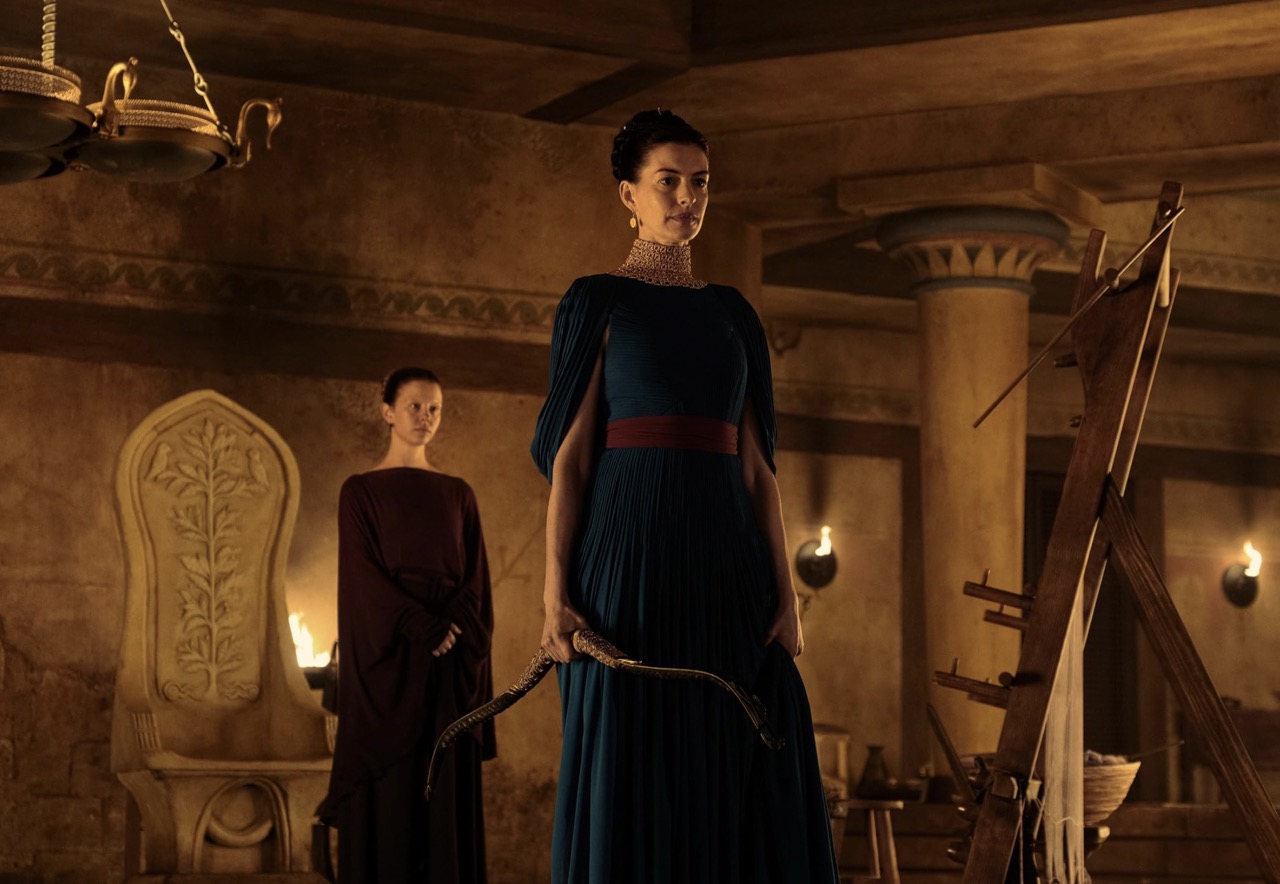
Penelope (Anne Hathaway) is the woman with the most screen time and the most fleshed out in the original myth as she is in this film. Whilst she is traditionally the good and patient wife, we are presented in the film with a queen who is all these things and just as We know that she is just as, if not more, cunning and wise as her husband is, making the suitors wait for her to finish a shroud that she is never going to finish and sets the ultimately impossible task, buying her family time.
“I always accepted the narrative about Penelope that focused on her likability, her goodness, her morality,” Hathaway told Variety. “Chris created a character that’s not a denial of those things, but who is dealing with a constraining and challenging set of circumstances. This paragon of patience is staring at an uncertain future and wearing thin. The costs of playing the game are becoming clear.”
Penelope is the most important woman in the Odyssey’s narrative, as Odysseus’ wife. But she is given space in the film to be so much more. She is given the space to be angry at everyone insisting she needs a king when she’s been ruling the kingdom all this time. She is loving and kind to the beggars who come to her palace, and Penelope was far more patient than most of us; that is for sure.
Nolan has previously given us individual three-dimensional women in Interstellar and Oppenheimer. Kitty Oppenheimer (portrayed by Emily Blunt) is demonstrated to be just as capable as her husband, if not more politically intelligent, and Murph in Interstellar (Jessica Chastain) is a brilliant sci-fi character, and ultimately saves humanity. I will say that Nolan’s strengths lie in writing and making films that confront masculinity and what being a man looks like and how men interact with the world and situations around them. However, with The Odyssey, Nolan has demonstrated growth in his writing and directing by giving us a host of diverse and interesting women who are just as integral to the story as the men.