

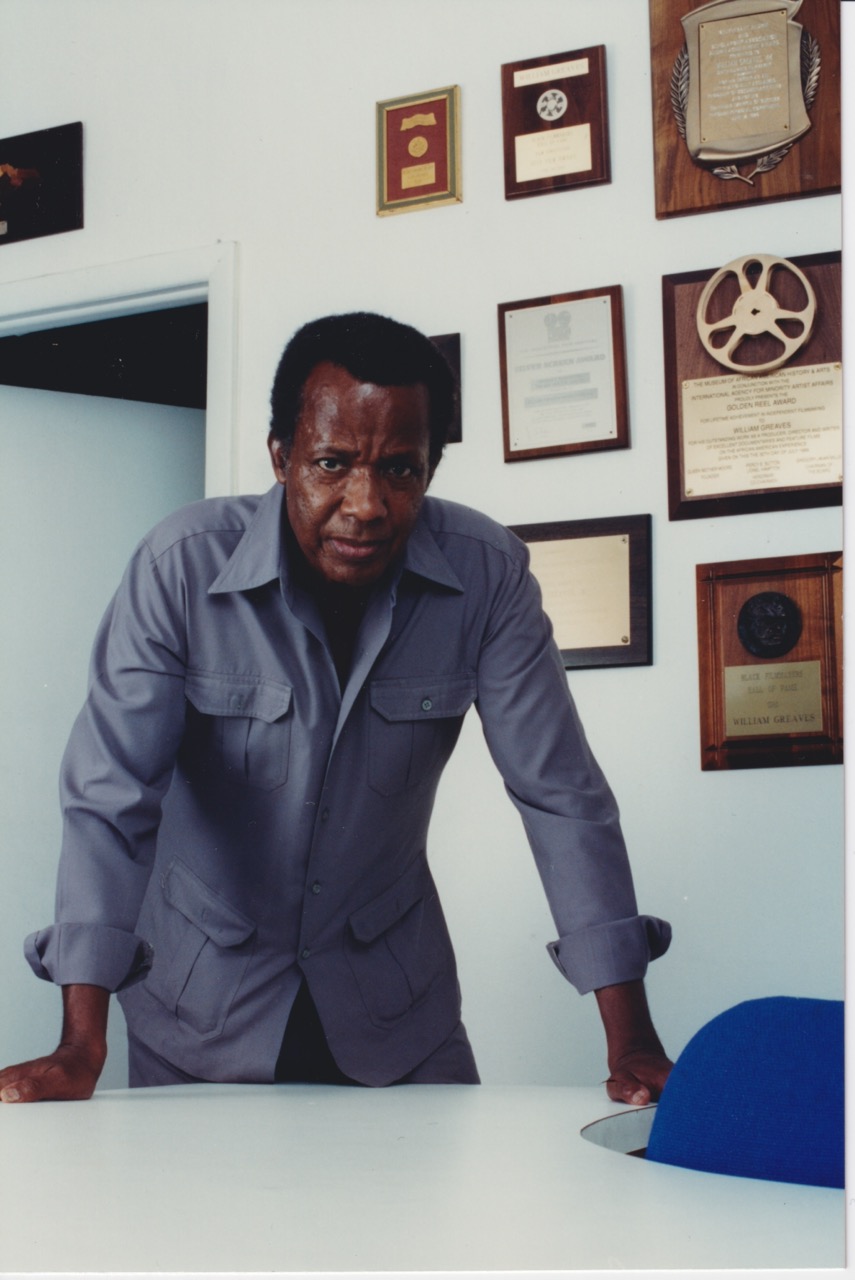
As a new season devoted to his work opens at the Barbican Centre, Joshua Thermidor analyses the kaleidoscopic career of filmmaker and actor William Greaves.
William Greaves’ first appearance on screen as an actor is about a quarter way into Alfred L. Werker’s Lost Boundaries (1948). Cue the black-and-white din of a New Hampshire university parlour where Arthur Cooper (William Greaves), and his friend Howard Carter (Richard Hylton), are playing a new piano tune to friends in attendance. No one has a clue that Howard’s old man has been passing as white to secure employment as a doctor. Howard will bring Arthur home to small town Keenum for their Christmas holiday: of all the boys at college, my brother has to bring home a coon! says sister Shelly Carter (Susan Douglass). It raises a fever pitch from inside the house. Soon enough the Carter siblings will discover that they’re passing Blacks, too. Shelly plays a different tune at the family party when she hears Arthur sing. “Nobody loves me now, nobody cares at all,” he croons, leaning against the piano. Applause permeates the camera’s fade into Dr. Carter’s office. As the old man dips into another room for booze, Coop tells Howard, you know Howie your dad’s swell. I feel completely at ease with him. While he explains the tendencies of white cordiality, and how Dr. Carter’s nothing like that, we realize that the astute observation of Arthur Cooper belongs to William Greaves. It’s as if he has used his own performance to learn something about authenticity—a vision he’ll use for the rest of his career.
Lost Boundaries is the earliest film screening as part of The Barbican’s upcoming retrospective, I Am Furious Black: The Films of William Greaves. Spanning over seventy years, the retrospective includes nearly the entirety of the avant-garde film-maker’s acting, writing and production. Born in Harlem, New York, in 1926 William Greaves was one of seven children to Garfield Greaves, a taxi driver and minister, and mother Emily Muir. Coming from a working-class family, Greaves attended City College of New York studying engineering before leaving to pursue acting.
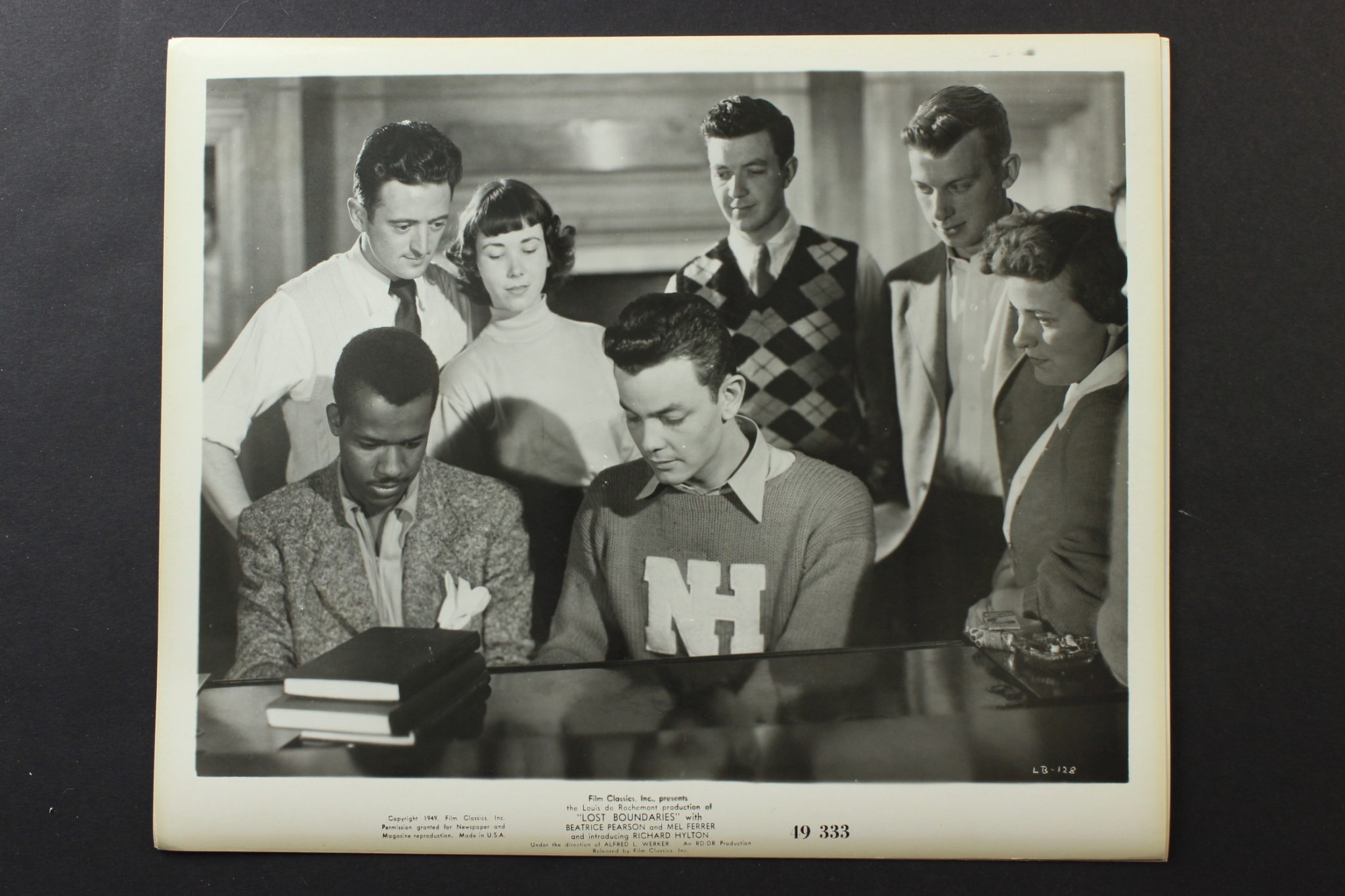
William Greaves in Alfred L. Werker’s Lost Boundaries (1948)
Greaves’ career began running lines with Sidney Poitier, Harry Belafonte and Ruby Dee at the American Negro Theatre. In 1948, he joined the Actors Studio, training with Marlon Brando and Anthony Quinn. During that shared tenure Greaves would appear in several “race films”— films produced for black audiences, and often featuring black casts— such as Miracle in Harlem (1948), Souls of Sin (1949), and Lost Boundaries (1949).
Hollywood wouldn’t offer the young performer a kind thesis on where the Black actor’s place should be in cinema. It begs mentioning, for example, that no actor in Lost Boundaries who plays a passing Black person passes for a passing Black— all of the leads are white. Even a film meant to center the Black community does it with a kind of cinematic blackface. As a supporting role in a “feel good” film, Greaves sings a swell song and bails his buddy out of jail. That’s about it. Despite the problems around the genre, Barbican Cinema Curator Matthew Barrington notes the stature of the characters that Greaves chooses to portray—often well-to-do, upstanding, and gentlemanly. There’s a sense that “the things that he’s in are the things he wants to be in,” Barrington tells me.
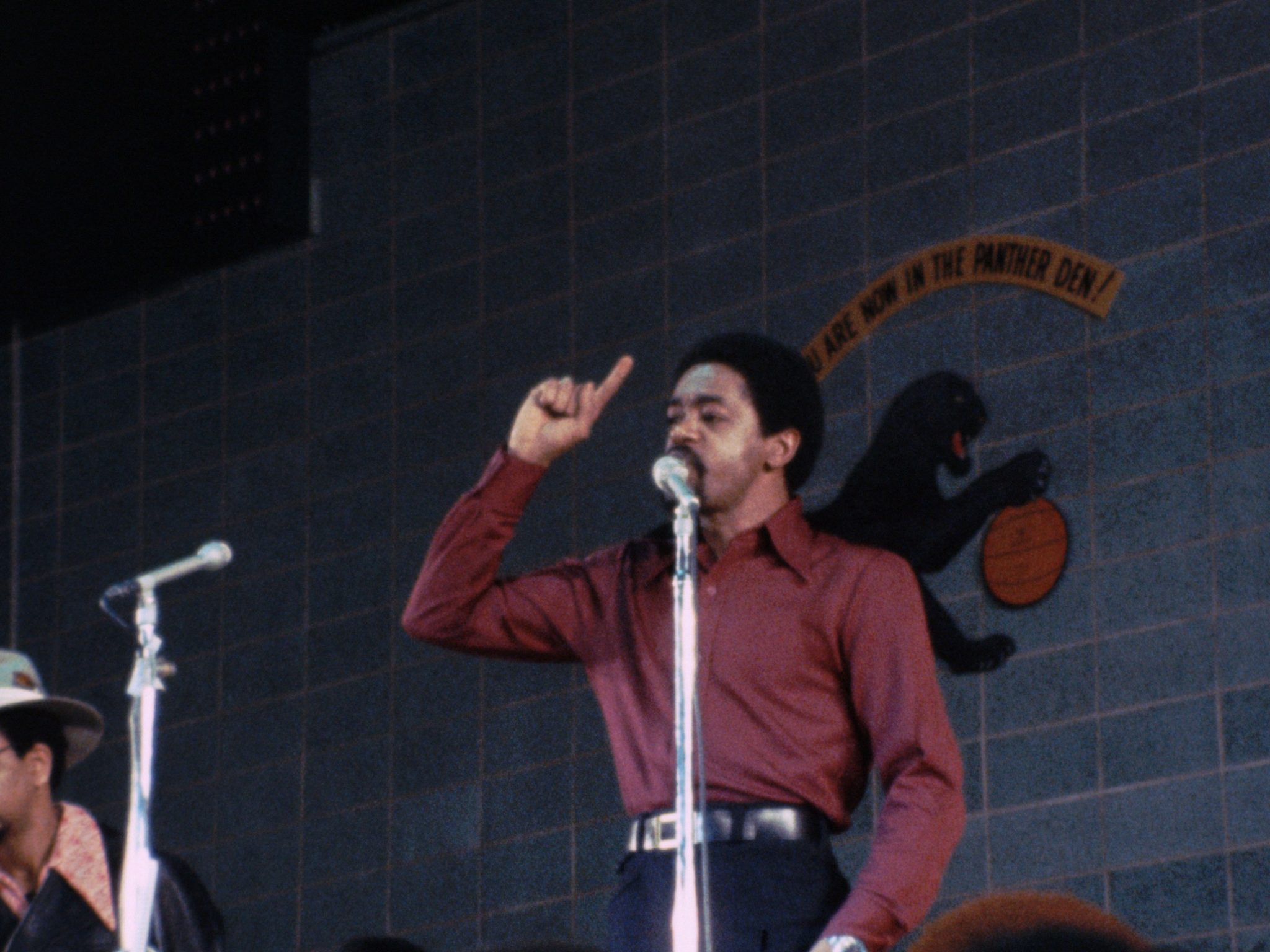
William Greaves, Nationtime (1972).
Even as a successful early-career actor Greaves was optimistically picking up scripts only to find racist stereotypes. Upset by this constraint, and unwilling to bend any further, the actor would pivot to filmmaking; a means of “refusing to be a passive figure,” Barrington says. With a letter of recommendation from German painter and avant-garde filmmaker Hans Richter, and spurned by a lack of opportunity in the United States, Greaves leaves for Canada in 1952. There, he’d begin producing, writing and directing for the National Film Board of Canada. Working mostly in the documentary format during his self-exile, Greaves’ films show a keen aptitude for narrative. Smoke & Weather (1958), follows a day-in-the-life-of a forest ranger named Ben during fire season. “Not every smoke you see is a forest fire,” Ben tells us as he tests a new recruit with false smoke off in the distance. It’s a simple line but it shows Greaves as an attentive writer. What’s more is that this kind of writing speaks to a necessary discernment of vision. Tested against the banalities of daily life, Greaves’ writing interrogates dental procedures in Putting It Straight; daily healthcare crises in Emergency Ward; and the overlapping aspirations of world faiths in Four Religions.
It’s a career nothing short of kaleidoscopic, one that allows you to “see someone trying many different things. Trying to learn and grow as an artist,” says Barrington who, upon seeing the films at a festival in 2023 in Washington, D.C., couldn’t believe they were all by the same person. “It didn’t occur to me that someone could be doing all of these things simultaneously,” he tells me. The more we watch, the more simultaneity emerges as a driving feature in Greaves’ artistic practice. But this desire to hold and present several things at once also has its own energy: fury. Fury that he famously writes of in the 1970 New York Times op-ed “1000 Madison Avenues Will Be of No Help.” Rather than merely complain about the state of affairs for Black actors after uttering “I am furious Black,” the filmmaker rallies against the standards of American social programming as the nation struggles in its visual modes of communication— particularly in the binary of white and Black audiences.
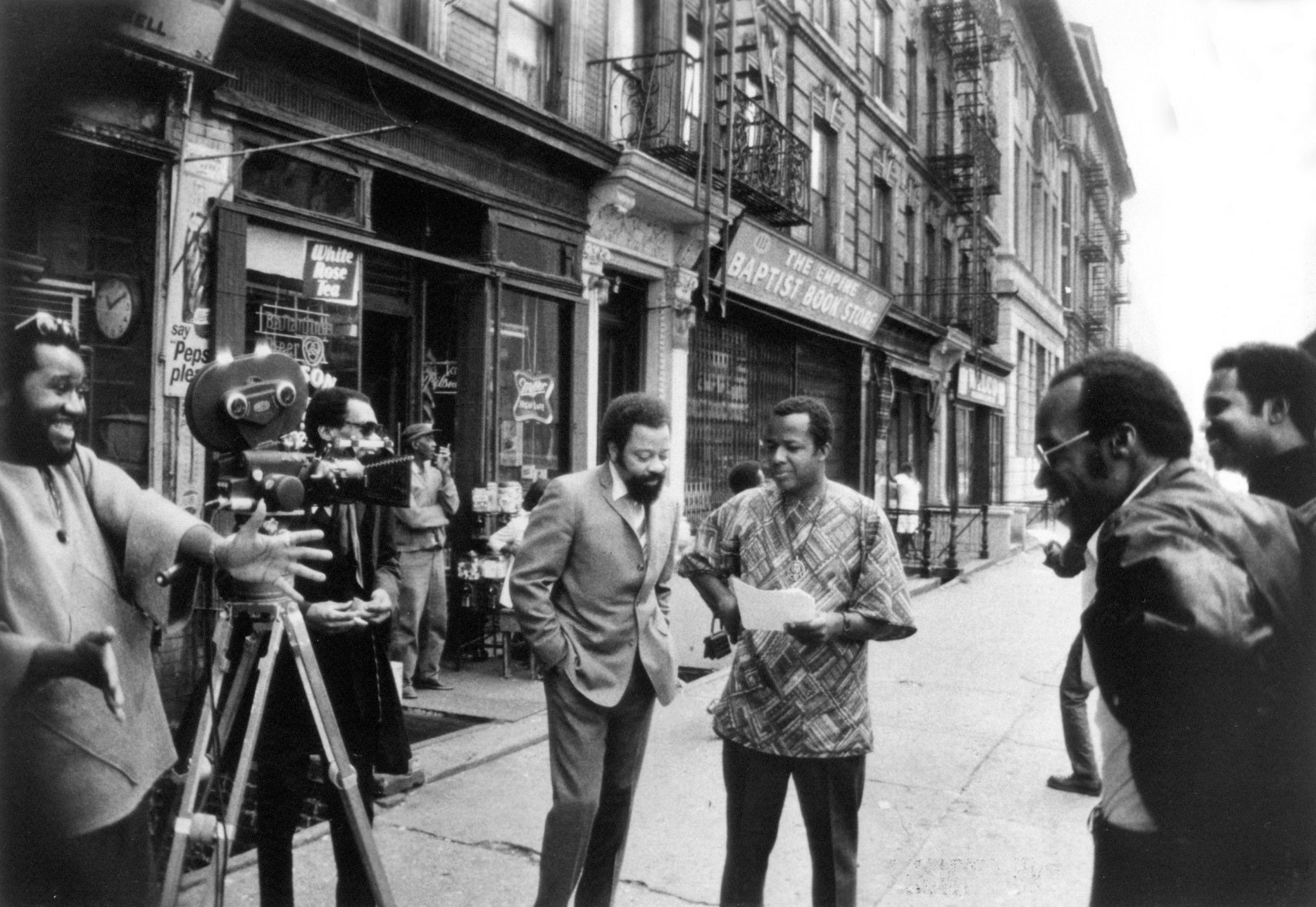
The Black Journal crew shooting in Harlem
Greaves would bring his assertion that “Black producers must redefine Blacks to Blacks and Blacks to whites,” to his leadership of Black Journal, a publicly funded monthly television broadcast that reported on achievements and issues pertaining to Black Americans. With Greaves at its helm, Black Journal would garner an Emmy award in 1969 until his departure in. But after leaving Black Journal in 1970, the work of Black redefinition would inevitably bring him back to Harlem. Filmed in 1972 and completed by his son David Greaves in 2024, Once Upon A Time in Harlem is like a vivid dream. Acquired by Neon in 2026 after a triumphant appearance at Sundance, the film follows a house party thrown by the elder Greaves in Duke Ellington’s apartment. What ensues is a gathering of living Harlem Renaissance legends— writer Richard Bruce Nugent, painter Aaron Douglas, poet Arna Bontemps, photographer James Van Der Zee, and others. Made on 16mm film, it’s a capsule providing unprecedented closeness to some of Harlem’s great titans.
Perhaps it was this kind of closeness that Greaves was thinking of when he wrote of harnessing the “violent energies” of encounter and to channel them “through the electronic circuit” of the television. Revisiting the documentary style of his Canadian saga, Greaves would bring “encounter television” to the United States— programs in which two opposing groups would meet, mediated by a knowledgeable and non-partisan moderator. In The Company of Men (1969) sees the psychologist Walter Plavoun take a group of white factory foreman through a series of confrontations they’ve had with their Black coworkers. He (Plavoun is white) plays the role of the Black coworkers until the two groups are merged to act out these confrontations together. In a way, Plavoun is a sort of surrogate Greaves— staging the performance, and also performing for the performers.
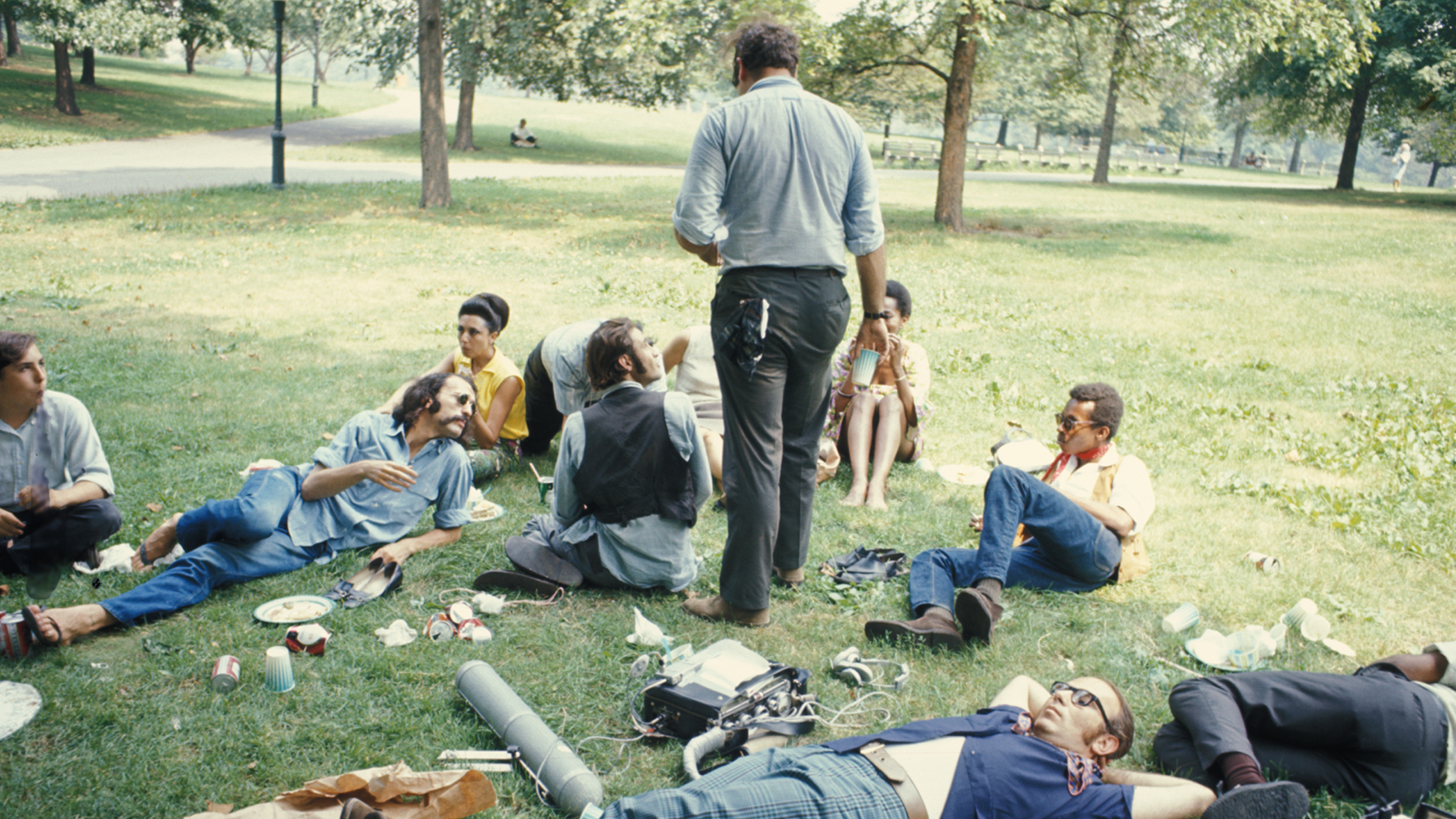
William Greaves, Symbiopsychotaxiplasm: Take One (1968)
Nowhere else is this stacking of performances more palpable than in Symbiopsychotaxiplasm: Take One (1968). Partially funded by a student who studied under Greaves while in Canada, Symbio is not easily synopsized. Using a cinéma vérité style, the film follows a couple having an argument in Central Park. We become aware that the making of the film is being documented as well. Finally, there is a documentation of the documentation. A film, within a film, within a film.
The actors portraying the couple change (at one point, the woman is portrayed by William Greaves’ late wife, Louise Greaves), and so do settings and performances. At times, the screen splits in three and we are made to watch each plane of experience simultaneously. As the crew hunkers in a room and records their displeasures, they scrutinize the script, as well as their director. One member even offers up the brave opinion that Greaves is a bad actor. He’s in a sense written himself a part but also, as another crewmate adds, it’s like somewhere the director is hiding. But where, if anywhere, can a director hide in a film where all reality is exposed? What part can he write for himself, other than himself? Greaves’ vision was not merely fractured but fractal— increasing in detail the closer he dared to look. Questioning the authenticity of performance through performance, in order to uncover a self.
But the fractured vision with which he filmed the cult classic would later doom the work. Admitted to the Cannes Film Festival in 1972, the film’s print was inaccurately assembled so rather than seeing the film with all its complexities, they saw it in the completely wrong order and it was rejected. Now however, his genius is being understood— fifty-four years on from rejection Once Upon A Time in Harlem was nominated for the L’Œil d’or at Cannes in January of this year.

“Greaves’ vision was not merely fractured but fractal— increasing in detail the closer he dared to look. Questioning the authenticity of performance through performance, in order to uncover a self.”
Joshua Thermidor
It’s tempting to categorize Greaves’ career as one of unlucky timings and erratic experimentation. We assume the pieces are abstract and can’t make sense of them. But here is a filmmaker who is just beginning to be understood as avant-garde in his time. Symbio wasn’t seen for twenty years, and Once Upon A Time in Harlem has just arrived. While not every film of Greaves is as electric as these, in every film we get all of him— a filmmaker willing to “get into the weeds of how people engage with each other,” Barrington says. One who truly “believed that film could shift perceptions.”
In the middle of Symbiopsychotaxiplasm: Take One, from off camera, Greaves beckons, “Are we making a movie or are we not?” From our own seats, beyond every plane of exposition, we scan our surroundings. We check for our line. I’m not sure, Bill. Are we?
I Am Furious Black: The Films of William Greaves is on at the Barbican from Wed 21 Oct—Sat 28 Nov 2026