

After 20 years editing and reporting foreign news, mostly from Palestine, for outlets such as the Guardian, the Telegraph and the Sunday Times, Phoebe Greenwood weighs in on the recent Macklemore and Ed Sheeran controversy.
Ed Sheeran was once — way back in the summer — among the most successful live performers in the world.
His last tour, The Mathematics Tour, made around $875 million and sold 8.8 million tickets, making it the fifth-highest-grossing and fourth-best-attended tour in history. The first ten shows of the Loop tour this year brought in another $70.8 million.
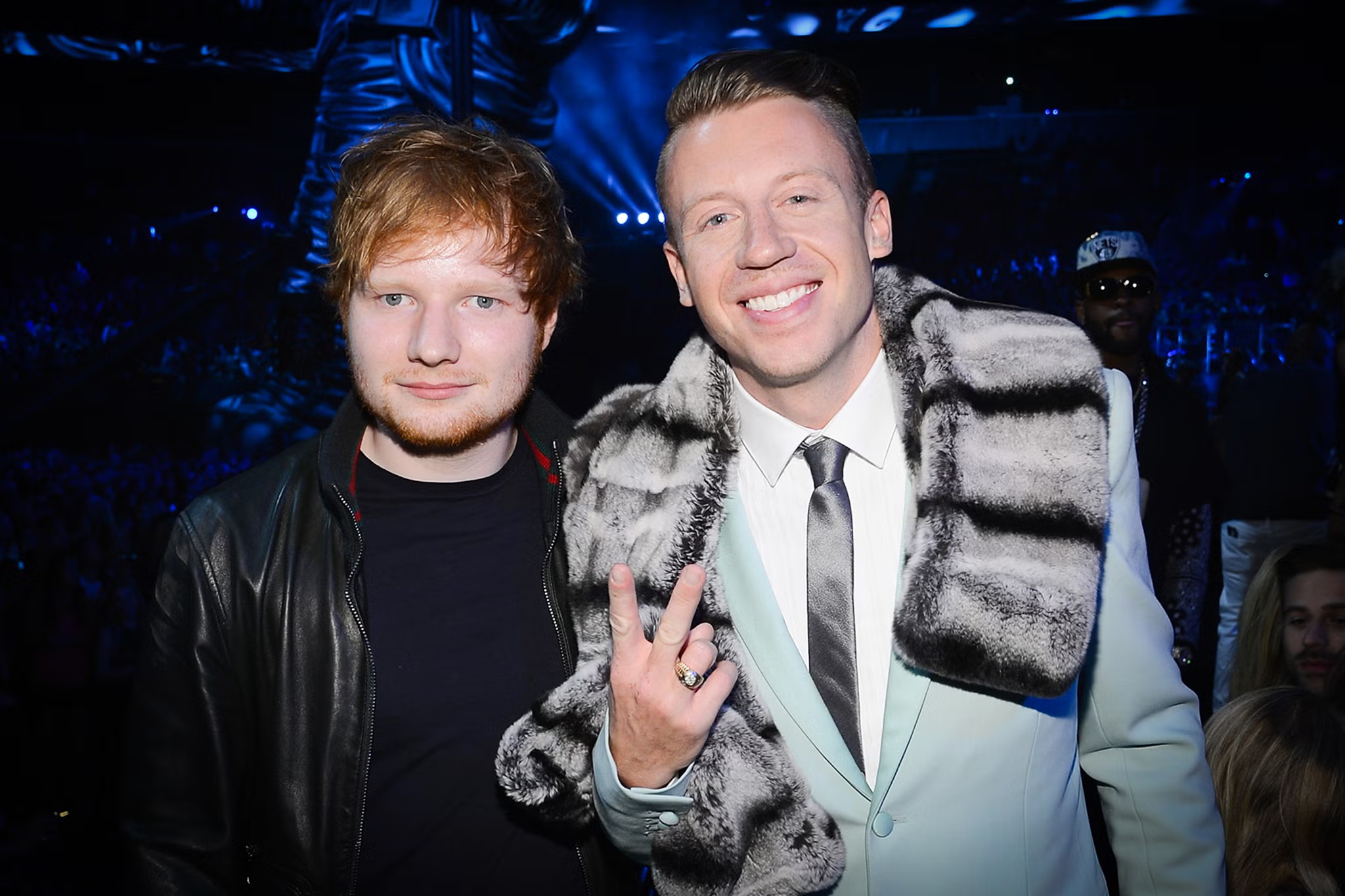
Then halfway through the North American leg Sheeran dropped his support act, the American rapper Macklemore, for saying “Free Palestine” on stage — and his story changed.
Almost overnight, he lost around half a million Instagram followers. His three remaining support acts and his band dropped out of the tour. The cheapest resale ticket for his Philadelphia concert fell from approximately $100 to $42, while the number being offered for resale rose by 54 per cent. He gained the support of Boy George, whose self-released “We Will Dance Again” is a pop defence of Israel’s military action in Palestine with the catchy opening lyrics “You say genocide, I say war.”
Sheeran cried on stage in Philadelphia while trying to clarify his position on the “complex” situation in Israel and Palestine. He blamed the promoter for making him drop Macklemore. He said Gillette Stadium owner Robert Kraft — a longtime friend of Israeli prime minister Benjamin Netanyahu — objected to the political messaging. Prices for his two Gillette Stadium dates subsequently fell before both concerts were cancelled and refunded because of severe weather.
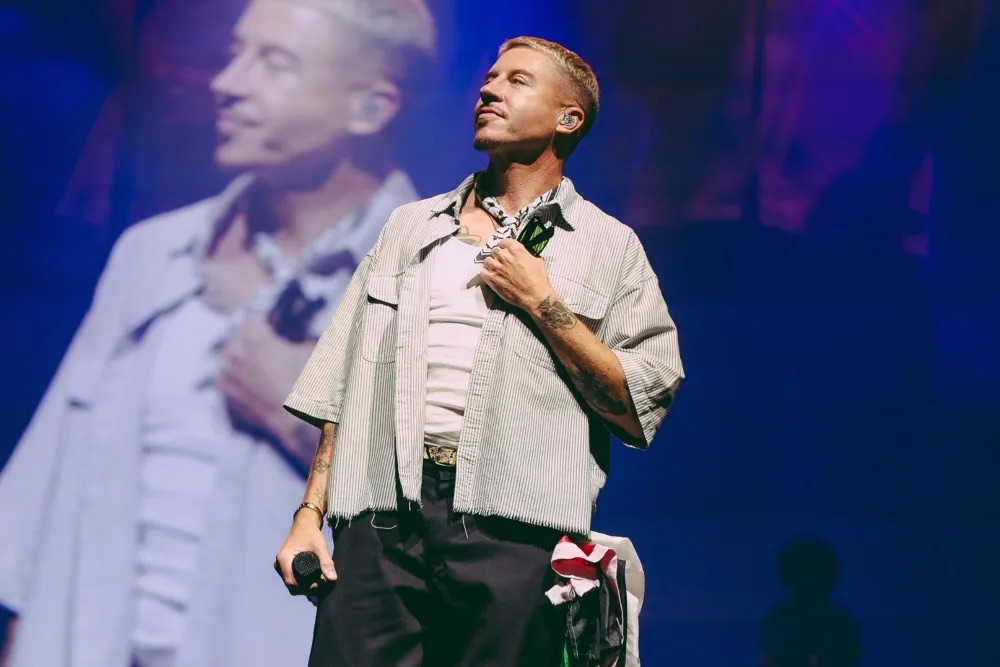
Macklemore, meanwhile, has gained more than 1.6 million Instagram followers since being dropped and US streams of his catalogue almost doubled. Daily streams of “Hind’s Hall” — that rare thing, a modern protest anthem for the Palestinian cause — rose from around 5,000 to nearly 87,000. He announced Free Palestine benefit concerts in Dublin, Paris and London, with North American dates to follow and proceeds going to organisations supporting Palestinians. They sold out immediately.
Ed Sheeran has become the cautionary tale for culture in 2026: the artist whose attempt to remain above politics made him the most political artist of them all.
After decades of pop stars carefully protecting their neutrality in the interests of mass-market appeal and the greatest possible success, there seems to be a reversal in what audiences will reward. Certainly when it comes to Palestine.
And I’m almost as staggered as Ed Sheeran.
I spent two decades editing and reporting foreign news, mostly from Palestine, for the Guardian, the Telegraph and the Sunday Times.
Since I first reported from Palestine in 2009, I’ve been furious. Not just about the humanitarian catastrophe there but at the failure — or refusal — of those who knew what was happening and had the power to change the situation — the politicians, public figures, the media — to act. The staggering lack of political will to intervene in a conflict at the heart of global strife was explained away, over and over again, as “political complexity”.
That frustration resulted in my first novel, Vulture, a satire set in Gaza in 2012 about a news media that turns global tragedy into narrative, spectacle and professional opportunity while maintaining a pose of moral distance from the horrifying events it covers.
It’s difficult to point to exactly when the shift happened. It didn’t happen on 7 October or the weeks after it, despite the horror of Hamas’s attack and the ferocity of the Israeli government’s response. Nor did it happen when the first, tenth or fifty-thousandth Palestinian was killed.
In July, Massive Attack led chants of Free Palestine on stage in Singapore and two of them were banned from the country indefinitely; Prada was slammed for appointing Saint Levant an ambassador because he wore a pendant with the outline of Palestine; Swedish singer Zara Larsson says she lost a $3 million brand deal, was pulled from awards shows and had gigs cancelled for asking: “Oh, so it’s okay to stand with Ukraine, but not with Palestine?”

“In July, Massive Attack led chants of Free Palestine on stage in Singapore and two of them were banned from the country indefinitely; Prada was slammed for appointing Saint Levant an ambassador because he wore a pendant with the outline of Palestine; Swedish singer Zara Larsson says she lost a $3 million brand deal, was pulled from awards shows and had gigs cancelled for asking: “Oh, so it’s okay to stand with Ukraine, but not with Palestine?”
- Phoebe Greenwood
But certain horrors explode the boundaries of political allegiance in the public consciousness: apartheid in South Africa, the AIDS epidemic. Refusing to acknowledge these crises doesn’t look like restraint or impartiality. It looks like accommodating the unconscionable.
Ed Sheeran seems to have marked the point at which Palestine ceased to be treated as a complex political issue and is acknowledged as a human catastrophe.
Shortly after the Macklemore fiasco, Amelia Dimoldenberg went on Saturday Night Live UK joking that a “world-famous, red-headed puppet with a hand up his arse telling him what to say”. Who else could it be but Sheeran? An earlier sketch had featured an impersonation of him singing that both sides of every conflict were equally right. Suddenly, the pretence of neutrality was ridiculous.
In the same week, Susan Sarandon and Hannah Einbinder were among more than 100 people arrested at a Jewish Voice for Peace protest against Benjamin Netanyahu’s appearance at the United Nations. Cynthia Nixon, Elliot Page, Indya Moore, Sarah Sherman, Mary Beth Barone and Caleb Hearon joined the demonstration. As pictures of Sarandon and Einbinder in handcuffs sped across the internet, Einbinder resisted the elevation of celebrity activist into hero: “Let us not mistake the spectacle for the story. Genocide is the headline.”
So has the audience delivered its verdict? Did Ed Sheeran just handle a crisis badly, or do we really want our artists to be political now?
I hope not. I don’t want culture that demands its singers, filmmakers, model/ actors formulate a position on every war, election and political crisis. We don’t want a return to the Sean Penn era: actors driving their dinghies into disaster zones in front of the world’s cameras, converting their celebrity into political authority. The United States has now twice elected a former game-show host as president. Let’s not conclude that the answer is to blur these boundaries even further.
“Sheeran was not being asked to save Gaza, devise a peace plan or transform his concerts into political rallies. A billionaire stadium owner with an unmistakable political position objected to words spoken by another performer, and Sheeran bowed to him. That’s what made the whole sorry episode so defining.”
- Phoebe Greenwood
This year’s Venice Film Festival served as an opening ceremony for a new era of political art. Jury president Maggie Gyllenhaal declared that films which honestly enter another person’s experience are “fundamentally, unavoidably political”. She located cinema’s political force in empathy. George Clooney agreed.
When asked about Gaza at the Berlin festival earlier this year, Wim Wenders said that filmmakers should “stay out of politics” and do “the work of people, not the work of politicians”, prompting Arundhati Roy to withdraw from the festival in protest. At Venice, he was rowing back hard. He had been misunderstood. Filmmakers, he said, were an “antidote” to politics because they worked through empathy rather than power.
Martin McDonagh offered a more persuasive model without making any grand declarations about the artist’s duty. His film Wild Horse Nine — a story about CIA agents on Easter Island just before the 1973 Chilean coup the US brought about — questions six decades of American intervention by putting John Malkovich on screen next to Sam Rockwell with some sharp dialogue and plenty of photogenic horses. Talking about the film he described as his ‘most political thing’, McDonagh said he liked “questioning authority” and argued that the CIA’s actions around the world had escaped the scrutiny they deserved.
That’s more to the point. He’s not presenting himself as political: the argument is in the film. And that’s nothing new — art has long stepped in to point out vile injustices media, politicians and public figures have failed to address.
During the AIDS crisis, when the US government remained indifferent and the media had stalled in euphemism, David Wojnarowicz turned his illness into furious art, essays and direct action. Keith Haring took the epidemic out of hospital wards and plastered it on billboards across New York. Gran Fury turned advertising against official neglect. They weren’t claiming greater expertise than doctors or epidemiologists. They were insisting that we acknowledge a horror no one was fixing.
As a journalist, here’s what I think: artistic talent does not confer political knowledge, moral purity or democratic legitimacy. Defending an artist’s right to speak cannot create a corresponding duty to pronounce on everything. Fame cannot become an office elected by album sales.
But Sheeran was not being asked to save Gaza, devise a peace plan or transform his concerts into political rallies. A billionaire stadium owner with an unmistakable political position objected to words spoken by another performer, and Sheeran bowed to him. That’s what made the whole sorry episode so defining.
Kraft and Macklemore represented opposing political positions, but only Macklemore’s was described as “politics”. Kraft’s position, backed by ownership and money, became a practical reality; Macklemore’s became a problem of offence and public safety. The promoter could invoke the venue, Sheeran could invoke the promoter, and everybody could deny having made the decision. An artist was punished for political speech, but somehow nobody else involved was being political.
Sheeran eventually told his thinned-out Philadelphia audience that the suffering in Gaza was “catastrophic and unjustifiable”. Well, yes. This did not require foreign-policy expertise. It required him to state what had become morally obvious — and to accept some responsibility for what happened on a tour conducted under his name.
Audiences’ moral standards seem to be shifting, but not because they suddenly want their artists working political oratory into every performance and awards speech. Many have just seen the cynicism concealed within “non-political” and it’s given them the ick. They are no longer prepared to watch money and institutional power present themselves as neutrality.
I think we can sleep without fear that Ed Sheeran has delivered us a generation of Bonos. No one wants artists to save the world or govern us — we have TV hosts for that. We don’t want film stars to formulate positions on every election, war and constitutional dispute. Any artist can — and arguably should — decline that role.
But the non-political artist — the artist who submits to power, helps silence somebody else and then calls that self-serving obedience neutrality — is dead. Few will mourn him.