

In the second essay of this style triptych, critic Emma Loffhagen looks at the fashion of one of music’s greatest enigmas: Sade, full name Helen Folasade Adu.
Fashion usually rewards reinvention. In an age when style is measured in visibility, icons are often expected to be chameleons-evolving and surprising, relentlessly shedding one skin for another. It’s interesting, then, that one of the sartorial world’s most enduring icons has done almost the exact opposite. For 40 years, Sade Adu has remained remarkably faithful to her unique visual language, recognisable in silhouette alone: the oversized blazer tailoring, slicked-back braid, and signature gold hoops.
Four decades after her eponymous band’s debut album Diamond Life (1984), Adu has managed to build a legacy based largely on absence. The 67-year-old British-Nigerian singer hasn’t released an album in more than a decade, rarely gives interviews, almost never appears in public, and has resisted the performance that modern celebrity demands. Yet her image remains ubiquitous. Her face is tattooed onto Drake’s torso, she appears on rapper André 3000’s merchandise, and she is the blueprint for a generation of online fashion creators attempting to decode the “Sade aesthetic”. One of her outfits was recently included in London’s V&A East’s inaugural exhibition, The Music is Black, which opened earlier this year. She has become a metonym for a kind of effortless elegance: the ultimate, elusive, “cool girl”.
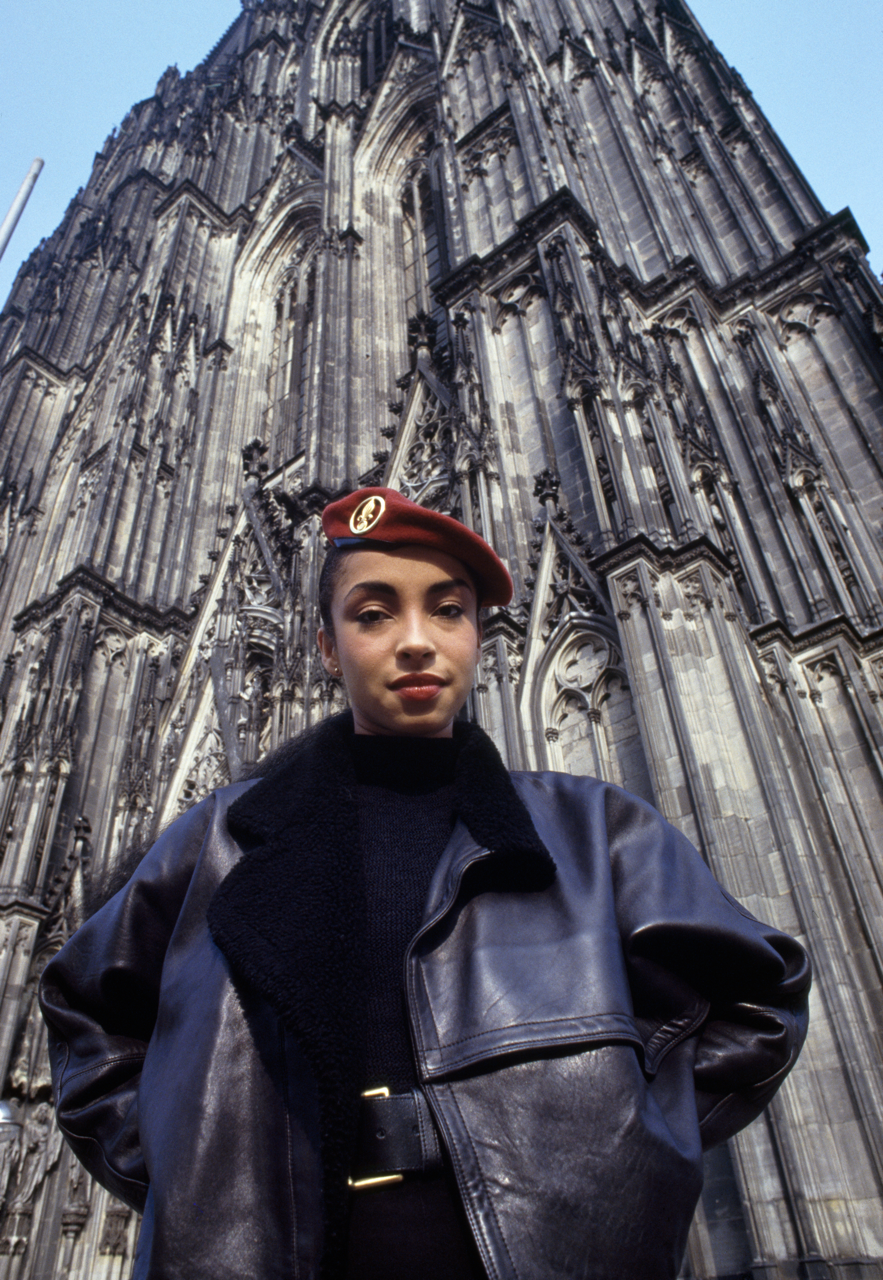
Sade Adu in front of Cologne Cathedral during a tour of West Germany in March, 1986. By Peter Jordan.
I came to Adu in a rather different way. As a mixed-race, somewhat tomboyish girl growing up in the noughties, I spent years trying to locate myself within a narrow visual vocabulary of beauty. Femininity, as it was sold to girls then, was polished, flowing, and tacitly synonymous with a whiteness I was always on the margins of. Which was why, as a 12-year-old, I found myself Googling “famous mixed-race women” one afternoon, trying to find a celebrity lookalike I could parlay for social currency at school.
And there appeared a now-iconic photo of Adu from the early 1980s, arms folded in a tie-front cropped denim shirt and jeans, hair scraped back, jewellery pared down to gold hoops, and sporting her signature red lip. Seeing her full name, Helen Folasade Adu, I realised she was British-Nigerian like me. She had the same constellation of freckles scattered across her face, a feature I’d spent years trying to conceal. She wore oversized tailoring with an ease that made androgyny look effortlessly cool. Looking at that photo, I realised there was a version of femininity I could belong to.
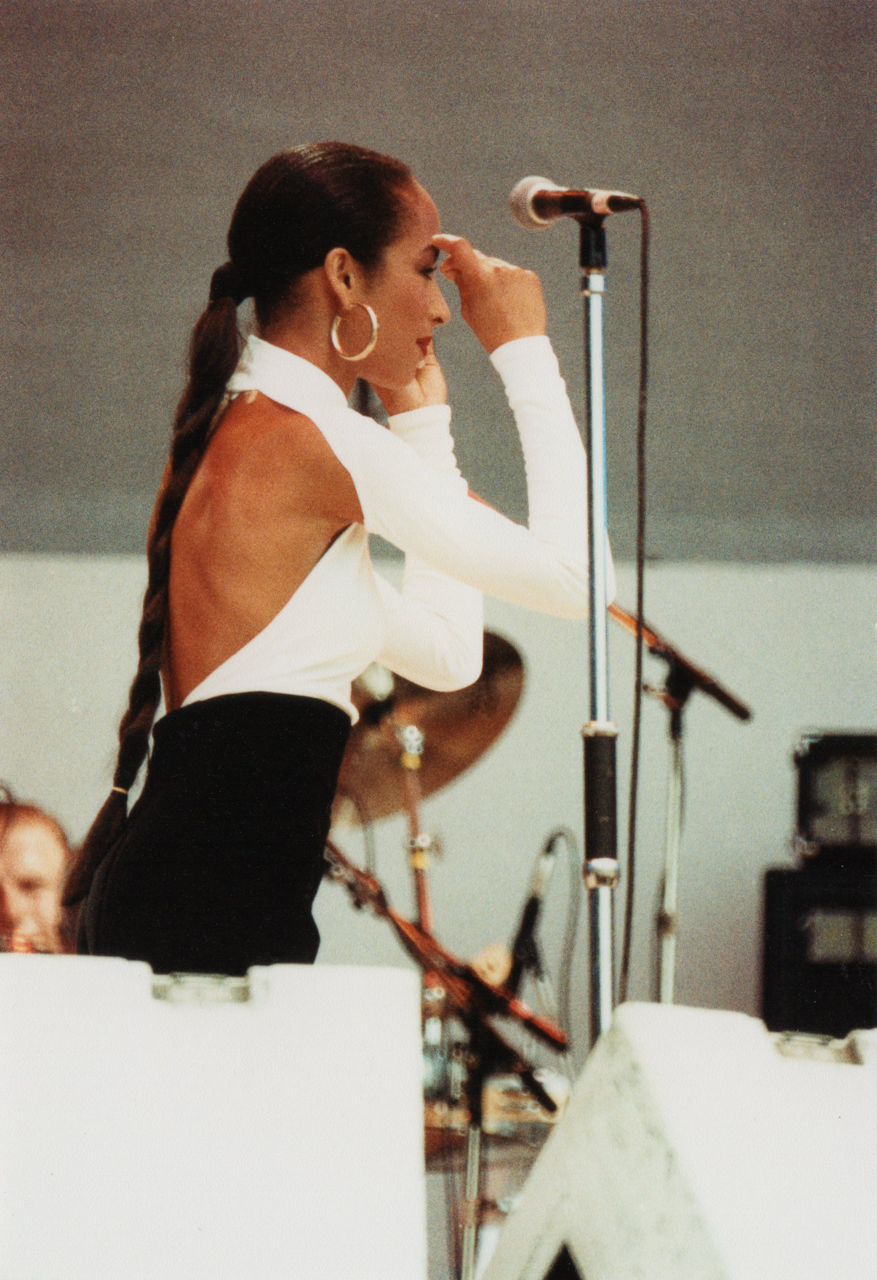
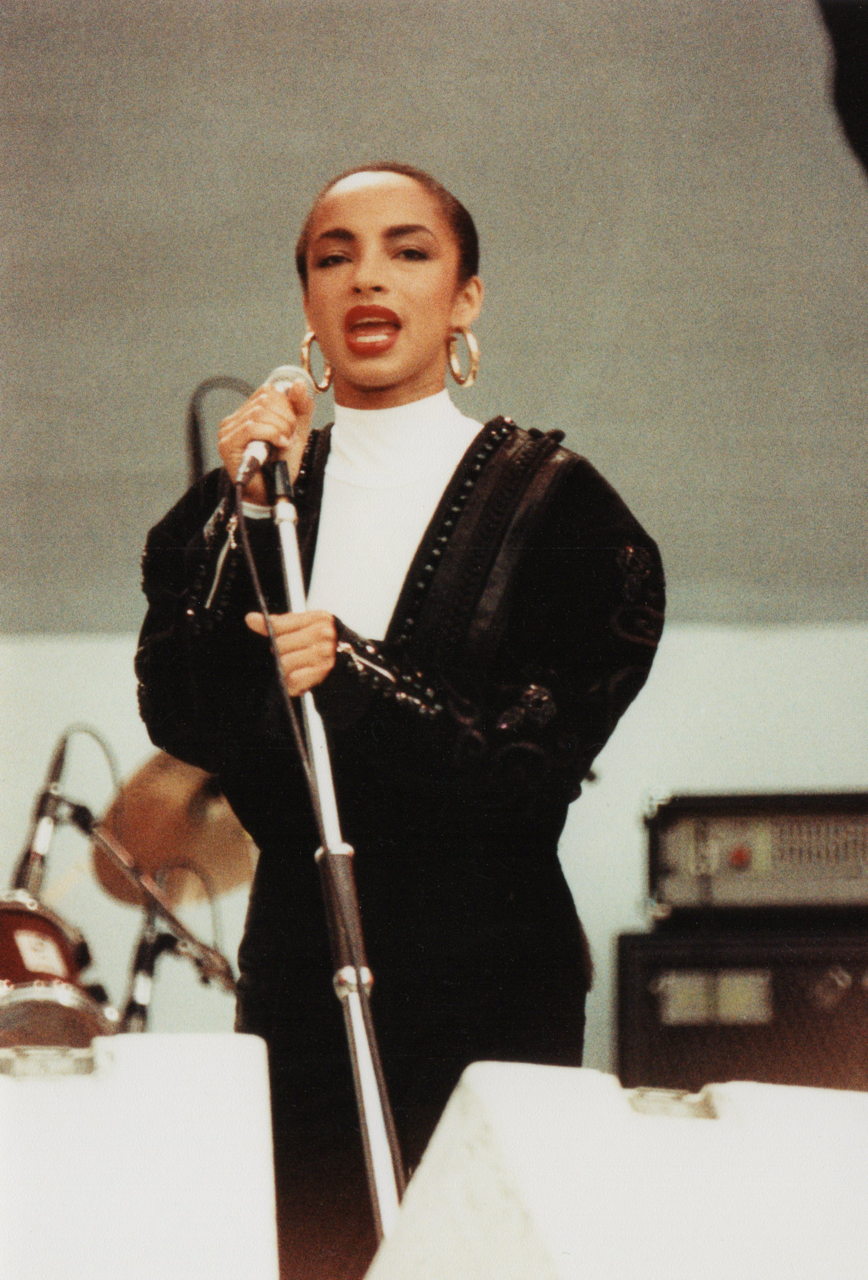
Sade Adu performing on stage at Live Aid on July 13th 1985 in Wembley Stadium, London.
That androgyny wasn’t accidental. Before music took over, Adu studied fashion at the iconic Saint Martin’s School of Art (now Central Saint Martin’s), specialising in menswear, and briefly co-founded independent fashion labels within London’s New Romantic scene. The influence remained stitched into her wardrobe during her music career—oversized blazers, crisp shirting, trousers, and sweeping trench coats became signatures. In many ways, she was ahead of her time: before oversized shorts and boxy T-shirts became the streetwear uniform of the 2020s, Adu understood instinctively that masculine and feminine could be complementary forces.
By the mid-1980s, the band Sade had become a bona fide global phenomenon. Their sophisticated blend of soul, jazz, funk, and smooth pop, anchored by Adu’s languid vocals, was unlike anything else in the charts. Her debut studio album, Diamond Life, topped charts across the world, and their sophomore record, Promise (1984), was an even greater commercial triumph, reaching number one in several countries and earning double-platinum status in the UK and quadruple-platinum certification in the US.
For the rest of the pop world, it was the era of heady maximalism-shoulder pads, leopard print, and leg warmers were embraced by contemporaries such as Tina Turner and Madonna. But Sade moved in the opposite direction. She practiced restraint, maintaining her minimalism. She once remarked, “I don’t really like the fashion industry, to be honest with you… I don’t like fashion, but l do like clothes.” It is this distinction that defined her style; one that never felt like it was in pursuit of a trend.

Adu understood instinctively that masculine and feminine could be complementary forces.
Her on-stage outfits were sometimes softened, through-a bejewelled, cropped two piece here, the elegant curve of a bare shoulder there. Nowhere was that balance more perfectly realised than during her performance of Your Love Is King (1984) at Live Aid in 1985. Midway through the song, she took off a black bolero to reveal a white backless turtleneck. Both chic and seductive, it has since become one of fashion’s most enduring images.
Now, Adu’s mythology has found fertile ground online. On social media, “Sade” has become a genre in its own right. Young women speaking into their front-facing cameras promise tutorials and checklists to decode the formula to Adu’s style. Fan accounts such as @sadeaduwife, which has amassed more than 378,000 followers on TikTok, serve as digital archives, preserving concert footage and editorial photographs for a generation too young to remember her heyday.
As I’ve grown older, I have kept Adu in the back of my mind as a kind of sartorial compass. My own wardrobe has since veered away from the overtly androgynous, but I still experiment with oversized silhouettes and menswear-inspired pieces, and I think of her whenever I do. Crucially, I no longer feel the need to perform excessive femininity in my dress as a way of proving it, to be softer to subconsciously counterbalance my blackness. On that day 14 years ago, when I found that image on Google, Adu offered me another possibility.