

For author, essayist, and one-time editor of LA Weekly Joe Donnelly, moving to California was a chance at starting all over again. But to truly become Californian meant conquering the waves, returning time and again to the blue surf.
It’s the middle of January. In a week, the calendar will indicate another trip around the sun for me. That number won’t lie. It will remind me that the arc of my vessel reached terminal velocity some years back and is currently descending to whence it came at breakneck speed. But that number isn’t the important one now. Another set of numbers has superseded it—all of them lucky. That is to say, the wind is onshore at two knots, working like a spatula on the shoulder-high waves. The tide is halfway through its retreat from a six-foot high to a -0.8 low. The air temperature is around 70 degrees at 11:30 a.m., on the way to 80. The water is steady at 60 degrees so my 3/2 mm wetsuit is more than enough for a 62-year-old whose tolerance for cold is decreasing as his age increases. I’m at Bolsa Chica State Beach, just north of self-proclaimed surf city Huntington Beach, California. I’ve never surfed the HB Cliffs or the pier and I don’t plan to. There’s only so much proximity to Huntington Beach this erstwhile Los Angeles man can handle.
Bolsa Chica might be the extent of it. I paddle out at Lifeguard Tower 17, a little north of the jetty, where I usually go because the waves form better there. Today, the waves are breaking a little further from shore than usual. This is good on a receding tide, promising longer rides if you can string some sections together. But it’s not good for my shoulder burn. I’m out of practice and out of surfing shape. Not that I was ever good; I started too late for that. But they say there’s no zealot like a convert, and I was pretty stoked once.
In fact, despite mostly living inland during my Los Angeles days—everywhere from Hollywood to Echo Park—there were years during which I managed to surf two or three times a week. Los Angeles was different then. I know they all say that, but it was. It didn’t cost as much and you could stroll into work at 11a.m. smelling of salt water and sunscreen so long as you got your work done. Which I did.
I mostly surfed at El Porto back then, just north of Manhattan Beach in the South Bay. That’s where I learned. For reasons I can no longer remember, I was taught by Davey Latter, then the erstwhile drummer for the near-great Stanford Prison Experiment and soon-to-be drummer for bands such as Great Northern and Everest at the forefront of the early 2000s Silver Lake rock revival.
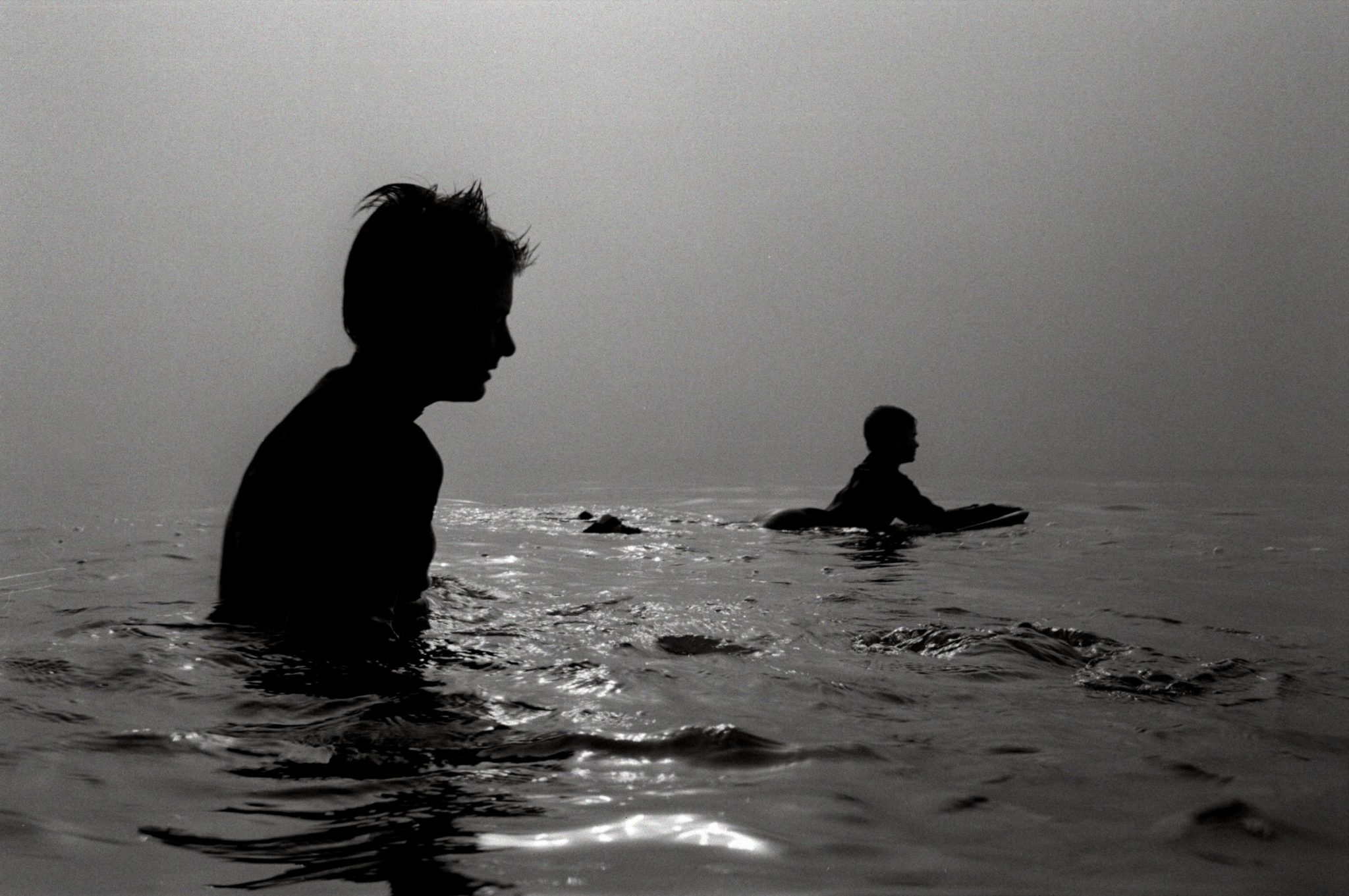
Surfers Andrew Nahin and Justin Eakin in the water, Los Angeles. By Al Schaben.
Davey was from nearby Hermosa Beach. Hermosa and the South Bay were once a spawning ground for punk rockers (Black Flag, The Descendents, Circle Jerks) and semi-pro surfers (Mike Purpus, Chris Wells, Tyler Hatzikian) before capitalism turned it into a bro shitshow. Mostly tech millionaires and professional hockey players live there now.
Some South Orange County snobs like to call El Port “El Crapo”, even though it lines up a lot like Newport’s more-acclaimed upper jetties: the so-called “hottest hundred yards” in surfing. To be fair, though, even El Porto regulars have a love-hate relationship with the break. Mostly, they love that it reliably picks up swell from all directions, making it the spot you go to when there’s nowhere better to go. If you reside north of San Clemente, that’s most of the time. What El Porto provides in consistency, though, it often lacks in shape. It’s a punchy beach break with narrow shoulders and quick closeouts. It’ll give you more bang for your buck when the swell is modest and it’ll sort the kooks from the core lords when it’s pumping. That’s why they say if you can make it there, you can make it anywhere. Indeed, Greg Noll and Mike Parsons cut their teeth at El Porto before going on to conquer the world’s biggest waves.
Once, I almost didn’t make it there. I was in the tail end of my mid-30s, and still just starting to surf regularly after a couple of previously aborted attempts to insinuate myself into the SoCal surfing milieu. This would be my latest and possibly last attempt to cop some kind of subcultural identification, a casting about of the sort with which I’m sure other sensitive former jocks are familiar. I’d already had dilettantish detours as a jaded Manhattanite, hardboiled journalist, and semi-influential Los Angeles hipster man of letters.
Anyway, it was the winter, a day not unlike this one, only the surf was twice as big and a lot heavier. I was naïve then. I didn’t know much and I especially didn’t know enough to not paddle into head high+ surf on a used, bright yellow, 9’ 2” McTavish that we called “the banana”—a stick more suited in these conditions for an expert longboarder such as Hatzikian than a then-37-year-old kook who thought the normal rules didn’t apply because he played Division One soccer in college. They did.
I can’t remember how, but I soon got stuck in the impact zone, which was too far from the beach for comfort. A multiple-wave set rolled in and I took a heavy on the head, losing my handgrip on my leash in the process. The next wave to explode in the zone snapped my leash and took my board with it, shooting the unmistakable yellow log down the line on a thick right. The friend I had gone out with that day said he saw the board speeding toward Hermosa, squarely in the pocket, and was duly impressed. Until he realised I wasn’t on it.
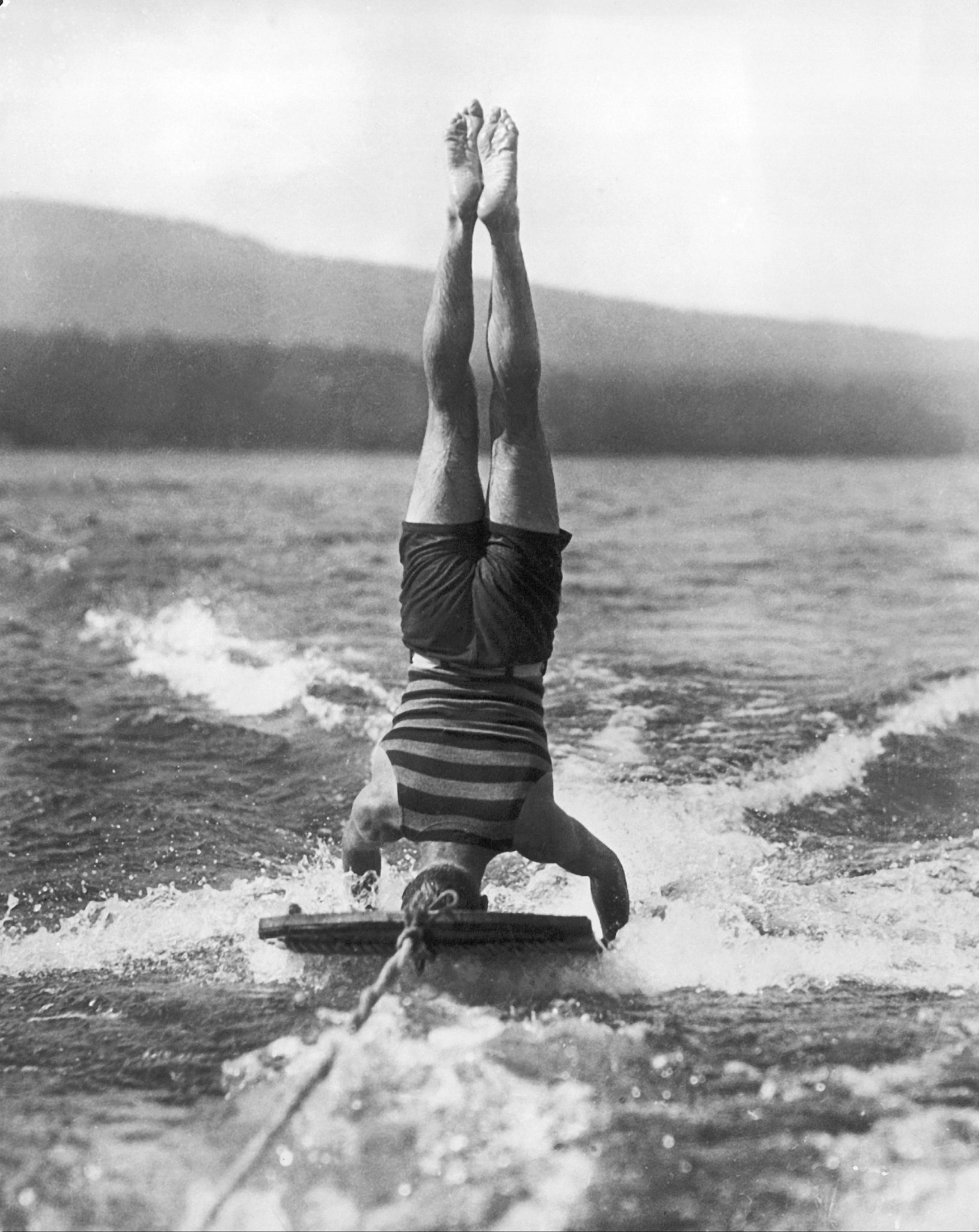
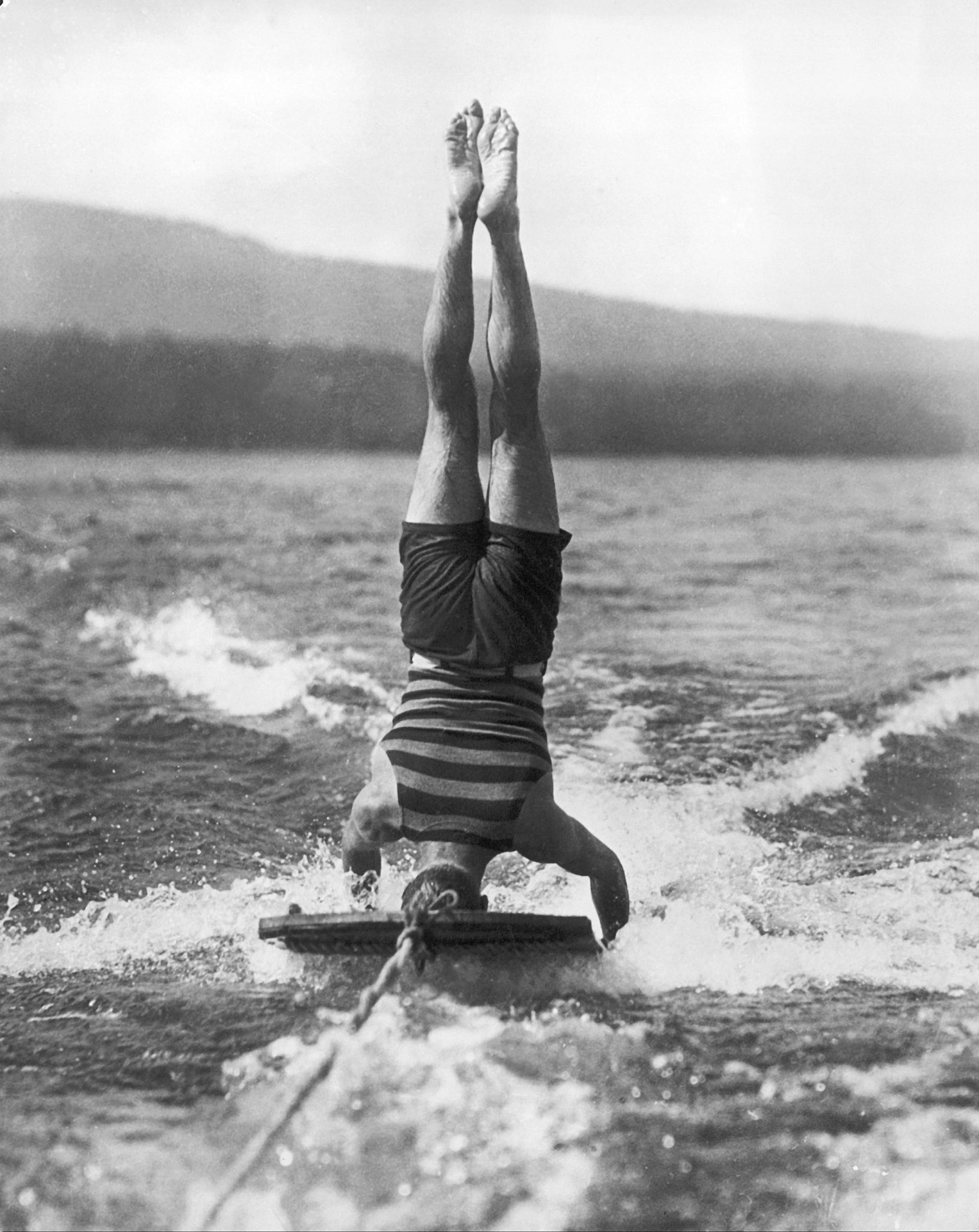
Aquaplaning in Lake Tahoe, California.
I was getting tossed around in the spin cycle like a penny that had fallen out of a pocket. When I came up for air, another wave sent me tumbling again. It’s hard to describe how quickly you get exhausted in those circumstances if you’re not used to them. The key, which I didn’t then know, is to surrender and let the waves push you toward the beach.
I thought I was going to drown. So I fought. It was a two-front war: one with the pummelling set and the other with trying not to look like the kook I was. So, despite the urgency of my situation, I did my best to mask my distress. I didn’t wave for a lifeguard or yell for help. Instead, I tried to backpaddle toward the beach. A really bad idea that revealed my dire straits to anyone paying attention.
Angels do exist.
I’ll never forget the guy who appeared out of nowhere with a bevy of bouncers that time when three drunk Marines in an alley outside a Santa Monica bar were getting ready to play whack-a-mole with my head. And I’ll never forget the girl, somewhere between the age of 16 and 18, on a shortboard (the right choice), who must have noticed the look of terror in my eyes as I flailed on my back despite my attempts to appear calm.
“Do you need help?” she asked, hurriedly paddling over to me.
“I think so,” I said. She let me use her board like a lifebuoy and we traded on and off till we reached the beach, where I collapsed in a heap. I saw the banana stranded on the sand a couple hundred yards away. It was unscathed.
“You should be more careful,” she said.
“You’re right,” I replied.
She headed back into the maw of the pumping winter surf before I could say anything more. As my friend and I gathered to leave, me shaken and stirred, I promised myself that if I ever saw her again, I would repay her.
It was maybe a year later when I ran into her in the parking lot. She was with a handsome young man. I asked if she remembered me. “Of course,” she said. “Are you being more careful out there?” It was a gentle way of asking if I was less of a kook.
“I am,” I said.
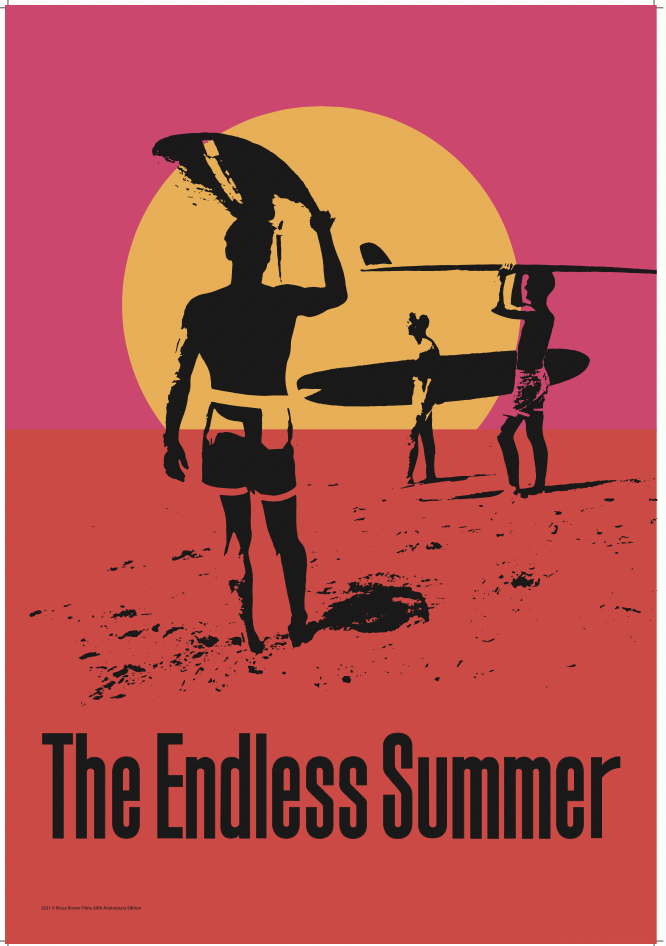
60th Anniversary Edition Poster for Bruce Brown’s 1966 film The Endless Summer
I’d also gotten better. I’d been surfing consistently and had traded in my banana boat for an eight-foot Roberts funboard, a good board for someone clawing their way from kook to semi-competent. I had $40 bucks in my wallet and I gave it to her. “Take your guy out to dinner,” I suggested. You could do that on $40 back then. She smiled and said she would.
She must be nearly 40 now. I wonder how her life turned out. I hope well. Aside from the panoptic travesties of the current American situation, I have to say that mine has been pretty good. I’m not rich and my house is small, my car is old, and my wages are modest, but my cup is full of blessings.
Which is what I’m thinking on this day when I turn my back on the ocean for a minute (betraying my former saviour’s warnings to be careful) to take stock. The beach, glimmering in the high sun, is 150 yards away. Past that is Highway 1, the iconic Pacific Coastal Highway that can deliver me to Seal Beach in 10 minutes or to Eureka in 10 hours. Either one would be fine—both ribboned, as I am now, by mountain and sea.
I catch some waves. Get a few decent rides, handling the rights a little better than the lefts, but not too bad. I’m not really a surfer. I don’t go enough and I’m not good enough. But here, too, I’ve been lucky. I’ve surfed Miramar in Santa Barbara on the rare days when it’s firing; a wave of euphoric memory. I even caught one at hallowed Hollister Ranch in the generous and slightly inebriated company of “Wingnut” Weaver and Dana Brown. Further up the coast, I dodged a great white shark in Cayucos and broke break with the Malloys. I had three glorious weeks alone in Costa Rica. Surfing has given me a lot.
It’s also taken some—pieces of my body sliced away by the dermatologist, infections that pinned me to the bed in fever sweats while I shat myself, concussions, stingray barbs. I don’t think it helped my first marriage. Over the years, though, even now when the waves have become harder and harder to get to, surfing remains what my body and soul long for; what I really want to do. My surfing dreams are modest—to not be the worst one in the lineup. Today, on this blue-sky, offshore, three-to-four-foot day, I wasn’t. Not even close. It’s been a long journey to get here, one that began years ago and miles away in colder, darker places. But that’s another story. For this one, let’s just say I know my end is much closer than my beginning and, as I approach it, I keep this thought in mind. Malibu in 1964, the year I entered this dimension, surely still exists in some other. Maybe in my next life I’ll be recycled there and get to be a real Californian, not just a Johnny-come-lately. Consider this my early application. Until then, it’s enough to not be the worst surfer in the lineup, waiting for a wave, looking at Mount Baldy, absorbing the sun and the salt.
The ocean, pregnant with possibilities, swells beneath me. It says, “Welcome home”.

Footnote
Bruce Brown’s 1966 film The Endless Summer launched the Southern California surf culture into a global phenomenon. In conjunction with the film, John Van Hamersveld (JVH) de-signed a poster that has become one of the most recognisable images from that era. Bruce Brown Films collaborated with JVH to produce a limited edition release of the poster to celebrate the 50th Year-Anniversary of the film and the iconic art. They worked in tandem with Pr1mary Color to authentically recreate the poster.