

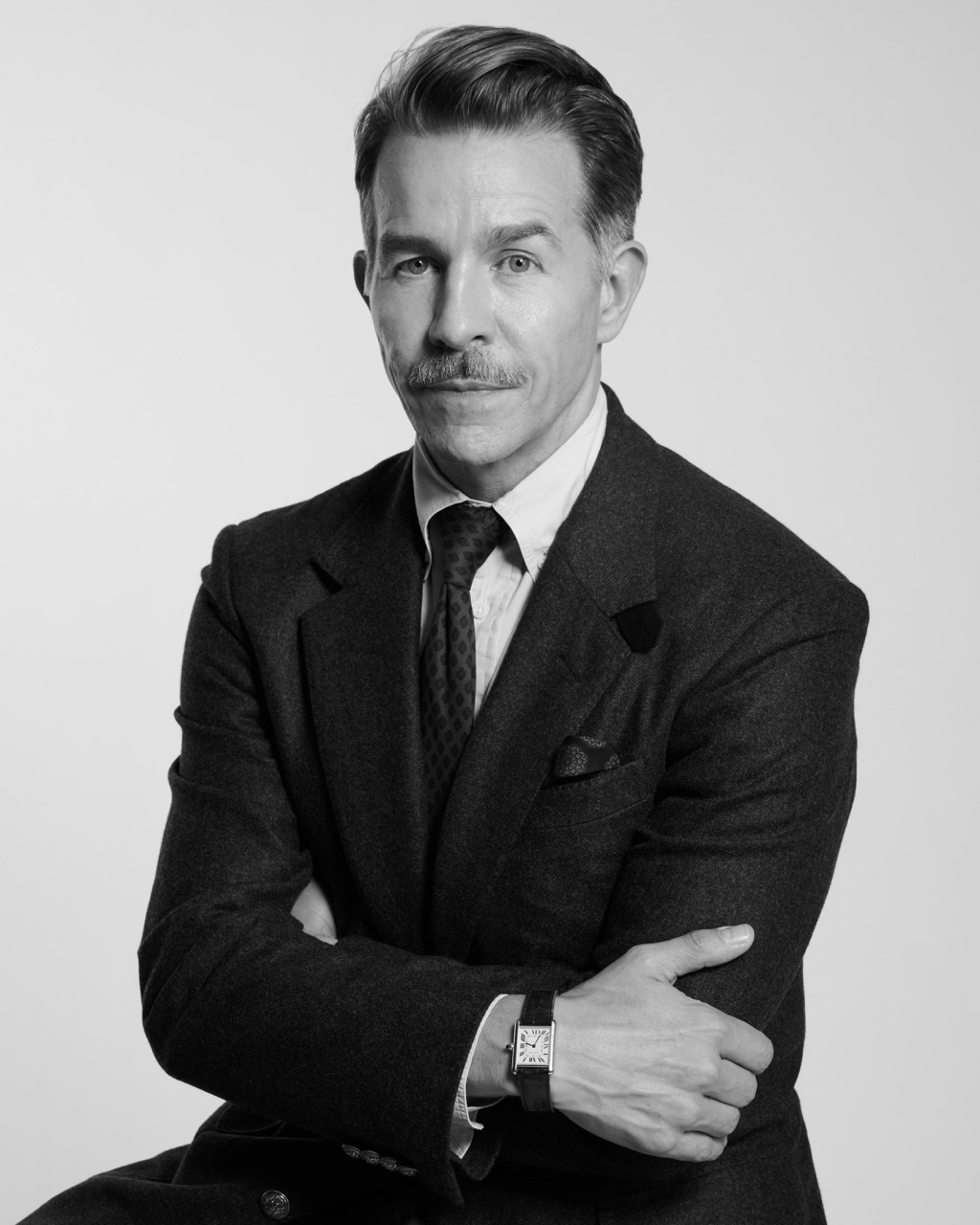
Simon Holloway is redefining British menswear at Dunhill, bringing Bond-worthy elegance, impeccable tailoring and timeless sophistication back into focus. Below, he talks to Deputy Editor Chris Cotonou about British style, craftsmanship and the art of dressing well.
If they haven’t already, the studios should ask Simon Holloway to dress James Bond. Meet him and you’d wonder whether he might play the part himself: the creative director of Alfred Dunhill is British refinement in a well-cut suit. His clothes would suit the younger, no doubt sleeker, special agent that Robert Pattinson is set to play.
Dunhill has been a British institution for more than 130 years. Its founder, Alfred Dunhill, designed the driving coat, among other inventions, and employed Savile Row cutters to make pieces with a relaxed drape built for ease of movement. Holloway joined in 2023. “It felt like a homecoming,” he tells me when we meet.
Born in Newcastle, he began his career in Paris, then moved to New York and on to Italy, at some of the world’s great fashion houses. Each stint produced some of their most creative phases, driven by an obsession with the finest fabrics and a philosophy he calls “Invisible Innovation”: the subtle, overlooked details that elevate a garment. I found them on every piece I looked over at Dunhill’s showroom last week.
At Dunhill, his references range from the archives to Lord Snowdon to Bond himself, above all Roger Moore, the best dressed of them if you ask me. He is now among the nominees for British Menswear Designer of the Year. If he wins, it’s also a victory for British craftsmanship.
What I love about Holloway is that he describes his work in almost Wordsworthian terms. We talk about fabrics from the north of England, and he describes the colours of the hills and woods, the influence of nature, giving each garment as much British romanticism as handcrafted savoir-faire. He is also resolute, which is refreshing in an era when fashion seems ever more rule-breaking and shouty, especially on the red carpet.
His Dunhill is about quietening down. It is about “making movie stars look like movie stars again”, and about returning to what matters when you put on the clothes, particularly the navy blazer, the hallmark of his collections, as you’ll read below.
Chris Cotonou: You’ve been nominated for British Menswear Designer of the Year. What does British menswear mean to you now, in 2026? Dunhill has a particularly strong British identity. How do you balance reinventing that identity with drawing strength from its traditions?
Simon Holloway: When I started at Dunhill, I felt we needed to lean into our British identity: the codes of the English wardrobe, the vernacular of English cloth, the knitwear of the British Isles, tailoring and outerwear. These are foundational elements of the modern male wardrobe.
Dunhill was born on Conduit Street, at the end of Savile Row, as a sport tailor for the newly invented sport of driving. From the outset, it wasn’t a traditional Savile Row tailor. It had a modernity built around a lifestyle, which separated it from the idea of the suit as the whole story.
Each collection references Alfred Dunhill’s beginnings in the 1890s, the Art Deco period and, later, the more refined tailoring of the 1980s, when the brand became known as a destination for blazers and tuxedos. That identity is powerful. Dunhill was never simply about Savile Row tradition, but it shouldn’t become about fashion for fashion’s sake either. It is a maison of style, with excellent tailoring skills and a commitment to finding the very best materials. We work with mills in Biella and with great heritage mills in England and Scotland.
Chris Cotonou: How has Dunhill evolved under your direction, as you’ve learned more about the archives and the brand?
Simon Holloway: The intention was for each collection to reflect that arc of history: from the 1890s, through the Art Deco era of the 1920s and ’30s, to the refinement of late-century tailoring. The idea was to bore people with consistency and delight them with newness each season.
What has changed is that we’ve gone deeper into the psyche of the British man and the archetypes that represent him. For spring, we often refer to the British social season and its very coded way of dressing. Autumn and winter bring a different, more relaxed kind of social dressing. We might build a collection around the blue blazer: what it means, and how it can be exaggerated.
I want things to feel like the heightened expression of reality, taken into a cinematic place. We might look to Lucian Freud and the way he tied a silk scarf, Roger Moore in a turtleneck and military-feeling blazer, or the wardrobes of Prince and King Charles. We tease out those codes through the styling, the shirt or the turtleneck, and find ways to reinvent a navy blazer so it feels relevant and new, but also entirely expected. Dunhill should deliver what people want, then over-deliver on quality, colour nuance and styling.
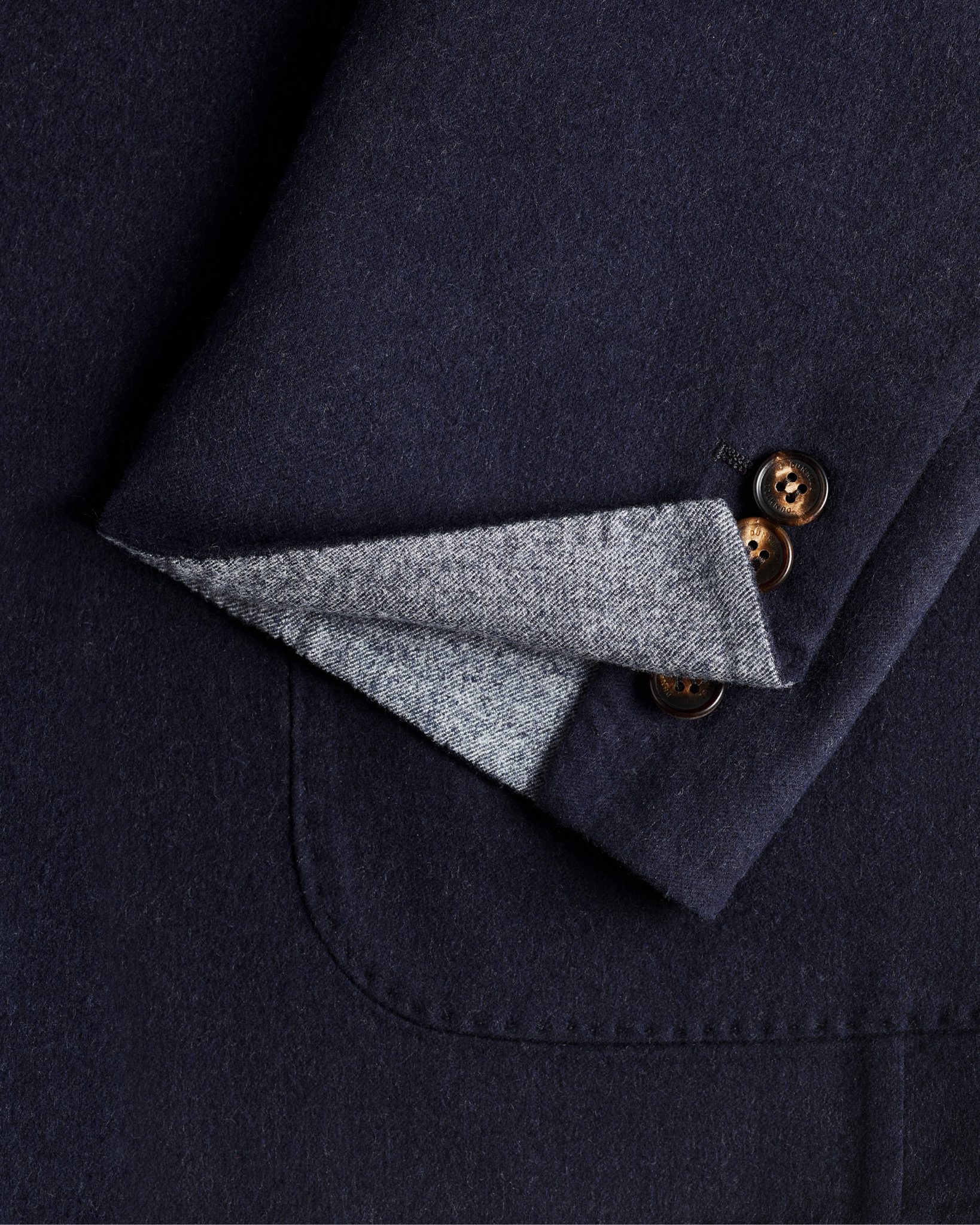
“I want things to feel like the heightened expression of reality, taken into a cinematic place. We might look to Lucian Freud and the way he tied a silk scarf, Roger Moore in a turtleneck and military-feeling blazer, or the wardrobes of Prince and King Charles.”
- Simon Holloway
Chris Cotonou: The collection felt more elevated, especially in its textures and the cut of the trousers and blazers. What are the non-negotiable elements of a Dunhill blazer?
Simon Holloway: It starts with the shoulder and the construction. I wanted a very English shoulder, represented by a block we call the “board and block.” There’s a hint of rope and construction, creating an architectural stance. The shoulder is slightly wider, with an easy fit through the waist and hip.
Because of Dunhill’s origins as a sport tailor, the jacket isn’t built up with a very heavy canvas. The canvas drapes against the shoulder and body, creating a soft, rolling lapel. The construction is reduced and the canvas is lightweight, but the silhouette still reads as English.
Then we pair that construction with lighter fabrics. We work hard with the mills to redevelop traditional English fabrics at half their original weight without losing their texture, pattern, identity or depth. When you bring together a lighter English cloth and lighter construction through the shoulder and chest, you get something that feels like a new product. Ideally, you put it on and barely notice it.
Chris Cotonou: Do the English mills enjoy the challenge of making these fabrics, or is that something you’d have to ask them?
Simon Holloway: You’d have to ask them. They always deliver for us, so whether they enjoy it is another question. They know how to rise to the challenge and use their savoir-faire: understanding colour and twisting different yarns together to create nuances that feel English.
There’s a vocabulary in English fabric that differs from Italian fabric. I work with Italian mills too, particularly for summer linens and blends. We tend to go to the English mills for pure camel hair, worsted cashmere and beautiful Escorial wool. But they can also make a beautiful tropical wool—perhaps a Super 160s blend with a touch of cashmere—that feels incredible, doesn’t wrinkle much and travels well.
There’s a misconception that English mills only make heavy fabrics. They can do much more, and their understanding of colour is second to none.
Chris Cotonou: You’ve worked with Italian houses. Does Dunhill feel like a greater expression of your own taste?
Simon Holloway: I think James Baldwin said, “You can never go home.” I did come home, in a way. I worked in Paris, Los Angeles, New York and Milan. When I came back to London about 15 years ago, I found a way to appreciate what was good about Englishness, British taste, English style and English fabrics—perhaps in a way I couldn’t have if I’d never left.
Being in London, in Mayfair, and going past Hyde Park each day is inspiring. There’s the English sky, the shifting weather, the parks and the countryside. Take a train to Somerset or Yorkshire and you find mills weaving the colours of England and Scotland. That feels like a singular difference between us and maisons elsewhere: English colours and fabrics have a muddier, gloriously richer quality. I hope we celebrate that in every piece and collection.
“When I came back to London about 15 years ago, I found a way to appreciate what was good about Englishness, British taste, English style and English fabrics—perhaps in a way I couldn’t have if I’d never left.”
- Simon Holloway
Chris Cotonou: You’ve described a philosophy of “invisible innovation.” What does that mean, and where do those ideas come from?
Simon Holloway: It’s an approach, or a practice, rather than a single detail. Lightweight tailoring construction and lighter fabrication are examples. A blazer may look classic, but when you touch it, you feel something different. You put it on and want to forget about it. That’s invisible innovation.
There are more technical examples. We make shoes in Northampton, and some loafers have no cut across the heel. They’re moulded by hand; an artisan spends hours shaping leather around a last so there’s no seam at the back. You might not notice it unless you’re looking, but it’s there.
We also make hybrid shoes in Italy, like lightweight summer loafers with flexible soles and an injected rubber panel to stop you slipping. Again, you don’t see it when you’re wearing them.
Our archive includes leather driving jackets and car coats lined with tweed or camel hair. We work with a factory that can make double-faced leather and fabric: French lambskin bonded to camel hair woven in Yorkshire. The edges are split and finished invisibly; some seams are laser-cut and bonded so the join is barely visible. Those are technical details that you could miss in a glance.
Chris Cotonou: Where do the standards behind that work come from? You seem obsessive—in the best possible way.
Simon Holloway: Partly from the house’s heritage. Alfred Dunhill was an obsessive inventor, and there’s an ethos I borrow from him. There’s a quote of his that ends, “It must be the best of its kind.” I’d add that it must also be beautiful.
I take that ethos seriously. Dunhill has an atelier of Savile Row-trained tailors at Borden House, making handmade bespoke suits. I wanted our ready-to-wear and made-to-measure tailoring to be aligned with that pinnacle of bespoke work, while still having a concept that’s distinctly of the maison.
Dunhill’s history is about finding the best artisan for the job. For knitwear, we go to the finest fine-gauge knitter in Italy or the best cashmere handler in Scotland. For worsted cashmere, we might go to a mill in the north of England; for high-twist linen, Biella. We look for the best material, then the best hands to express it.
There’s always a quest for improvement. I don’t throw away ideas; I return to them and try to make them better. Can a beautiful canvas linen be lighter next summer? Can the quilting inside a coat be lighter but just as warm? Can we find another way to reinvent a navy blazer? That process is constant. We start researching fabrics early: while one season is still to be shown, we may already be developing fabrics for a collection several seasons ahead.
Chris Cotonou: Is the blazer always at the forefront of your mind?
Simon Holloway: I grew up wearing a navy blazer as a school uniform, so it’s hardwired into me. If I open my wardrobe, the middle section is full of too many navy blazers: wool, flannel, mohair, brushed cashmere, worsted cashmere, jersey and double-face.
Dunhill had a golden age of tailoring in the 1980s, ’90s and early 2000s, when the stores had racks of amazing blazers. I feel at home with that. When we’re working on a future collection, the question is how to make an already exceptional blazer more exceptional.
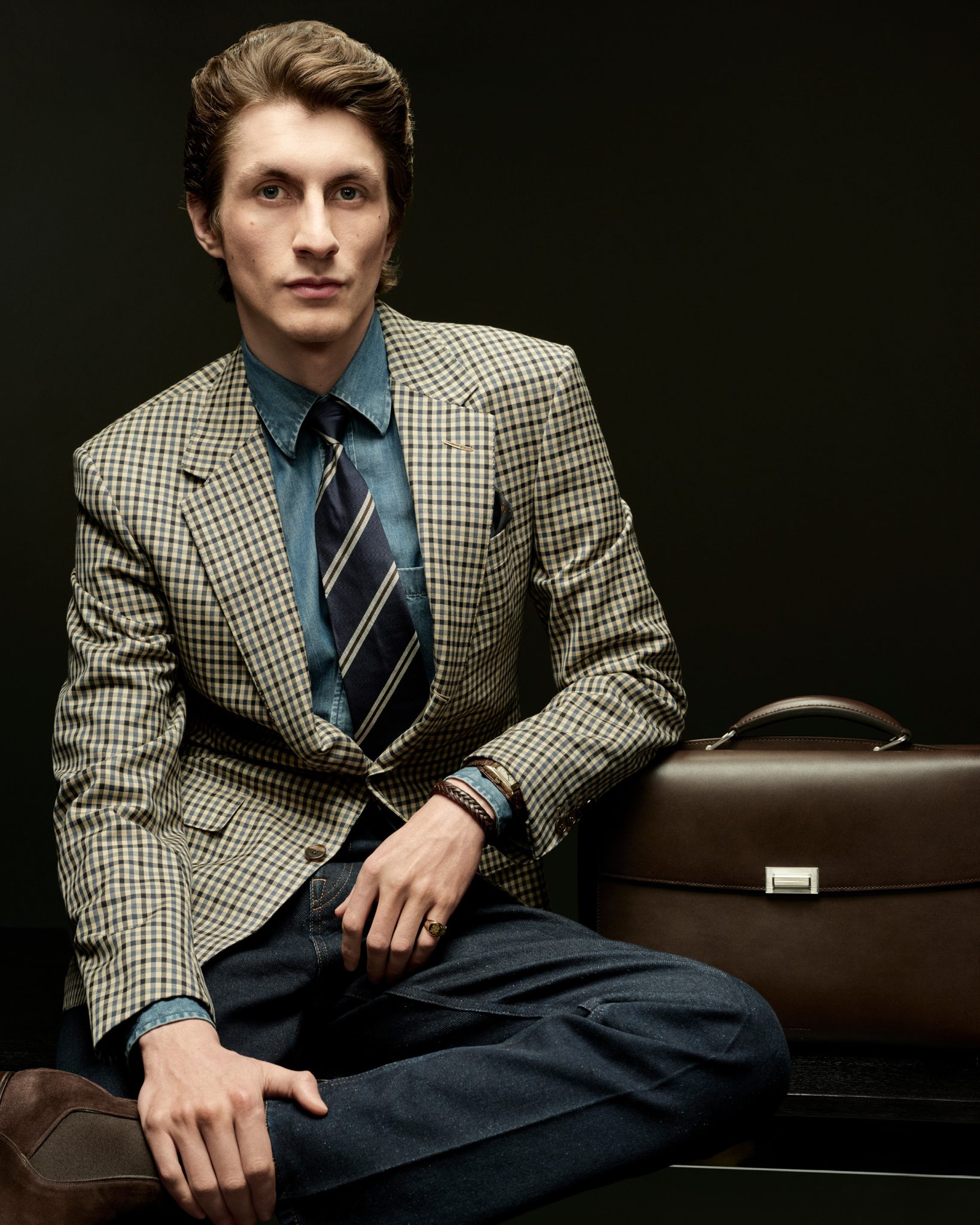
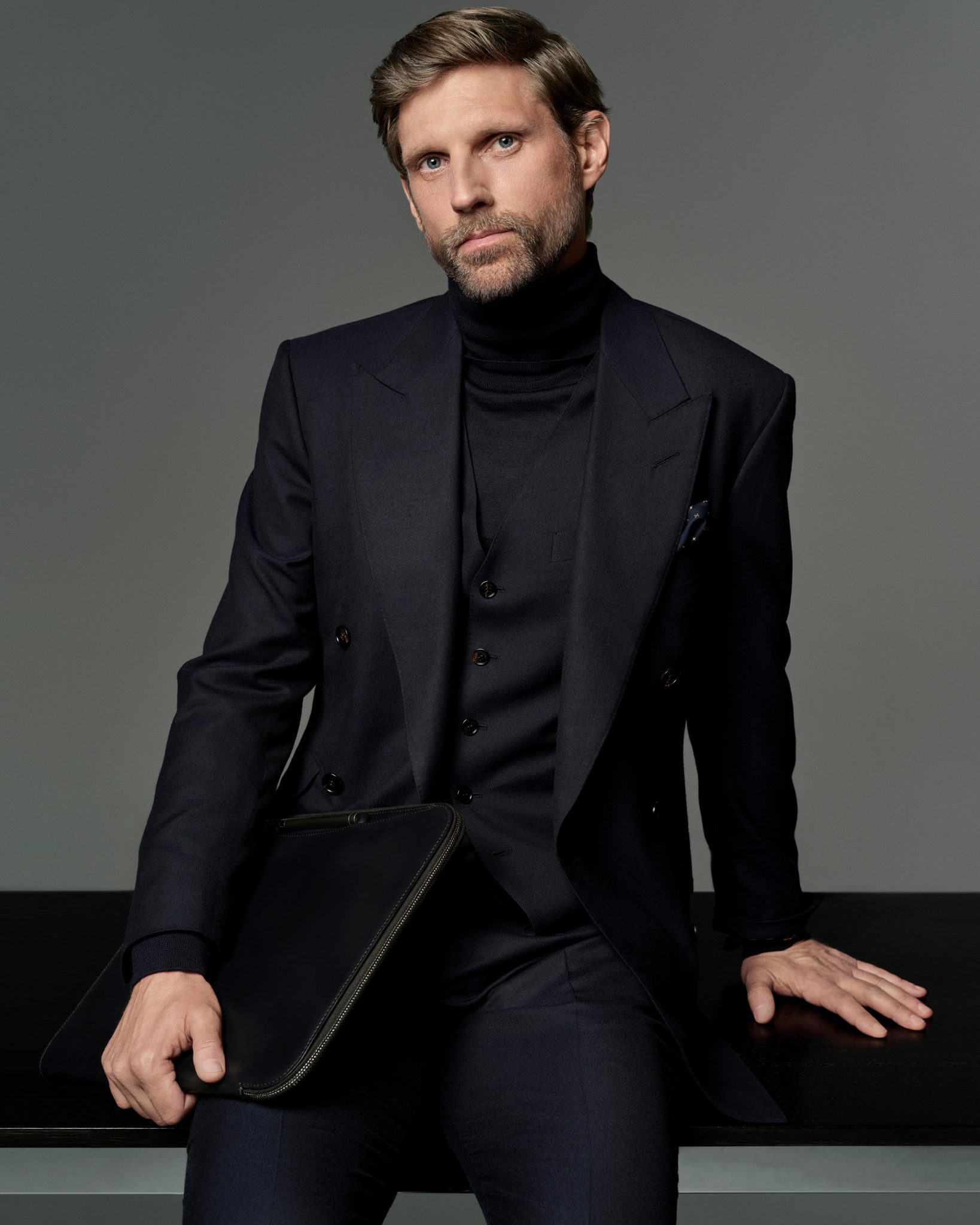
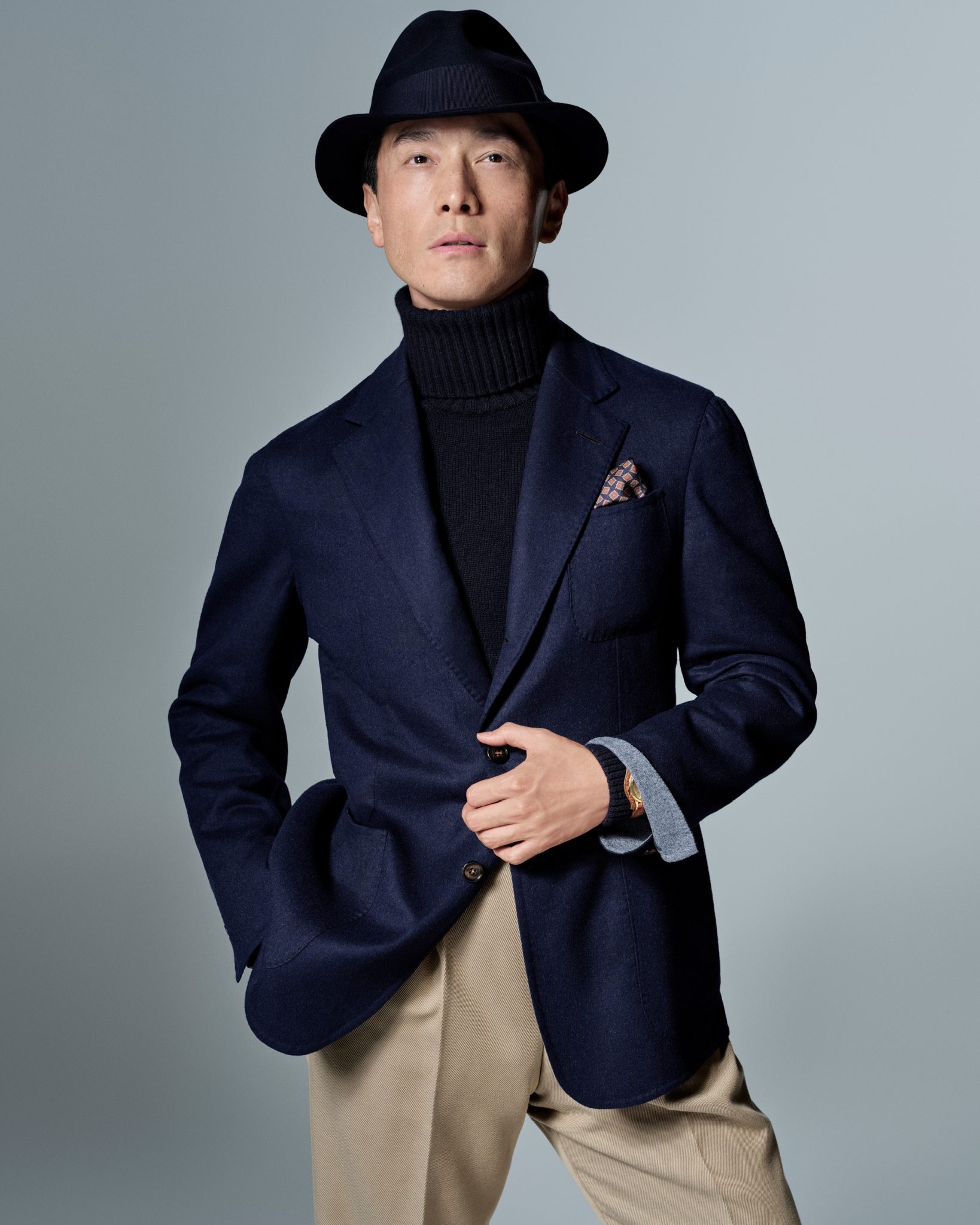
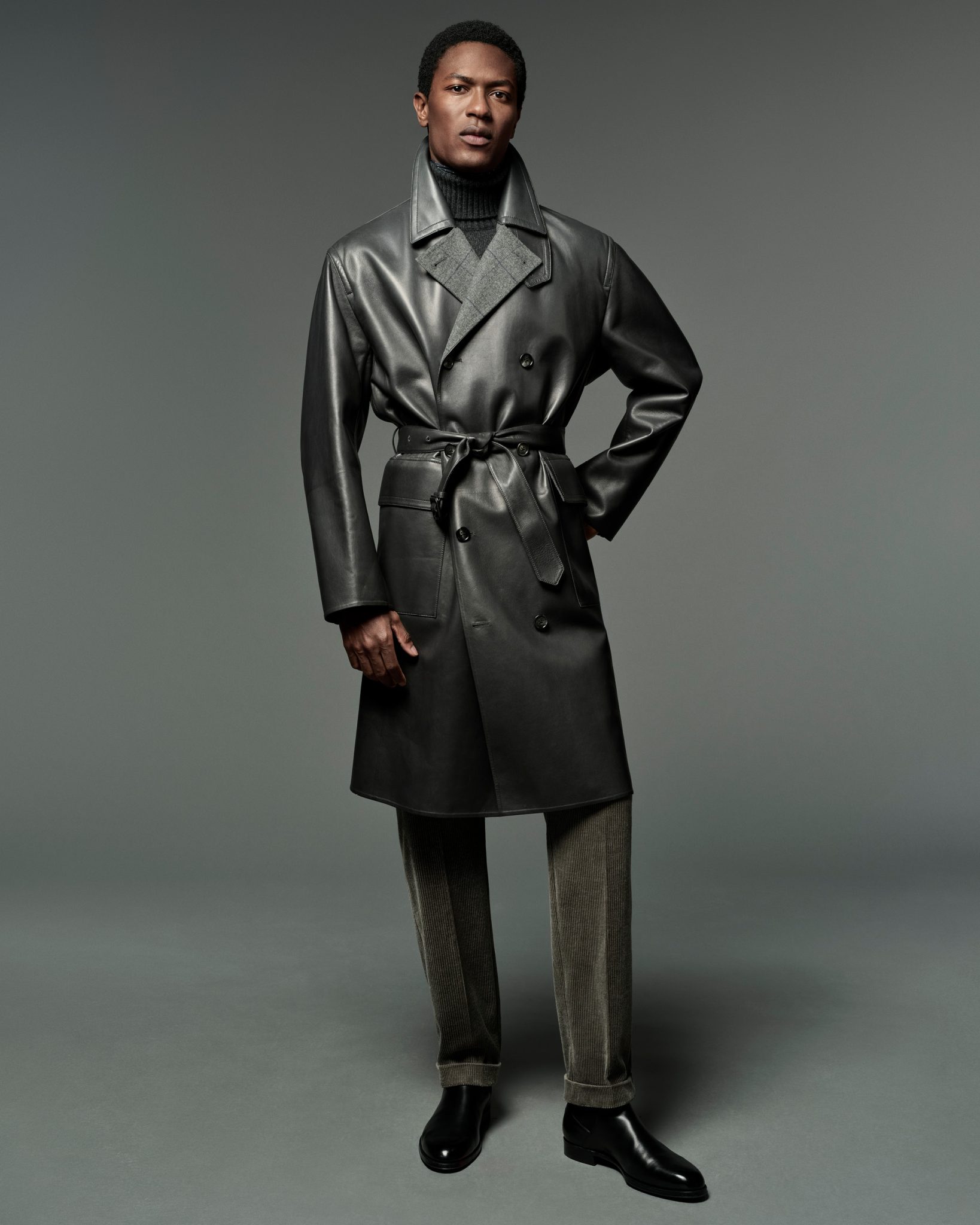
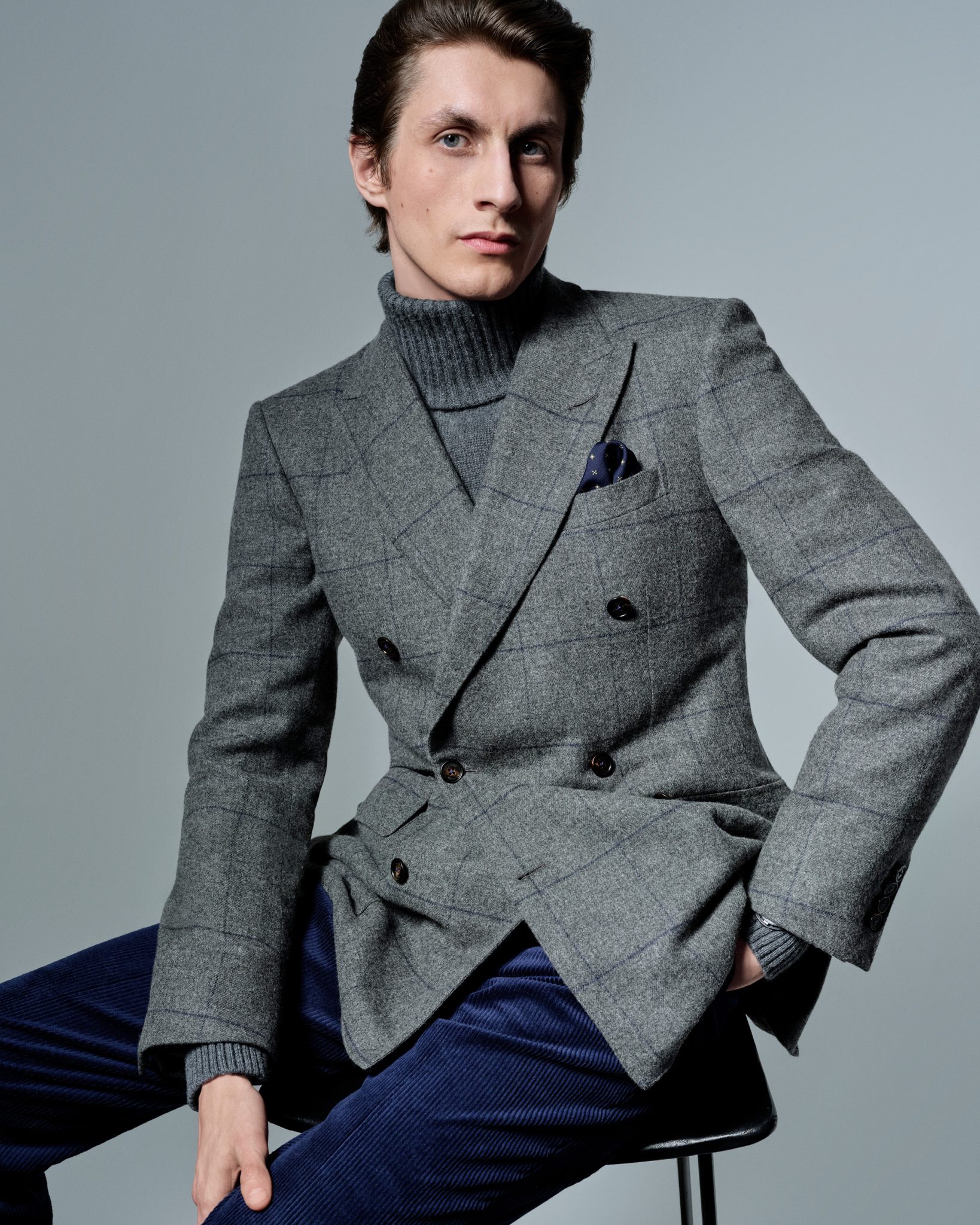
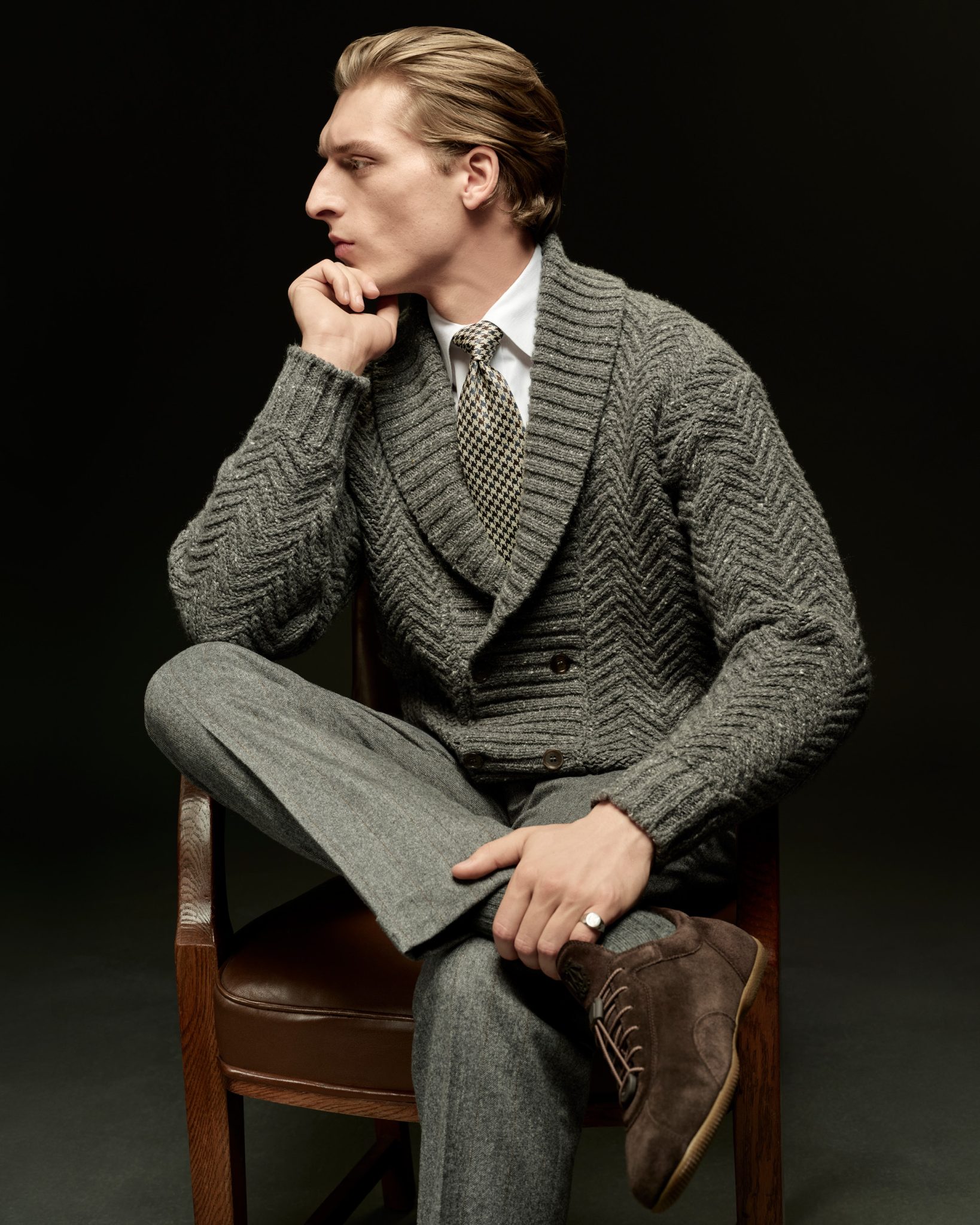
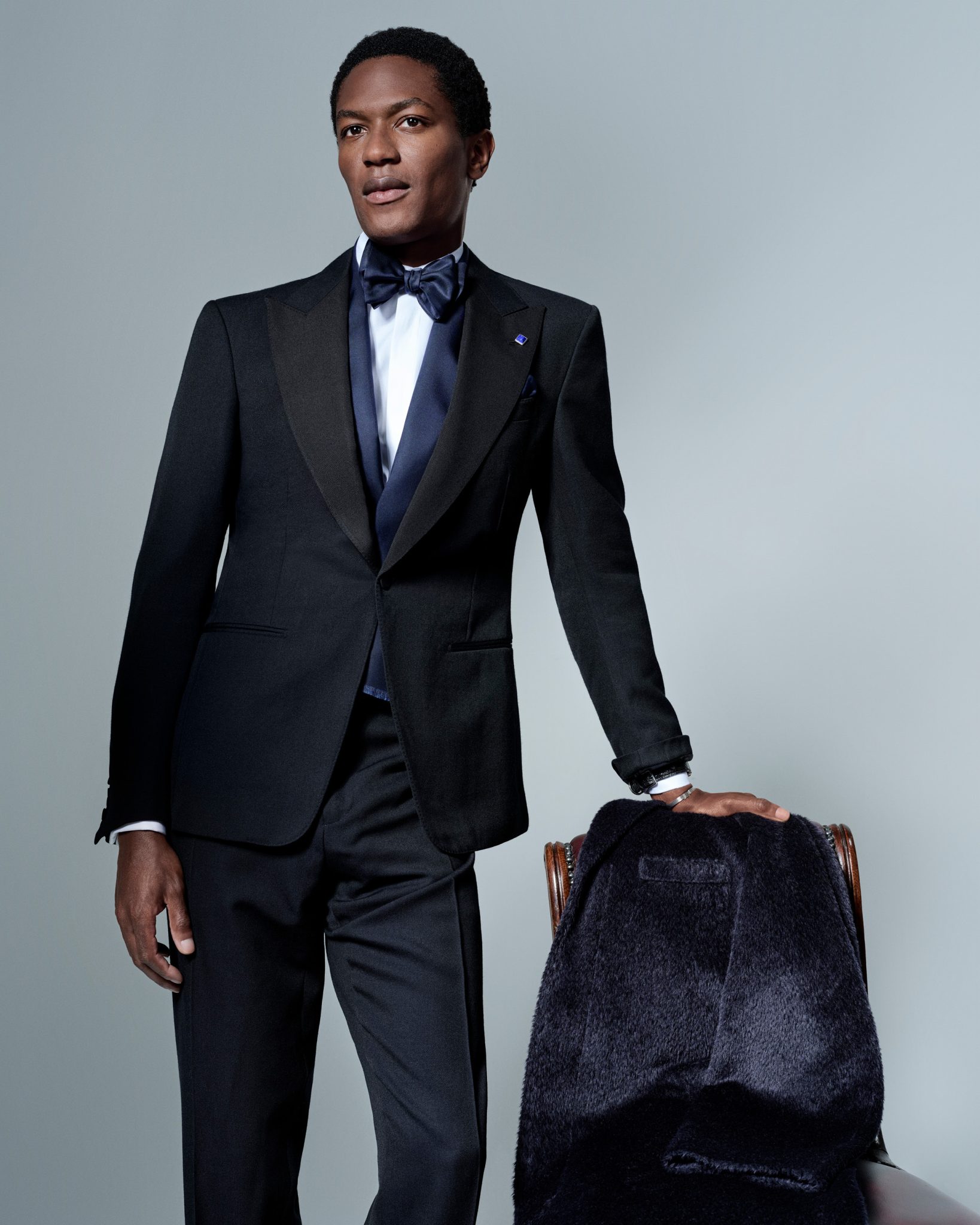
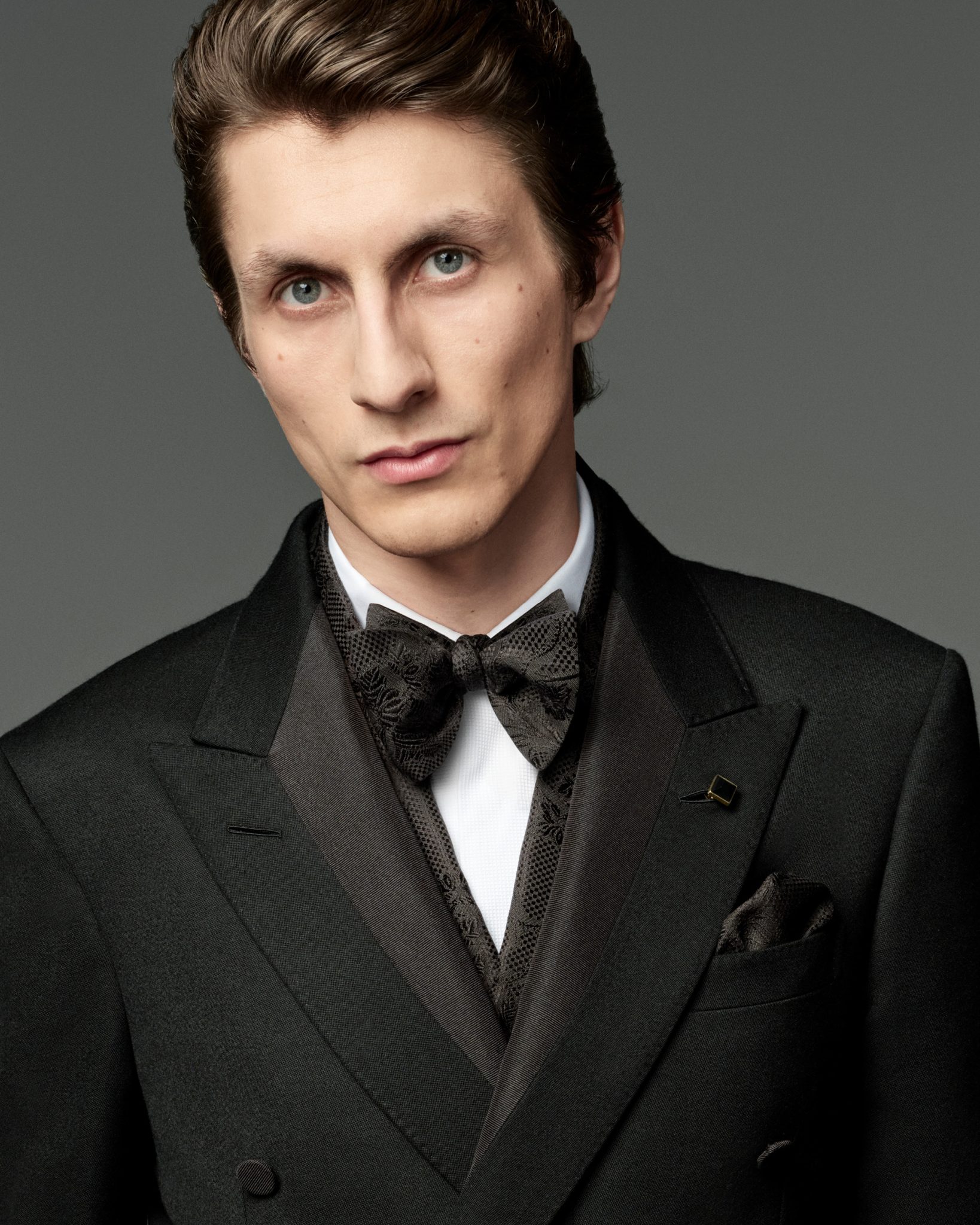


Chris Cotonou: Dunhill has Pitti Uomo in January and new stores planned for Madison Avenue and New Bond Street. How do you preserve the brand’s identity as it grows internationally?
Simon Holloway: A few years ago, it was important to restate Dunhill’s Englishness and its position in London and the US. Pitti Uomo is a huge honour for a timeless menswear maison. The director sent me a book about the English in Florence, from the Grand Tour onward. It included old adverts for Aquascutum, Burberry and Dunhill, and it showed how closely Dunhill was connected to that history.
We want to distil the world of London—the bespoke tailoring, the history of sport tailoring, British cloth, saddlery leather and Art Deco metal accessories—into a beautiful English townhouse. You might find a blazer in a gorgeous cloth, handmade Northampton shoes, a car coat, a driving jacket, a folio or an umbrella made in England. It should feel like stepping into an exceptional world that comes from London.
That’s what I want to show in Florence, to clients in New York and here at Borden House. Dunhill has always been an English house intended for an international audience. It opened in Paris and New York in the 1920s, Tokyo in the ’60s and China in the ’90s.
Chris Cotonou: How do you think about the people who represent Dunhill, particularly in film and entertainment?
Simon Holloway: The clothes are designed for men of good taste. Whether someone is fashion-oriented or a classicist, I hope they can find something here. Everyone needs a good suit, a good blazer and a good tuxedo.
I want the collections to feel cinematic in a real sense: able to wardrobe a character on screen, or a real person on a red carpet or at a press event. The clothes shouldn’t be a fantasy that no real person can wear. The identity should be grounded in reality, but heightened and exceptional. I love the idea of Great British Hollywood and the classic off-duty style from when studios dressed movie stars. I want movie stars to look like movie stars.
Chris Cotonou: And for red carpets, do you steer people toward a particular look?
Simon Holloway: We’ve had requests for things that I’ve said aren’t right for us: a head-to-toe bright look, a crazy proportion or a clown shoe. We’re not the maison for that. What we can promise is that someone will look polished, expensive and like a leading man, if that’s what they want.
There’s nothing more powerful than arriving somewhere like the Met Gala, where everyone is overdressed, looking sublime without wearing something that wears you. You may not get the clicks if you understate it, but you’ll get admiration. And when you look back years later, you won’t feel that the clothes have dated.
Chris Cotonou: What do you enjoy most about being creative director?
Simon Holloway: You sit at the centre of something like a conductor of an orchestra. When everything is in full flow and looks beautiful, that’s an amazing moment.
Underneath it, though, this is a very human endeavour. People make these things by hand. You receive a beautiful shoe or jacket whose fabric was woven by someone you visited months earlier, after discussing a particular colour and quality. They create something with artistry and experience, and then someone else tailors it so beautifully that it sits perfectly on the shoulders. That’s a human moment of creation and industry that makes me laugh, cry and smile all at once.
Chris Cotonou: Could you name three films that have influenced you, whether through their style or the way they approach character?
Simon Holloway: I was very influenced by the cinema of my youth: the films of Merchant Ivory, James Bond, and the new-guard cinema of the 1970s and ’80s. I’m thinking of the talking films of the ’70s and avant-garde cinema, including My Beautiful Laundrette. Perhaps those are three genres and eras rather than three individual films.
That sort of sums up the Britain I grew up in: Merchant Ivory and My Beautiful Laundrette. That’s everything I love about Englishness—the tension between the old-world establishment and aristocracy, and creativity and artistry. I love that fusion in art, theatre, music, cinema, architecture, graphic design—all of it. We’re so good at all of that. Think about Grand Theft Auto that just came out today.
Chris Cotonou: We need to work Grand Theft in very quickly if you’re going to bring it up. Are you paying attention to Grand Theft Auto as a creator?
Simon Holloway: Of course. We’re living through these amazing UK cultural moments. You’ve got Grand Theft Auto launching the same week they announced the new James Bond. How brilliant is that? All eyes are on the UK creatively, and these are some of the biggest franchises in the cultural sphere. It’s incredible. Even the idea of it is endlessly inspiring.
Chris Cotonou: I love that. And Dunhill is part of that too, isn’t it? It’s a great British institution.
Simon Holloway: I’d like to think so.