


The Moroccan-Lebanese filmmaker Shaden Safieddine Tazi discusses A Few Moments of Happiness, a deeply poignant short film made up of screen recordings during the 2024 bombings in Lebanon by Israel.
Shaden Safieddine Tazi first started recording her phone in 2020. It was the pandemic, and a sense of bewildered disassociation encouraged the filmmaker to capture the increasingly out of control world on her screen. In 2025, the habit took on a new urgency, when the Israeli army started to bomb Beirut, where much of Safieddine Tazi’s immediate family live. The filmmaker, back in Paris, began to document the world even more obsessively, going out into the streets to record protests and conversation with friends, as well as phone calls with her parents. She also continued to record her phone.
The result is A Few Moments of Happiness, a 17-minute film which has just taken home the prize for Best Short at the Venice Film Festival. Deciding to focus on the phone screen (rather than IRL) content, hours of footage were whittled down into an exacting composition (edited by Rafe Scobey-Thal) that captures the alienation of experiencing war in your homeland from afar. Brat summer TikToks and fuzzy Instagram videos of Paris nightclubs intertwine with terrified and angry private WhatsApp messages amongst friends and Instagram stories reacting to the horrors of Israeli warfare. Far from the overstimulating glut of infinite scroll, the result is deeply affecting and urgent, with each strange image asking us a question. Phone calls with family members—the filmmaker’s mother and father—reject images all together, overlaid onto a screen of deep black. Yet, instilled with a fear and tenderness, it is impossible to look away.
In Venice, A Rabbit’s Foot spoke to Safieddine Tazi to talk about the process of making the film and its reception at the festival.
I wanted to start by asking about the origins of the project. When did you start recording your phone?
I started recording my phone when Russia invaded Ukraine and during the pandemic. These were such dissociative moments, and it’s just something that I did, not for a film, but for myself. This particular film started while I was back in Paris after spending the summer in Lebanon. I was supposed to shoot a fiction short film there about birds and drones, and I ended up leaving Lebanon urgently after the bombings had started again. I found myself in Paris, worried for my friends and family and feeling guilty for having left. With no film anymore and no purpose, I would scroll for hours and hours on Instagram in an attempt to stay connected to my loved ones. Once again, I started recording my phone. But I also picked up my camera, which made me get out from bed, and filmed my life for two months: mundane moments but also intense ones like protests on Place de la république, conversations with my friends and family and a Lebanese drag show full of Lebanese people who were simultaneously celebrating and mourning.
The first rough cut of this film was two hours and edited alone in my apartment. Once I had that, I showed the film to Rafe Scobey-Thal, a great editor and my best friend, and we edited together for seven months. During this process, I started gradually stripping away the real life footage. So I didn’t come up with this idea of a film made up of screen recordings, it just happened by subtraction. It’s what felt right.
What was it about this medium of phone screen recordings that made sense? What could it say that a more direct video couldn’t?
I think intimacy, surprisingly. The screen and the phone, it’s one of the most intimate modes you can have in a relationship with the ones who are far away. People write what they can’t say. People speak more authentically when nobody’s watching… Also, not having grown up in Lebanon but still being so attached to the country and its people, I’ve gotten used to loving and mourning from a distance. This film made me realize that I could own up to my point of view. That it was also a legitimate one.
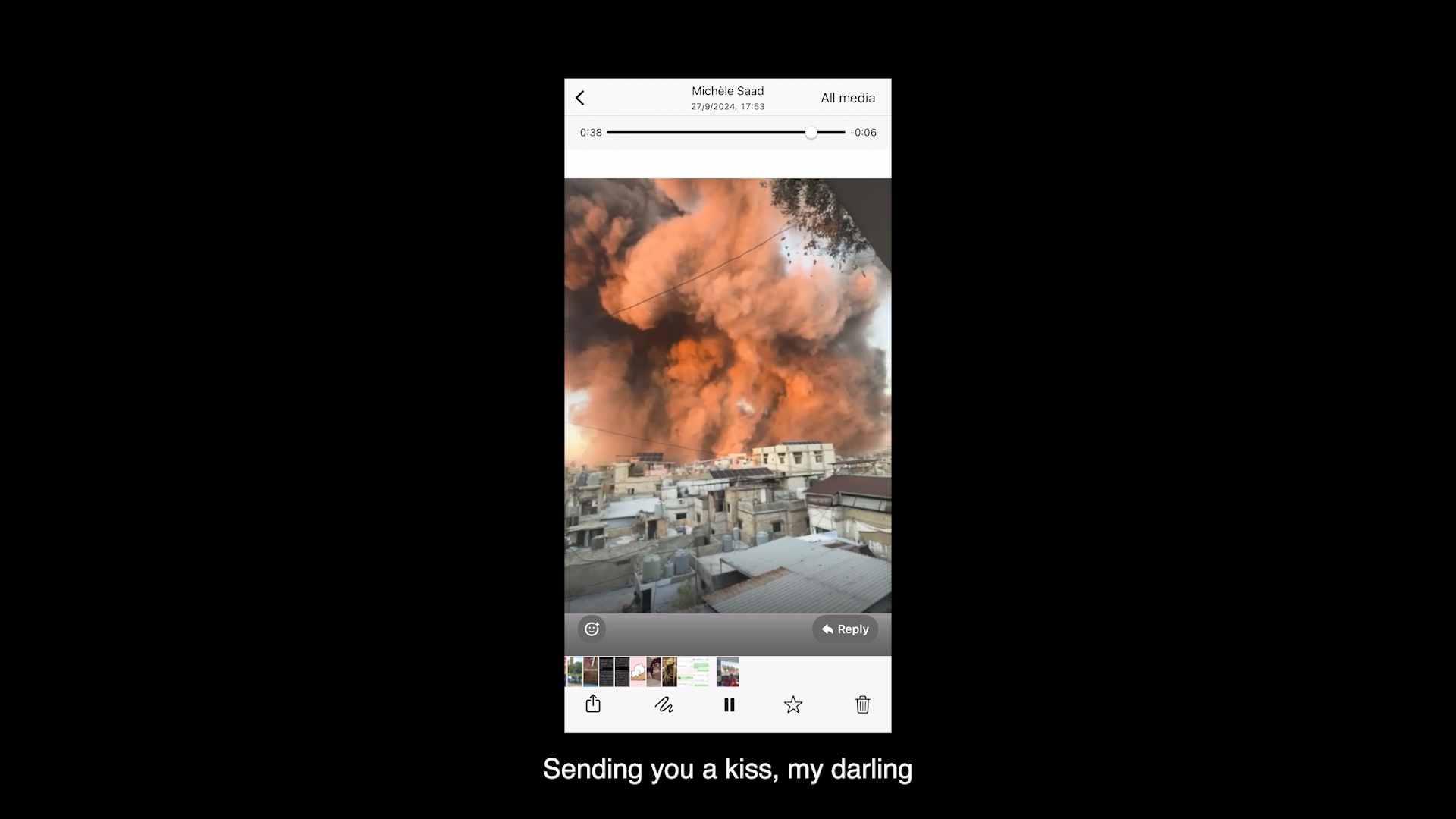
A still from A Few Moments of Happiness, directed by Shaden Safieddine Tazi
Obviously our phones are a tactile thing, and then when you watch these videos as cinema, they are put at a remove. For me this showed a kind of powerlessness. Was this something you thought about?
I felt a lot of powerlessness, yes. But when you pick up the phone and start recording, you start taking agency. It’s almost like a little rebellion: I’m going to record, capture in time, what will disappear in 24 hours. I also started thinking about our collective memory as Lebanese people that live on those devices designed to manipulate us and distract us. And I found that my friends were writing things online that were so powerful. Like this line my friend wrote on an Instagram story: “Drones looming over Beirut like bloody, thirsty mosquitoes.” I thought, this is a poignant testimony of war, of life, but who will capture it? How do we make sure our testimonies don’t disappear?
When I watched the film, it reminded me a little of Chantal Akerman, with the voiceovers in News from Home, but also the experimentation of her later films. Were there other references you had in mind here?
My inspirations for this film are filmmakers who find the form by making. They aren’t trying to fit a story into a mould, a structured mould with conventional tools of cinematic language, a three-act structure. Don’t get me wrong, I love traditional cinema more than anything else. I’m myself writing fiction at the moment, but some situations and stories simply need to invent their own form and be subversive.
Also, we had no money to make this film. It cost $1000, DCPs included. To be honest, it was not a choice. The truth is that I was actively looking for funds for almost a year but no one wanted to invest into such a weird form. But this was not going to stop us and I had to embrace the constraints and limitations. I always think of Maya Deren who said: I make films for the price Hollywood spends on lipstick. I love Maya Deren.

“We had no money to make this film. It cost $1000, DCPs included. To be honest, it was not a choice. The truth is that I was actively looking for funds for almost a year but no one wanted to invest into such a weird form.”
Shaden Safieddine Tazi
I found it almost sculptural—you have this huge body of material that you have carved away to find a form. It’s surprisingly refined. ‘Light’ is maybe the wrong word.
It’s precise, I think. There’s power in minimalism in an oversaturated society.
Yes. How did you decide when to hold back images and just have the voiceover?
At a certain moment two years ago, when Israeli bombings were extremely intense in Lebanon (they still are), and I spent all of this time looking at devices, I started rejecting images and almost had an allergic reaction to them. I even rejected cinema, which as you can imagine was almost like rejecting a part of myself. Thank god this time is over, but I started to become a lot more interested in conversations and sounds. Using images to fill up gaps over the voice of my father, I felt there was nothing that could do that properly. Anything else would have just been fillers. I also think that my father’s voice embodies the strength and vulnerability of our Arab fathers who try to protect us at all cost – far from the stereotypical, racist, and orientalist representation of Arab and Eastern men as despots, machos, supremacists.
The title of the film: A few moments of happiness, was there meant to be an irony in that?
No, happiness and pain coexist. It’s also one of the reasons I decided to include all the memes we send to each other, the parties, the laughter… The Arab world is portrayed in such a victimized way, people forget that we laugh – makes it easier to dehumanize us. We’re not only victims. I hate this victimization label. And I, myself, refuse to self-victimize nor to make my father, the voice of this film, a victim. First of all because people have it way harder than us, but also because it would be too easy. I discovered a letter by Jean-Luc Godard in the third edition of MAGMA, where he wrote: La tragedie c’est facile. [Tragedy is easy]. Happiness, moments of happiness are hard to find sometimes, they don’t come as easily as we might think. But it’s something to work towards.
You might trick people into thinking they are watching an upbeat film! What has the reaction to the film been like, both here in Venice and amongst your family?
Venice is a beautiful and invested and rigorous audience. I’m really happy to be showing the film here. It’s an honor and privilege. But my family and friends: I was so anxious to show it to them. I was super scared of crossing this line, of almost voyeurism or extraction. Here, I’m amongst strangers, so it doesn’t matter to some extent if they don’t like it. Luckily, my friends and family all responded extremely well. I think they felt seen and heard. And most importantly, dignified.
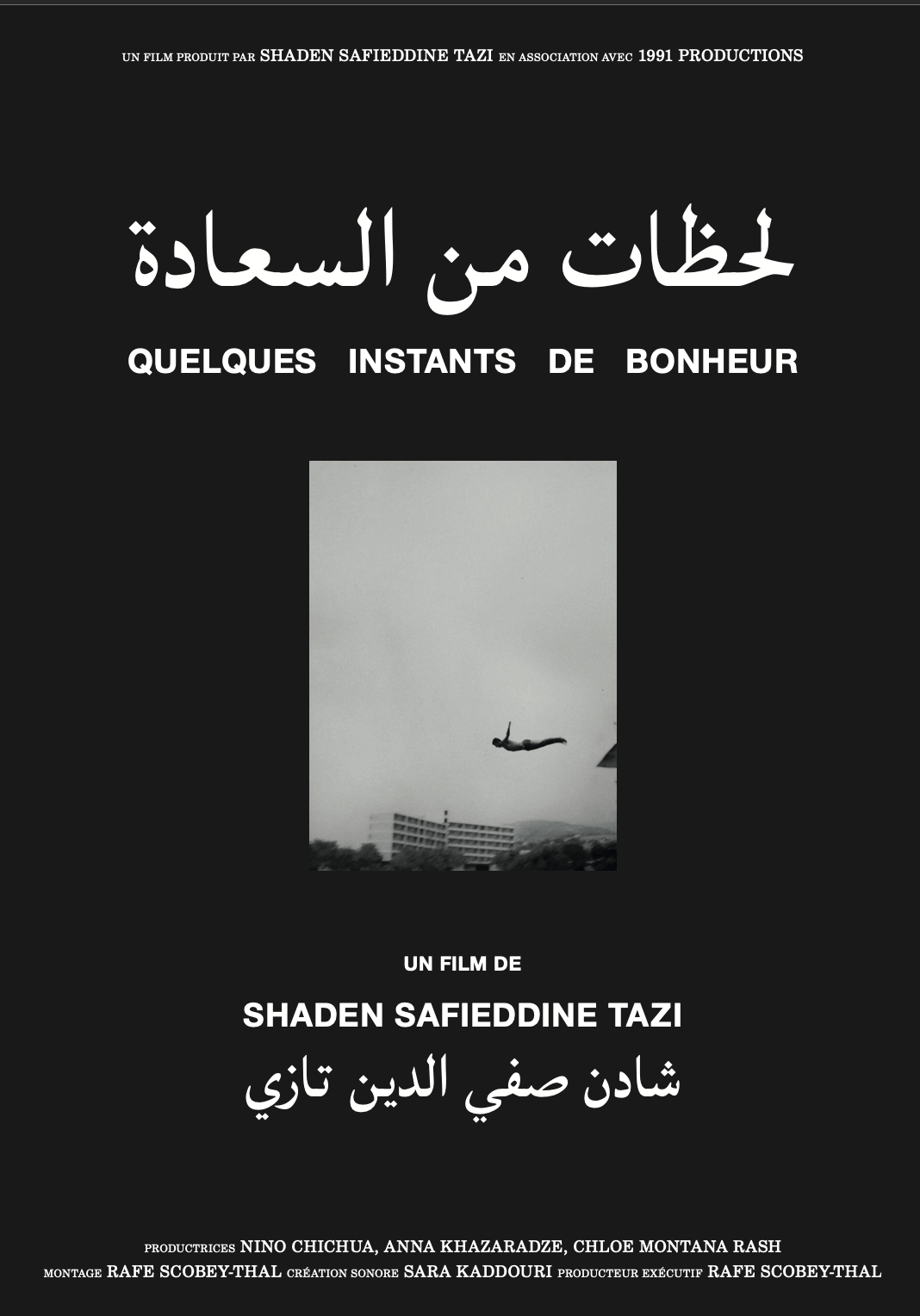
Poster for A Few Moments of Happiness, directed by Shaden Safieddine Tazi.
It’s fitting that it’s been a communal experience to watch it. Particularly amongst diaspora who are living away from home.
Roughly 4 million Lebanese live in Lebanon, while perhaps 10–14 million Lebanese and people of Lebanese descent live abroad. So, of those 10-14 million Lebanese, how many millions of us are looking at what’s happening in Lebanon on their phone, far away, isolated, powerless? I hope this film makes them feel less alone in this isolating experience.
In the film you talk in a phone call to your father about feeling blocked. Did the film help you in this process of unblocking?
Yes, to get out of bed and paralysis, to encourage people to talk about things they are trying not to talk about, break our intergenerational language of silence, force myself to own up to my point of view, one that I was often ashamed of, like all the people who don’t feel the legitimacy to express themselves when they are half this-half that, live far away. Everyone is just waiting to be heard. People need to talk and I just listened.
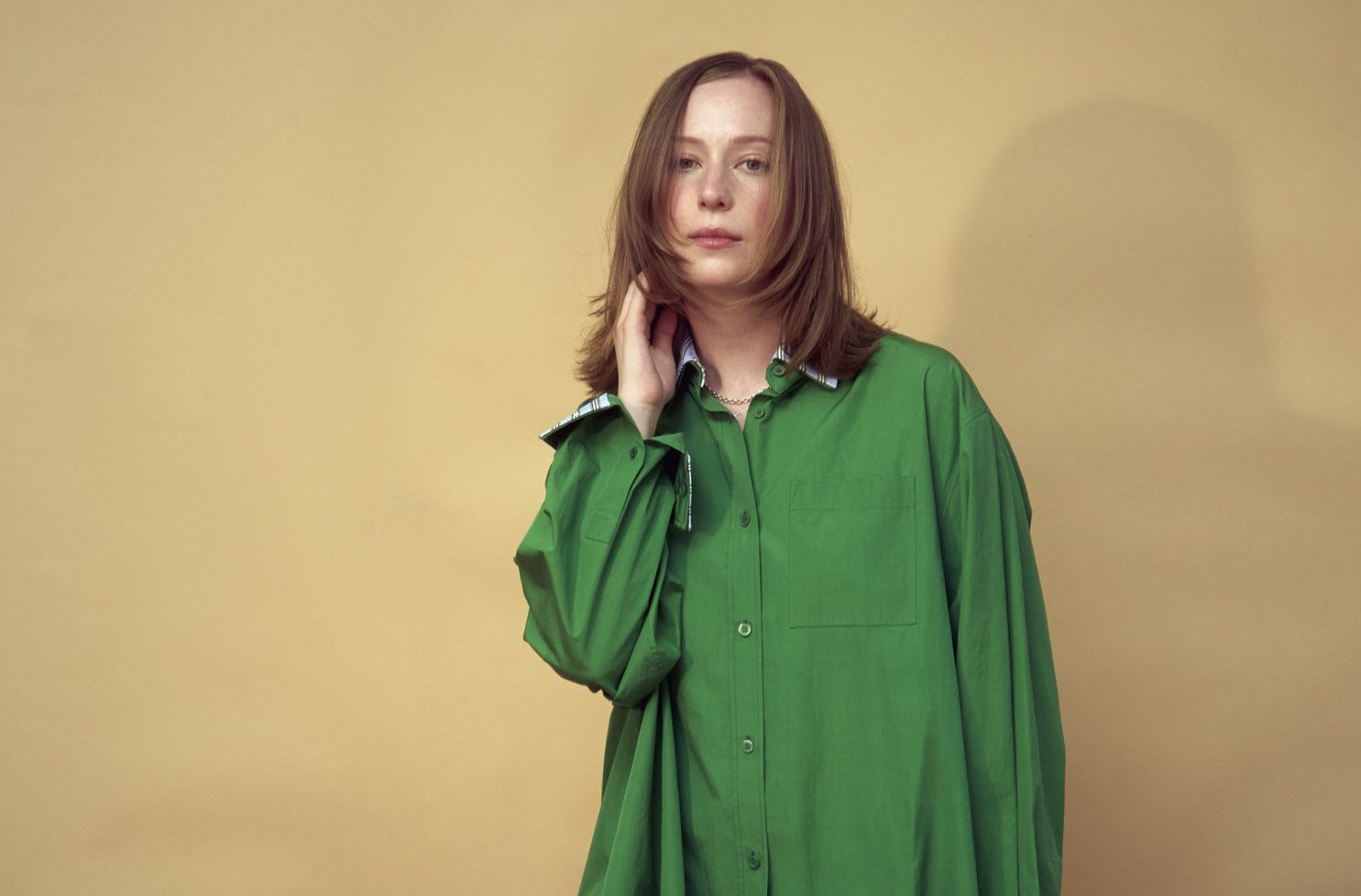
Main portrait: Photo by Paul Olivennes
Continue Reading