

Aristotle Onassis and Stavros Niarchos were notorious enemies, as the shipping magnates who ruled the waves (and rooms of power). But style was also at the heart of the fight writes Joseph Bullmore.
Jackie Kennedy once claimed that Aristotle Onassis would check beneath his bed every night for evil spirits before going to sleep. His friends said he was hunting for surveillance bugs, planted by unseen foreign interests or dubious lackeys. But perhaps he was simply checking for Stavros Niarchos.
In the history of one-upmanship, envy, and rivalry (which is to say, the history of humanity), few contests have been quite so sparkling, quite so extravagant, and quite so intriguing as that between Onassis and Niarchos. Two of the grandest and most successful shipping tycoons of the 20th century, the pair, like twin superpowers, were locked in a decades-long cold war across multiple fronts—ships, women, islands, airlines, yachts; fame, prestige, wealth, ego.
The metaphors came thick and fast in the press that the pair simultaneously courted and disdained. Twin gods on Mount Olympus? Players in a modern Greek tragedy? Or perhaps simply two small men measuring their various appendages for the world to see? (Onassis, you will remember, delighted in having the bar stools on his yacht clad in the foreskin of a whale.) “They had more in common than not, as it happens” says Taki Theodoracopulos, a writer and Greek shipping heir, who knew them both. “As well as being short, they were both brilliant businessmen. Really, I never understood why they didn’t get along better. Because they were both incredibly successful men.”
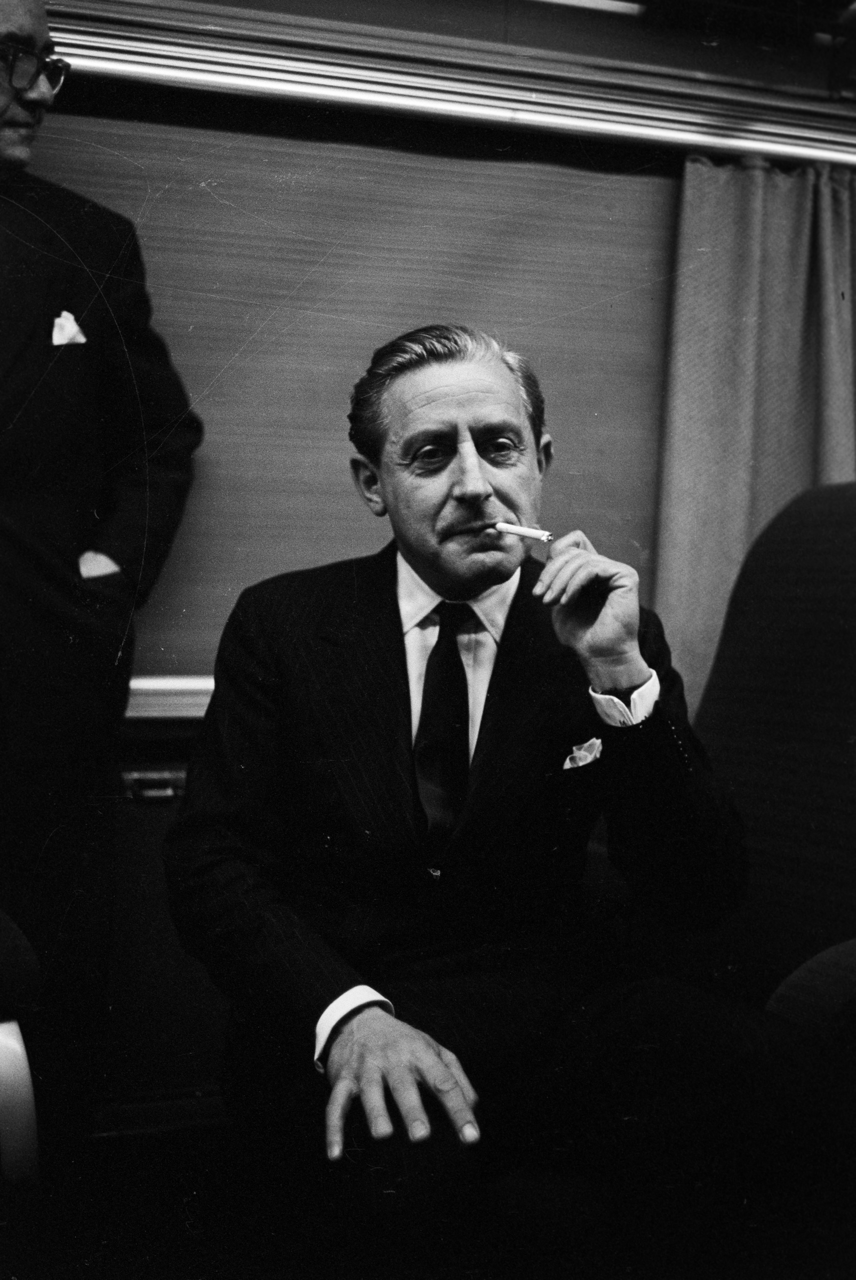


Onassis and Niarchos both made their fortunes in the post-war Greek shipping boom. But each had arrived in the business from radically different directions. Onassis, an ethnic Greek, left his birth country of Turkey for Argentina as the Ottoman Empire came crashing down, setting off as a teenager in steerage class with $60 in his pocket to make his fortune however he saw fit. (One story claims he was a stringer for dancing girls, including a young EvaPeron.) He began importing cigarettes, and only moved into shipping when he saw the chance to buy cheap surplus freighters during the Great Depression.
Niarchos, by contrast, was born into a wealthy Athenian family which had made its money in flour and grain. He studied law, dated rich girls, and soon had the bright idea that his family should own the ships that freighted their goods around the world instead of contracting others to do so for them. When the war arrived, he became a naval officer, but kept one eye on the flotilla he had built up with his uncles—until a large chunk of it was destroyed, resulting in a hefty insurance payout that later formed the cornerstone of his investment in a sparkling new fleet.
Both men had realised that the supremacy of coal was on the wane, and that oil was the fuel of the future. Both built tankers to transport it before almost any of the competition. And both were perfectly placed to reap the vast rewards in the moments following the war, when a huge number of additional ships suddenly became available and the Western economy boomed. And then, in 1956, at the height of the Suez Crisis, when global commerce became choked by the blockade, both saw their wealth explode almost exponentially, as fleet owners were effectively able to name their prices for shipping services. At the height of the crisis, the pair were said to each be making an extra $1m per day. Onassis and Niarchos were minted as billionaires overnight.
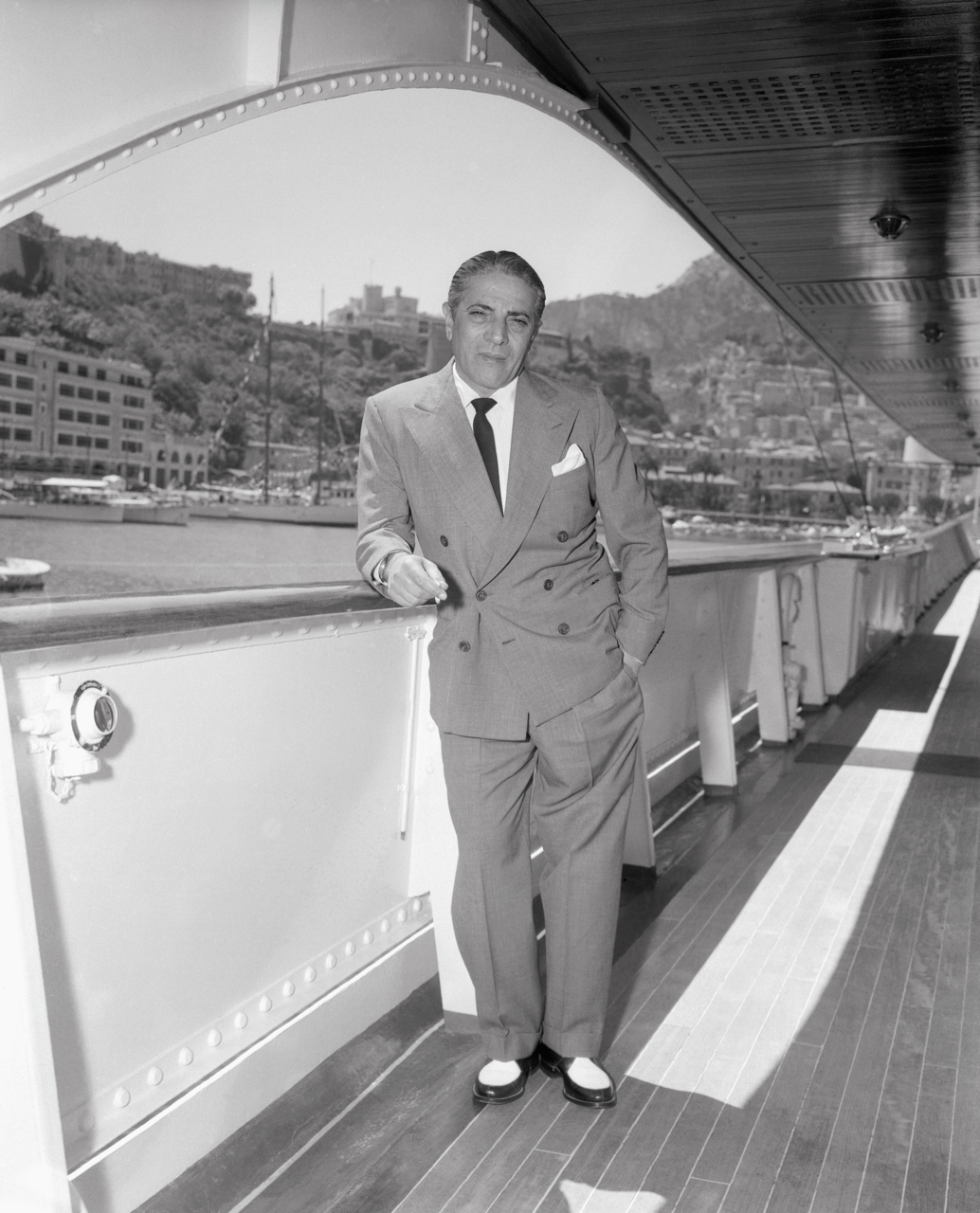
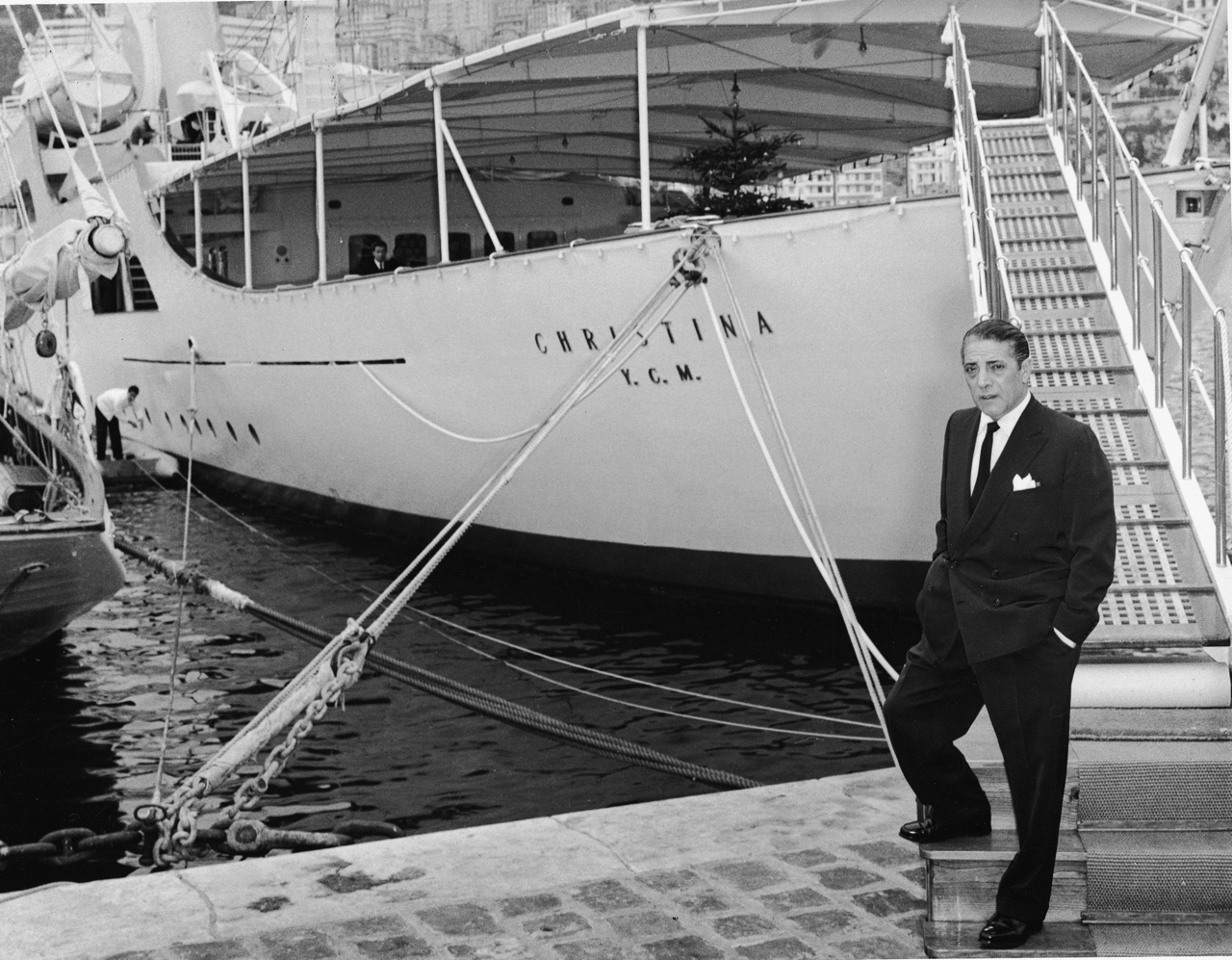
Aristotle Onassis in Montecarlo, June 1961.
For a long time there was a natural respect between the pair—and more than enough money and opportunity to go around. Onassis, eight years the senior of Niarchos, later offered his “In the history of one-upmanship, envy, and rivalry… few contests have been quite so sparkling, quite so extravagant, and quite so intriguing as that between Onassis and Niarchos.” counterpart a rare pseudo-compliment about this period: “No one has been so smart or so lucky to make the right moves at the right time as Stavros Niarchos.”
“It’s strange,” says Theodoracopulos, “because they were friends in the beginning. But then fame got in the way. And women.” The women in question were the daughters of George Livanos, the godfather of Greek shipping, whose endorsement was akin to a royal warrant. A third-generation shipping heir, his fortune dwarfed even those of the two young pretenders. A patrician presence from the island of Chios, he was initially suspicious of the ’Turkand the city boy—but was savvy, too, and knew which way the wind was blowing. A marriage between one of his two daughters and either of the new upstarts would consolidate his dynasty for several more generations—and, better yet, would negate the need for an irksomely hefty dowry. Soon, both Niarchos and Onassis were seen out and about, courting his youngest daughter, Tina Livanos. Niarchos asked for her hand in marriage, but papa Livanos turned him down.

“In the history of one-upmanship, envy, and rivalry… few contests have been quite so sparkling, quite so extravagant, and quite so intriguing as that between Onassis and Niarchos.”
Joseph Bullmore
A few months later, Onassis—renowned for a warmth and charm largely absent from Niarchos—made an entirely more successful approach. Tina Livanos and Onassis married in December 1946. He was 46; she was 17. Niarchos, desperately keen not to lose either face or standing, proposed to Eugenia Livanos, the elder daughter, the following year. And so the friends became brothers-in-law—and, very shortly, bitter rivals. The tycoons’ presence under the same roof quickly served to expose their stark differences in style and personality.
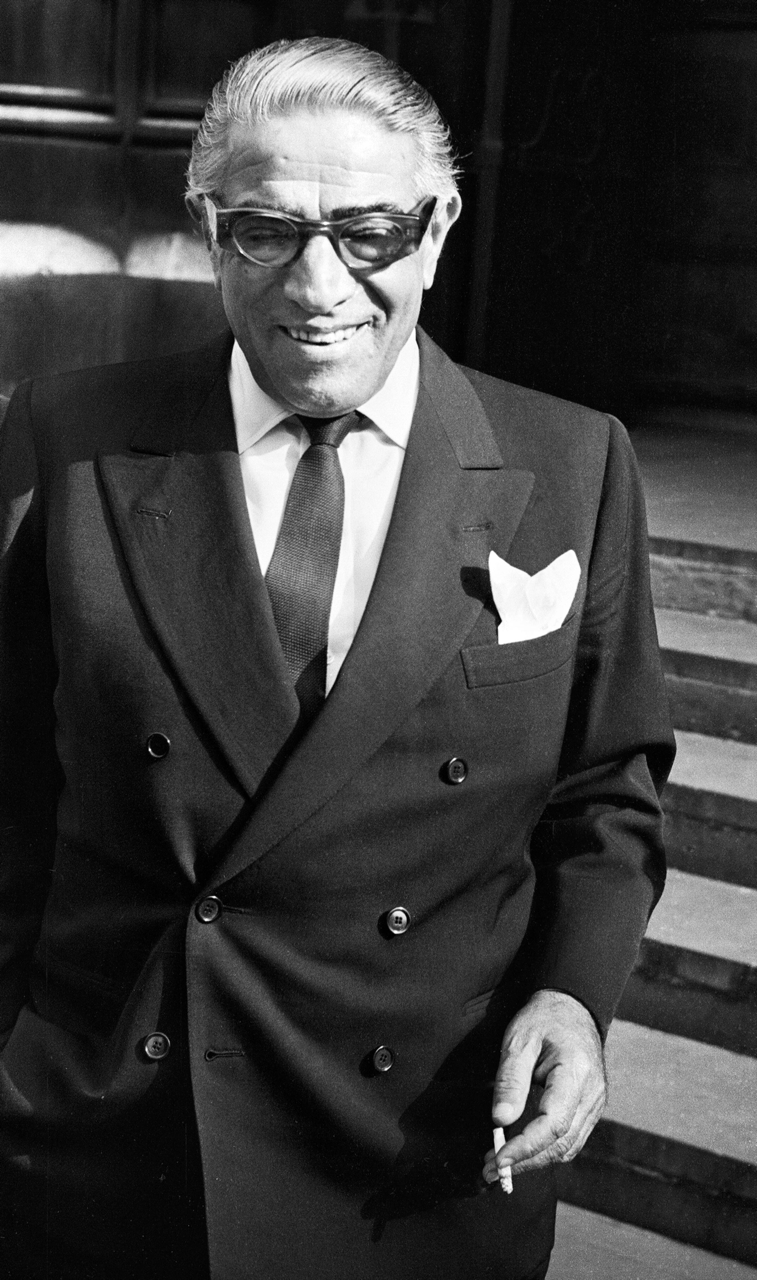
Niarchos was good looking, smooth, and possessed of beautiful suits. Onassis was ugly, could be brash and uncouth, and little interested in culture or style. “He didn’t care about those things,” says Theodoracopulos. “He always wore a double-breasted dark suit and a white shirt, and that was it.” And yet Onassis’s more robust authenticity seemed to attract and charm people, in a way that the sleeker, colder Niarchos never did. “Onassis was much more fun to get drunk with,” says Theodoracopulos. “He was very much one of the boys, let’s put it like that.” Niarchos, on the other hand, could be cruel and insecure. “I have affection for both of them, but Niarchos was a horrible man,” Theodoracopulos says. “He was always looking to say anything that wasn’t nice.”
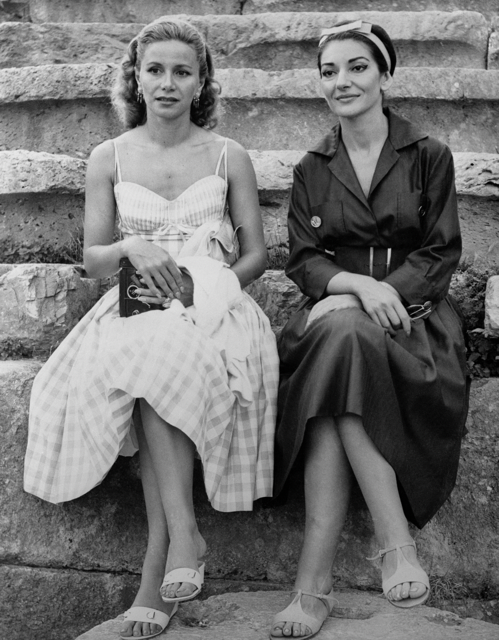
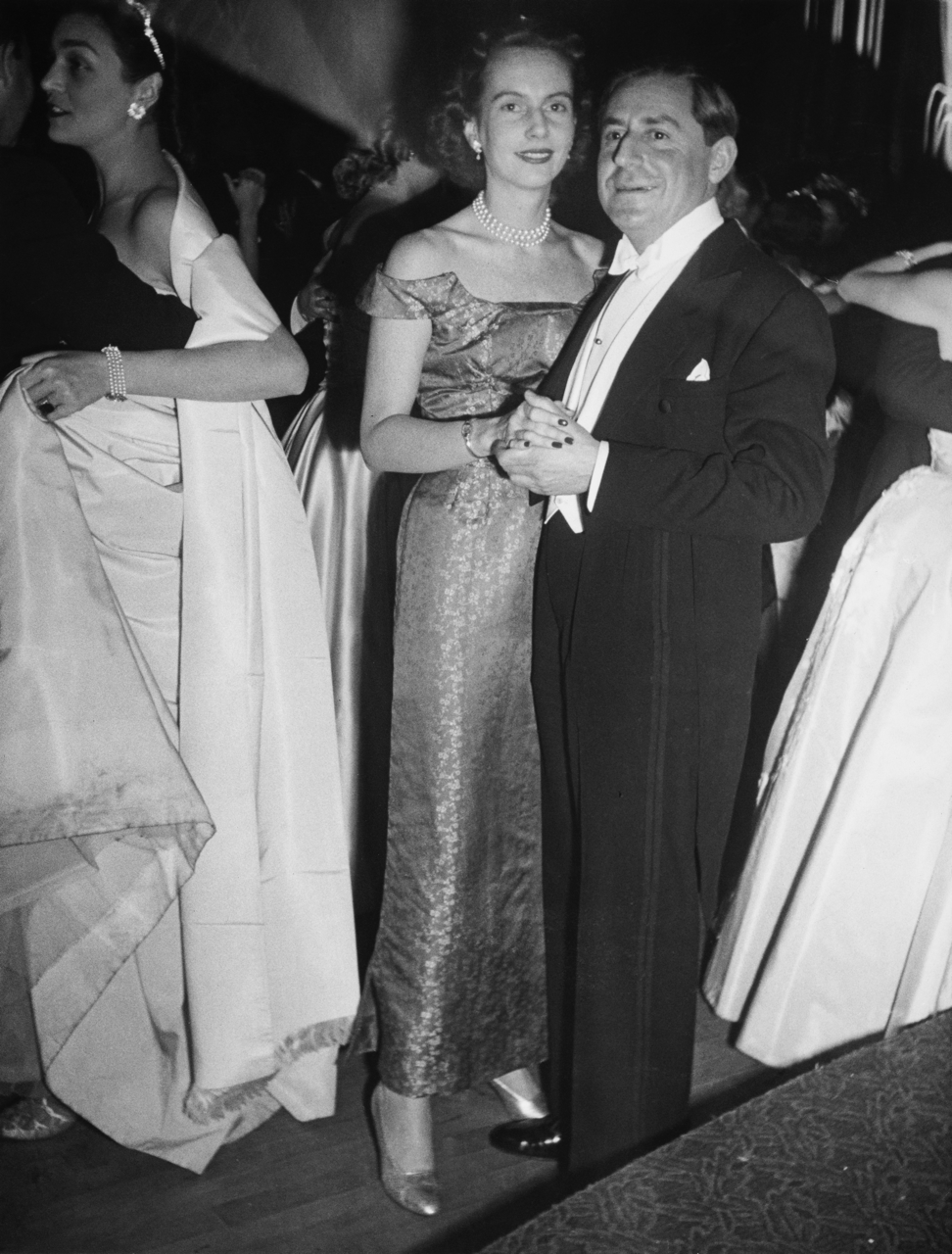
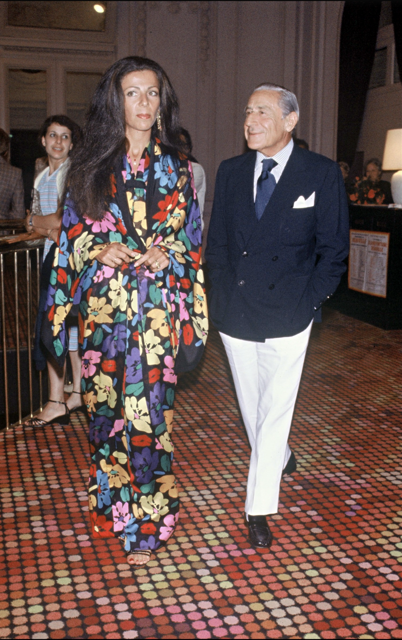
Their differences soon manifested themselves in a series of gaudy arms races. Each battled to own the world’s largest tanker, commissioning ever-longer ships across the 1950s to claim the title. When Onassis acquired a vast villa near Antibes, Niarchos found a bigger one closer to the coast. After Niarchos bought the private island Spetsopoula in 1962, Onassis acquired the slightly grander Skorpios a year later. At one point, after battling to purchase Hotel le Bristol in Paris, the pair arrived at a truce: that each would cut the other brother-in-law in on any property deal made from that moment on.
It worked for a time, but Onassis conveniently forgot about the pact in 1953 when he bought a controlling share in the Société des Bains de Mer, the company which effectively owned most of Monaco. (His nine-year-old son was soon permitted to drive a miniature car on the public streets of Monte Carlo, and rode a powerboat around the harbour until he crashed it.) Niarchos got his revenge a year later by bitterly torpedoing the so-called Jeddah Agreement—a monstrous deal which would effectively have granted Onassis full control of the transport o all Saudi oil.
When Greece sought to privatise its national airline in the mid 1950s, Onassis pipped Niarchos to the concession and transformed the newly branded Olympic Airways into a serious player in the jet age—leading Niarchos to spend years and years challenging the deal in court. (As a consolation prize, Niarchos was given control of the country’s first oil refinery.)
Everything became a competition. It killed Onassis that Niarchos appeared on the cover of Time magazine before him, in August 1956, and he did everything in his power to get his own cover as soon as he could. The two were even said to hire valued and loyal members of staff away from each other using outsized financial inducements.
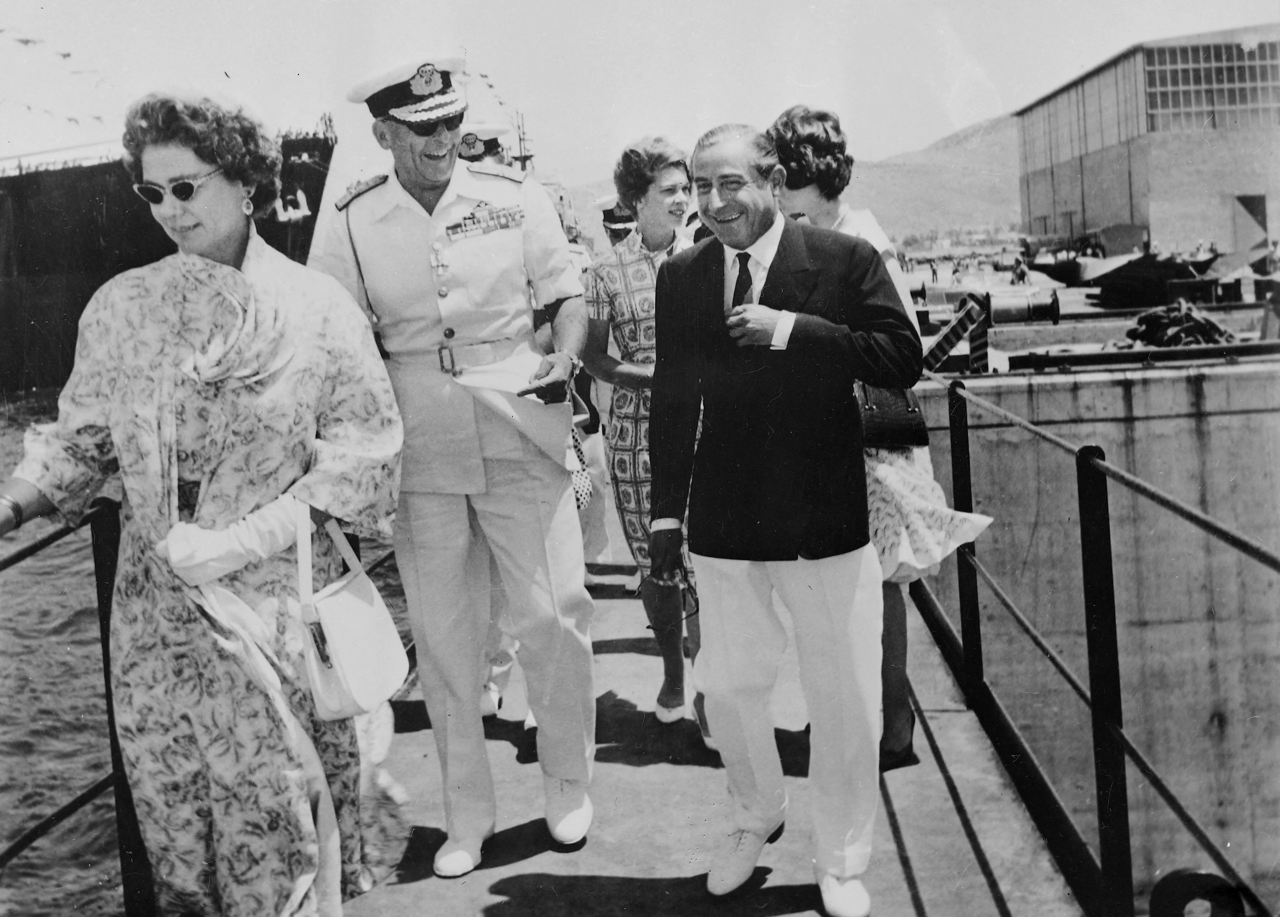
Stavros Niarchos christening a dock in Athens with King Paul of Greece, 1960.
It was at sea, however, where the most personal battles were fought. In 1952, Onassis bought his own gargantuan private yacht, naming it the Christina O after his daughter and transformed it into a floating party palazzo. Frank Sinatra loved it, Winston Churchill drank deeply from its extensive cellars, while Greta Garbo was less than impressed to be told she was sitting on the world’s biggest penis as she perched on those aforementioned bar stools.
The swimming pool had a Minotaur-themed mosaic bottom which could be raised to become a dance floor at the touch of a button, while the walls in the bedrooms—Maria Callas, then the world’s most famous opera singer, got to see plenty of those—were decked in hand-painted frescoes and priceless works of art. “I remember Gianni Agnelli telling me that Onassis had a great, great eye for art—he could tell what was good, what was bad,” Theodoracopulos says. “I don’t think there is a man or woman on earth who would not be seduced by the pure narcissism shamelessly flaunted on this boat,” Richard Burton once claimed.
And so Niarchos bought his own yacht, Atlantis, a year later—bigger and more extravagant—as well as Creole, a remarkable three-masted wooden schooner, to keep up. “It was the most beautiful boat,” says Theodoracopulos. “I remember I was having lunch on it one day, when I made a joke. Onassis had just married Jackie Kennedy and effectively become the most famous man on the planet. I said, ’Even If you go to deepest, darkest Africa, they’ll know the name Onassis!’ It still makes me laugh. And Stavros said to me: ’Leave the fucking table at once.’ He lost his temper. It clearly hurt him. But he calmed down eventually…”
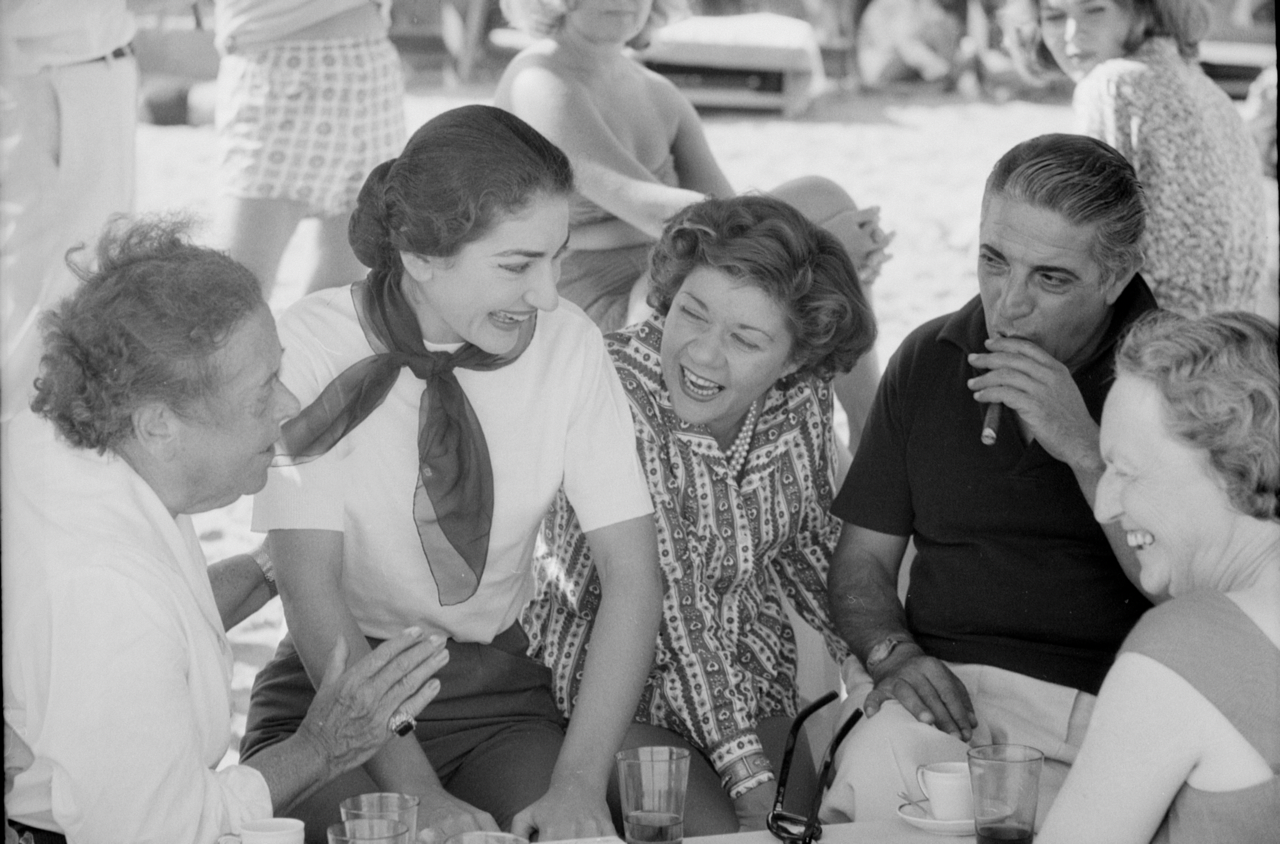
Maria Callas, Aristotle Onassis, Anna di Castelbarco, and Elsa Maxwell talking together during the Venice International Film Festival. Venice, 1957
Both men had highly colourful personal lives, attracted often to famous women—perhaps as much for the fame as the women themselves. Onassis had embarked on an affair with Callas in 1959 after meeting her at a party in Venice; his children dismissively referred to her as “The Singer”. Niarchos married five times. “He left Eugenia, the nicest woman ever, to marry Charlotte Ford,” Theodoracopulos says. “She was a nice girl—but it was mainly because she was Henry Ford’s great grand-daughter.” (Eugenia and Niarchos later briefly reconciled.) But then Onassis played the killer blow. “He marries Jackie Kennedy, the most famous widow, and maybe woman, in the world,” Theodoracopulos says. “So what can you say? If you’re competing with him on that, you’ve lost.”
The wedding, which took place on Skorpios in October 1968, was a sensation, minting Onassis as the most famous businessman on the planet. It seemed to be the first time that there was fresh air between him and Niarchos; that one of the two tycoons was so clearly in the lead. It took a tragedy for the straggler to claw back some points.
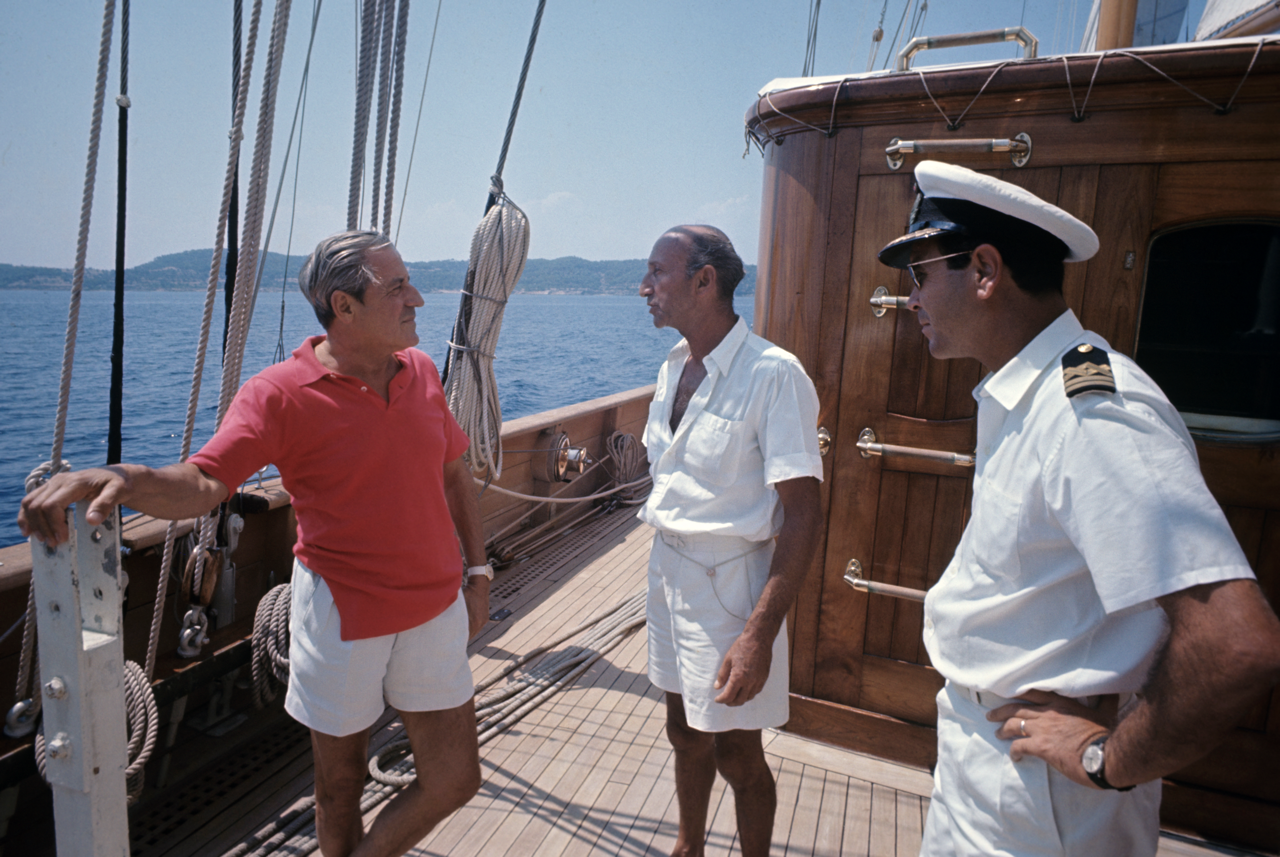
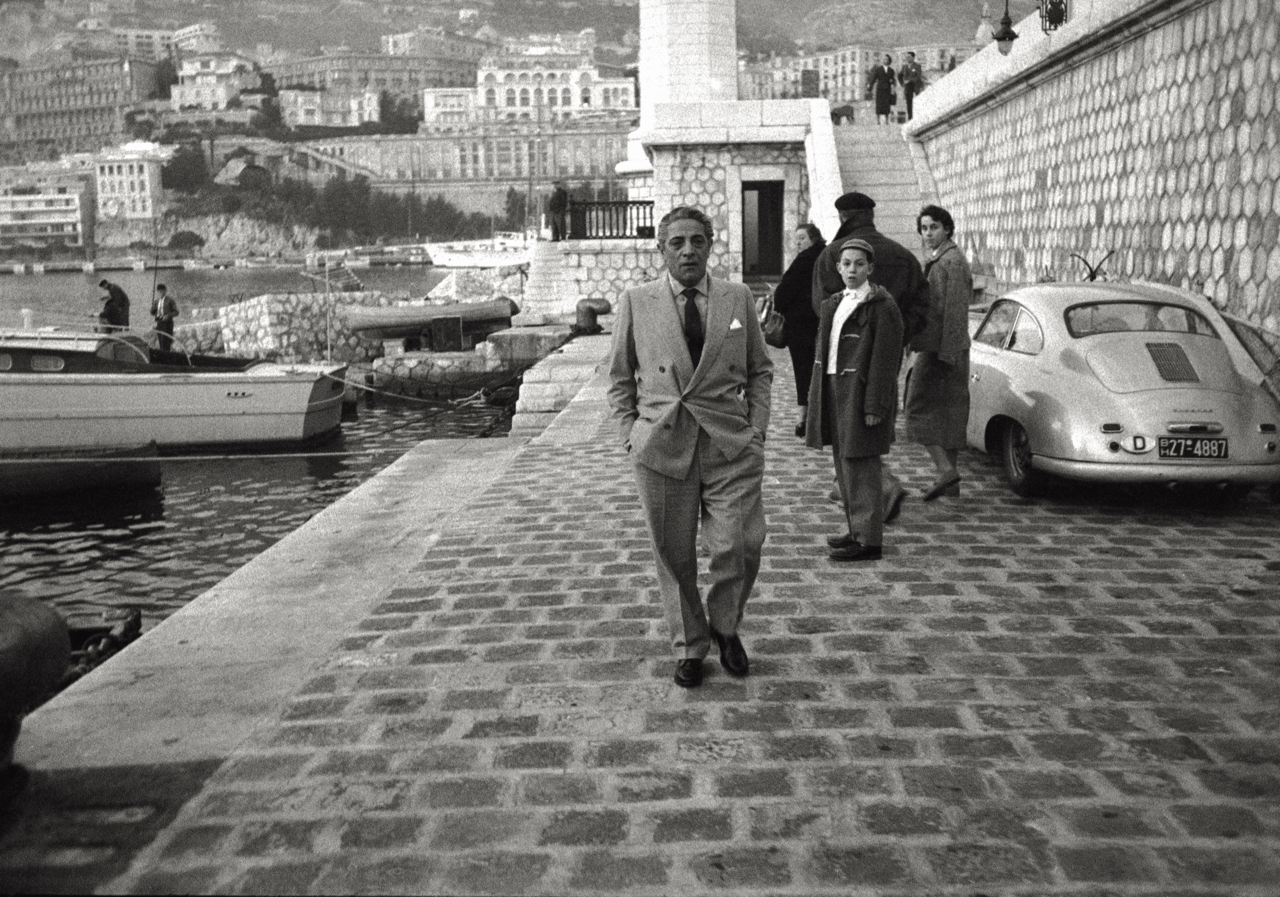
Stavros Niarchos in Monaco, 1974.
In 1970, Eugenia Livanos Niarchos died in her bedroom on Spetsopoula from an overdose of barbiturates. And then, in 1971, in a dramatic twist that shocked even Niarchos’s close friends, the magnate married her sister, and Onassis’s ex-wife, Tina Livanos Onassis. As a pal told Vanity Fair in 1989: “Who was there left for him to marry, after Ari married Jackie? The Queen of England? So why not take Ari’s own wife?” In an encapsulation of the strange parity now reached between the two, Tina became Tina Onassis Niarchos. She died three years later in Paris, again from a suspected overdose. She was buried next to her sister at the Bois-de-Vaux Cemetery in Lausanne, Switzerland.
The tragedy seemed to underline a raw truth in the rivalry between the two tycoons: that the winners may be unclear, but the losers are plain for all to see. Towards the end of his life, Onassis began to talk of himself as a modern-day Odysseus, especially after a whisky or two—a hero beset on all sides by trials, threats, and monsters. Perhaps in Niarchos he saw a personal cyclops; his own Scylla and Charybdis. But just as Odysseus was nothing without his Odyssey, so was Onassis a lesser figure without his Niarchos—and vice versa. Each spurred the other on to great heights and successes.
Their rivalry has now become legacy, too. (Onassis died in 1975; Niarchos in 1996.) In 2010, the ribbon was cut on the Onassis Cultural Centre on Syngrou Avenue in Athens—a building crafted from a vast block of Thassos marble and inscribed with the dedication: “All we have is words. All we have is worlds.” Seven years later, an equally impressive building opened its doors just a couple of hundred metres away. It goes by the name of the Stavros Niarchos Cultural Foundation Center. As a local newspaper wrote on the occasion of its unveiling: “The ancient rivalry is alive and well—and the city of Athens remains eternally grateful…”