

In the latest instalment of Hotel Notes, Ramzi De Coster examines the peculiar relationship between hotels and rock mythology. From Keith Moon’s infamous escapades and the rock star parody in Almost Famous to Leonard Cohen’s encounter with Janis Joplin and Charli XCX’s more recent forays into rock iconography, hotel rooms have served as the backdrop for some of popular music’s most enduring legends. Yet beyond the stories themselves lies a deeper question: why do hotels so often become the places where artists perform, reinvent, and mythologise themselves?
There’s a well-known scene in Cameron Crowe’s Almost Famous, the canonical band-on-tour movie, where Russell, the lead guitarist and de facto frontman, yells “I’m a Golden God!” from a suburban roof while high on acid. He’s quoting Led Zeppelin’s Robert Plant, who allegedly yelled those exact words from the balcony of the The Continental Hyatt House hotel (nicknamed the Riot House after its parties and benders) in 1975, in L.A.. That scene best captures something Almost Famous gets right that no other music biopic or film does, which is the way in which musicians (even or especially successful ones) play at being famous musicians regardless of where they sit on the fame meter. The irony that Almost Famous follows a made-up band called Stillwater is worth noting, implying potentially that fictional rock narratives make for better and more accurate commentary on actual rock sagas. The stories, rumors, legends, and myths, whatever we want to call them, that have been passed down as musical lore have a sometimes theatrical and self-aware quality to them. Stating the obvious: artists mimic other artists. But what may be equally or even more intriguing than the dynamics behind these dramas and myths, is the fact that they have a propensity to take place in luxury hotels.
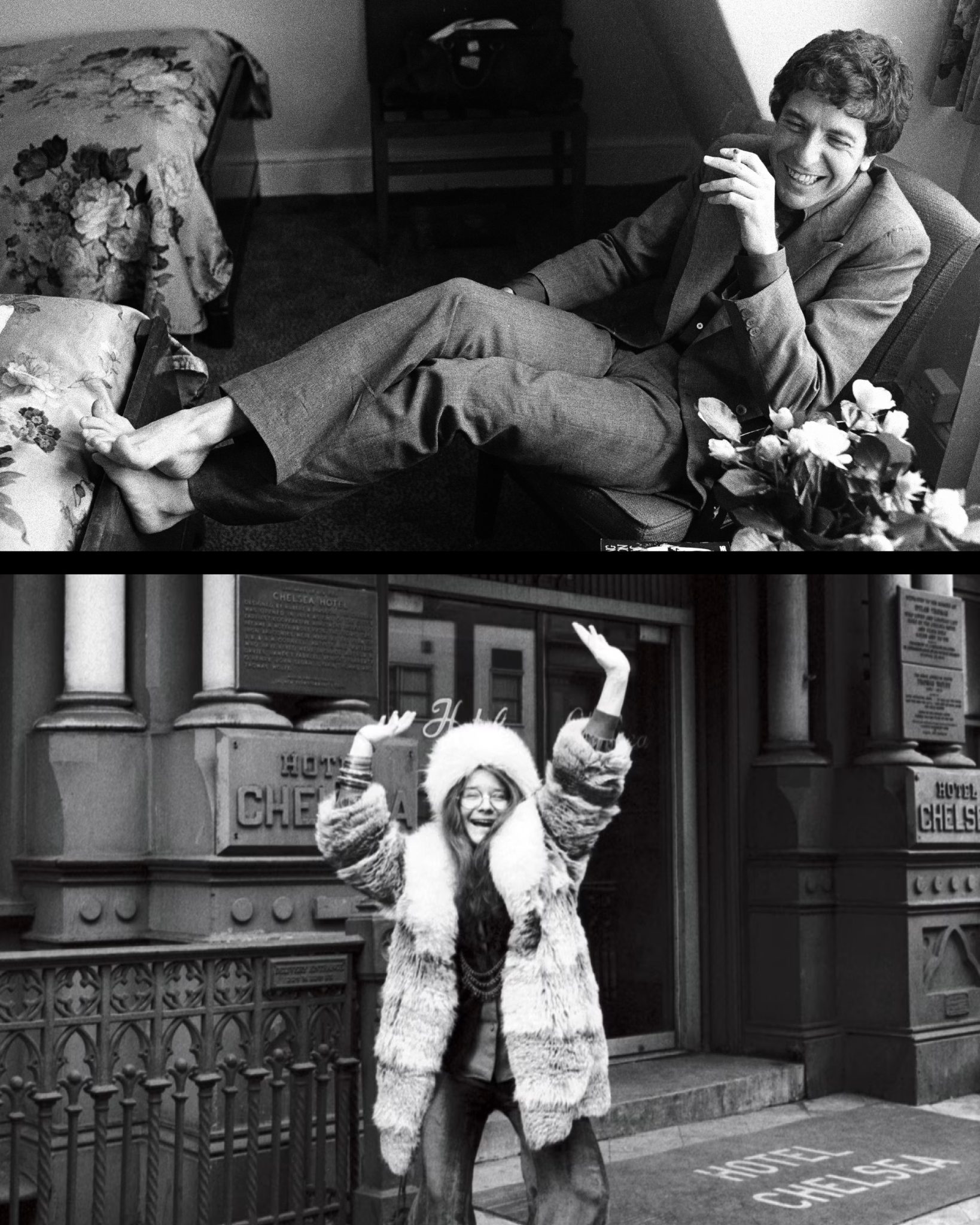
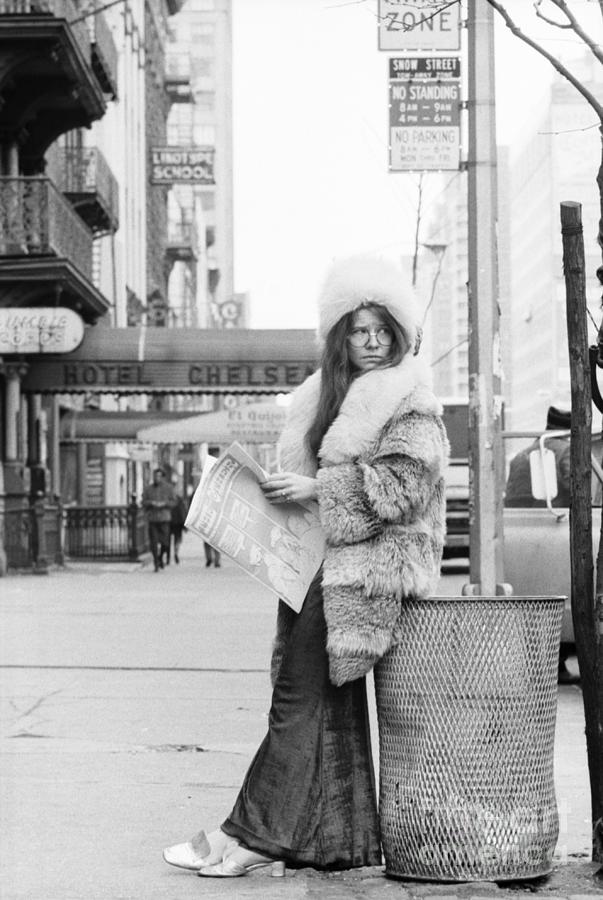
Leonard Cohen and Janis Joplin, both pictured at the Chelsea Hotel in New York in the late 1960s
Keith Moon, the late drummer of The Who, had a habit of flushing cherry bombs down hotel toilets. His antics were often so violent and chaotic they ended with the band being thrown out of the establishment they were staying in. Moon once caused them to incur a lifetime ban from all Holiday Inns for celebrating his 21st birthday at their Flint, Michigan location with a food fight and brawl that ended with him allegedly driving a Lincoln Continental into the hotel swimming pool. Joni Mitchell and Leonard Cohen wrote lyrics about the Chelsea Hotel and the latter’s encounter with Janis Joplin is well-known and immortalized in song (less well-known is how they met, in the Chelsea Hotel’s elevator, where Joplin claimed to be looking for Kris Kristofersson and Cohen joked that we was looking for Brigitte Bardot). And there are those smoky hotel room scenes in D. A. Pennebaker’s documentary Don’t Look Back where Bob Dylan, shades on, cigarette between his knuckles, sits around his suite at the Savoy in London, playing guitar, surrounded by managers and journalists and hotel staffers in neatly pressed uniforms. The entire thing feels like a set piece for the “life of a rockstar.” The fact that a man pulled a knife on Dylan a year later after calling him “a traitor to folk music” at the North British Hotel, in Glasgow, is its final flourish.

Charli XCX’s 2026 music video for ‘Rock Music’, directed by Aidan Zamiri.
Then there are the tragedies and other stories of the lesser-known hotels that are slightly less folkloric, perhaps because they are simply sad and harder to sensationalize. Chet Baker fell to his death from a second-story window at the Prins Hendrik Hotel in Amsterdam. Ray Davies of the Kinks wrote the song “Sitting in my Hotel” from the luxury hotel rooms that became the band’s prison cells while touring North America. Janis Joplin slipped away from an accidental heroin overdose in 1970, at the Landmark Motor Hotel. Even Almost Famous, with much of or most of the film taking place on tour, captures the spiritless grind of moving from hotel room to hotel room, each of them blurring together to form a single stage upon which the benders and disappointments and angsts and betrayals of the film’s characters dance from start to finish.
Almost Famous is broadly interested in the act of imitating a lifestyle fueled by myth, but it’s also specifically interested in the 1970s. Maybe the hotel trashing stories and dramas of that era have few contemporary equivalents and documentaries, films, and essays like this one that ruminate on them are evidence that that time is no longer with us. Yet the role hotels play in today’s music culture has undoubtedly carried on and adopted its own identity well into the 21st century. Charli XCX’s music video for “Rock Music,” a song on her recent Music, Fashion, Film album directly parodies the hotel trashing myths of the 1960s and 70s. In it, we see tall mountains of cigarettes, smashed guitars, and leftover room service in a hotel room that vaguely resembles Bob Dylan’s hideout at The Savoy. That the song’s music video opens with a television being pushed out of a hotel room window is as clear a nod to Keith Moon—who adopted the habit in the 1960s, and Keith Richards, who followed suit once in the 1970s—as anything. These self-aware parodies and commentaries on fame, myth, entertainment, and image are a fixture of our times in a way that contrasts starkly with their 20th century precedents. There are many more examples of this, including the Arctic Monkeys’ Tranquility Base Hotel & Casino album, which uses a fictional sci-fi hotel to satirize similar issues of fame obsession, star treatment, and the empty, vapid experience of staying in the modern leisure or chain hotel.

“Staying in them might be like being backstage, where the performance continues, long after the lights are turned down and the crowd filters out.”
In his song, Ray Davies called the hotel “just a symbol for my isolation.” “We had all the trappings of that success around us,” he observed, ”but there I was, in the middle of it all, asking the question ‘Who am I?’” All the myths, legends, and stories mentioned in this essay, and not, are naturally part of the cultural lexicon. They continue to tantalize the imagination and the rooms that were host to them will forever be their synonyms. Fictional characters will persist in emulating them. Hotels will continue to represent the physical spaces in which the fantasy of what it’s like to be a rock star or musician or artist is allowed to play out. But the more interesting question at the heart of all of this is the only one that ever seems worth asking about a myth, true or not. Why? Where did it come from? Why do so many of these episodes take place in hotels? Is it merely that that’s where musicians spend a great deal if not the majority of their time on tour? Or do hotels that end up getting called “iconic” or “institutional” provide the people that stayed there, the mythmakers, with the very thing that enables them to weave stories out of those spaces? Hotel rooms are physical suspensions. Not home. Not public. They’re the world’s temporary rooms, they hold the illusion of being able to respawn and retract into what they were before their guests ever occupied them. Staying in them might be like being backstage, where the performance continues, long after the lights are turned down and the crowd filters out.