

Opening the Un Certain Regard category at Cannes, Jane Schoenbrun caters to cinephiles with this nerdy homage to the slasher that is “sensual, indulgent and a little disgusting.”
A young woman drives to a remote cabin in the woods. What happens next? Two distinct yet linked eventualities surely come to mind. “Flesh and fluids” are the foci of Teenage Sex and Death at Camp Miasma–the corpse of a classic slasher film reworked into something funny, sexy, and far more slippery: a pitch-dark romantic comedy that doubles as trenchant critique of contemporary Hollywood, holding to account the hackier impulses of the horror genre and operating as a strangely piquant corrective to the misogyny of the industry and its decades-long pathologisation of trans people.
That Camp Miasma found an enthusiastic audience at Cannes is no surprise: Schoenbrun’s film is unabashedly for the cinephiles. In an opening scene that evokes the Satanic panic, VHS video rentals, tie-in merch, and sequel fatigue, the movie keeps the cultural landscape of the 1990s squarely in its rearview. But the question of desire and the particulars of pleasure in physical existence are the themes at the blackened core of its weird thrumming heart.
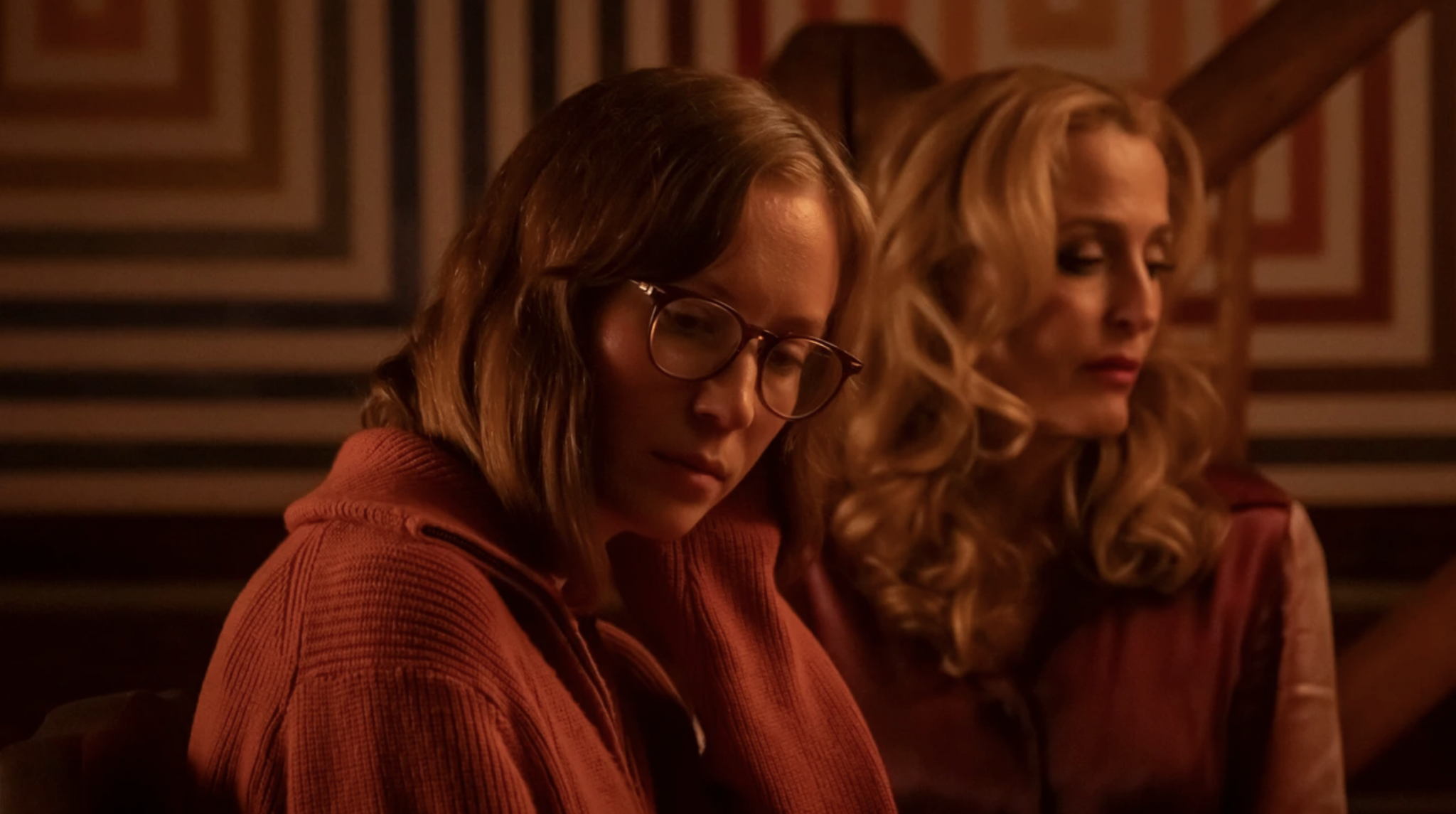
The story follows Kris (Hannah Einbinder) a nerdy, repressed, non-binary filmmaker tasked with resurrecting and wokifying the “zombie IP” of the schlocky horror franchise she grew up fascinated with. Wide-eyed in round glasses and bunny slippers, she finds herself spending the night in the isolated home of Billy Presley (Gillian Anderson), who is introduced by the sound of her clopping heels. Now an elegant, weed-smoking dowager living in the abandoned campsite where she filmed that first movie, her suave visage emanates from under the wide brim of a plum-coloured fedora.
Kris’ sweet tooth marries with Billy’s stonerism and the pair tear through shared joints, sweets, and fried chicken with sachet after sachet of dipping sauce. Their indulgence is sensual, indulgent, and a little disgusting, like some of the best things in life are. Away from her sweet-yet-oblivious polyamorous partner (Jasmine Savoy-Brown), hectoring agent (Sarah Sherman), and the bland executives don’t understand her experimental vision, Kris feels her determination to have Billy star in her reboot shift into a powerful want for Billy herself.
Part of this is, of course, Billy’s connection to the films that Kris was raised on. Their killer antagonist Little Death (Jack Haven) – the violent, vengeful spirit of a gender non-conforming child who was drowned at the camp years ago, now resides at the bottom of Lake Miasma. Rumour has it, that’s where the movies come from. Little Death’s character design is simple, but impressively multi-functional as a symbol: their box-shaped gunmetal mask resembles an industrial vent, a collapsing black hole, an early cinematograph camera and a blocky television set all in one. In various places, Schoenbrun borrows the datamoshed visuals of their first film (We’re All Going to the World’s Fair) to heighten the sense of dissolution between fact and reality. Additionally there are clear parallels to I Saw the TV Glow, which also emphasises the transformative nature of the media we consume as children.

“[W]here other directors might play into the queer aversion that has become something of a cinematic tradition, Schoenbrun presents a confident, ambitious eroticism.”
While Schoenbrun’s film feels singular in many ways, the film’s central dynamic – a homoerotic connection between two diametrically-opposed women – is recognisable in a number of recent projects. In David Lowery’s Mother Mary, another ghostly two-hander and chamber play, its central characters also spend much of the runtime talking about the past. Unlike Schoenbrun’s film, their mutual attraction is never made overt, and the pay-off arrives in the form of an Iris van Herpen dress rather than an earth-shattering orgasm. Pete Ohs’ understated drama Erupcja contains another example of this type of imbalanced interaction with its protagonist being a tourist (and therefore the more vulnerable party) in Warsaw, the home city of a friend with whom she shares an intimate connection. Once again, the romance is only subtextual; given that an official yuri zine featuring its leads was distributed around the film’s release, one can’t help but sense a missed opportunity.
But where other directors might play into the queer aversion that has become something of a cinematic tradition, Schoenbrun presents a confident, ambitious eroticism. As I watched Camp Miasma in the 1068-seater Salle Debussy, I was reminded of an effect described in Xuanlin Tham’s Revolutionary Desires, regarding how the sex scene is able to reacquaint you with your body: “Think about the blood rush it instigates, maybe the held breath; the heightened awareness of other people in the room, the way you might begin to feel your clothes against your skin.”
In Camp Miasma, death is fast and easy – the swipe of a blade yields an instantaneous geyser of blood. By comparison, sex (and by extension life) is difficult, far longer and more uncertain. Schoenbrun has spoken about the story as a means of reckoning with their own sex life, and embracing the “new terror” of trying to enjoy it in their post-transition body. Perhaps truly wanting something is the scariest prospect of them all.