

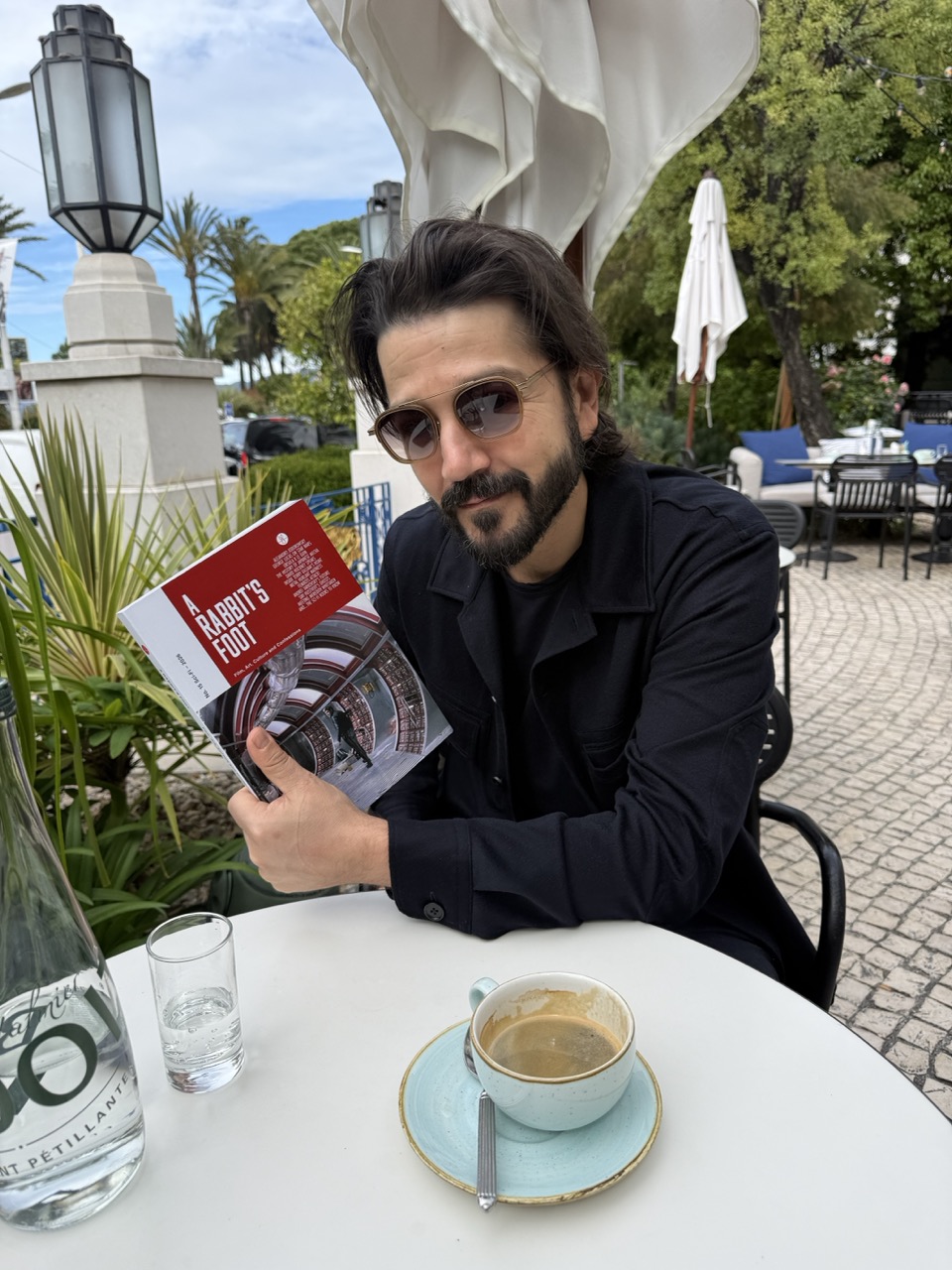
Next up in our series of quick conversations at Cannes: Diego Luna. The actor-director is taking a break from his duties as the lead of acclaimed Star Wars TV spinoff Andor to premiere his latest directorial effort Ashes in the Special Screenings strand at the festival this year, and joined us for a quick chat where he discusses his memories attending the festival with Alfonso Cuaron and Gael Garcia Bernal, the importance of challenging audiences with his cinema, and why, after 20 years in attendance, the festival community has become like a family for him.
Congratulations on the premiere of Ashes! How did it go?
It was very special! I was moved by the reaction. It’s been a long journey, and I saved the experience for the festival. I had shown a few people the movie, to hear their opinions, but I was never in a room with more than two people. I saved the experience for the Cannes screening, and it was worth it. It was nice to finally get confirmation of the work you’ve been doing for so long.
There’s also this beautiful thing that happens at Cannes, where a good third of the people inside the cinema were either from Mexico, or Latin American, or Spanish speakers. They react in a way to certain things. Then you have the French, who you can tell are reading the subtitles because their reactions are a little bit late. Then you have members of the industry there that you’ve known for so long. I’ve been coming to this festival for more than 20 years, so it’s like a family.
Considering the timely themes, did you feel any nerves bringing it to a stage as big as Cannes?
The opposite. I think it’s important to raise questions, trigger debate and confront audiences. I like that cinema. I am always trying to defend that beautiful thing that happens when you’re confronted with an event that includes all the people you don’t know, but now share something with through the art. I like cinema when it challenges you, and migration is happening. There’s no way to suggest it’s not, and you are part of it. You’re either the one moving or receiving, there’s no way to remove yourself from the equation. So it’s important to think about what we’re doing and not doing. It says a lot about who we are. I don’t think we’ve been the best version of ourselves. We have an opportunity here to open up and learn to accept our ignorance. The main issue is ignorance. That’s the wall we’ve built that needs tearing down.
Your friends and Y tu mamá también collaborators Gael and Alfonso were also at the premiere, which the internet was quick to celebrate. How was that for you?
It was special. Gael was meant to be there as an executive producer of the film. He’s been my partner for a long time. We always work with each other. But Alfonso being there was just a part of the wonderful magic of Cannes. I got to the opening night screening and they sat us together. I didn’t know he would be there, and he didn’t know I would be there. It was beautiful. I said to him, ‘my film is tomorrow’ and he said, ‘perfect, I’ll be there!’ Sharing that moment at the premiere was special. Previously, I’ve shared the film with him beforehand, but this time I was able to surprise him.
Do you usually reach out for his opinion when directing a feature?
“Usually” isn’t a word I can use, because I’ve only directed five times in 17 years. It’s been many years since my previous films. I blame it on the format of TV. Doing Narcos and then Andor made things difficult. It allowed me to do movies as an actor, but not a director. It’s non-stop work in a machinery that requires you to either be prepping, shooting or promoting.
“The first time I attended was Amores Perros. It was screened at the Semaine de la Critique, and Alfonso decided to bring me and Gael. We were about to start shooting Y Tu Mama Tambien, so we came to support Amores Perros and to sell our film. He turned to me and said, “you’ve got to witness this, because next year, it’s your turn.” We had a wonderful experience. Amores Perros was a surprise hit at the festival.”
Diego Luna
Has your relationship with Alfonso evolved since you began directing?
We worked very closely during a very important moment of our lives, then I worked with him closely as a producer, but never again with him as a director. But directing has changed the way I interact with the whole industry. You become aware of so many things that as an actor you don’t get to witness. There’s actually this logic that actors need to be protected from what goes on behind the curtain, which I completely disagree with. The cinema I like doing is when I’m able to inform my actors of every step of the process. They are my allies through the journey. Maybe it’s because, as an actor, I don’t have a method that requires complete isolation [laughs] I don’t understand it. Actors are amazing allies when they know what’s at risk. Sometimes you need the help of an actor to get away with something that’s going completely South. I also like the idea of moving towards a vision with the energy and commitment from everyone. Directing isn’t a lonely journey for me. There has to be that feeling of leadership, but the best work comes from everyone putting their heads together to solve a problem. So, yes, directing has changed the way I behave as an actor, as a producer, as a friend.
Do you remember your first time attending Cannes?
The first time I attended was Amores perros. It was screened at the Semaine de la Critique, and Alfonso decided to bring me and Gael. We were about to start shooting Y tu mamá también, so we came to support Amores perros and to sell our film. He turned to me and said, “you’ve got to witness this, because next year, it’s your turn.” We had a wonderful experience. Amores perros was a surprise hit at the festival.
Does it feel different attending the festival as a director?
The first time as a director, when I attended with Abel, was really important. We screened at what today is the Agnes Varda theatre. My father was there. Thierry [Fremaux] gave a beautiful introduction. We organised a huge party—we brought the actors, the team, and we celebrated beautifully. It meant a lot to suddenly be exposed to the good and bad of the industry. That’s being a director. The good reviews, the scathing reviews. You go through a beautiful experience with an audience, then you’re confronted with the reviews. It’s hardcore shit [laughs]. But you come to terms with it. You come to terms with what those reviews mean. A good or bad review is just that. The experience that matters most is the one you have making it and the one the audience keeps.
But on a level, it all matters. The reviews matter. The interviews are important. The events. Everything around this film festival matters, and it makes me feel like a part of a community. I’ve been here as an audience member, an actor, a producer, and a director. Cannes has been wonderful to me. The premiere of this film has been the most special memory of all my years going to the festival.
What are you looking forward to watching most in the lineup?
Sadly when you come with a film—and this one, for me, is as personal as emotional investment as it gets, to the point where I almost sold my car to make it—you don’t stop with promotion. I’m trying to get this film out there. So, this year, the only film I had the opportunity to watch was the opening night one. But I’m seeing a film by Valentina Maurel. It’s a Costa Rican film called Ton animal maternel. It’s in Un certain regard. That’s the only film I’m going to see in the cinema, and I’m very proud and excited that it’s that one.