California Mystic: Jeff Buckley and Nusrat Fateh Ali Khan




Get unlimited access to all our articles for just £3.50 per month, with an introductory offer of just £1 for the first month!
SUBSCRIBEGrammy-winning singer and composer Arooj Aftab explores the unexpected link between Jeff Buckley and Pakistani icon Nusrat Fateh Ali Khan, and how the Californian songwriter became a devoted student of Sufi Qawali music.
When I look at my life and career now, it feels like there is this profound, almost cosmic thread running between three people: Nusrat Fateh Ali Khan, Jeff Buckley, and myself. It’s not a lineage I ever sat down and designed. I didn’t think, “I’m going to follow in their footsteps.” It has all unfolded really organically, in a way that feels gentle, and beautiful, and, in many ways, very Sufi.
One of the first voices that ever shook me awake was Nusrat’s. I was about six years old, in our family’s Chevy Caprice Classic—my dad driving, my mum in the passenger seat, my siblings and I in the back—while my dad played Nusrat cassettes. Those drives are where I first felt a really deep connection with Nusrat’s voice and music. Even as a child, I was very aware of my imagination. I didn’t need much to start creating worlds and universes in my head. But Nusrat’s music was the first that actually teleported me—it flipped a switch and became a catalyst for my imagination.
He was also, as he is for most Pakistanis, an omnipresent sound. Once you hear him, you hear him for the rest of your life: at weddings, in cars, at coffee shops, at parties. We play him for almost any occasion. He slips so seamlessly into your life that you stop noticing when he starts or ends; he just becomes part of the cultural air you breathe.
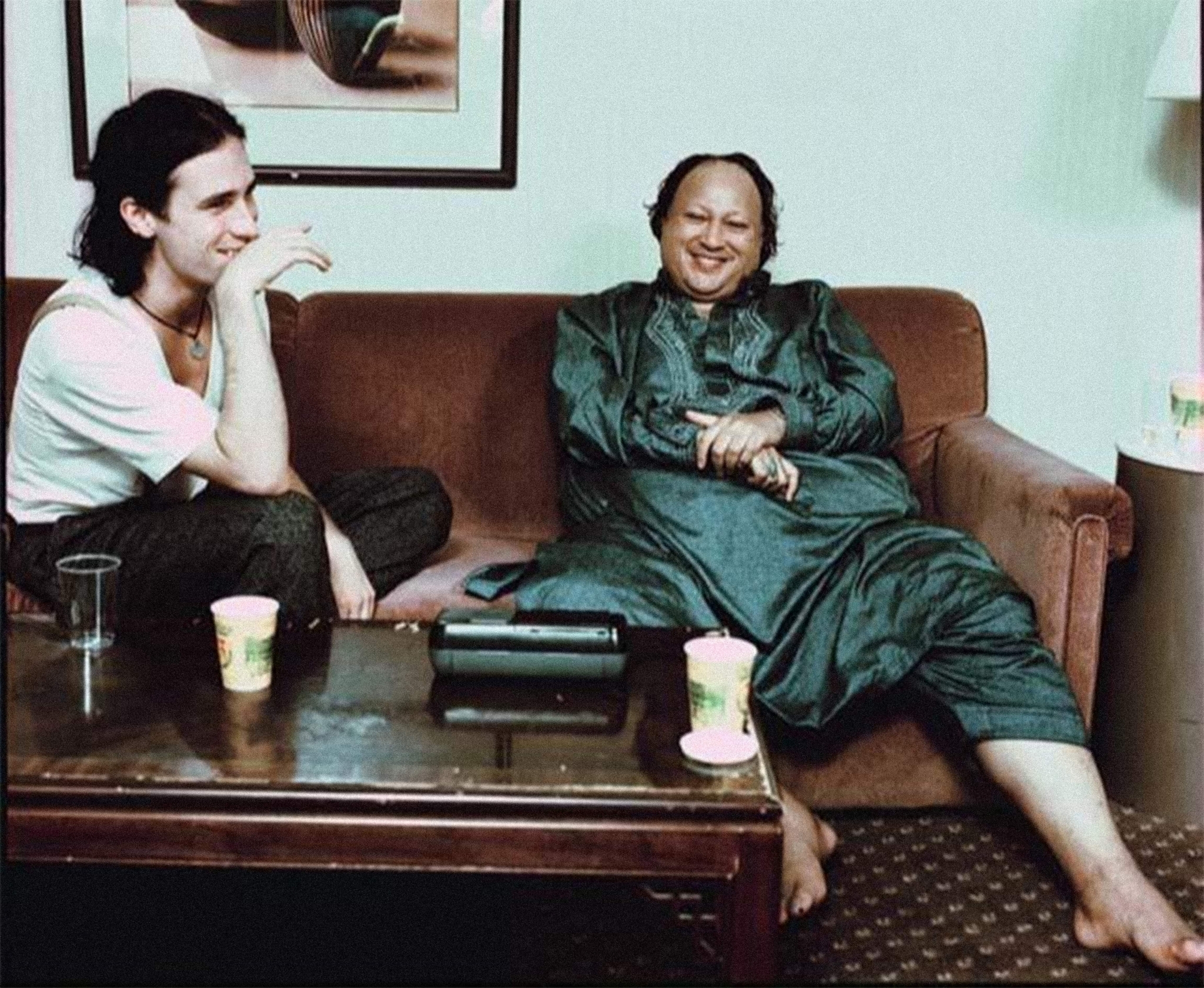
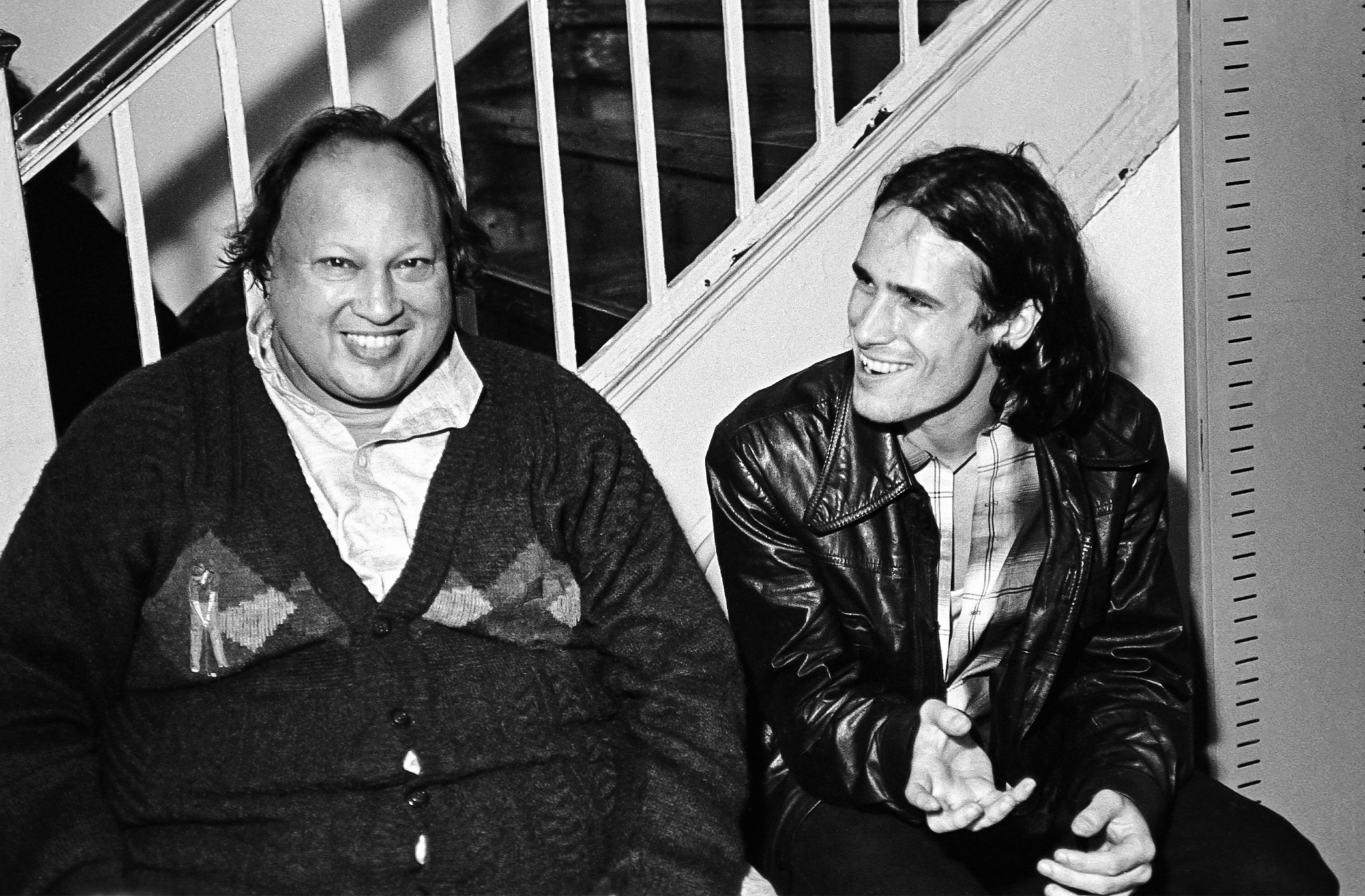
Nusrat Fateh Ali Khan and Jeff Buckley
I moved to Pakistan when I was 11, in 1996. A year later, Jeff Buckley passed away and unbeknownst to me, he was an admirer of the same voice that had already been shaping me for years. In liner notes he had written on Nusrat’s music, he explained, “I felt a rush of adrenaline in my chest, like I was on the edge of a cliff, wondering when I would jump and how well the ocean would catch me.” Eerily he passed into the other realm through a body of water. Another very deep and cosmic parallel that is so characteristic of Jeff, to be so moved by music to then filter it into his own reality.
As a teenager, I listened to everything: jazz, classical, rock, pop—Eminem, Backstreet Boys, whatever everyone was into—but I had this vast hunger for all kinds of music. Somewhere in there I found Leonard Cohen, and a friend said, “You should listen to Jeff Buckley.” I remember being 17 or 18, putting on his one studio album, with songs like Lover, You Should’ve Come Over (1994), and just being completely dismantled. It was like what happened with Nusrat when I was six. I can count on one hand the artists who have had that kind of effect on me.
“Nusrat once said that musicians can go into the void between flesh and spirit and come back with messages from God. That’s what his music felt like to me as a child, and it’s the same space I sense in Jeff.”
This was before you could instantly Google an artist and see their entire life story. You put on a record and had a singular, unfiltered experience with a stranger and their music. That’s how I knew both Nusrat and Jeff at first: through the sound alone. I didn’t know what haunted them, what brought them joy, what their childhoods were like. With Nusrat, we still don’t really know; he wasn’t interviewed in that revealing, Western, biographical way. We’ll never fully understand the personal well he drew from.
Later, I learned that for Jeff, Nusrat and Nina Simone were his two greatest influences, but at the beginning I didn’t know any of that. I didn’t even know he loved Nusrat. How did this handsome brown-eyed Californian feel such an affinity to a Qawali singer? Regardless, I just knew this record had arrived in my life and rearranged everything.
At one point, I decided to apply to music school. Explaining that to my parents was difficult—they didn’t know what a music career meant, whether it meant financial security, or even whether I was truly good at it. I had nothing to show them. What I did have was a recording of myself singing Hallelujah (Jeff’s version of Leonard Cohen’s 1984 song), with a friend on guitar. We’d done it for ourselves because I loved the song so much.
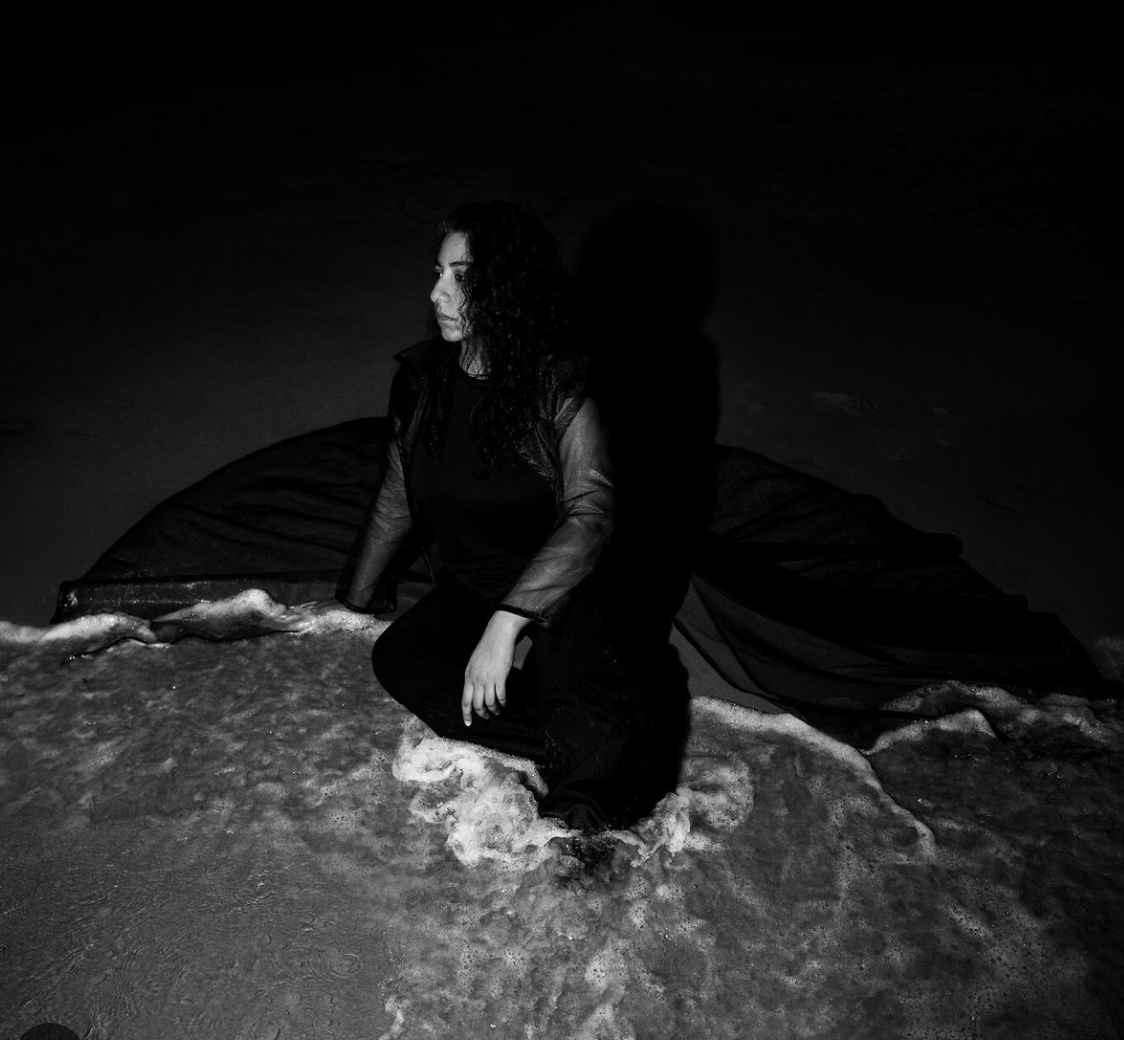
Album by Arooj Aftab: Night Reign (2024)
There was this ongoing tension about Berklee, about going to Boston, about their worries, and one day I just pulled my dad over to the computer, put these tiny, flimsy headphones on his head, and pressed play. I didn’t prepare a speech or watch his face while it played. He just sat there and surrendered to the moment. When the song ended, he took off the headphones, looked at me, and said, “Okay. Okay. Okay.”
That was one of the most pivotal moments of my life. He had been moved enough by that cover—Jeff’s arrangement, Leonard’s song, through my voice—that he finally understood I had to pursue music. That “yes” came to me through Jeff, who had himself been transformed by Nusrat.
Later, that cover went viral. I did a lot of interviews, and people would ask me about Jeff. I remember once saying, “Don’t tell Jeff,” and the interviewer replying, “Well, I can’t.” That was the moment I finally looked him up properly and discovered he had died. From then on, I just carried his music with me.
I carried both Nusrat and Jeff into college, into my music education, and then into my life in New York. For almost a decade and a half now, every show I do begins with my own version of Nusrat’s Ye Jo Halka Halka Suroor Hai (1992). Only recently did it really hit me that this is the same song Jeff sang of Nusrat’s in the one recording we have of him doing so. These connections keep revealing themselves as I think more deeply about this piece; it’s honestly very awe inspiring.
In New York, I met people like Michael Tighe and Joan Wasser, who were close to Jeff. They talk about him as though he’s still just in the next room—someone you just missed. Listening again to his music as an adult, after living and working for years, I can hear Nusrat shining through his singing: in the phrasing, in the emotional leaps, in that willingness to inhabit a kind of spiritual extremity. There’s a reckless tenderness, a daredevil softness, that I recognise in both of them—and, in a way, in myself.
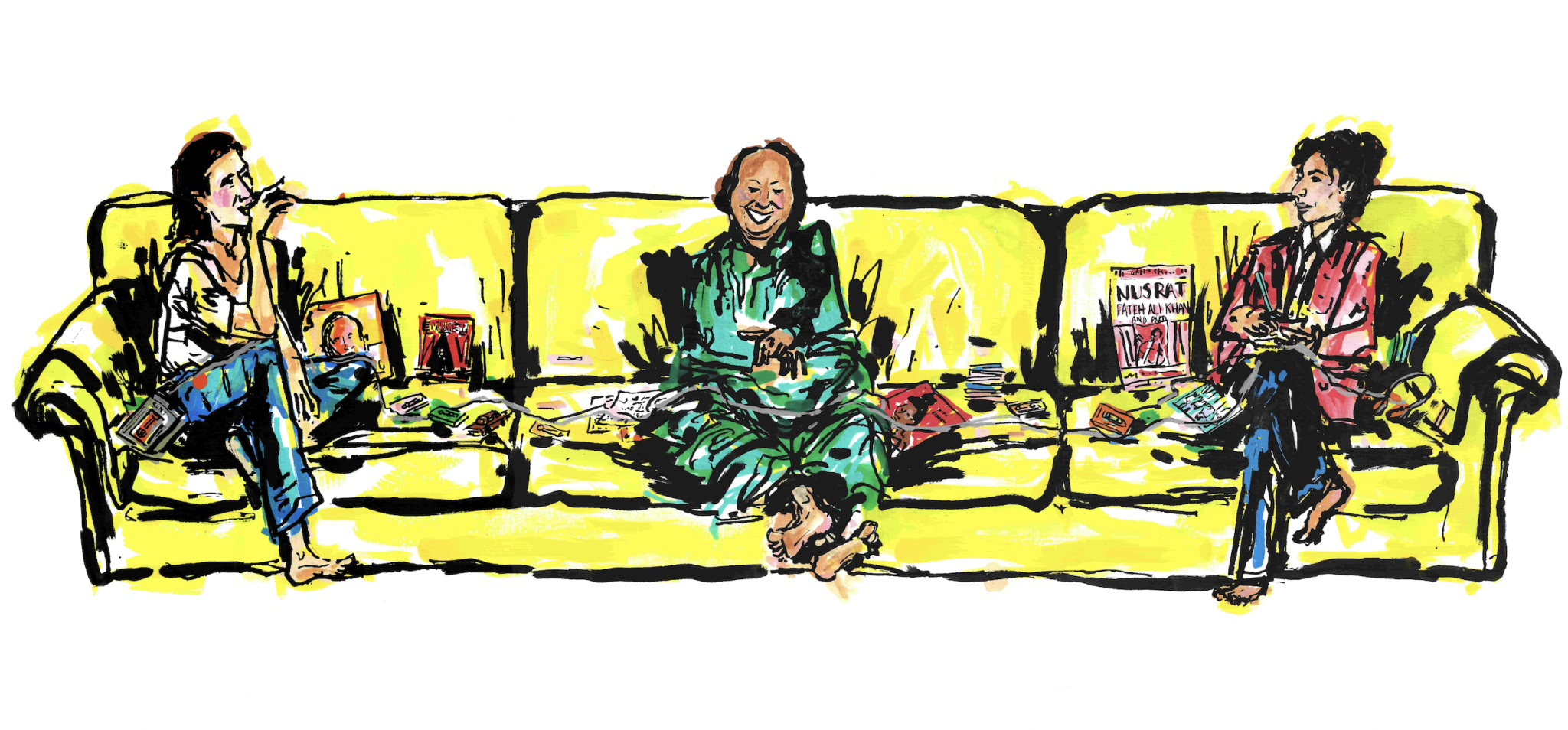
Jeff, Nusrat, and Arooj. By Natasha Nayee.
Nusrat once said that musicians can go into the void between flesh and spirit and come back with messages from God. That’s what his music felt like to me as a child, and it’s the same space I sense in Jeff. Nusrat would say he wasn’t Sufi, but that he “follows the design”—the repetitions, the spirals, the way the music builds and dissolves. Jeff, who dove into Nusrat’s recordings, collected cassettes, studied Urdu, and even interviewed him, also followed that design. He approached Nusrat with genuine curiosity, not exoticisation. He wanted to understand the tradition, the innovation, the spiritual dimension behind the sound. It wasn’t just romanticism.
I’ve come to feel that the three of us share a certain way of moving through music: not as rigid guardians of a tradition, and not as shallow fusion artists either, but as people who are willing to change the shape without changing the form. Nusrat softened and reshaped qawwali to keep it alive and accessible without betraying its essence. I try to do something similar in my work—embedding hidden complexities and secrets inside music that may seem simple on the surface. Jeff internalized both Nusrat and Nina so deeply that, even if you don’t consciously hear them, their ghosts move through his voice.
So the relationship between Nusrat, Jeff, and me is not just a chain of influence; it’s a braided lineage. Nusrat to Jeff, Nusrat to me, Jeff to me—threads that cross continents and decades, carried by tapes, by covers, by small personal moments, by other people’s memories. They’re both gone, but I feel them in my work as something almost intangible, moving through the air rather than sitting in any one body.
I don’t carry them as distant, untouchable icons. I carry them as companions—artists who showed me that you can be reckless and tender at the same time, spiritual without claiming the label, deeply rooted in tradition while daring to mutate it. We are all, in our own ways, following the same design, even if we never had the chance to sit in a room together and name it.
Main image: Nusrat Fateh Ali Khan and Jeff Buckley backstage at Khan’s concert in New York, 1995. By Jack Vartoogian.