

After eight Tony awards, a grammy, two North American tours, and countless trips to the underworld, the musical phenomenon is ready for the next stage in its remarkable journey: a filmed version of the live show.
It’s been a long road.
By the time theatre director Rachel Chavkin met singer-songwriter Anaïs Mitchell in 2012, a single image had long been seared into her mind. It had come to her while listening to Mitchell’s 2010 folk-opera concept album retelling the Greek myth of Orpheus and Eurydice, and it would soon become the base visual for one of the defining stage musicals of the past decade: Hadestown.
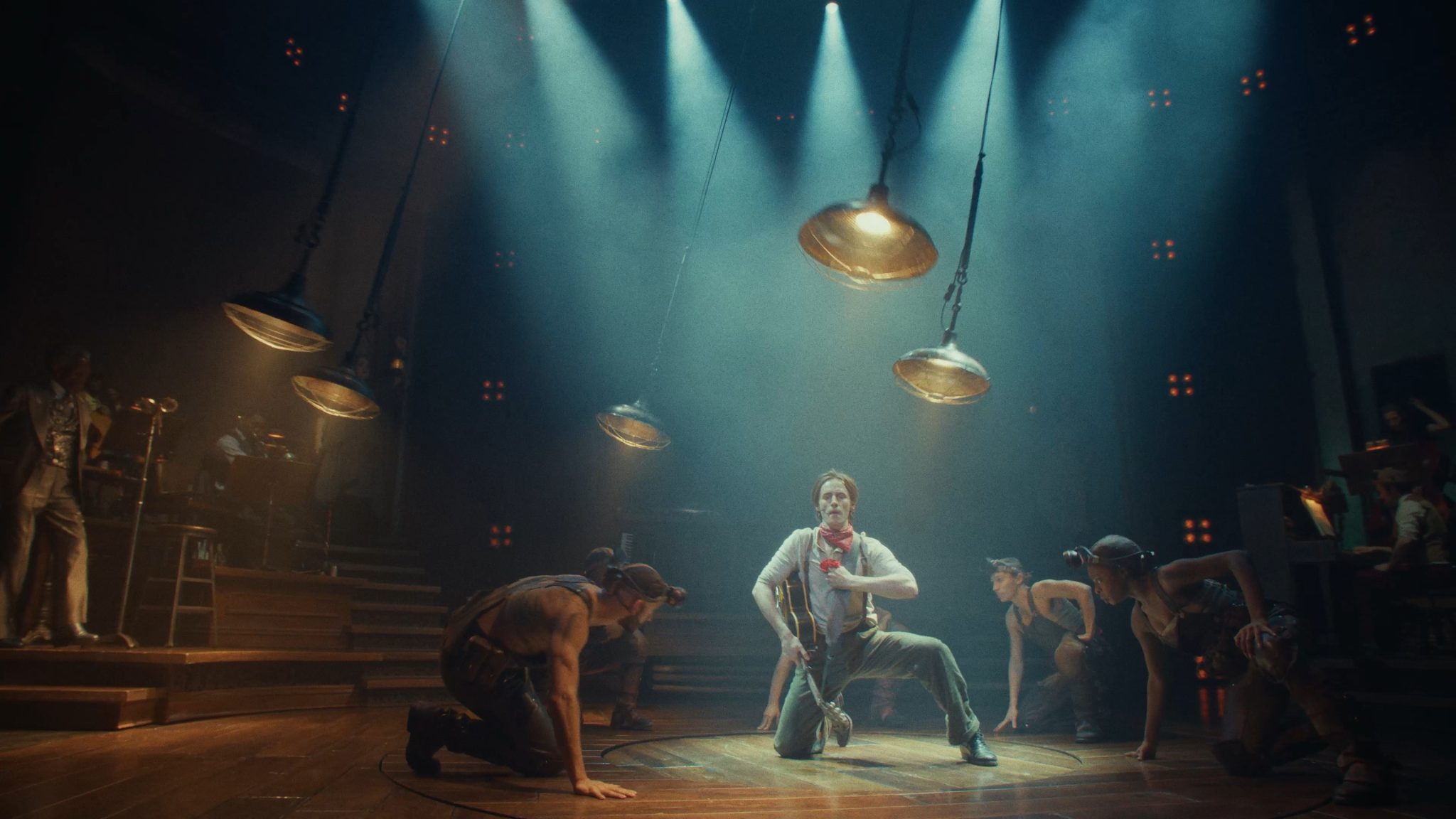
“It all started with this image of the swinging lamps,” she says, over a Zoom call. “I was listening to ‘Wait For Me’ from the original concept album, and I couldn’t shake this image of lamps swinging to and fro. There was just something about the surge of the music that encouraged that. It was the very first thing I ever said to Anaïs when I was throwing out ideas for the production, and the very first thing she said to me, which is something that I learned from her again and again, was that Hadestown is a poetry piece, not a prose piece. The swinging lamps were in harmony with the poetry of her music.”
By 2016, Hadestown was beginning to take shape as the musical we know today. Mitchell and Chavkin brought together a new company of performers at New York Theatre Workshop, Patrick Page (Hades) and Amber Gray (Persephone) among them, for the show’s original Off-Broadway run, featuring reworked music and staging. The following year, during a pre-Broadway engagement in Canada, they welcomed Reeve Carney—best known at the time for playing the title role in Broadway’s Spider-Man: Turn Off the Dark—as their brand new Orpheus. In 2018, Page, Carney and Gray were joined by rising star Eva Noblezada as Eurydice and legendary Broadway actor André De Shields as Hermes for the show’s acclaimed London run at the National Theatre. From there, the show finally made its way to Broadway, opening at the Walter Kerr Theatre in 2019 to rave reviews.
Eight Tony Awards, a Grammy, two North American tours, two leads-turned-husband-and-wife (Noblezada and Carney) and countless trips to the underworld later, the musical phenomenon Hadestown is ready for its next act. In early 2025, nearly six years after its run at the National Theatre, nine years after its Off-Broadway premiere and almost fifteen years after Mitchell released her original concept album, five of the original principals reunited at London’s Lyric Theatre for a series of performances, three of which were filmed by pro-shot master Brett Sullivan. After years of fan anticipation, Hadestown was finally being preserved on screen.
To mark the release of Hadestown: The Musical in UK cinemas, A Rabbit’s Foot spoke to six people instrumental in bringing the musical, and its filmed version, to life: original Broadway cast members Eva Noblezada (Eurydice), Reeve Carney (Orpheus), André De Shields (Hermes) and Patrick Page (Hades), director Rachel Chavkin and filmmaker Brett Sullivan. Together, our conversations explored the show’s remarkable journey, its enduring legacy, and what it meant to return to the West End to immortalise Hadestown for generations to come.
LG: How did it feel stepping out on stage as these characters again?
André De Shields (Hermes): It was a feeling of great satisfaction, and it was the end of a journey that began in London, at the National Theatre. We didn’t know we were going to Broadway when we first went to the National Theatre; we were simply in the process of putting the show together. The show has proved to be… Well, it’s been, what, eight years now, so maybe it’s going to be eternal.
Each of the original OGs had to decide: am I going to do this forever, or am I going to make the choice to leave and move on? When I made that choice in 2022, I felt very satisfied, certainly, with having won the Tony Award, but I also felt that my work was unfinished. I needed to pass it on to some other entity, some other actor. Then, when we finally got the opportunity to film it and return to London to do that, I thought, “Oh, well, we can tie a bow around this package and call it done.”
The very lesson of the show is that it never stops. We ask this question endlessly and depending upon the personality of the audience, you have to respond to their questions differently. So I could do Hadestown for the rest of my life, until I died, and never arrive at a single, totally satisfying response. This is the lesson in the actual show: you have to let go of the question and move on.
Eva Noblezada (Eurydice): We wanted to immortalise something that we put blood, sweat and tears into. It’s a sweet thought for me and Reeve to imagine our future kids saying, “let’s watch Hadestown!”
Patrick Page (Hades): It was such a crisis for me because I’d been so looking forward to making this film, and then 10 days before we were to shoot, I snapped my achilles. When your Achilles is snapped, there’s nothing connecting the foot to the calf muscle, and so it’s just a floppy thing down there, and you can’t really walk.
It was fully ruptured, but there is this thing called a vacoped boot. So they put me in that thing, and I realized that I couldn’t walk at all when I didn’t have that on, but with it on, it supported me. I called Rachel and Anaïs and asked if they thought that there was any way I might be able to make the film. The dance, of course, would be the big issue, and negotiating the stairs, but they said they were up for giving it a try. So we did, and there are things that are sort of camera magic in the pro shot, where it looks like I may be coming down the stairs, but in fact I’m not. But in the film, it absolutely allows me to play the part.
And what was interesting is that when I first did the role at New York Theater Workshop in 2016, I had gone to Rachel during previews and said, “I want to experiment with something physically. It feels to me that this man is somehow disabled, that he’s somehow wounded in a way that we’re not seeing, and so I said I want to experiment with a limp.” And it didn’t work. So we got rid of it, and there was something about Hades being quite feline or reptilian and powerful that ended up becoming useful. But when I injured myself, it was my chance to return to this original idea of a predatory stalk that he might have.
“I was terribly disappointed when I saw the film. [Pause]. Well, no, not really. It’s because of ego, right? It’s because I’m anticipating what Hermes is going to do, and when the camera doesn’t capture what I want to be captured, it’s like, “What the fuck? What are you doing?” But I got over it quickly because I felt myself leaning forward in my seat and resting my chin on my folded hands, and feeling emotions bubble up in me and quizzing myself: “Well, André, what would you do in the presence of silence?” Doubt would enter you also.”
André De Shields
LG: Did the cameras allow you to access a new kind of intimacy in your performances?
PP: I had someone say to me recently, “Well, certainly you must have altered the performances for close-ups.” No, we did the performances that we do, and it happens that a camera is close enough to read the subtext, which is quite wonderful because we had always felt, the five of us, that a great deal of what occurred between the characters was not on the page, not in the lyrics, but in what passes wordlessly between their eyes. It’s wonderful to have a record of the show in which that is captured.
ADS: I was terribly disappointed when I saw the film. [Pause]. Well, no, not really. It’s because of ego, right? It’s because I’m anticipating what Hermes is going to do, and when the camera doesn’t capture what I want to be captured, it’s like, “What the fuck? What are you doing?” But I got over it quickly because I felt myself leaning forward in my seat and resting my chin on my folded hands, and feeling emotions bubble up in me and quizzing myself: “Well, André, what would you do in the presence of silence?” Doubt would enter you also.
But now, with Hadestown having been filmed, I’ve crossed my own River Styx into an area where I didn’t have much of a presence. At least now people say, “Oh, that’s André De Shields, isn’t it? Oh, wow. He looks good on film,” or whatever they say. Because I’m not just a spiritual guy. I’ve got a Tony, I’ve got a Grammy, and I’ve got an Emmy. So I’m one alphabet from being an EGOT. When I get that! I don’t know how, don’t know where, but all I have to do to last is not give up—not turn around and look back. That will be the mountain that I will ascend next.
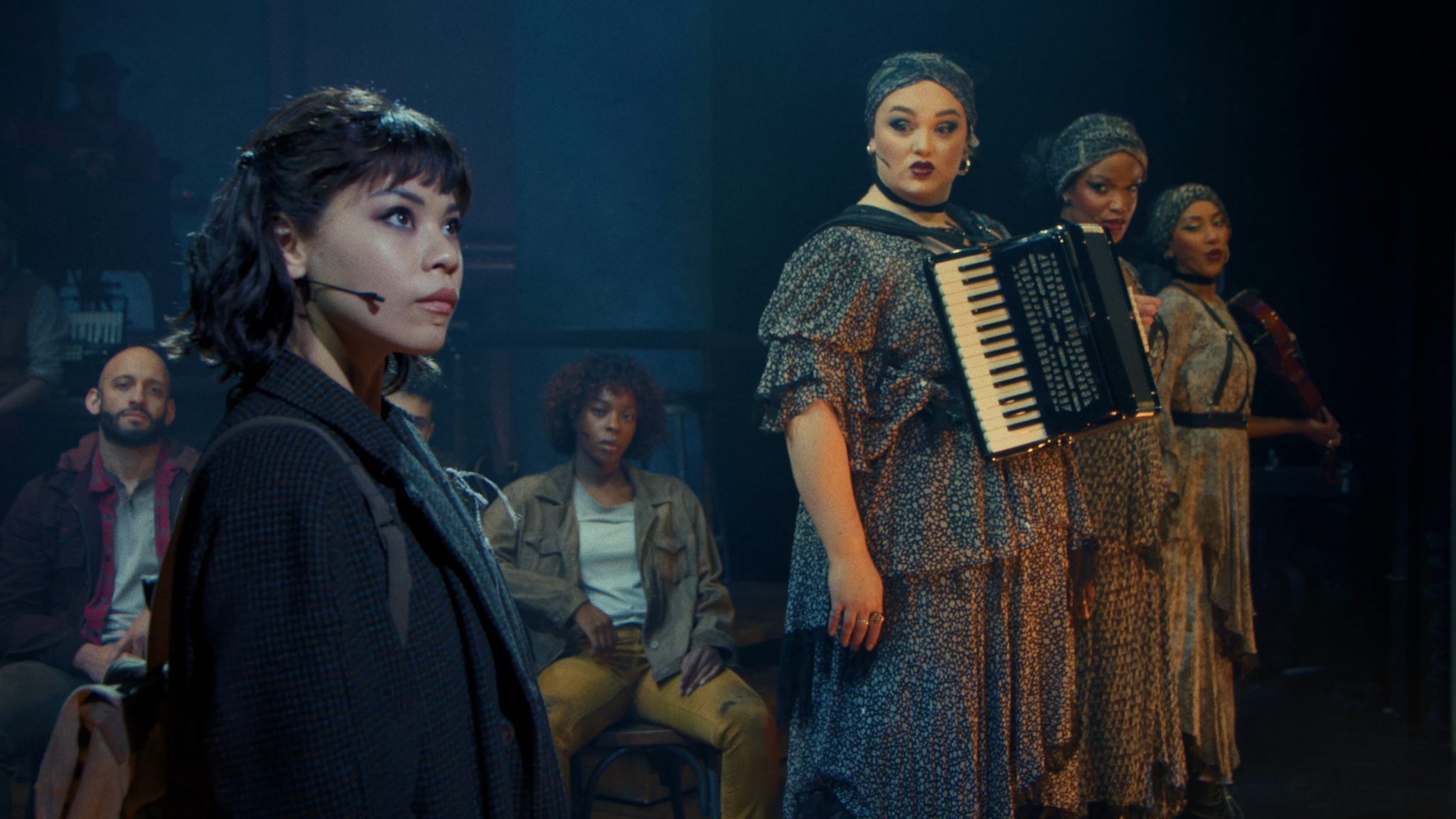
Rachel Chavkin (show director): There was a moment early on when we were starting to shoot “Any Way The Wind Blows,” where you see the Fates for the first time. I ran over to Brett [Sullivan], and I was like, the shots of the Fates are so beautiful, but they’re not right. The Fates should never be alone, because the Fates are not individual characters. They are a three-headed dog, and so if you begin to see them as individual performers, then you lose what they are as this supernatural force. And so Brett then adjusted the shots to always include multiple fates in a single shot. That’s one small illustration, but I was obviously bringing many, many years of familiarity with what the core of Hadestown is, and Brett was bringing this unbelievable capacity for cinematic storytelling.


LG: How has your relationship with your characters changed over time?
PP: I’m sure it has deepened, but my performance is entirely wedded to Amber Gray’s performance as Persephone. We have been with the show together the whole time since 2016, so in that way there has been a kind of stability. Now over that time, I think Persephone’s performance changed more, or who Persephone is, her dependence on alcohol, for example, I think became a larger factor, and Hades’ tracking of it became a larger factor. Her advocacy for the workers…you see, in that very first production, there were no workers. There was no chorus. There were just the five principals and the three fates. So you couldn’t have that same sense of “I want to stand up for these people” that she now has, so my performance has changed mainly in response to hers. My job is to just stay alert, since what I want is to reclaim my relationship with Persephone. My job has always just been to stay alert to how I might achieve that with Amber.
Reeve Carney (Orpheus): When you stay with a show this long, and you’re dealing with so many different types of different audiences, it’s natural that things will shift. My character changed the most throughout the whole run. I’ve suspected that Anais relates to the character of Orpheus—Anaïs is Orpheus. That’s gotta be tricky. When you’re writing a show and you, subconsciously or consciously, find yourself fitting into one character, I imagine that would be the hardest role to settle in on. For the first few years on Broadway, I was playing the character as guileless—that sort of went away for the film. In my opinion, Orpheus can’t be led by his ego. There’s a fine balance between ego and humility.
AS: This isn’t usually a part of the storytelling about the show, but in the fall of 2012, Anaïs came to New York, and for two weeks we were on an experimental contract. She was testing whether or not the skeleton that she had been working with, the album that she had been recording and taking around to different cabaret venues and getting great response to, would hold up on the structure of an actual musical. I was chosen at that moment to essay the role of Hermes. And then, after two weeks were over, as promised, Hadestown and Anaïs went their way, and I went my way.
But prior to going our separate ways, this is what I said to the character that I had created during the two weeks of that experimental contract, during which no promises were made to anybody, and we made few coins. I said, “Now, listen, Hermes, when you jump off commercially, come back to me. And as this covenant, I’m putting a piece of my DNA in you, so you have a homing device.” I know this sounds incredible, but this is what I did.
So it went away. Seven years later, after the premiere was done at the New York Theatre Workshop, I can’t explain where Anaïs was in her head, but she came back to me and said, “André, would you join a lab? We’re trying to work this out.” And I said, “Of course,” inside, enjoying this moment of glee, like a child who had finally gotten a cookie out of the jar. “Yes, Hermes, you’ve come home to the only person who understands you.” I knew that I had the literacy for Hermes. You can’t just sing a song. You can’t just tell a story. You have to weave a myth. You have the power to bring the people to the edge of their seat. You have to know when to recede into the shadows, not leave the stage per se, so that the audience knows, if they ever have a question, you’re there to answer it.
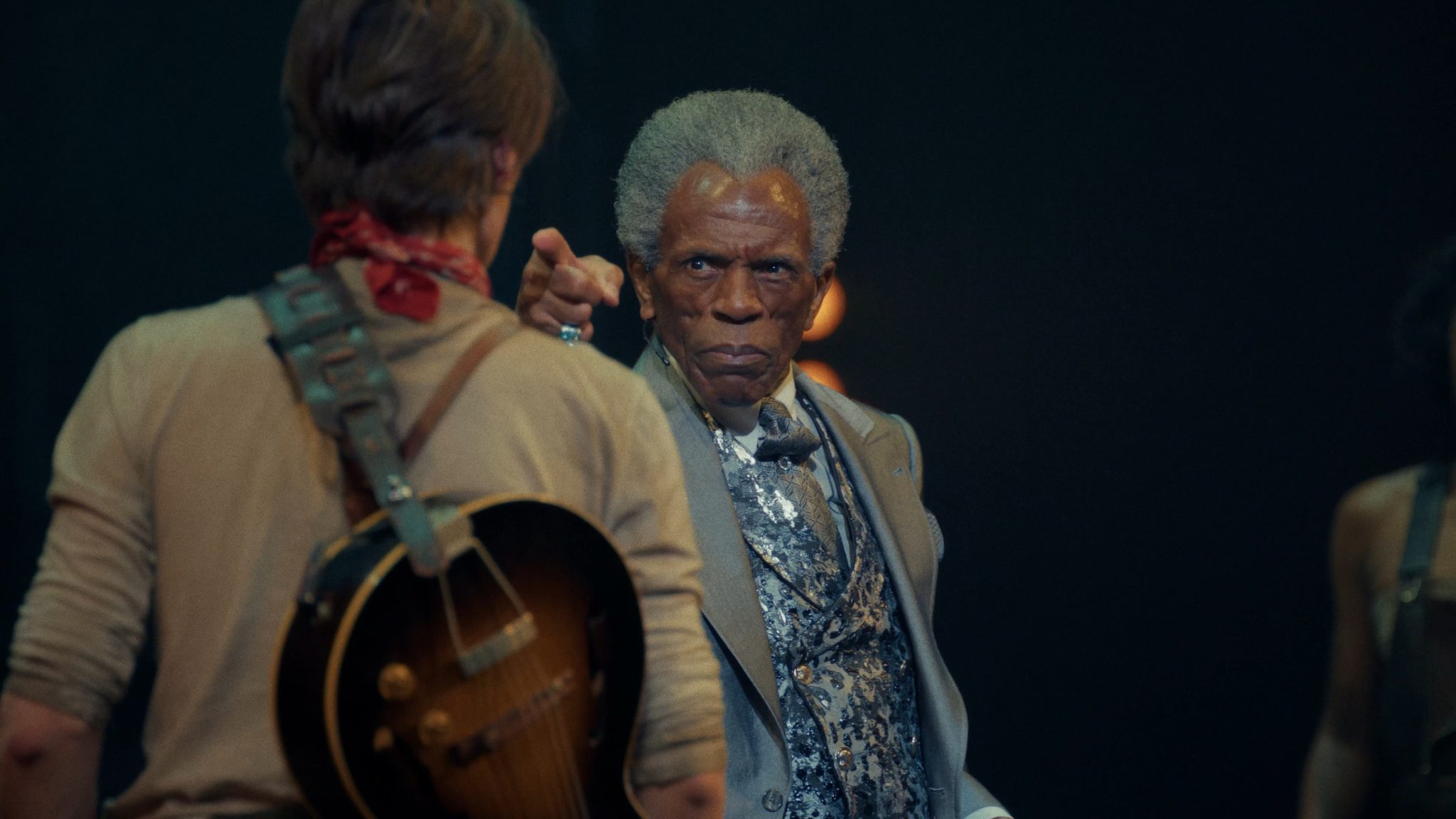
“Prior to going our separate ways, this is what I said to the character that I had created during the two weeks of that experimental contract, during which no promises were made to anybody, and we made few coins. I said, “Now, listen, Hermes, when you jump off commercially, come back to me. And as this covenant, I’m putting a piece of my DNA in you, so you have a homing device.” I know this sounds incredible, but this is what I did.”
André De Shields
LG: Andre, To me, you’ve always had the most difficult task in the show, which is to re-inspire hope in the audience after their hearts have been completely broken by the climactic tragedy. How have you always approached that responsibility and incorporated it into your performance?
AS: It was a great responsibility. Now, I mean that in two ways: great because it was a burden on the shoulders of the actor, but also great because that’s exactly what an actor wants to do. He wants to attempt to answer the only five questions that exist: who, what, where, when and why? So that was a pinnacle in my career, actually, to be given this opportunity not only to entertain but to enlighten and ultimately to bring a morsel of ecstasy to the audience. Because although there was this great disappointment at the end of the performance, I was aware of the faces of the audience, although they might be shedding tears, there was a kind of glow. And there’s no other word to use but ecstasy. There’s another opportunity to try to figure out this puzzle, this question posed by the Sphinx that no one has answered yet. So we’ll do it again until we get closer and closer to the answer. But of course, we can’t as humans. We aren’t gods; we fall short at the start of our seeking. And that is the hope of tomorrow, the next day, the next opportunity, and that takes a special kind of literacy, if you will. When I was trusted with the storytelling, I thought, yeah, this is what I wanted to do. For then, it was 55 years into my career. I wanted to be the storyteller; I wanted to be the searcher, the seeker.
Do you know the term griot? I was shocked that it wasn’t in the active vocabulary of the people with whom I was collaborating. Because in my history, griot is common. The griot is the individual who knows all about everything. And that’s what Hermes is. He’s a messenger to the gods. In my research, I came across the Corpus Hermeticum, which is a body of ancient knowledge about the three levels of Hermetic consciousness. What it’s about, essentially, is humanity in the presence of silence. Another great opportunity for learning about Hadestown was when Broadway had to close for 18 months because of the pandemic. As bad as the pandemic was, it wasn’t as torturous as people learning to live with themselves. And that’s one of the lessons of Hadestown. What do you do when you are exquisitely alone? That’s the opening of the door for doubt, as we say in the play.
LG: Reeve and Eva, you met on Hadestown and you’re now married. Was there ever a point where you talked about how that might change the way you play Orpheus and Eurydice?
RC: There was real concern about us getting together, actually! You always hear about movies where the chemistry ends up actually being horrible because the two leads were together. We were worried about that. But thank God, people didn’t seem to feel that way about us.
EN: Also, both of our approaches are that we both disappear into the roles. I grew up hearing this thing about, “oh, when you’re acting, bring something of yourself to the character” and I always found that to be more confusing, because then you’re splitting your brain in half on stage, and I don’t think that’s fair to the audience. So we set clear boundaries from the beginning on what is Eva and what is Eurydice, and what is Reeve and what is Orpheus. The worlds can inspire each other, but they should never exist at the same time.
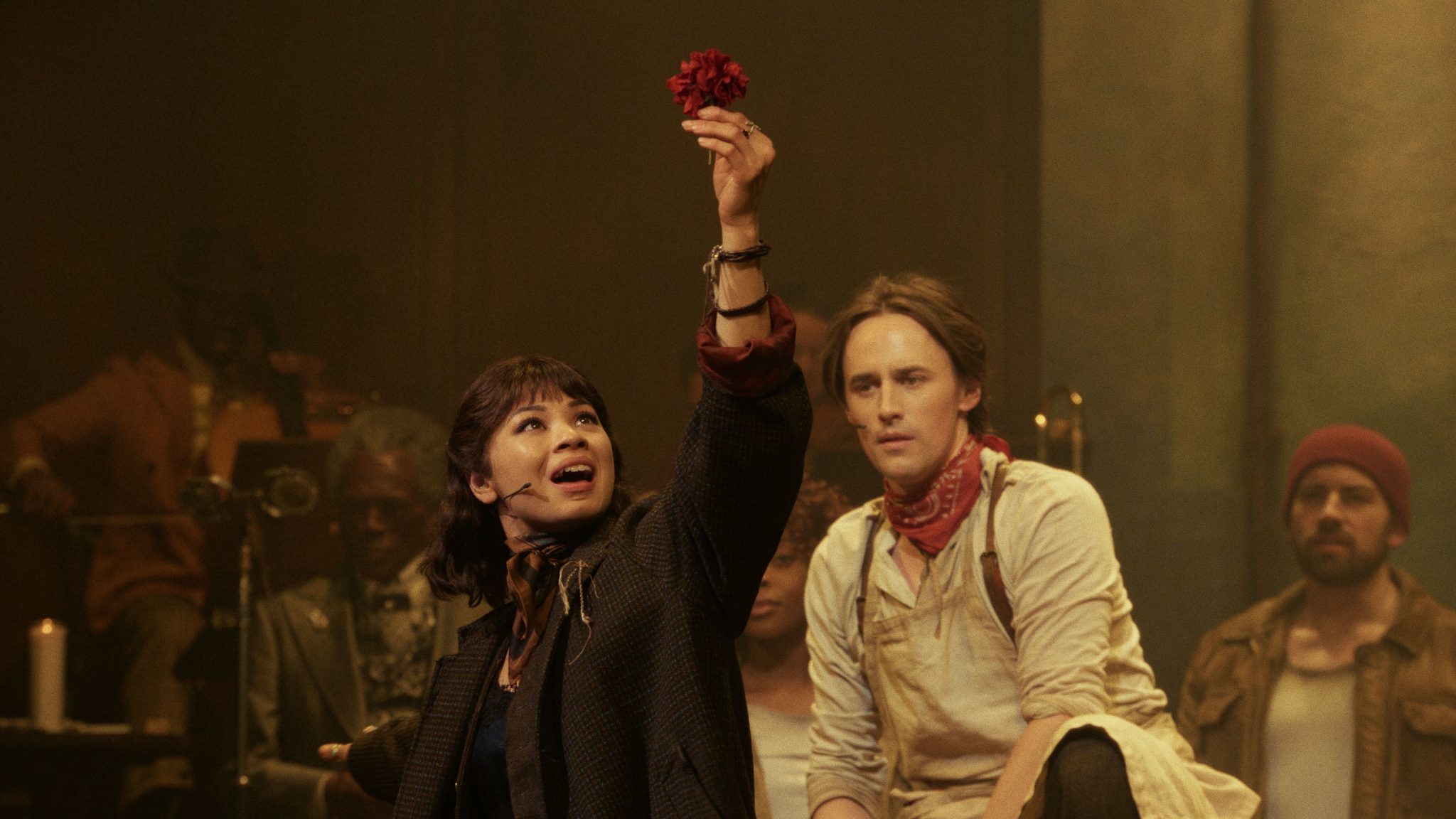
“There was real concern about us getting together, actually! You always hear about movies where the chemistry ends up actually being horrible because the two leads were together. We were worried about that. But thank God, people didn’t seem to feel that way about us.”
Reeve Carney
LG: Is there a moment in the show that still takes your breath away?
ADS: The alchemy is postponed until the very last five minutes of the show, when Hermes says, “So here’s the thing.” And that’s when the chills come! When Hermes in the film said that, that chill ran up my spine right into the pituitary gland. I was captured. As it happens in the performance, you think, “Oh, thank you, thank you. Here’s the answer.” But it’s not the answer; it’s the chance to do it all over again.
RaC: “You got a lonesome road to walk, and it ain’t along the railroad track…”
Brett Sullivan (film director): “Road to Hell” is a cracker of energy. I love the way André De Shields brings so much electric power to the final note of that song. The reprise at the end of the show always brings a tear to my eye, too. It’s a sublime song, and even when we know the end, we are willing to sign up again to experience the weight of emotion.
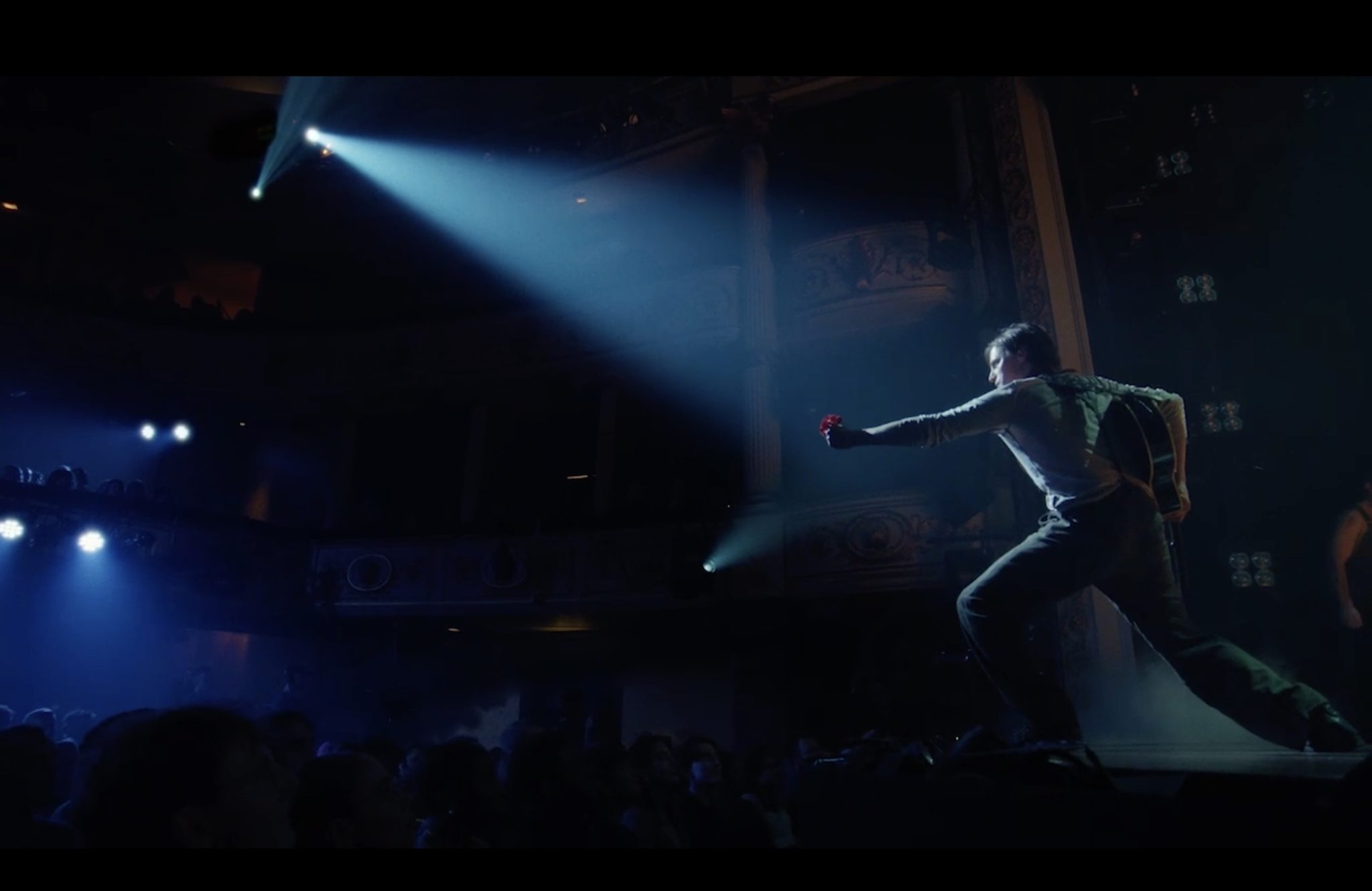
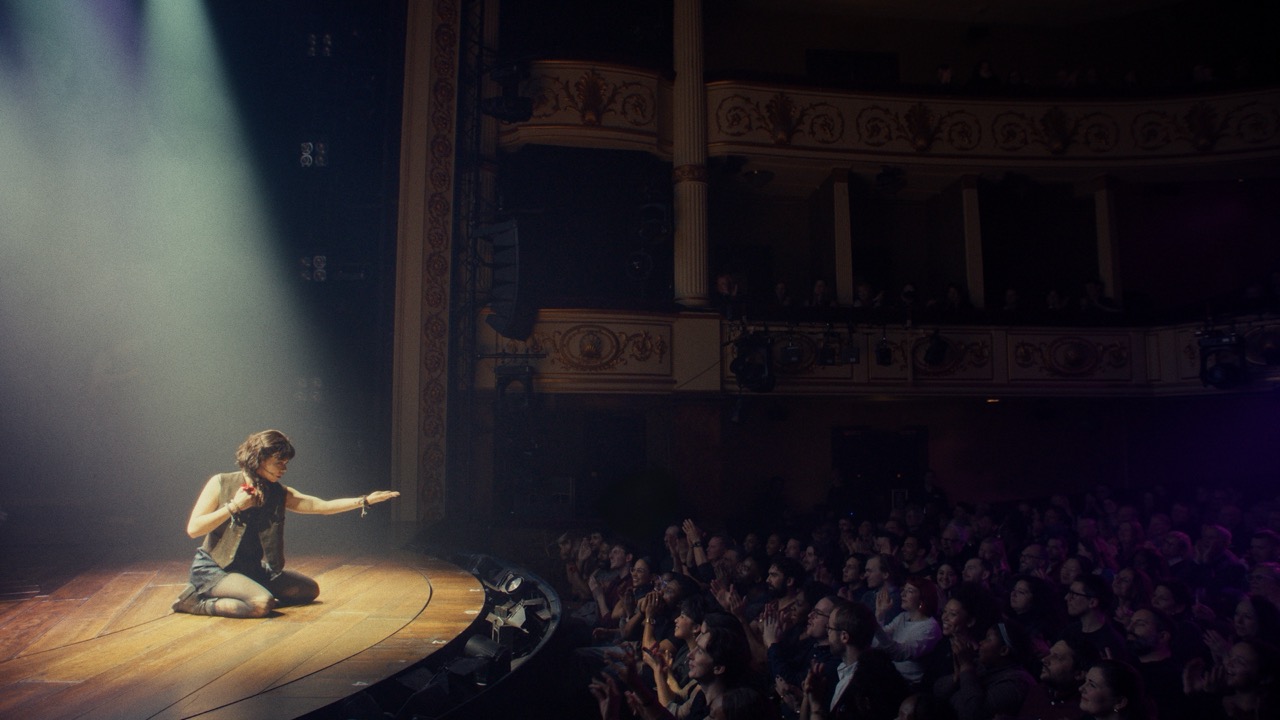
EN: I’m not usually able to see how Orpheus reacts to Eurydice descending back into the underworld. In the movie, I was finally able to see his final pose—his hand outstretched. It’s one of the most devastating, perfect images. It’s almost like a solar eclipse of an image. Even thinking about it now takes my body to another place. He’s saying so much with essence alone.
RC: Aw. Thanks babe.
LG: Then there’s the “Flowers” one-take…
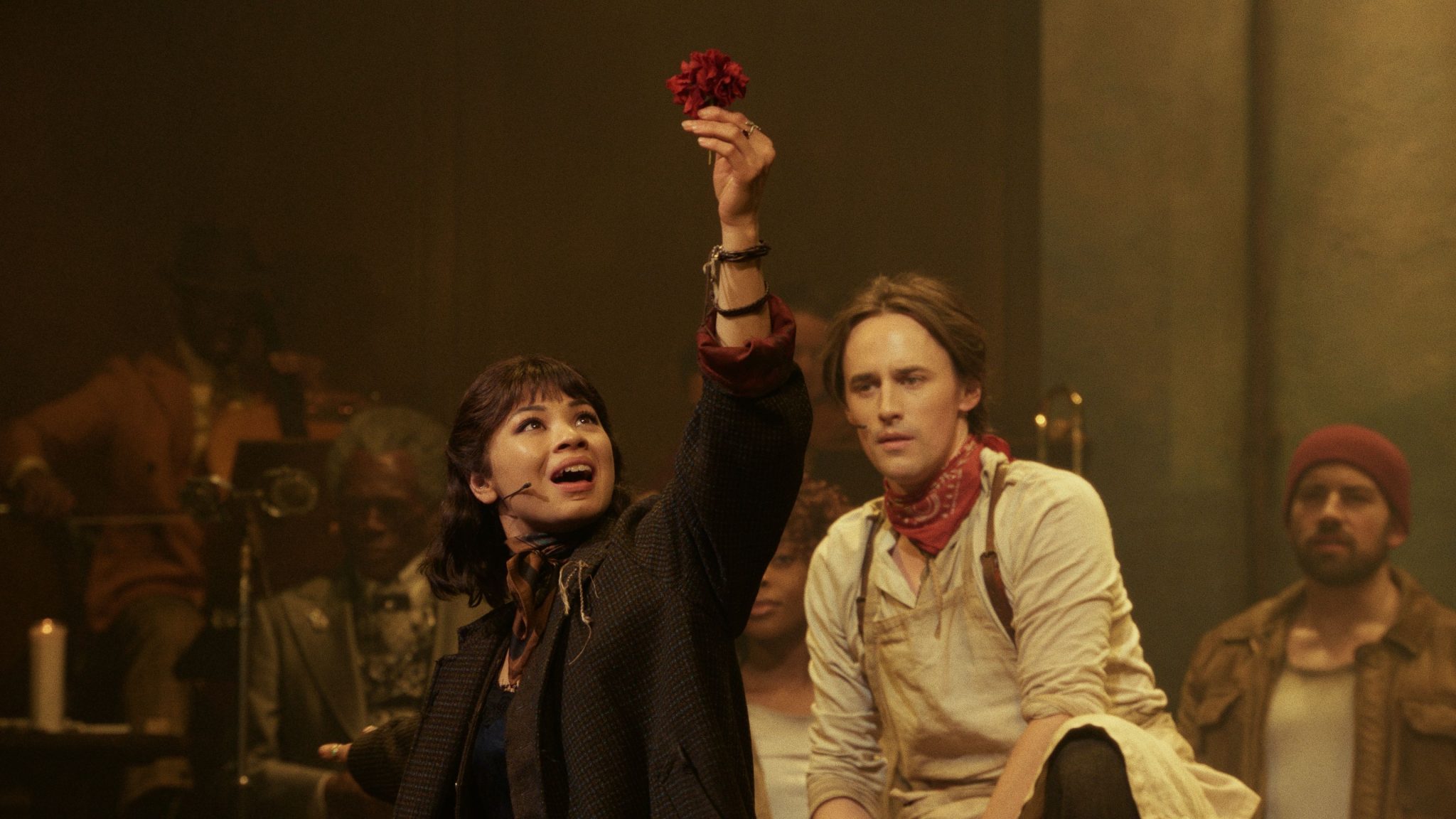
EN: It was easy for me, because all I need to do in that track is park and bark, as they say. That song is so set up for me. I don’t need to put anything on, because the material is so good. I’m naturally transported to a place of heartbreak and devastation. It’s a hopeless picture. I remember Rachel being like, “I know for sure what we’re doing with ‘Flowers’”, [laughs] and I was like, “I don’t know what that means, but okay!”
BS: I’ve always liked when you can see something at stake—actors on a stage that totally succumb to playing the part. That’s what Eva does in “Flowers”. It felt right to see Eva’s performance in a single take—no edits. The risk is also on the film crew to get it in one take. When you combine both, you can feel we’re right on the edge at every level and that makes it exciting. Eva’s performance is mesmerising and crane operator Dave Emery’s oner flying over the live audience from wide to close makes it truly special for me.
RaC: The “Flowers” oner was a very strong early desire that I had. The reason for that is I have seen Eva do that number so many times, and I know she will not be dishonest.
RC: I watched them film that number, and there were so many brilliant shots. The one you see is the one-take, but Eva did one other take where they started close-up and stayed closed in on her the entire time, and a part of me wishes people could see that too.
EN: Maybe we could do a Taylor Swift-inspired thing where we re-release the movie in different ways with a different combination of shots entirely [laughs]. Then they’d see it.
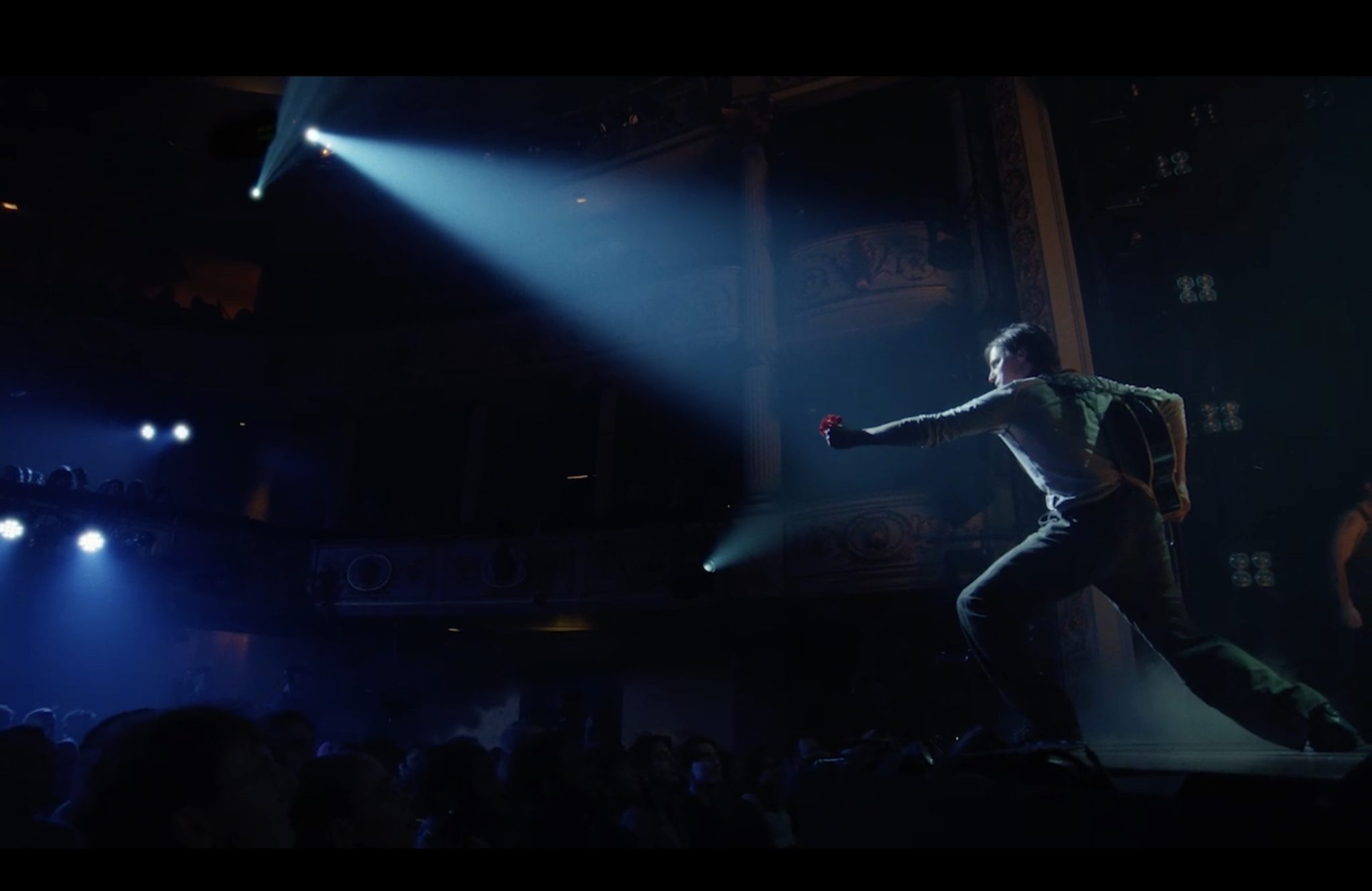
“I’m not usually able to see how Orpheus reacts to Eurydice descending back into the underworld. In the movie, I was finally able to see his final pose—his hand outstretched. It’s one of the most devastating, perfect images. It’s almost like a solar eclipse of an image. Even thinking about it now takes my body to another place. He’s saying so much with essence alone.”
Eva Noblezada
LG: What advice would you give another actor taking on your role?
ADS: Hermes has to be ever-present. Once I was on stage, I was there, and I was able to find a corner to deposit myself and be very still. I wasn’t there to attract attention or to upstage anyone. I was there for accessibility, for knowledge, to answer those five questions. I was trying to be a proper psychopomp. Hermes is a psychopomp, the fantastical individual who accompanies the human spirit when it has to visit Hades. No one can enter Hades without Hermes accompanying them to and across the River Styx, paying the coin, meeting Cerberus, descending the lairs to Hades.
That being said, Hermes was meant only for me. That’s all!
PP: Don’t try to play the big boss. Play the man in love, because everything Hades does is about Persephone. Everything. When he seduces Eurydice with “Hey, Little Songbird,” the whole time in my mind, the real target is Persephone. The idea in the end game is I’m going to bring this girl down, and it’s going to drive my wife crazy, and she’s going to fall. And in something like “Why We Build the Wall”, it is a necessity that Persephone is standing to my left. It may look as if I’m talking to the workers or the audience, enlisting them in my cause, reminding them of their roles in Hadestown, but in fact, all of my energy is going just to my left there. Because it’s all for her, and we do that all the time in life. If you’re sitting in the library, pretending you’re studying, and the girl you have a crush on comes into the library, your focus remains on the book. You’re looking at the book, but in fact, all of your focus is over on the girl. They just walked into the library, and that’s Hades’ focus all the time.
RaC: I always say, “Look, Orpheus and Persephone rhyme—they are both creatures of faith. Eurydice and Hades rhyme—they are both creatures of doubt. And the Fates and Hermes rhyme—the Fates literally sing their anthem, ‘Nothing changes,’ and thus Hermes, the opposite to that, is ‘change is possible.’” That ends up giving a really essentialised compass to the performers, in terms of what their job is in the overall picture of the piece.
EN: I say two things. One: just because Hadestown is a commercial success, don’t bring any of that into your interpretation, because then it becomes presentational and about your ego as an actor, rather than getting closer to the truth. Getting as close to the truth as possible means trusting the libretto, the score and the music. There’s already so much information there to hinge your performance on, which you can then use to simplify and focus on the things that really matter in your character. Also, don’t watch anyone else. Make it your own. It’s good to be inspired, but if you’re trying to copy someone, then where are you in all of that as an artist? That’s more important than anything.
RC: From a technical standpoint, get used to playing guitar and singing immediately. Get that out of the way first. I don’t think any of us are thinking about singing or playing when we’re doing the show. It’s just about the acting. It’s complicated material in some ways. Sometimes people think of musical theatre as musical theatre as opposed to musical theatre.
EN: That’s true. You wanna be free on stage. Otherwise it’s like a ballerina dancing but chaining one of her arms to the side of the stage.
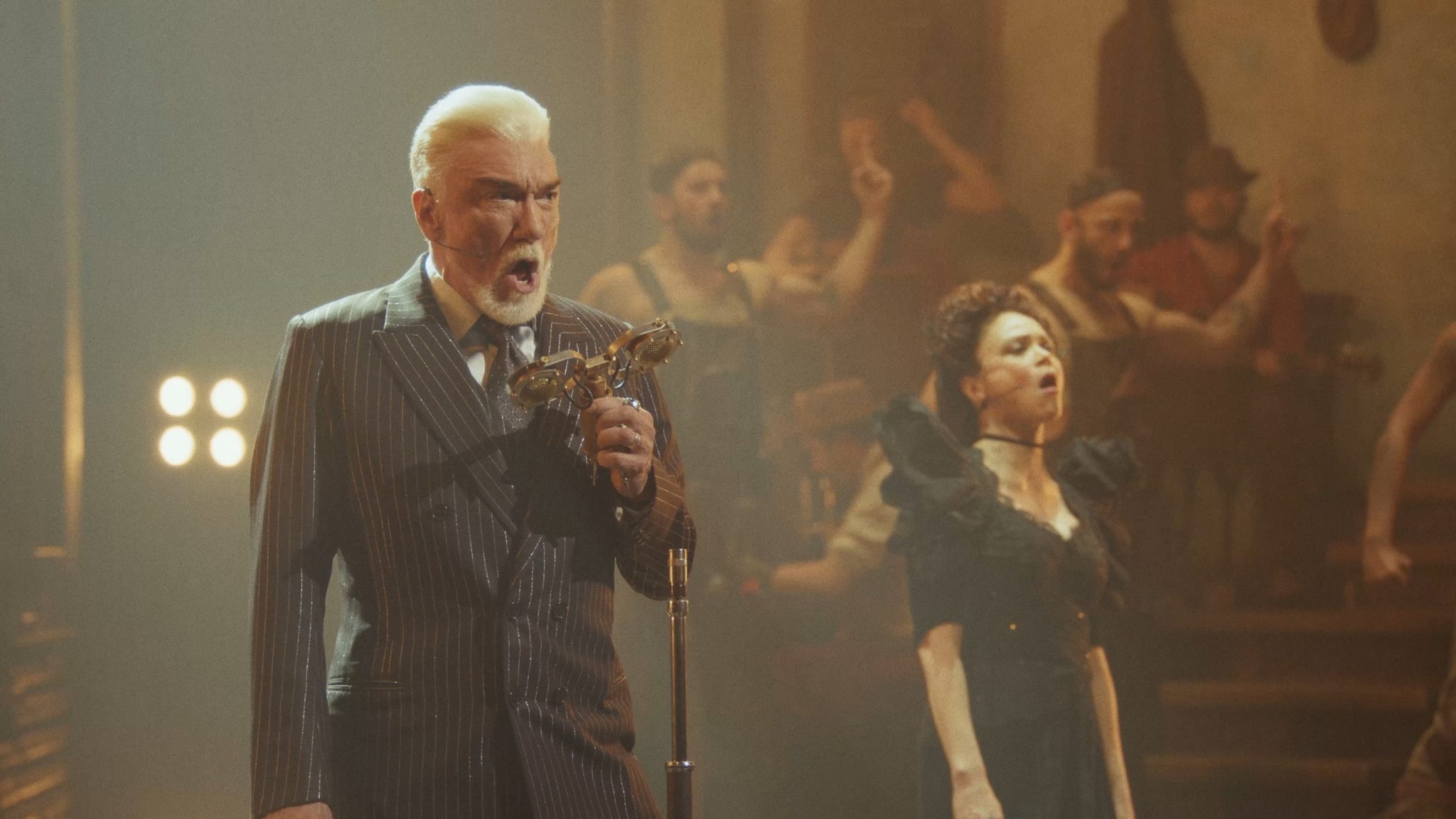
“Don’t try to play the big boss. Play the man in love.”
Patrick Page
LG: What does this movie means for the legacy of Hadestown?
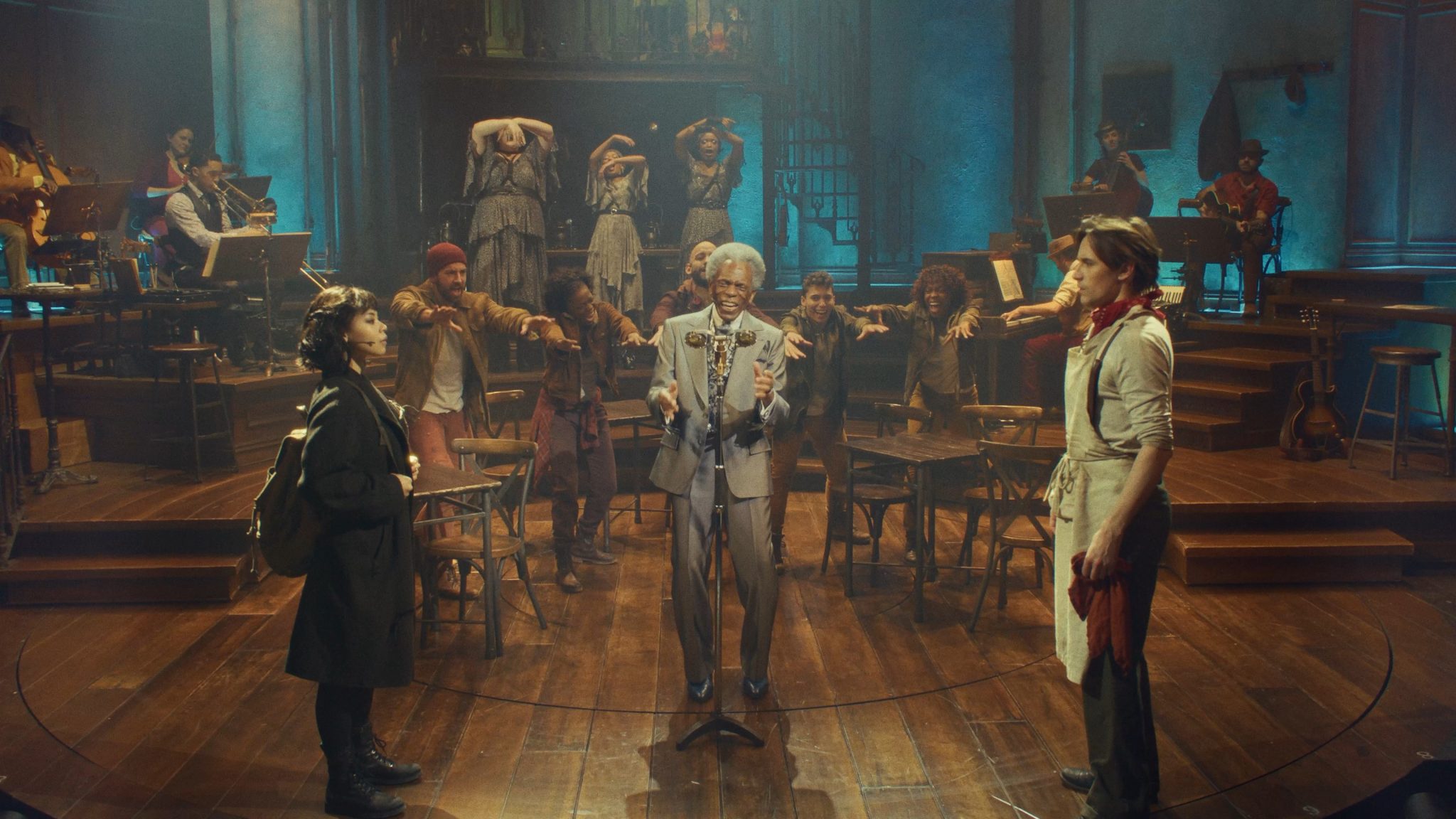
ADS: The film has given the live show a new lease on life. The release of the film guarantees it another eight years on Broadway, because what the collaboration gave us was an art film. No extra frisson, no fringe on the edges, trying to get your attention. Plain, simple, and deeply affecting. The story is told, and because of the cameras, you can look into Hades, and then you can look up from Hades. Because it’s important not only to identify with the gods and goddesses, but to identify with the workers who are dirty and tired and hungry.
BS: I think the film is one version of the show. It’s not the definitive version—I don’t think that could exist.
PP: Legacy…well, I really feel in a way that that’s already happened, and I hope it will continue. I had this unbelievable experience recently where someone had posted on Instagram and tagged me. A young man at a high school somewhere in America, performing the role of Hades, conducting the Electric City. A proud mom had posted this, and of course, he was essentially doing what he heard on the album. I realised, oh my goodness, it’s such an amazing bonding thing with these kids who are doing this show. That’s enough legacy for me right there.
Hadestown: The Musical available in UK, Ireland, Australia and New Zealand cinemas now for a limited time only. Tickets can be purchased at https://www.hadestownfilm.com/