

In 1962, avant-garde master Marcel Duchamp arrived in Pasadena for a retrospective of his work. The result would send lasting ripples through California’s art scene, and give birth to one very iconic chess photograph…
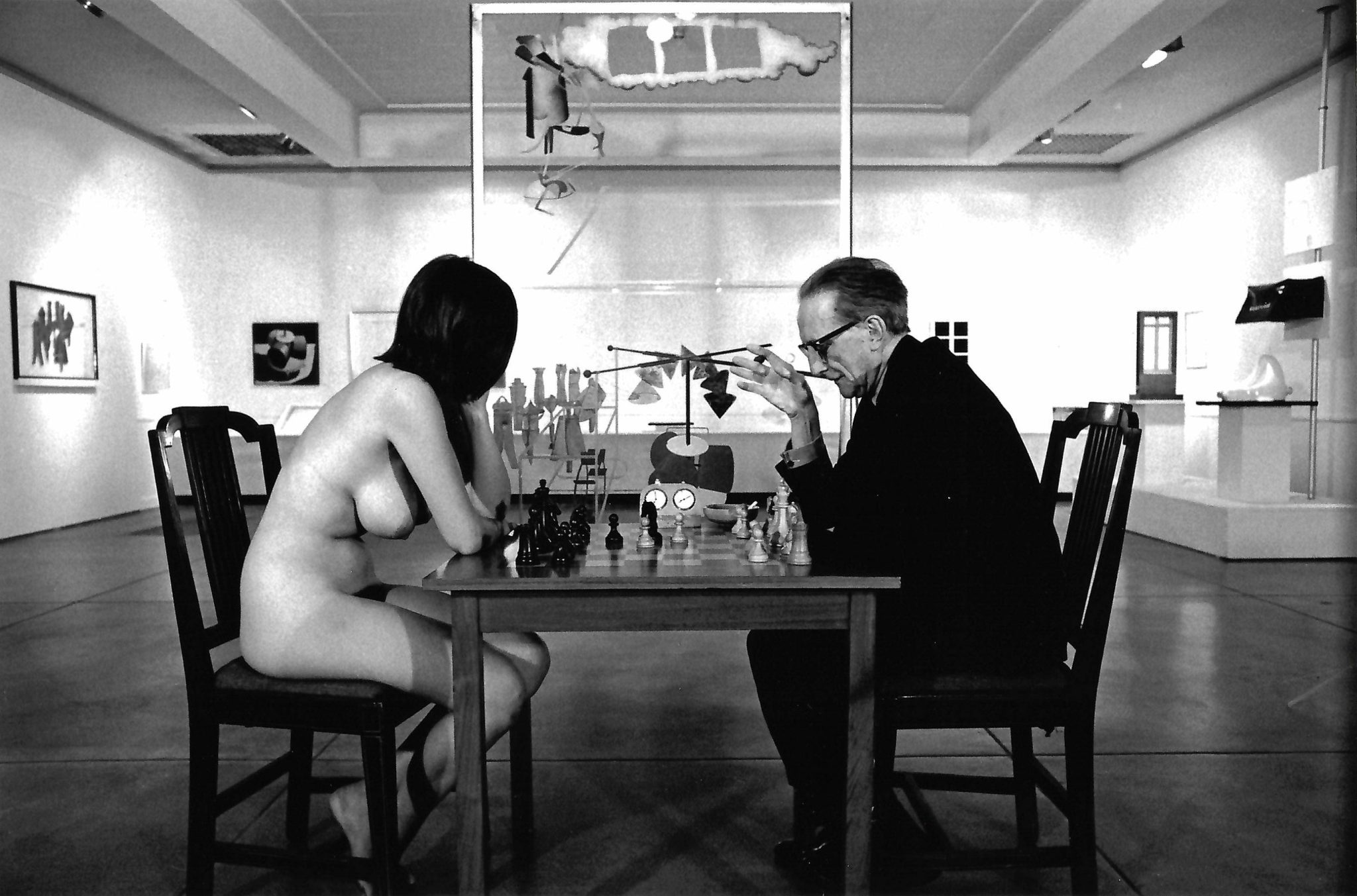
Every artist knows the photograph. Two figures sit across from each other in a gallery, playing chess. On one side is the legendary French artist Marcel Duchamp, and on the other is Los Angeles writer and party girl Eve Babitz—who is nude. Duchamp’s hand is poised to make its next move; Babitz is leaning her elbows on the table, waiting.
The pair sit surrounded by Duchamp’s work. The Large Glass (1915-23) frames the table between them, while a replica of his notorious Fountain (1917) rears its head in the corner. Duchamp is absorbed by the board, while Babitz is less conscious of the camera than the imminent arrival of Walter Hopps—art curator, older boyfriend, and, at this time, persona non grata—whose mouth would gape so wide when he walked into the room that his chewing gum would fall to the floor.
The picture was taken in 1963, when Duchamp was in California for a retrospective of his work at the Pasadena Art Museum, orchestrated by Hopps himself, who had tracked the artist down in New York. Duchamp had been approached by Los Angeles photographer Julian Wasser, who asked if he would sit for a staged photograph as part of the exhibition. Knowing only that it involved a chess board, he agreed.
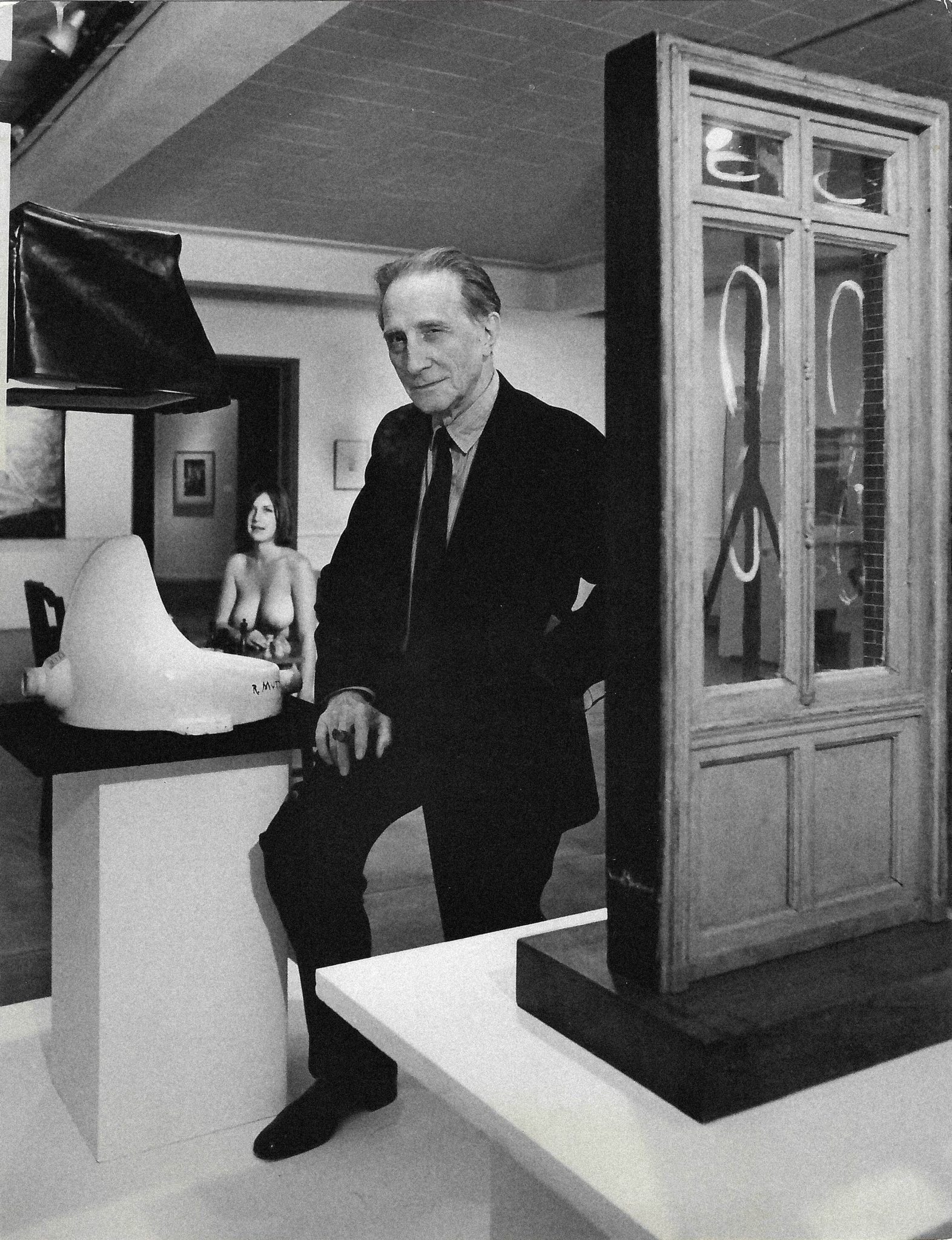
Marcel Duchamp with Eve Babitz in the Background, 1963. By Julian Wasser.
Gelatin silver print 10 x 8”. Courtesy of Craig Krull Gallery, Santa Monica, California.

In an interview for the February 1963 issue of Vogue, Duchamp remarked, “There is no art; there are only artists.”
The retrospective was a seminal moment in Southern California’s burgeoning art scene of the 1960s, and Wasser’s lens captured it in a moment of undeniable Hollywood glamour. His photograph brought Babitz into full view, turning her from local It-girl to Los Angeles icon, but it captured something else—an unexpected alignment. Here was Duchamp—enfant terrible of the art world turned professional chess player—in a picture whose allure and studied indifference belonged so instinctively to California, a place most often synonymous with the word cool.
By the time Duchamp arrived for the retrospective, a series of gallery openings had signalled a breakthrough generation in Southern California, as galleries such as Frank Perls, Paul Kantor, and Dwan had mounted one-man shows of major European and American modernists, and helped establish a new market for contemporary American art. While these galleries expanded the art that could be seen in Los Angeles it was the Ferus Gallery, co-founded by Hopps and artist Edward Kienholz in 1957, that would make a point to show the work of Los Angeles artists from the outset—giving local artists such as Ed Ruscha, Billy Al Bengston, and Larry Bell their first solo shows. Ferus would also give Andy Warhol—spiritually a Californian—his first solo pop art show in 1962.
Hopps would take this transformative energy with him to Pasadena in 1962—a move that would take an act of faith. At the time, Pasadena was something of a cultural backwater, “a hick town, as far as art went”, Babitz would insist. But by the end of Hopps’s first year at the museum, it would see exhibitions such as New Paintings of Common Objects (1962), the first show dedicated to pop art in America—putting Los Angeles suddenly ahead. It was at this moment, when Southern California’s nascent art scene was finally on the rise, that Duchamp would arrive.
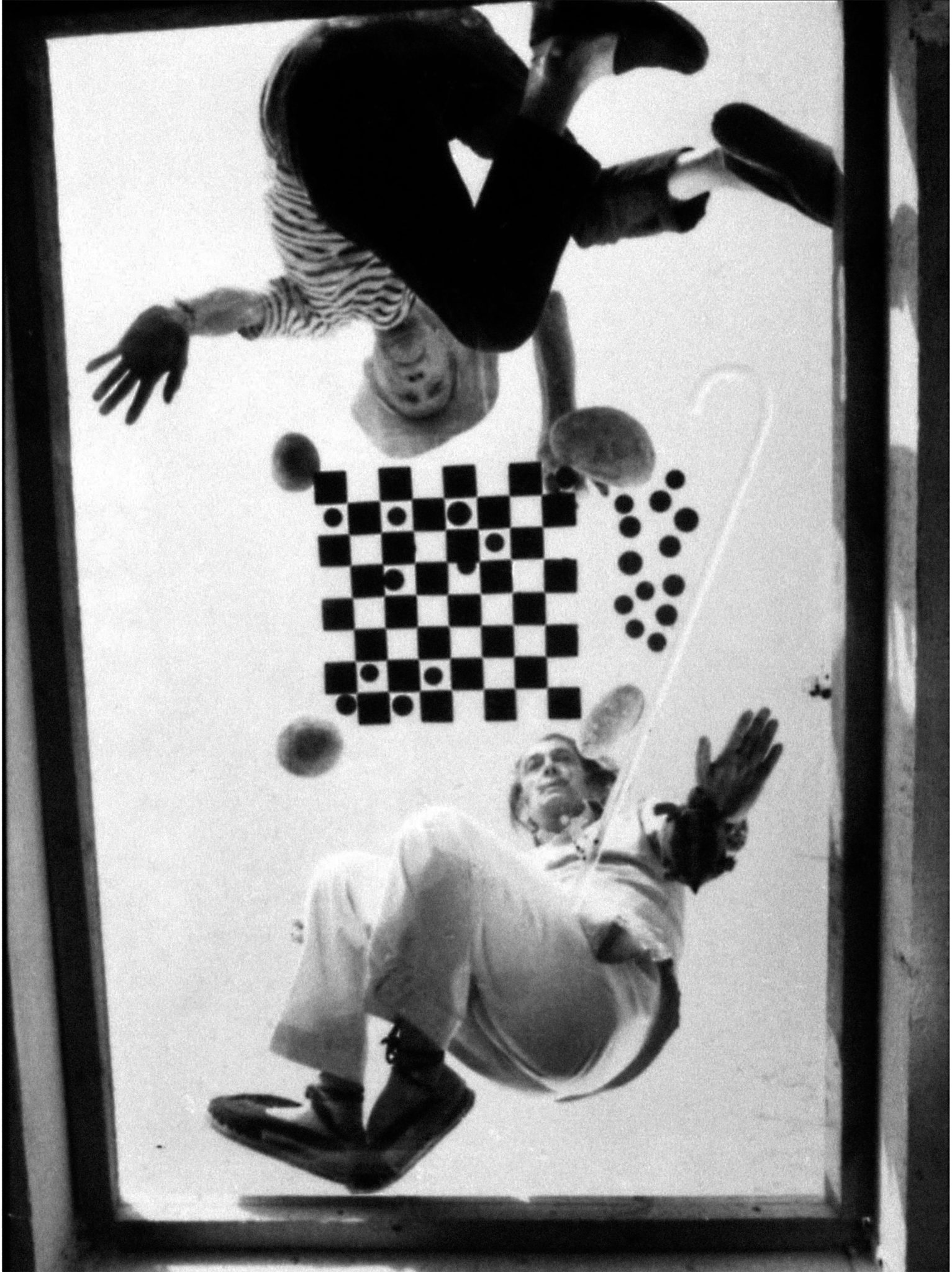
Duchamp and Dalí playing chess during filming for A Soft Self-Portrait, 1966. By Robert Descharnes and Paul Averty.
In 1915 Duchamp fled Paris for New York, where he lived for the most part until 1923. He moved between the two cities for much of his adult life. Though he loved both cities, he resisted their artistic schools and movements. This was the man who had drawn a moustache on the Mona Lisa and called it Elle a chaud au cul (1919)—irreverence was in his nature. After flirting with cubism and dadaism, Duchamp gave up art entirely in 1923 to play chess. In New York, his days would be spent at the Marshall Chess Club near his home in Greenwich Village or the plaza in Washington Square Park, and, during the summer months, at the beachfront cafés in Cadaqués, Spain—where a plaque now commemorates his favourite table at the Café Meliton. Duchamp had some links to California through major patrons Walter and Louise Arensberg; he had visited their home in Hollywood for the first time in 1936. Then, there was the San Francisco art dealer who had bought his controversial Nude Descending a Staircase (1912) in 1913. But it was Duchamp’s defining instinct—to do art differently—that makes the setting of his first retrospective in Pasadena such a compelling coincidence.
In an interview for the February 1963 issue of Vogue, Duchamp remarked, “There is no art; there are only artists. In other words, the school has absolutely no importance. It’s only a few names, a few men who are so powerful in themselves that they impose their work.” It is this emphasis on the artist that Duchamp would encounter later that same year in Pasadena—with an artistic life still loosely organised and unclaimed by an academy. Art in Los Angeles remained a social affair. Its main event was the Monday evening promenade, when galleries on La Cienega, near Hollywood, would open their doors to art students, young artists, musicians, and the occasional beatnik on their evening stroll. For all the grandiosity of his ideas, Duchamp was an affable man, never without a sense of humour. His character was serious and reserved.
He was, first and foremost, an intellect whose mind was always ten steps ahead. But his work, like his manner, came with a wink—a rebellious wit that made him both infuriating and hopelessly appealing to his critics. Duchamp was strategic in chess, in his ideas about art, and in a cultivated persona perfectly detached: the debonair Frenchman, somewhere between the coyness of Warhol and the celebrity of Dalí.
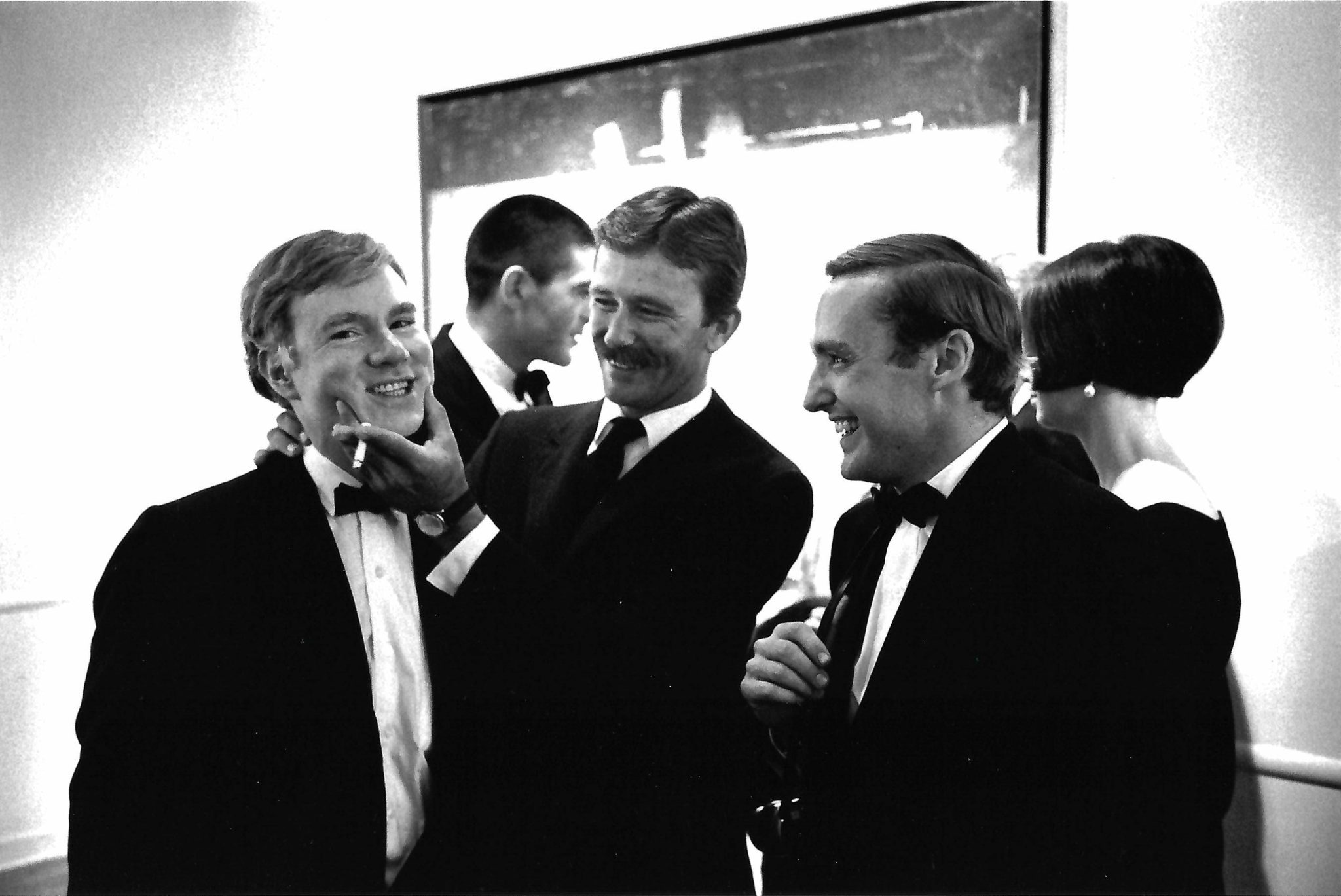
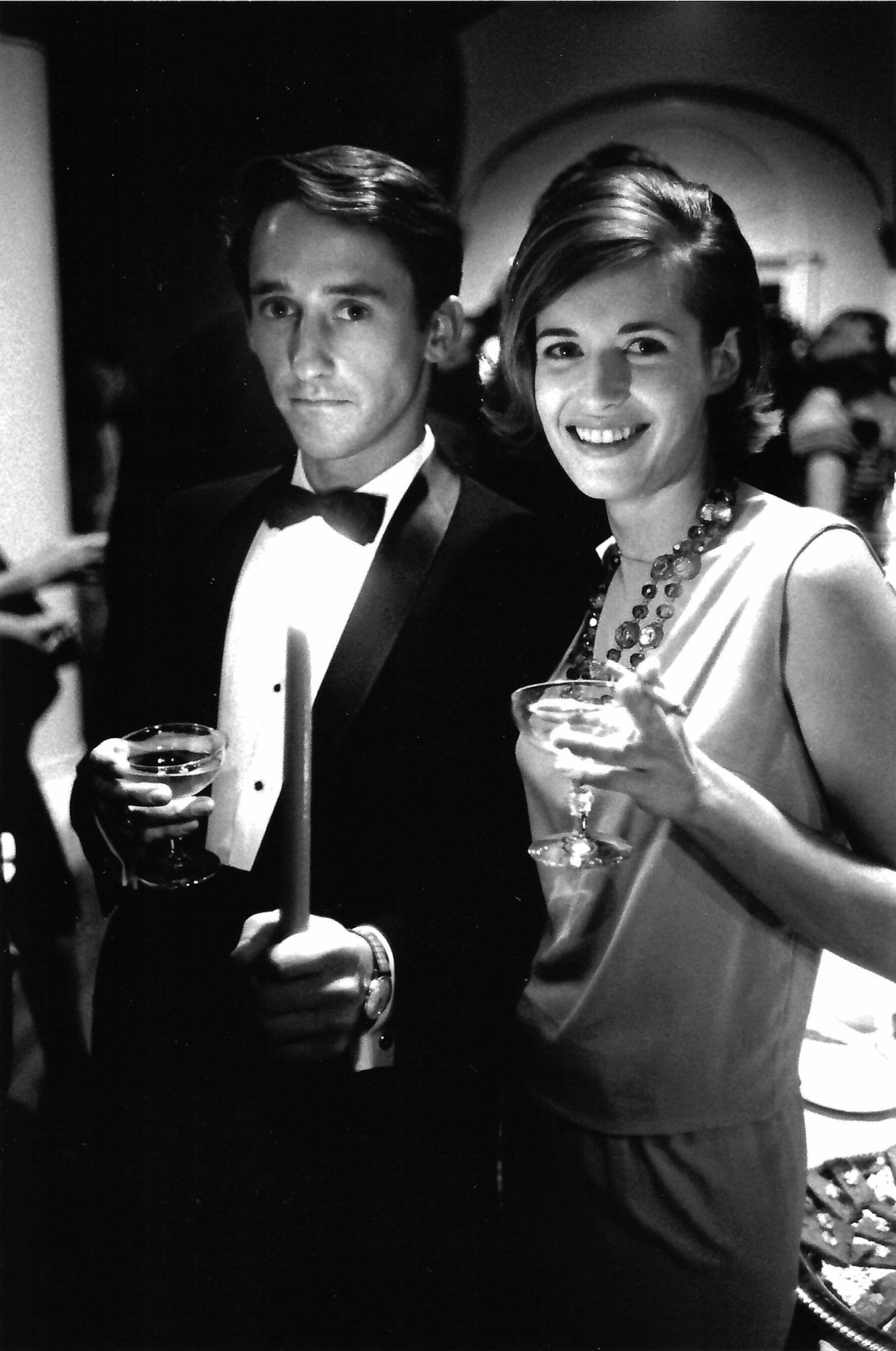
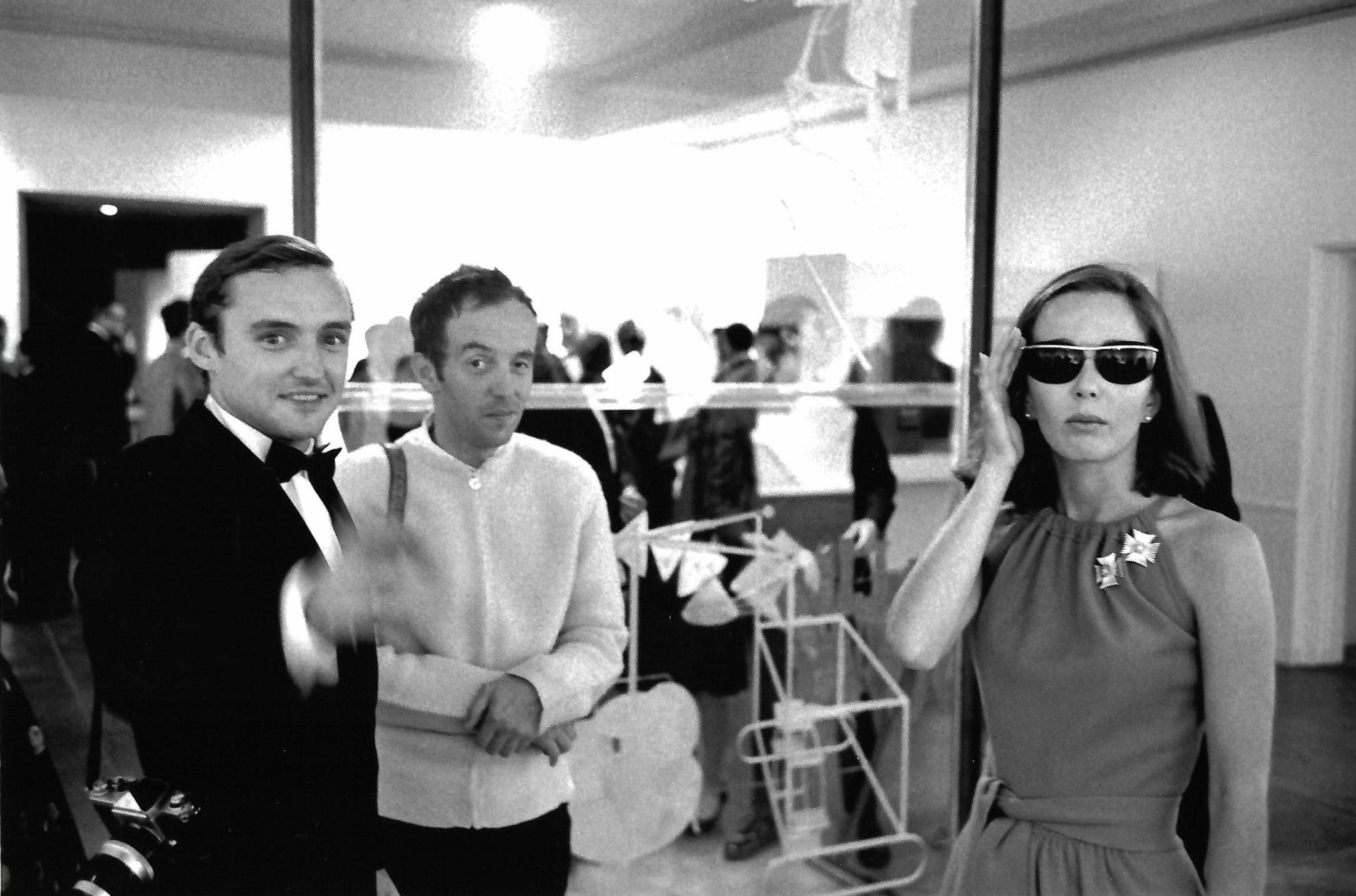


Duchamp’s time in California would soon crystallise into local myth. In just nine whirlwind days, he would have an impact that was immeasurable, legitimising with his own work a scene that was already doing things differently. But what strikes me most of all is the inverse: the impact those days in California might have had on Duchamp—though he would never let on.
On the retrospective’s opening night, there would be a party held at the Hotel Green in Duchamp’s honour. Music would eddy through a crowd of movie stars, artists, collectors, and Los Angeles types. Outside, Andy Warhol would be woozy from pink Champagne, while Dennis Hopper would take wire cutters to the HOTEL ENTRANCE sign (a memento that Duchamp would sign the following day). On this night, Pasadena would meet Paris, and Hollywood would flutter its eyelashes at New York—but, like Wasser’s photograph, where miscellaneous ready-mades become the backdrop for a match between opposites, it would be a picture strangely harmonious.
In Wasser’s image, Duchamp’s gaze is firmly fixed on the chess board. He is seemingly indifferent, though undoubtedly aware of the moment’s significance. Babitz rests comfortably, cushioned by the fame she knows the photograph will bring her; she is the California counterpoint to his European gravité. Except, famously, Duchamp had an alter ego: a woman named Rrose Sélavy, a pun on “Eros c’est la vie”. Rrose was Duchamp stripped bare—his complex ideas reduced to her pleasure and play. She was the artist’s spirit. And there she was sitting across from him, about to take his knight.
Wasser’s photograph was an iconic moment for California. But it also captured an artist in all his enigmatic shades: play, intellect, and sex appeal, all wrapped up in a game of chess. What could be more California cool?
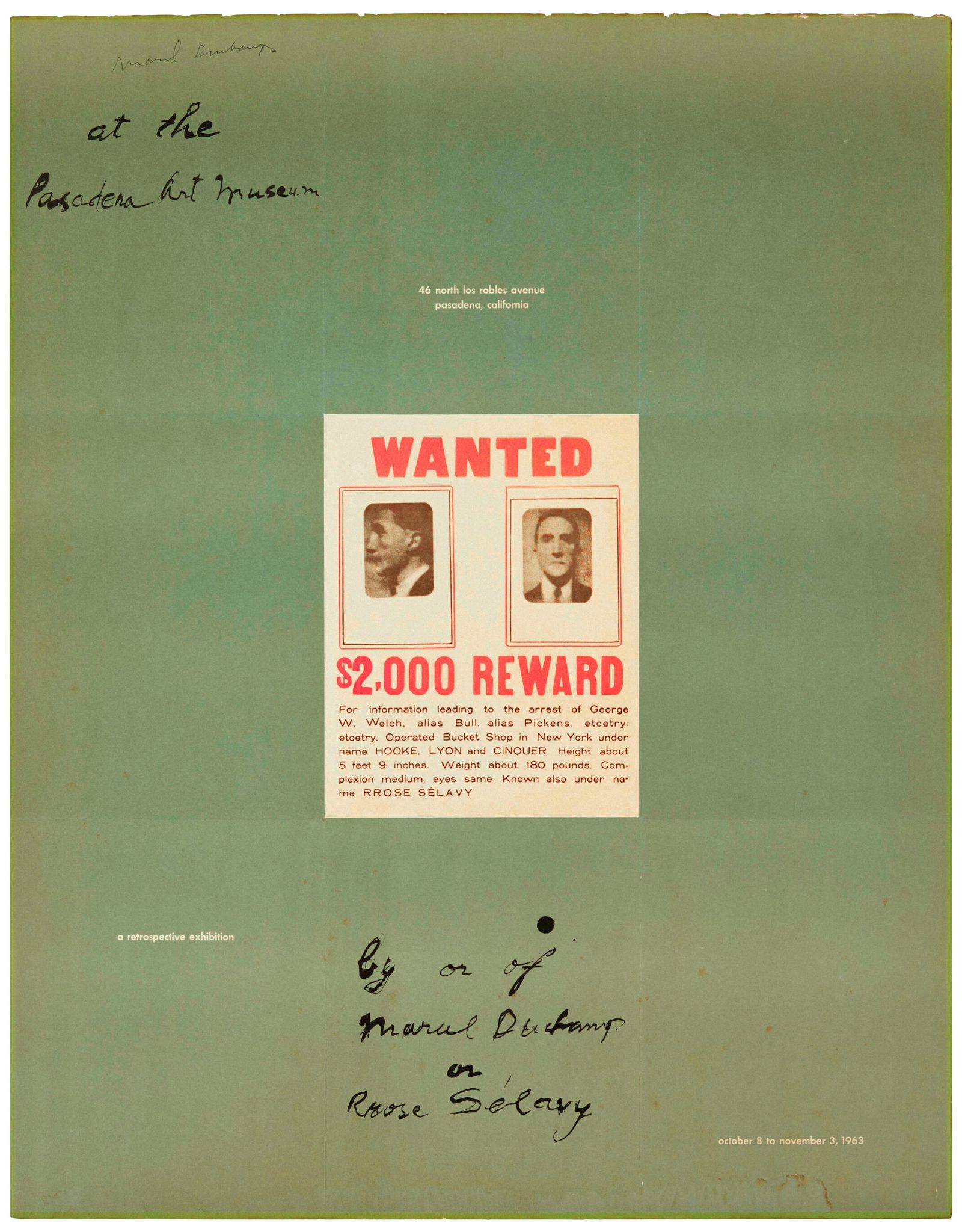
Wanted, $2,000 Reward (1923). By Marcel Duchamp.