Public Access Afterworld, the debut novel from Jane Schoenbrun, is a typically hybrid, fantastical and wonderfully strange offering from the director of cult indie titles such as Teenage Sex and Death at Camp Miasma and I Saw The TV Glow.
Jane Schoenbrun’s first book came to be shortly after the advent of their first tattoo, a lowercase scrawl on their upper arm that reads “make it real.” The phrase is something of a mantra in Public Access Afterworld, the near-century-spanning sci-fi novel they initially conceptualised as a television series: “I’d always had this plan in the back of my mind to write it as a book or let it die like all those other TV shows in my brain. With this one, I just felt really strongly that I shouldn’t. So I was like, ‘I’m putting it on my skin.’”
The book is an impressive debut from Schoenbrun, whose filmography tends towards the interplay between the real and the fantastical. Public Access Afterworld lives in this space too, rooted in canonical markers like Oppenheimer’s Manhattan Project, or the transition to digital from analogue television. The latter is where the story begins, a seemingly innocuous event in 2009 that triggers the disappearance of high schooler Erin Morrison and the radicalisation of her best friend David, who subsequently dedicates his life to tracing the conspiracy that took her. Things only get stranger from there, and the cast of characters grows wider: there’s Bethany Peters, the trans tech worker frustrated with the confines of her life; Jules Estrada, a disaffected streamer trying to join the cult that has sprung up around the potential existence of a televisual afterworld; Willa, a repressed Texan housewife, and Chimotera—the black-and-white movie monster.
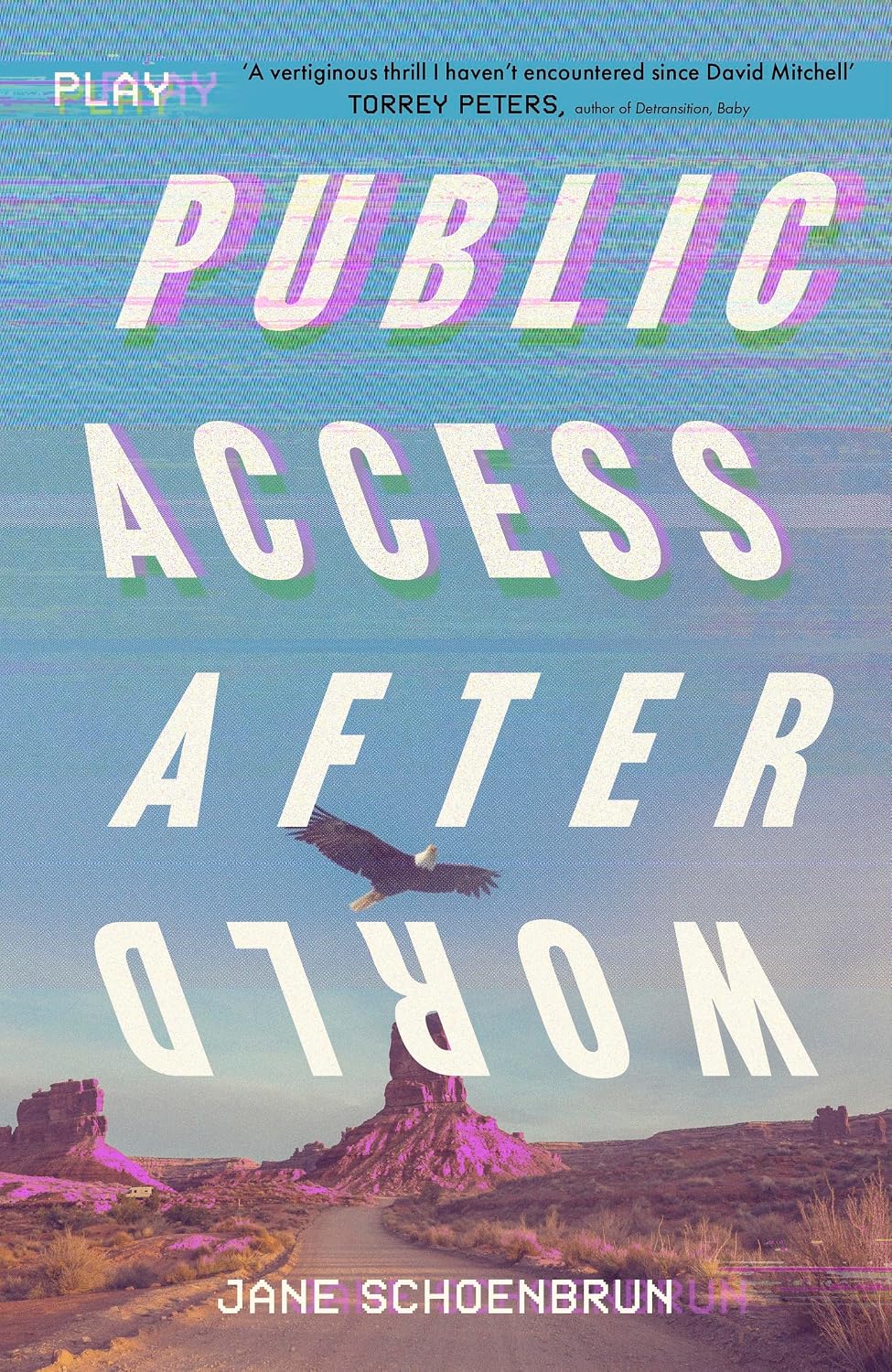
Public Access Afterworld, by Jane Schoenbrun
The novel touches on many of Schoenbrun’s signature themes—the experience of and stigma around transness as in I Saw the TV Glow, the location of identity through media consumption (also demonstrated in Teenage Sex and Death at Camp Miasma) and the internet as both a hub of community and a site of abuse à la We’re All Going to the World’s Fair—while being a wholly original work that jumps between genres, timelines and realities as deftly as its narrative shifts from first person to second and third.
Here, Schoebrun tells A Rabbit’s Foot about their long love affair with television, grappling with genre, and how they wrote their chameleonic first novel.
What was the process of turning Public Access Afterworld into a book?
When I talk about where it came from I have to start when I was literally four years old and obsessed with television. By the age of six or seven, I had launched a TV channel in my brain. I had all of these different shows that I made up, and by 10 or 11, I was writing my own fake episode guides.
I always had this belief that I would never be able to get any of those shows to exist out of my head because of the amount of money that it would actually require—I just didn’t see it for myself. I had made one film (World’s Fair, which was a tiny movie) and it cost a hundred thousand dollars. So I had a suspicion based on what I knew that if I was going to make Public Access Afterworld (PAA) in the way that I had written it, the first season alone would cost $100 million, give or take. And no one’s going to give that to a trans girl.
But after I’d written the script for TV Glow, I was sort of in this post-transition, manic artistic moment. I had just signed with a manager, who told me I should be thinking about writing TV. Very quickly, without anyone asking me to, I had written 1,600 pages of television scripts. I had taught myself to make movies by watching a lot of movies and being really agonisingly vicious about my own abilities. That was very much the process of writing this novel—teaching myself to write prose.

“Buffy…I can name 100 other shows but that’s the one I find myself trying to recapture the feeling of.”
Jane Schoenbrun
You said in an interview that “the relationship between the film and the audience” is always at the core of your movies. How does working within literature change this consideration for you?
This time I approached it quite humbly. I will read contemporary fantasy, story-driven horror-mystery—pulpy genre stuff, to see what’s working or what’s popular, and to sort of study the mechanics of storytelling. But for the last couple years, my big guys are Carson McCullers and Don DeLillo: I’m enamored with their storytelling from a plot mechanics perspective, but also because of the way their prose creates feeling and texture.
Did you use a particular method for planning out the novel across multiple timelines?
This is one thing that my brain can do that’s a little bit weird. Maybe it’s because I was so obsessed with TV as a young person, but the structure of a sprawling story with all these different plotlines—that kind of wide-canvas method of storytelling—has always naturally felt like my medium. I think I might just be a little autistic about it.
I’m working on an actual TV show now and I just pitched the [first] season from memory. It’s the same with PAA, like I could tell you what happens beat by beat in episode nine of season three. I think I can hold a lot in my head because I spent a lot of time there as a kid, teaching myself how to build those mazes.
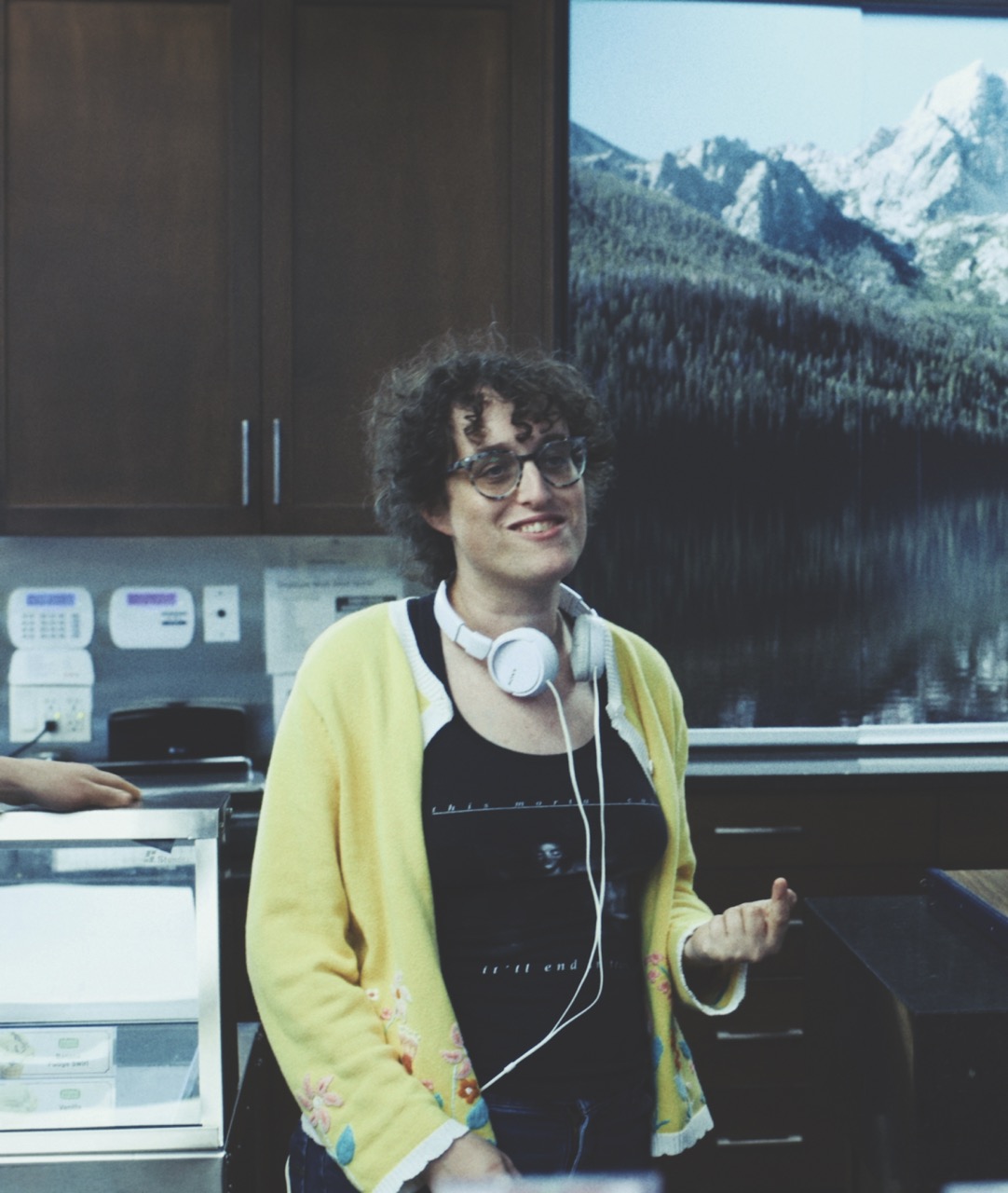
Jane Schoenbrun on set for Teenage Sex and Death at Camp Miasma
Tell me about the TV that you grew up with, which were your emotionally-load-bearing shows?
Above all, it was Buffy. I remember really thinking of those characters as family. I cared about them a lot in a way that I didn’t allow myself to care about my real world. Buffy is an incredible work of television, and I think it’s perfect in its structure in many ways. There are a bunch of garbage episodes, and by the end of the series it’s not very good anymore. But the way that it does humour, pain, and melodrama—I find the scope of it to be so well-balanced. I think I was 10 years old when I started watching it, and it was there with me through high school. I can name 100 other shows but that’s the one I find myself trying to recapture the feeling of.
I read in your conversation with The Bookseller that you made a short film about the analogue switch-off in 2009. What did you take away from that experience?
I never released it, and maybe I should. It’s an archival documentary: I came across all these videos on early YouTube of people filming their TVs switching to static. I just thought that was so wonderful, one format is dying and another is picking up the slack. There was also this ghost-like quality to so many of those broadcasts, where you had these ancient newsmen—long-retired, who had been there in the 1940s when they had built those studios—coming back to flip the switch and turn it off. The short film is called Nothing Comes Back and when I made it [PAA] was not in my mind yet. But this idea of a passage of time from one era to the next, and how haunted it felt; plain, cold static being there underneath, waiting to come back. Those were really potent, early inspirations for what became this story.
“I had taught myself to make movies by watching a lot of movies and being really agonisingly vicious about my own abilities. That was very much the process of writing this novel—teaching myself to write prose.”
Jane Schoenbrun
Content moderation is a very interesting, uniquely contemporary place to draw on horror—how did it find you as a subject?
Well, I worked in tech for a couple years. It’s such a footnote in my history at this point, but before I made movies, I worked with film artists at this nonprofit in New York for like five years. Then I got poached by Kickstarter, so I joined their film team, where my role was ostensibly to help filmmakers who were launching fundraising campaigns. The job quickly revealed itself to be way more biz-dev-y than I was hoping it would be. So a lot of those sections of the book are just me reflecting on that experience. I remember the way that everyone was so friendly in this creepy way, and feeling like, “I just want to make Rosemary’s Baby in this place.” Writing the novel 10 years later, I feared that it was maybe overdone. We’ve dissected content moderation as a concept, but also I’m not sure that we have? It remains as relevant a question as ever, and it felt like a great way to introduce some of the novel’s core tensions, which are about how we as a society and a culture moderate reality.
PAA is an epic that feels like it belongs to a few different literary specialisms, and your films are similarly hard to define in terms of convention. How would you say genre has been useful to you?
Maybe it goes back to the Buffy of it all, in that it’s a language that I learned. I didn’t grow up reading James Joyce and Dostoevsky and similarly I wasn’t watching Bergman and Tarkovsky although I like them all now. I grew up watching TV, going to the video store, reading Goosebumps and Murakami, stumbling my way towards high culture very slowly. I loved genre that made me feel something, not genre just for the sake of it. The best of Buffy was where it was using genre to speak in deeply like emotional terms about being a human in the world. That got its hooks in me, and I studied it and I think I understand how it works. So it’s just always come very naturally to me as a way to tell stories. It doesn’t surprise me that I found myself situated on this middle ground between pretentious-auteur and entertainment-genre storyteller, because it’s just the space that I always inhabited.
What can you tell me about the next instalment in the trilogy?
It’s called The Cinematic Universe. Its central question is: After a life of not living because the world didn’t let you live, is it even possible to have a life? It will return to all of these characters—Bethany and Erin and Willa. And it will explore that question as the world seems to be ending all around us—there is a literal apocalypse happening in book two. It’s a dark one, a lot darker than the first. It asks, is there a future for any of these characters that’s possible?
Public Access Afterworld is published now by Spectre.