

Art critic Ben Eastham discusses The Floating World, his debut novel about a journalist who goes to work on an exhibition on a remote island in the Aegean, where a shady billionaire is building a refuge for the super-rich.
The title of Ben Eastham’s debut novel takes its name from the Japanese tradition of Ukiyo-e, which flourished in the 17th and 18th centuries. This form of printmaking—which translates to ‘pictures of the floating world’—depicts hermetic scenes of pleasure, of brothels and courtesans, kabuki actors, blossoms and snow. Yet the concept gets a violent update in The Floating World, a satire of the contemporary art world. An unnamed narrator heads to Athens, where he takes on a job working for a billionaire, Thanasis Morel to work on the spectacular inaugural exhibition of The Floating World, a giant dome on an Aegean island whose ultimate purpose is as a disaster bunker where HNIs can enjoy themselves while the world burns.
In his elaboration of this billionaire’s hermetic civilization, art’s potential for escape is satirised by Eastham, who writes regular art reviews for The Guardian, is the editor of e-Flux Criticism and in 2017 co-founded the influential arts journal The White Review, which he co-edited with Fitzcarraldo’s Jacques Testard. The Floating World is filled with familiar, eyebrow-raising art world tropes: opaque curatorial speak, tattooed tech guys and pharmaceutical sponsors, whilst geopolitical catastrophes, from the migrant crisis to the climate crisis, encroach on the margins. Yet beyond cynicism, The Floating World retains an important sense of earnestness and belief in the transformative power of art. Our narrator, who is grieving his wife, Cora, exists on shaky existential foundations, with art and the people he encounters offering him a life raft from which he might also rebuild himself.
With A Rabbit’s Foot, Eastham discusses the transition from criticism to fiction, creating an unstable narrator and his belief in art to change us still.
Could you talk about the setting of Athens? It has an interesting temporality: on the one hand it’s touted as the ‘new Berlin’ of the art world, but then it’s also the bedrock of civilization.
I lived in Athens for four years and I worked on a big exhibition there in 2017. I went back in 2020 and then Covid happened and I got stuck. I had a beautiful apartment there and realised I could live comfortably on variable money. Athens is this really interesting geopolitical location. I thought of it as European, but it’s not really, it’s very North African, and particularly at that time you also had a lot of migration from Libya and Syria and Egypt and Palestine.
So yes, it has these two temporalities going on at once, but also these different ways of living on top of each other. I was living in this anarchist area, and a lot of people I met were involved in that scene. I ended up setting up a little studio, and we always made a space for refugee artists. But then there’s this conflict of being there, I was aware that I’m able to be there because I’m getting paid in dollars from my job as a critic and an editor and feeling uncomfortable about that. It was utopian in some ways and also quite dystopian in others. I was able to see these other ways of living and being, and I was also conscious of being part of a problem. You were so surrounded by the past, so aware of all these histories you were living amongst, and then there was this quite jarring feeling of also living right at the edge of the future. The refugee crisis in Greece was on the front line, and the climate crisis had arrived there in ways that it hadn’t where I’d lived before, with these fires every summer. There was so much political and economic crisis, and all of these things felt like harbingers of a future that was arriving elsewhere. I was intrigued by that, and also by how being an outsider anywhere brings a different way of seeing things.
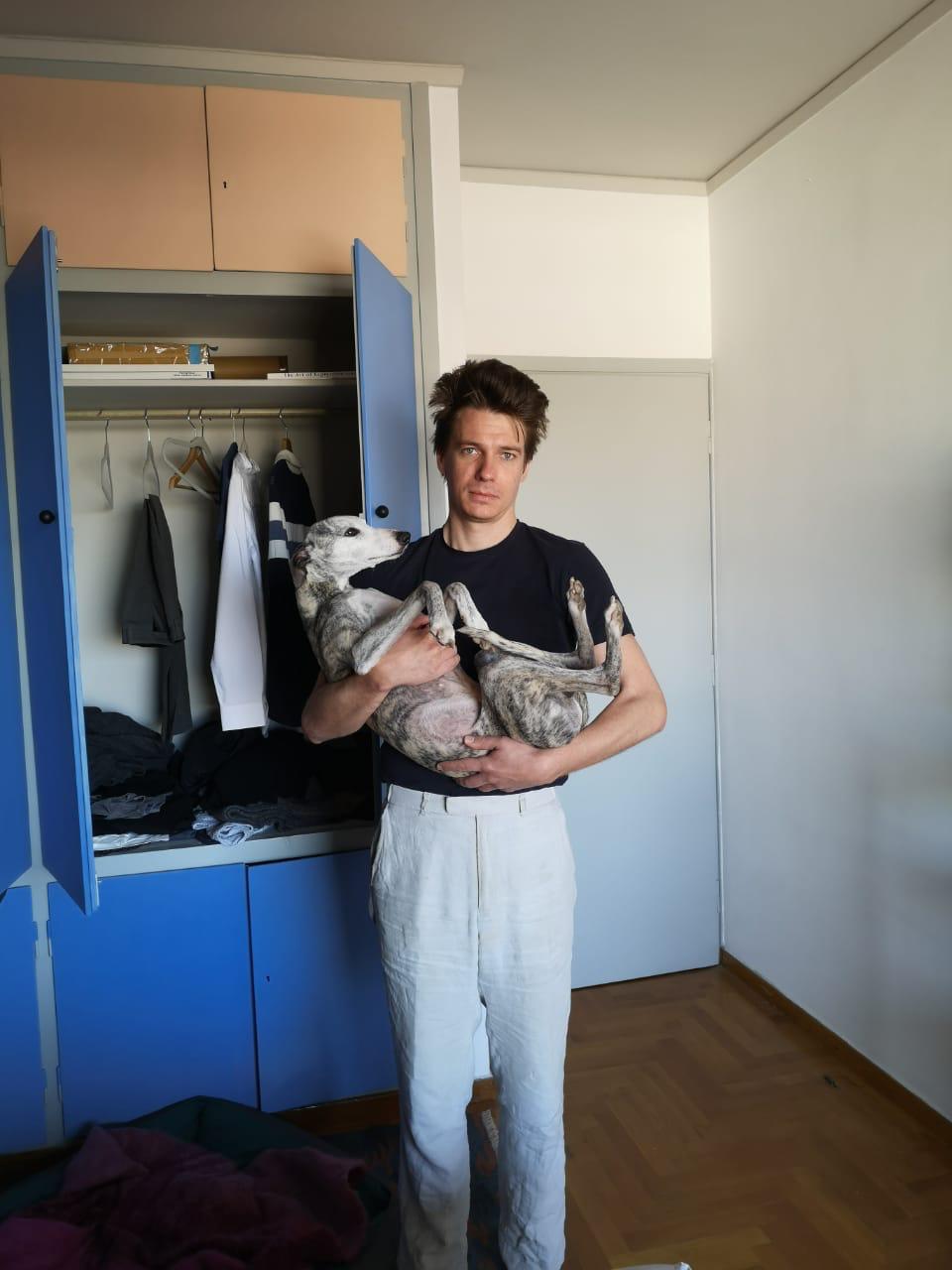
Art critic Ben Eastham. Image courtesy the writer.
Why did you feel like fiction was the right medium to develop this book?
I didn’t have this burning desire to write a novel or anything. It started when someone close to me died. In this experience of grief, I just couldn’t find a form to express that sense of how the world begins to feel unreal. Fiction was the only way I could get to it, because I wanted this feeling of slipperiness of things dissolving, to be woven into the novel. Fiction gives you the capacious space to do lots of things—you can have bits of art criticism and bits of satire and bits about grief and you can cobble them together. In fiction you’re aware from the beginning you’re reading this constructed world in the most literal sense that it’s fiction, but also because it’s a narrator taking you through it. Someone’s consciousness is full of gaps and overlaps and uncertainties and blind spots and that’s an exciting place to write from.
You create this persona in your art criticism, which is often humorous. How much of a jump was it from that to creating this first person narrator?
Writing as an art critic, I never thought about it in that way, but you definitely do that. And I’m also conscious because I write for different audiences and you build up a different persona for each one, with a different way of speaking perhaps, and different presumptions of shared knowledge. You can construct yourself a little bit. With the narrator of The Floating World, he was drawn from my own experience of working in the art world. But I also just wanted to construct someone who was unreliable, so the whole world that he constructs for the reader is on slightly shaky foundations, in the same way that the world he inhabits is on shaky foundations. He’s grieving—the whole book was built on this idea of grief and how it completely undermines your vision. That’s the feeling I wanted to capture, that you’re suddenly loose, untethered, in a fantastical, strange world where all of the things that previously made sense stop making sense.
The ‘floating world’ of this crazy art island… How much were you pulling and picking from things you’ve seen in relation to wealth and the art world?
I wanted to talk about what it means to belong or to be inside or build a world or construct a world and to live inside it, and whether this was possible, and what doing that means, and whether we can build a future for ourselves which is better, in the sense that it involves a degree of exclusion of other things. And also there’s this increasing disparity of wealth, which is something you have this strange relationship to in the art world, because you’re working with artists who have no money, and then you’re aware of this enormous reserve of wealth. So the floating world of the dome was just a way of making that real, giving a very literal expression to the idea of building something that’s insulated from the world, and whether it’s possible or ethical to do that. I was drawing on lots of utopian architecture—there had been plans to build these kinds of domes all around the world. And then these fantastical structures being built by billionaires in New Zealand. I wanted to give the narrator this opportunity to go to a utopia essentially and to leave the old world behind it that is crumbling with all his problems. Here’s a fresh start, and a place where all the world’s problems are excluded.

In the art world, we talk a lot about “constructing worlds” and “imagining futures” and sometimes that can be used as a fig leaf over the real construction of worlds that are not utopian, but are small and elitist and not for the general benefit.
Reith and Morel, the artist and the billionaire in the book, are both these looming, godly figures, but then it’s interesting that the billionaire is more godly than the artist, which seems to say a lot about the hierarchy (in the art world, and beyond) in this day and age.
I definitely wanted to set them up as twin figures. Both of them are building worlds—the artist in the kind of imaginative sense, and Morel in this kind of very literal way. But then actually something else entirely is going on and actually they are just distractions and that power lies elsewhere. In the art world, we talk a lot about “constructing worlds” and “imagining futures” and sometimes that can be used as a fig leaf over the real construction of worlds that are not utopian, but are small and elitist and not for the general benefit.
Every press release mentions the “construction of a world”…
Yes, and I think the thing about press releases and language and this rhetoric was that I wanted this growing disconnect between what is being touted and what you’re seeing, or the reality and the kind of way that language is used to cover up these things. The narrator is constantly having to kind of disguise what he thinks is going on, which is actually quite different to what’s actually going on.
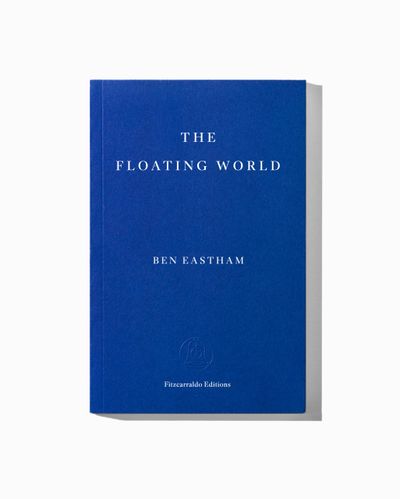
The Floating World by Ben Eastham, published by Fitzcarraldo Editions.
How do you approach what you write about as an art critic? Would you review or critique anything if you were asked to?
I think there are different kinds of art critics. John Berger wrote about this really beautifully, he says that there are studio critics, and they see their role as speaking to the artist almost. You’re providing feedback and then influencing how art is made. And then there’s the public critic, whose job is to speak to a readership and an audience and I’ve always felt like my job was to mediate and make things accessible. I came from a background where I felt quite excluded from all that stuff. So the idea of the critic as a facilitator or mediator is important to me. And I think if that’s your approach it’s important you aren’t making these god-like judgements but you’re there as a character with certain ideals—political, aesthetic, social—that guide the way you make judgements. That’s why some of my favourite critics are people with whom I don’t share tastes or political commitments, but because they write in a way that makes those sets of standards clear.
I feel like what you do well too is bringing levity to it—which I think is needed in the art world. Everyone should be encouraged to see that it’s funny.
I think the problem with the art world generally is that people are so terrified of looking stupid that it kind of sucks any potential for play or humour out of it. So much of the world survives on this tacit understanding not to say something because they feel like they might be the only one who doesn’t get it.
I had this really valuable experience years ago when I was just starting as an art critic. I didn’t really have any background in art. I worked as a book critic, and I’d written about music when I was very young. I only started writing art criticism because it was basically better paid than writing about books. I remember going to this totally impenetrable, in retrospect actually quite good, show at the Whitechapel and Adrian Searle, the old Guardian art critic, was there. We stood outside, and he asked me, “What do you think of that?” I blathered on some total crap because I didn’t know what it was about at all. Then he said, “I had no fucking idea what that meant.” And I thought, “Oh, you didn’t know either. You’re the Guardian art critic and you didn’t know.” Once you crack the idea that sometimes no one knows, that can be interesting. There’s such a taboo about anyone saying, “I don’t get it.” The myth on which large parts of the art world depend is that there’s a coterie of extremely clever people who immediately understand what something is. And it’s just not true at all. If it were, that would make for terrible art as well.
“You have a strange dual consciousness working in the art world, because so much of it is parodic and ridiculous and you find yourself in these absurd situations. But I wanted to be careful with the satire, because it’s like shooting fish in a barrel.”
Ben Eastham
It’s interesting that you came to art via books and music.
Art really wasn’t part of my adolescence at all. I grew up in a small town, in Oswestry, just outside Shrewsbury, on the Welsh borders. There were no museums or anything like that. But I read, and I listened to loads of music. Through that, you kind of come to art second-hand. I really fell in love with it when I arrived in London. I remember a friend who’d moved there telling me, “You can just go to galleries and there’s free beers.” There were young people and it was a way to meet people immediately, and it felt very exciting at the time, before you became aware of all the terrible stuff. A lot of the things I was interested in had found a home in the art world. I saw more interesting poetry readings in museums and galleries than in bookshops. You saw really interesting dance and theatre, a lot of really interesting music, even poetry. I was excited by the idea of the art world as a kind of space.
I’d love to ask you about your work with The White Review, which itself was a sort of utopia for art and writing. How do you feel about it now?
It was very much naive and utopian! Jacques and I were very young when we started it. I’m sure Jacques wouldn’t mind me saying that it was very smoke and mirrors. We had no money at all. But as well as the foolishness of it and excitement of it, the exciting thing was the community that formed around it. We had both arrived in London, it was a way of building a community in this otherwise quite hostile, expensive city and that felt really exciting. So many amazing authors and editors came through it. And I like the sense that it had this time span and natural ending. It was generational. You get to a point and you think, someone else should be doing this now.
Obviously, the book is published by Fitzcarraldo, could you imagine it being published elsewhere, given that kind of relationship with Jacques?
I couldn’t, no. In America it’s a different independent publisher [Astra House], which is also great. But it’s just really nice to work with Jacques. We know each other very well, and I think he really understands what I’m writing about. I love Fitzcarraldo. I’m sure he wouldn’t describe it as a utopia, but it’s an amazing achievement to create a little world, stay independent and do things on your own terms. You can still create these little pockets, these little worlds. I guess that’s what the book is about, too, but how do you do it responsibly?
The Floating World is published now by Fitzcarraldo.