

The legendary French actor Juliette Binoche reflects on making the leap from screen to stage and the making of In-I in Motion, her directorial debut which documents her intimate and transformative collaboration with choreographer Akram Khan.
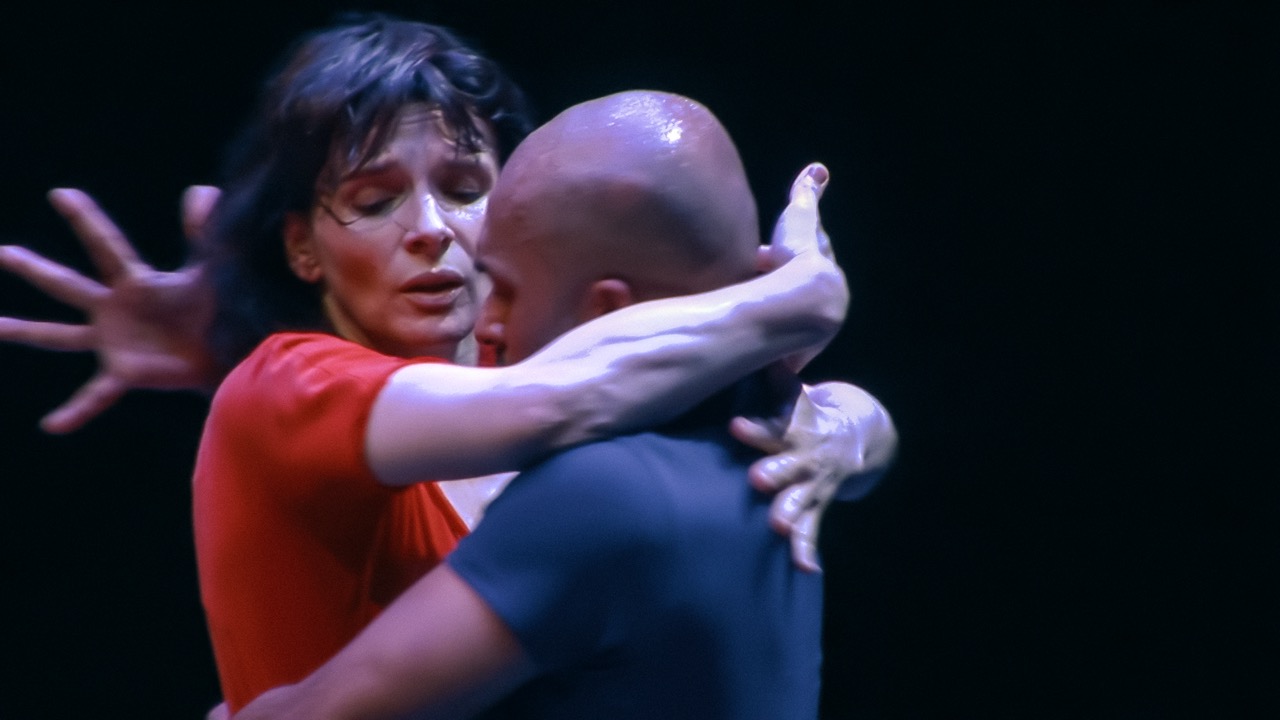
In the early 2000s Juliette Binoche was lying on a massage table in Paris when her masseuse Su-Man Hsu asked the French actor if she’d ever considered dancing. No sooner had Binoche replied “yes”, the pair were off to see Hsu’s friend, the choreographer Akram Khan, perform in London. Come 2008, Binoche and Khan would be on stage at the National Theatre, London, premiering In-I, a work of dance theatre that saw the actor dance and the dancer act for the first time in their respective careers. Nearly two decades later, Juliette Binoche and I are talking ahead of the UK premiere of In-I in Motion, her directorial debut which documents the making of that performance.
The performance In-I, Juliette tells me, originated from a point of daring: “did Akram dare go into his emotions, showing the sides of [himself] that [he’d] never shown”, and did she, then in her early forties, dare to dance, something, she had no training in. With every mention of dancing her eyes glisten with a fierce intensity. “Yes, we did,” she smiles. As their framework, they took that daring into a fictionalised world where they perform a romantic relationship. In a statement that accompanied the show, the pair wrote: “In between two people, there’s a third, the space in between the two, and it is in the search for the third that we discover who we really are. If the Greeks had 14 words to describe different ways of loving, how many do we experience?”
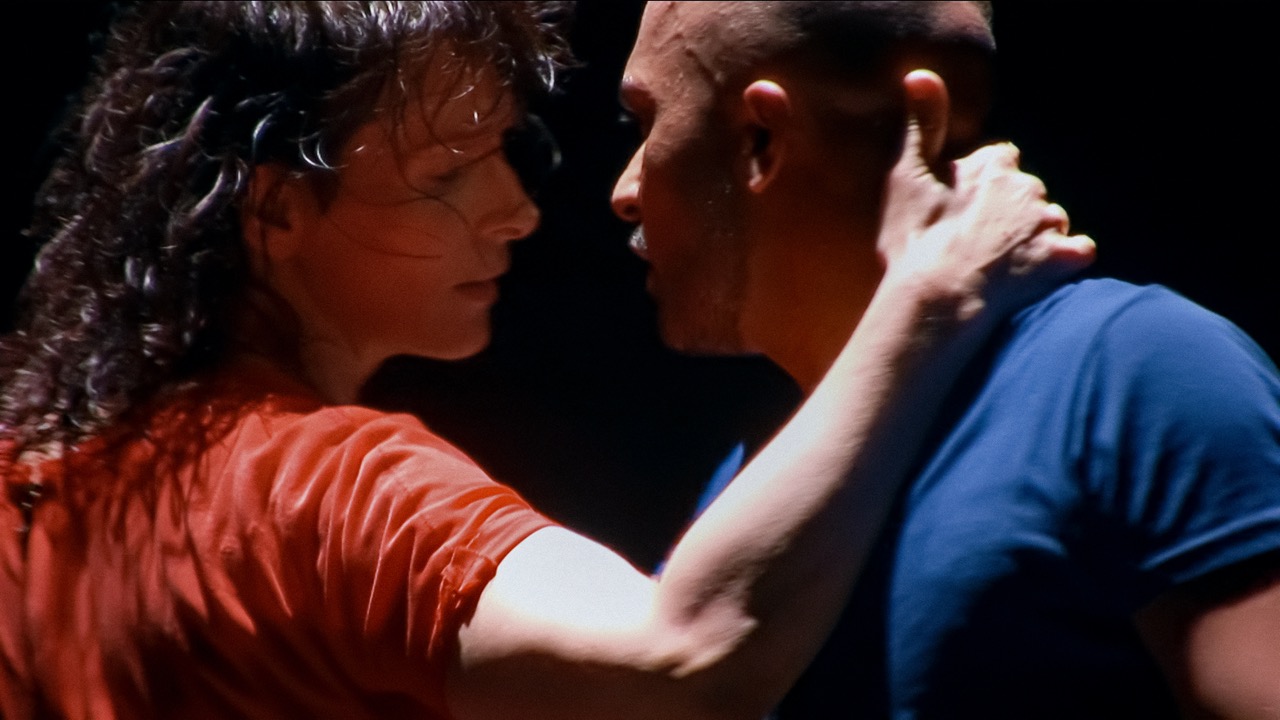
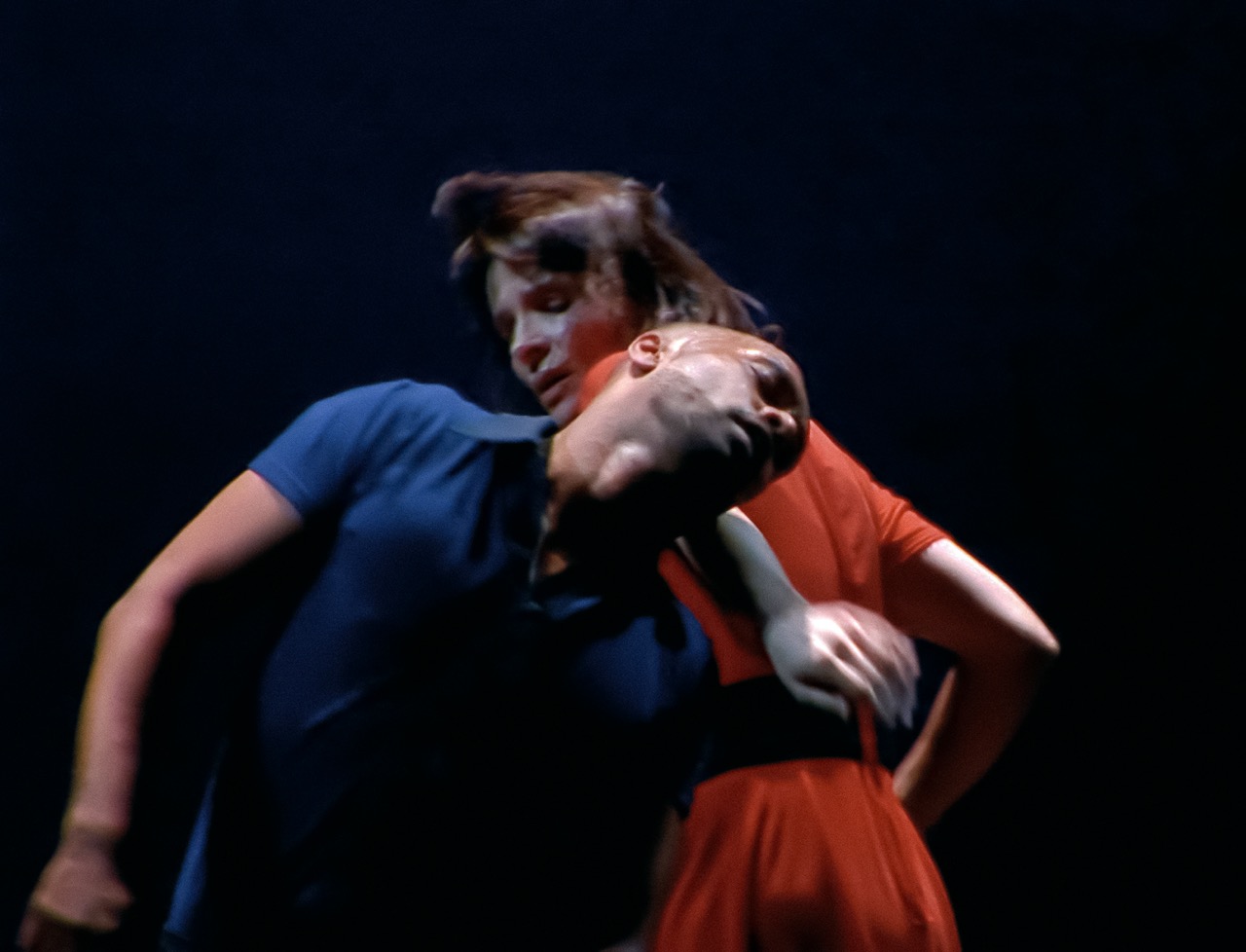


Appropriately, for the challenge of daring—to dance, to act, to love—they do not hide behind elaborate sets, costumes or dramaturgy. Autobiographical anecdotes—like Binoche’s trip to the cinema aged twelve (to watch Fellini, naturally) where she instead became captivated by a man a few rows in front, followed him home and professed her love for him—are transformed into vignettes on the spare stage. Flickering light transforms the back wall into a cinema screen, two chairs function as cinema seats. Later, one of those chairs becomes a toilet that fuels the pair’s bickering over wiping the toilet seat. Just as these episodes move from obsession to the quotidian, Juliette moves effortlessly from mischievous light-footed dance into comedic mime and exhaustive physical theatre. She is a dancer.
In-I was destined to become a film (the opening scene’s flickering cinema screen a premonition). Binoche recounts how the late Robert Redford attended one of the New York performances of the 100-date world tour. He subsequently visited her dressing room, exclaiming: “You’ve got to make a film out of this!”. “I knew he was right. I was even frightened he was going to do it himself!” says Binoche who, when back in Paris, asked her sister Marion Stalens (a director in her own right), who had already filmed 200 hours of “beautiful footage”, to capture the final seven shows. She carried on her usual acting work with the “desire to make a film in a corner of my mind,” then, when a film financier offered her the means to pursue any project she liked, “it put the need of making this film in me again,” she says.
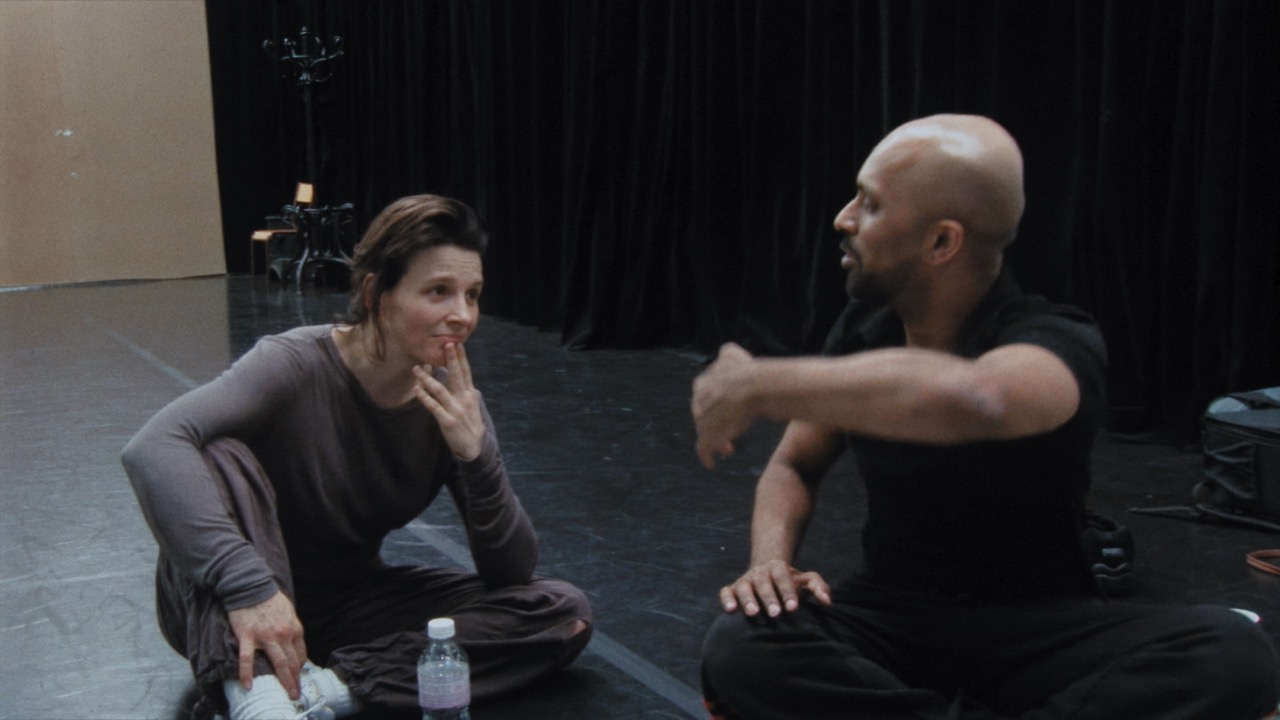
“The most difficult thing was the beginning. How do I start the film?” says Binoche, still open to the idea of it being otherwise. The decision? With the bare facts supplied in a voice over from Binoche: they’ve decided to create a show, he wants to act, she wants to dance, they hardly know each other, they have no preconceived ideas, they’ve got six months. Following that, we’re in rehearsals, somewhere in the middle of the process. Standing in a traditional duet hold, Binoche repeats attempts to release herself from Khan’s grip; acting coach Susan Batson heckles from offstage (“Don’t push it.”) They try again and again, the push and pull growing stronger against an operatic soundtrack. Another cut and Binoche and Khan are slow dancing to Paul McCartney and Stevie Wonder’s pop ballad Ebony and Ivory, as Batson encourages Binoche’s searching hands to “find his ass.”
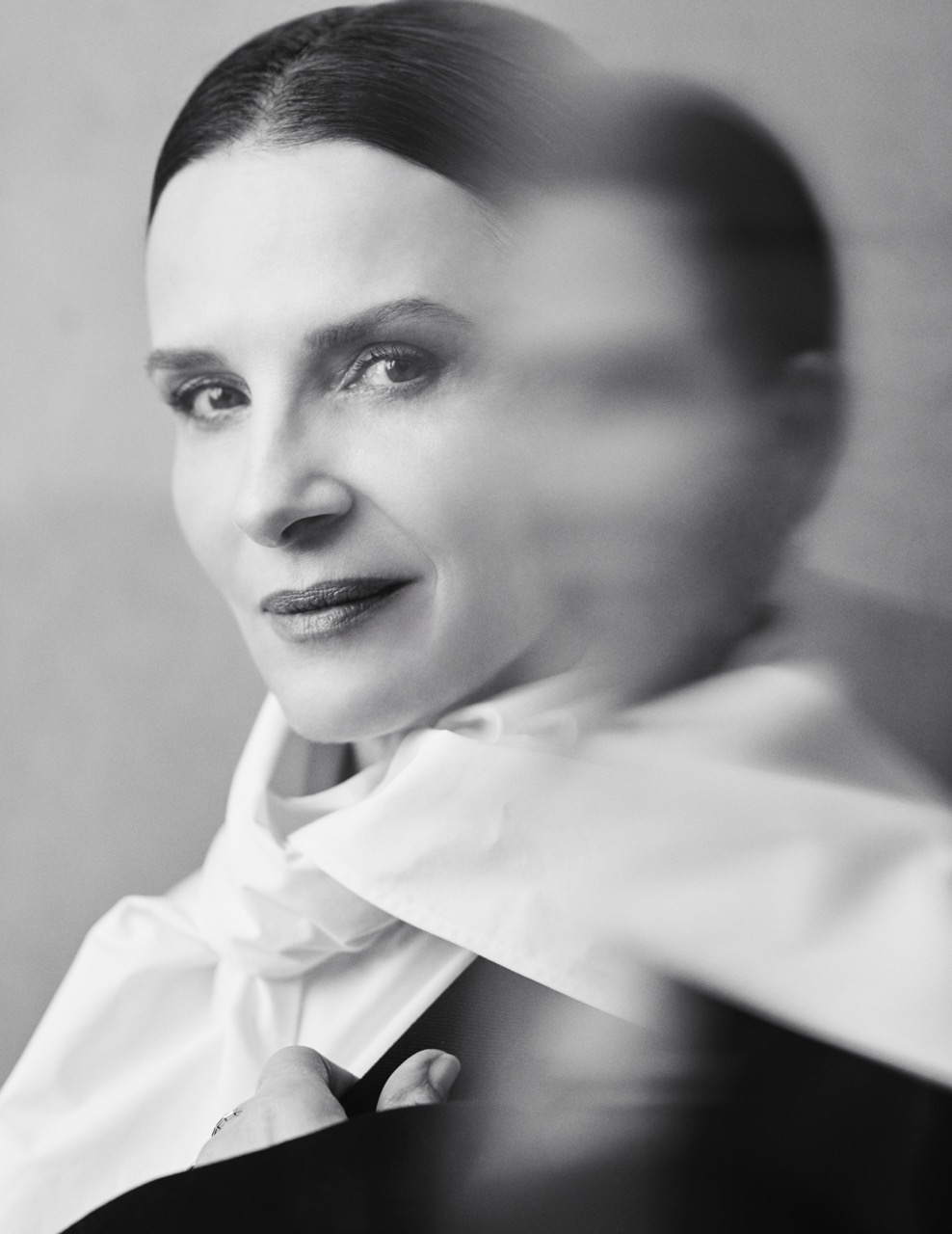
Juliette Binoche, Portrait Courtesy of Magnus Mogesen and Madame Figaro.
“I wanted the audience to understand that any form of art comes from being in touch with the sensation. It’s about the body and spirit working together and how that is expressed through your movements,” explains Binoche. Even without a clear chronology it is clear that we are watching both the development of an artistic relationship and the breakdown of a romantic relationship. Binoche nods, “it’s still a story you know, even when you see [something as non linear as] a Béla Tarr film, it’s still telling something.”
In-I in Motion is a film of two parts: preparation and then performance. First, we are teased with fleeting glimpses of monologues; phone calls with set designer Anish Kapoor for a “red–deep red” backdrop; and see Binoche push through physical pain and technical difficulties for the show’s climax where she is slammed into the back wall and suspended like a bug in a web. Then, from the claustrophobia of the rehearsal room we are transported to the theatre to watch the performance in full. “I essentially had two films. The question was: ‘do I show the process before or after the performance?’”
The performance follows a traditional linear structure: “we meet, we’re totally in love, everything’s beautiful, and you want to live forever in that bliss. But then comes everyday life, irritations that swell into passion possession, where it escalates into a nightmare,” says Binoche. Here any open questions from the rehearsal are put to rest, we see how scenes connect but also see how monologues are adapted. In these two hours you feel memory at work—the overlaps, gaps, misrememberings and revisions. It’s not unlike the memories that take root after a relationship has ended, you can never quite be sure what was projected, what was real.
In one rehearsal scene, Binoche speaks about the “need for resistance from your partner” for transformation. A fundamental resistance, and the motor of the performance, is how dance and acting meet. Binoche tells me how the process of making the performance required a reversal of inside and outside; “dancers usually start from the outside, in front of a mirror” but “as an actor I study from the inside, letting the feeling find its way out.”

“Dancers usually start from the outside, in front of a mirror” whereas “as an actor I study from the inside, letting the feeling find its way out.”
Juliette Binoche
Dance and film however have a history of working with each other with film often employed to preserve performances that would otherwise be lost to time. The camera can serve as a documentary tool or—as in works of dance for film— the camera can precede the choreographic, it can dance itself. In-I Motion joins a growing oeuvre of dance films; I was reminded of One Day Pina Asked, a documentary directed by Chantal Akerman that followed the German choreographer Pina Bausch and her Tanztheater Wuppertal touring Carnations through the summer of 1983. That film begins with Akerman’s narration: “In no particular order, here are some snippets, some feelings.”
Binoche confirms Bausch’s influence. “When my head was in the hole of the massaging table. I was probably thinking about Pina consciously or not,” she says. “Pina Bausch has everything to do with me wanting to dance: I saw the Rite of Spring at Theatre de la Ville, and I was just transformed by it. There was so much emotion I could feel from the stage, and that experience stayed with me.”
At the start of the project Binoche admits she was “clumsy, awkward… I couldn’t sustain a rhythm,” but watching the footage she saw herself changing “not only physically but emotionally, it showed something personal about my life.” In-I was never about learning to dance per se, but learning through dance (and dancing with a partner) to reach a new perspective, that “third” space the pair spoke of in 2008.. “I experienced it from the inside. In directing this work I’m now seeing it from an outside perspective,” says Binoche. In its essence the film is a duet of distinct and opposing parts — inner and outer, actor and dancer, process and performance, dance and film—that when combined create something entirely new. Binoche agrees. “The want to transform is the most beautiful wish you can have in any relationship.”