

As his latest film, Bitter Christmas enters the stratosphere, the legendary Spanish filmmaker speaks with us about his commitment to the greatest women actors, distinct fashions, and how he has built a universe—as well as a few notable careers—on his muses and mujeres.
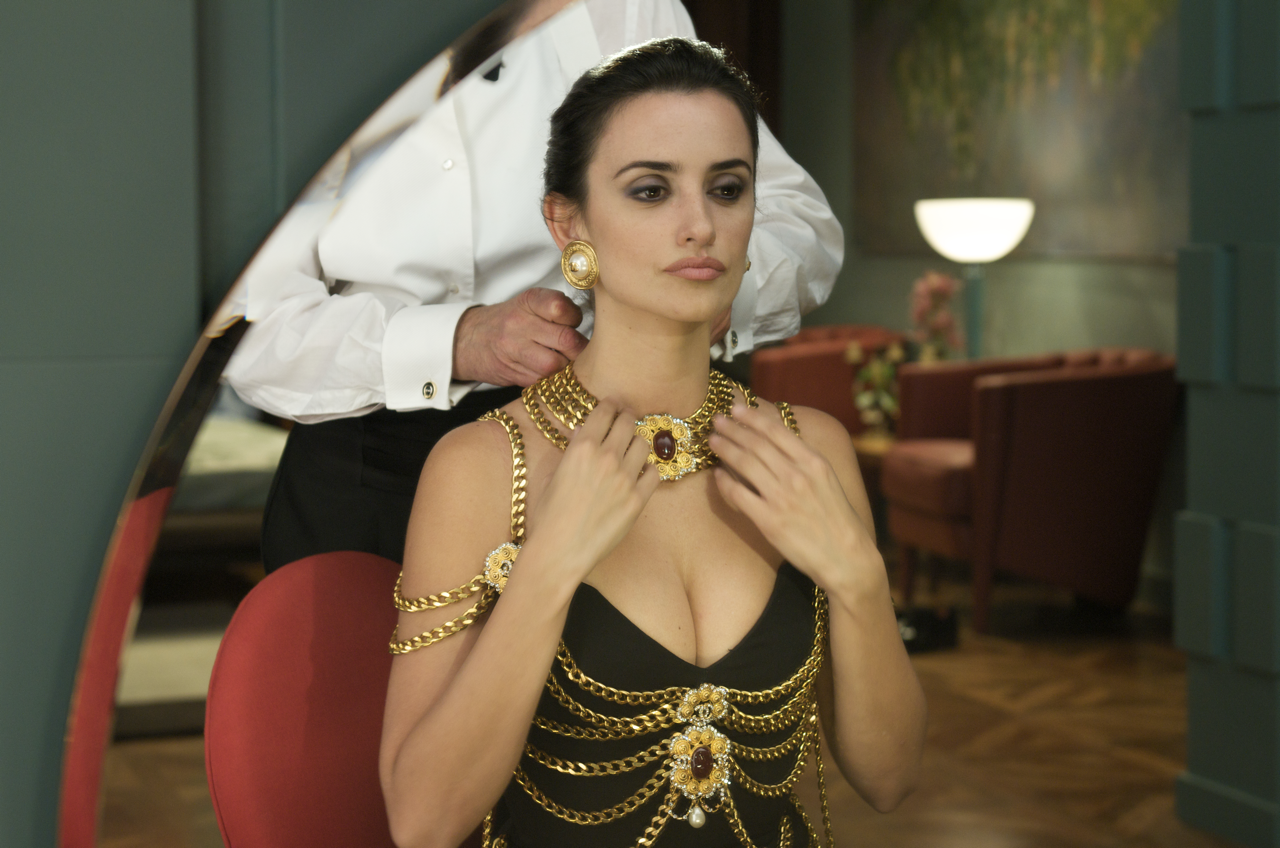
“Don’t smile, the wig is false enough!” exclaims Lluís Homar’s Mateo Blanco to the platinum-bobbed Penélope Cruz, playing the sublimely beautiful Lena Rivas in Pedro Almodóvar’s 2009 film Broken Embraces. A rumination on filmmaking, fixation, and artifice, the film moves through the decades in saturated, pulsing colour. Yet it is fashion that most clearly situates us within Lena’s transformations—and ultimately anticipates her tragedy.
She sheds the austere, broad-shouldered Alaïa suits of her life as a secretary for the opulent Chanel of primped housewifery and its gilded sadness, before adopting floaty island skirts as she begins to fashion a new, more hopeful existence. As the story unfurls, the lasting images are of Cruz in gold-chained Chanel haute couture and tomato-red skirts swirling against the Lanzarote surf. In Almodóvar’s cinema, costume does more than place a character in time. It reveals the self she is performing, the life she desires, and, often, the fate closing around her.
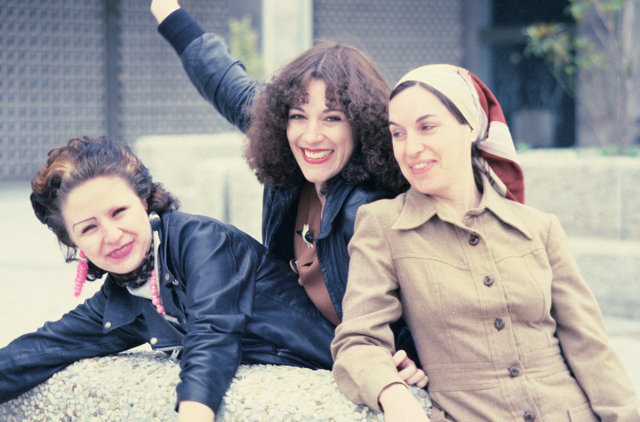
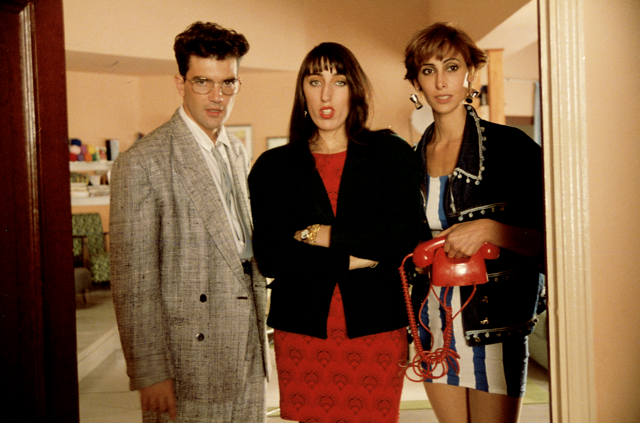
Olvido Gara, Carmen Maura, and Eva Siva in Pepi, Luci, Bom y otras chicas del montón (1980).
Speaking to us, Almodóvar describes how that process begins. “I think about costume once the script is finished and I decide the colour palette the cinematography will have,” he says. “I naturally gravitate toward saturated, bright, explosive colours combined with pastels. My ideal of colour is the Technicolor of the films of my childhood. But I also have to consider the period, and whether the clothes suit the actors.” The choice of wardrobe, he adds, only happens once casting is settled: “We choose the clothes once we have the actors.”

“His ’cinema of women’ has always been fearless in expressing grief, longing, and power through style.”
Anna Cafolla
Across a five-decade career, Almodóvar has built a singular visual language. He moved to Madrid in the late 1960s to pursue his dream of becoming a filmmaker, supporting himself by selling wares at the vibrant El Rastro flea market. With the film school closed by the Franco regime, he found himself at the forefront of the Movida Madrileña youth subculture, which emerged as dictatorship gave way to democracy and unleashed a hedonistic spirit of creative freedom.
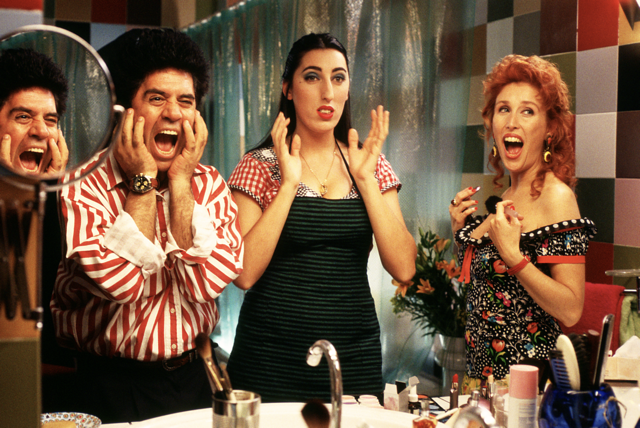
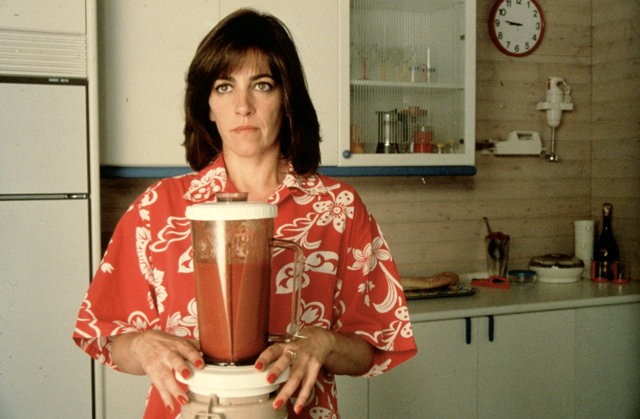
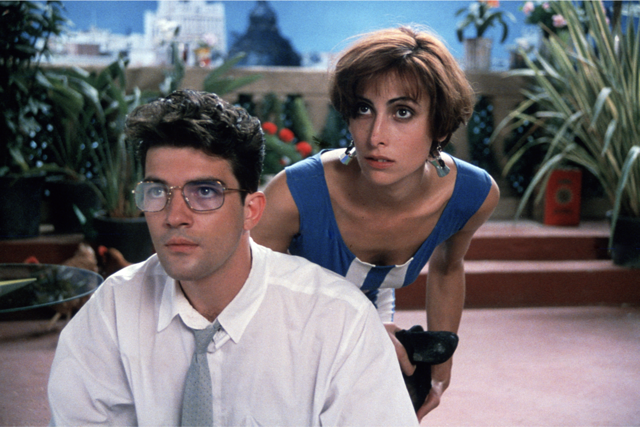
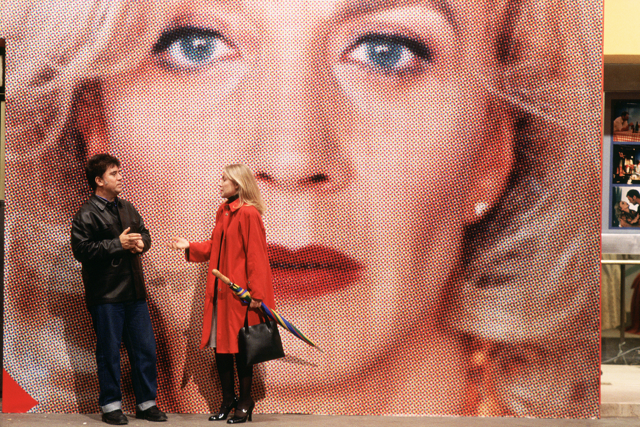
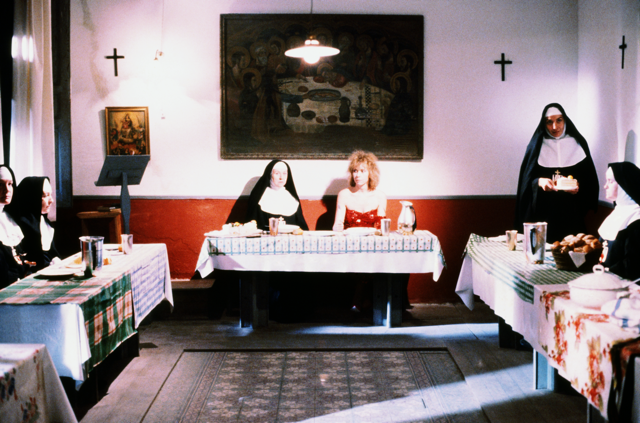
His first feature, 1980’s Pepi, Luci, Bom, captured that cultural and sexual transgressiveness through a punk aesthetic of checked shirts, leather, and slashes of acerbic make-up. As Almodóvar refined his visual codes, style continued to drive his stories of identity, desire, and distinctly female resilience. Art and life blurred through an insatiable appetite for references, while reality was sharpened by flashes of scarlet, cobalt, and marigold. Collaborations with Jean Paul Gaultier, Gianni Versace, and Karl Lagerfeld expanded the scope of his cinematic universe. His “cinema of women”—fronted by muses including Penélope Cruz, Rossy de Palma, Marisa Paredes, and Carmen Maura—has always been fearless in expressing grief, longing, and power through style.
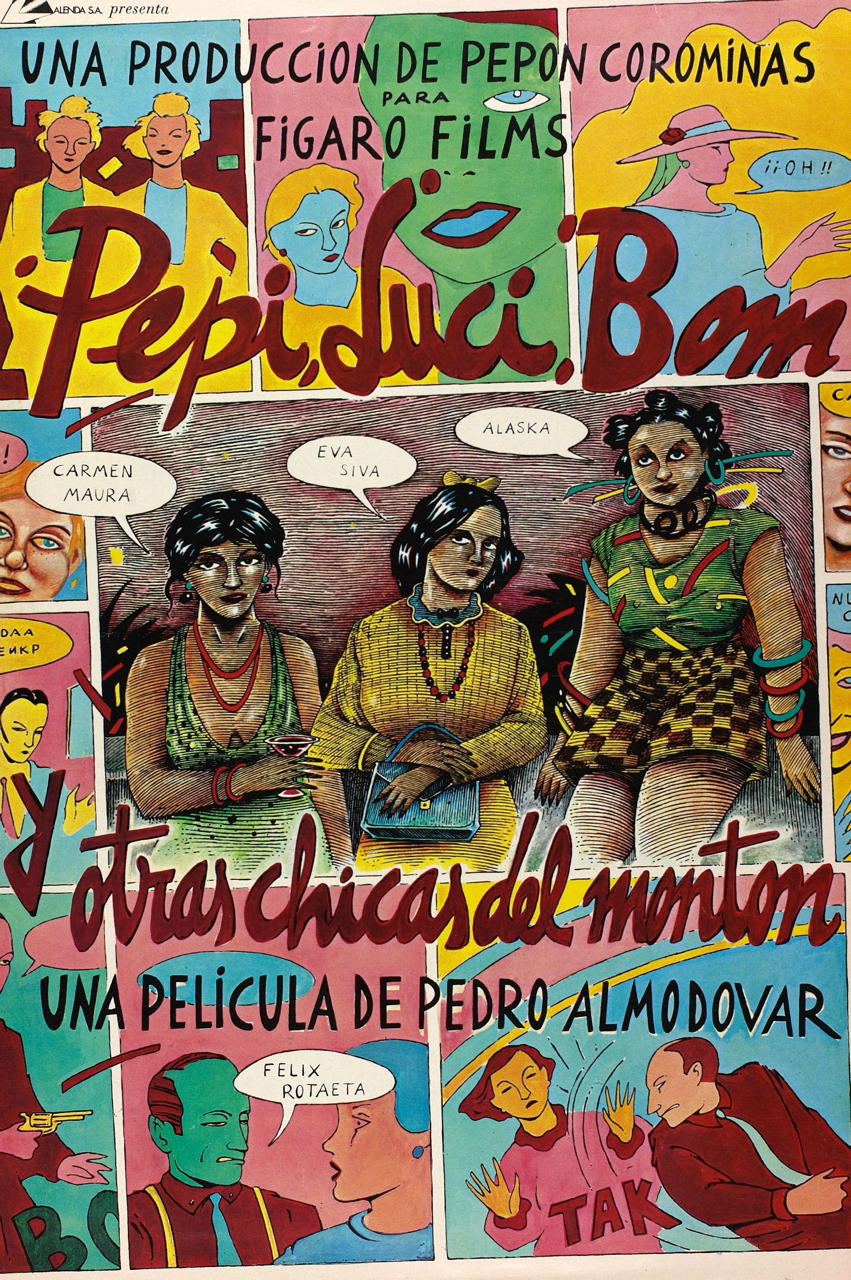
An illustrated poster for Pepi, Luci, Bom y otras chicas del menton (1980).
For Marilyn Smith, founder of Looks on Screen, Almodóvar is the filmmaker who has most brilliantly integrated the work of fashion designers into cinema. “His narratives and colourful cinematography naturally lend themselves to garments that often become more than costumes, becoming central to the story,” she explains.
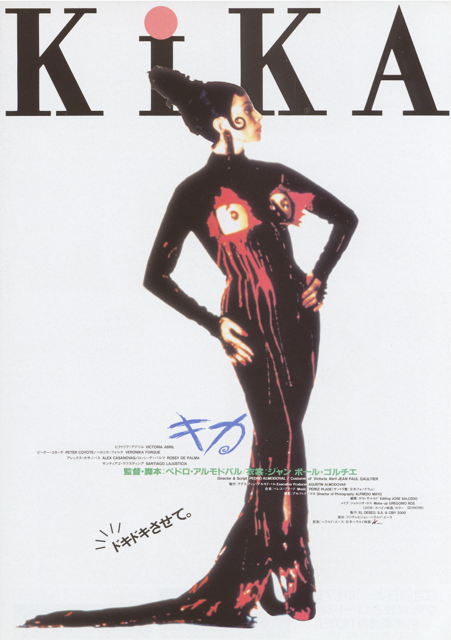
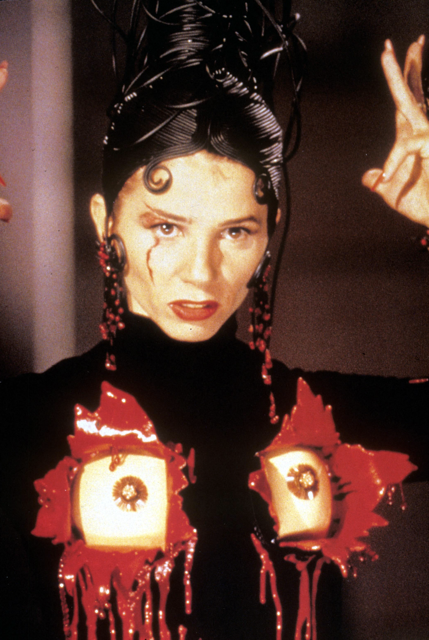
Smith points to his collaboration with Jean Paul Gaultier on Kika (1993). “Victoria Abril’s Andrea Caracortada wears custom pieces that perfectly embody the film’s blend of glamour and violence,” she says. “In contrast, Kika, the film’s unwavering optimist, wears a playful wardrobe made almost entirely from Versace’s spring summer 1993 collection.” “In his films, fashion is never incidental; it becomes another way of revealing character, emotion, and the heightened world they inhabit,” says Smith.
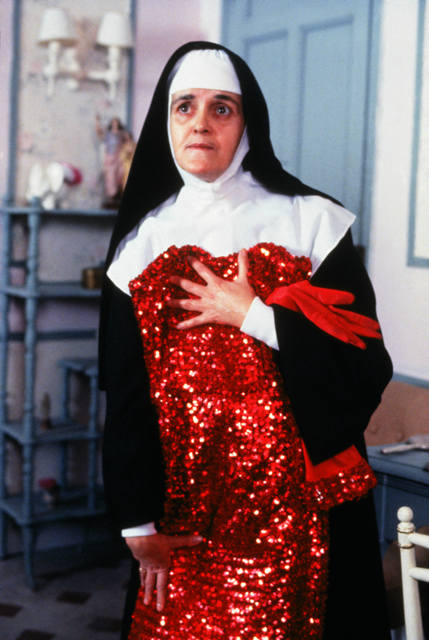
This is Almodóvar’s fashioning of femininity: moka pots swinging from the ears of a neurotic María Barranco in Women on the Verge of a Nervous Breakdown (1988); Verónica Forqué’s blood-sequin pocked corset in Kika; Tilda Swinton in a canary-yellow Valentino suit, striking against the sombre emotional landscape of The Room Next Door (2024). The relationship between costume, fashion, the body, and performance supports the construction and transformation of his characters while expressing their interior lives.
Working with Almodóvar requires a departure from conventional realism. “You have to adapt to his aesthetic language, his narrative, and his way of communicating,” says Sonia Grande, the costume designer who collaborated with him on Broken Embraces, Julieta (2016), and the short film The Human Voice (2020).


“You must completely abandon a naturalistic approach and transform the characters with a different sense of truth,” she emphasises, “turning them into something we could define as plausible.” But Almodóvar’s idea of the “plausible” has little to do with spartan realism or static reality. For Grande, it means “striving to create a poetic truth, which is ultimately the greatest of all truths. Colour, shapes, and textures are what move us, what touch our deepest emotions, what seduce us, and take us to other places. It does not have to be what it seems, but what it deeply is. Almodóvar does not copy reality; he writes a new poetry upon it.” “With Pedro, you learn boldness, courage, and freedom,” she says. “You learn to love the characters without judging them, with empathy, and a sense of humour.”
That poetic truth extends beyond the body and into the sets, backdrops, and furniture. Grande describes the process as “creating that poetic disorder that moves you, that new reality”, with Almodóvar closely involved across the artistic departments throughout pre0-production. “He knows that a single ’visual verse’ can be more powerful than two pages of script,” she says. Put this same idea to us directly, Almodóvar doesn’t disagree—though he’s quick to draw a line between instinct and evolution. “In the 80s everything was more exaggerated, and that’s reflected in my films,” he says. “It’s true that in my recent films, both the plot, the storytelling and the colours are more austere. I’ve evolved naturally.”
In Julieta, the protagonist is played by Adriana Ugarte and Emma Suárez across different stages of her life. She was also a woman of Grande’s generation; one whose evolution could be understood alongside that of post-Franco Spain. “I constantly associated the evolution of Spain with the main character,” explains Grande.
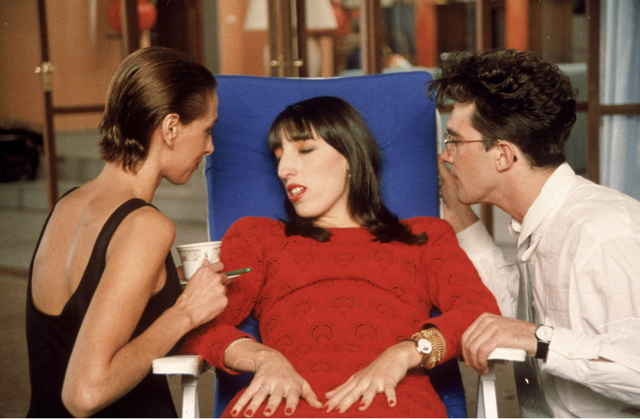
The young Julieta embodies the daring spirit of the 1980s, with cropped platinum hair and inherited jackets with exaggerated shoulder pads. By the late 1990s, her wardrobe has settled into a quieter eclecticism. She appears more refined and deliberate, a woman whoknows what she wants. Her changing hair completed the transformation. With Miuccia Prada creating almost an entire collection for the shoot, clothing became both a marker of time and a register of Julieta’s changing sense of self.
Broken Embraces is defined by Karl Lagerfeld’s Chanel. “It was the perfect brand… we needed its elegance, beauty, symbolism, and also its status,” says Grande. “The character achieved a restrained and melancholic beauty born of adversity. In some way, these are concepts that evoke the understated, melancholic style that Chanel introduced into fashion.”
“We custom made most of the wardrobe… in the style of women at the markets in Madrid.”
Bina Daigeler
For Grande, the sequence in which Lena’s husband fastens her black suit with its gold chains is especially moving. As he closes the chains around her neck, they appear to become the shackles of an unhappy marriage, locking her into a life destined never to be free. It is a moment in which costume does not simply support the narrative, but leads it. For The Human Voice—Almodóvar’s first English-language film, starring Swinton—the director and costume designer drew more explicitly on art-historical references, including Giorgio de Chirico and René Magritte.
The short reflects Almodóvar’s growing passion for painting, articulated on screen through sumptuous colour and texture, with a bird-like Swinton moving through the set in Balenciaga couture. In just under 30 minutes, there are at least six outfit changes, from azure to gold lamé, oil-slick black leather, and scarlet, with designers ranging from Dries Van Noten to Balenciaga. The scale may be intimate, but the visual ambition remains expansive.
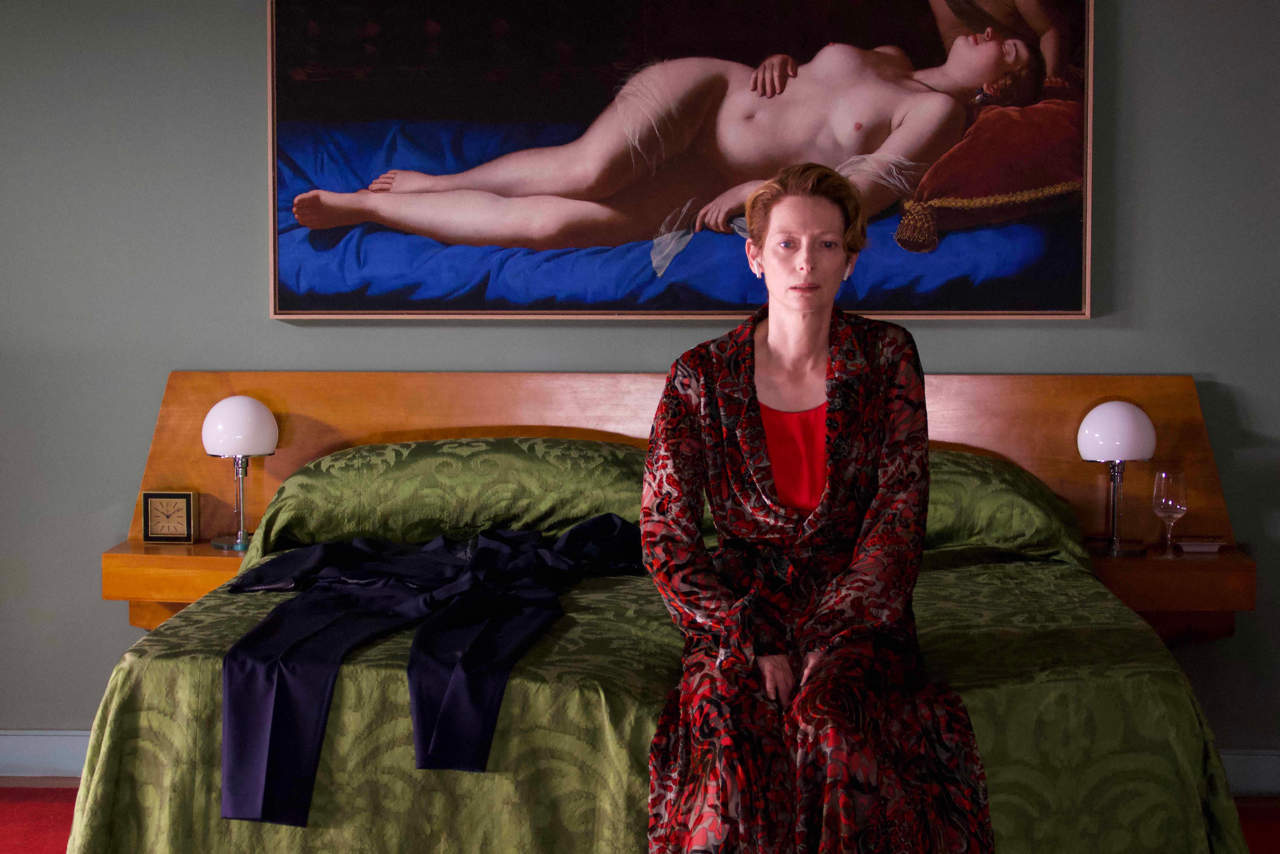
Tilda Swinton in The Human Voice (2020).
Bina Daigeler’s breakthrough came with Almodóvar’s All About My Mother in 1999. She later worked on the costumes of Volver (2006)and The Room Next Door, helping to define some of the more character driven aesthetics of his oeuvre.“His design language is something I have seen develop during each film,” says Daigeler. “It has evolved, and he is often copied and referenced, but it is always so Pedro. He is as inspired by Edward Hopper as he is by Pina Bausch.”
His references move fluidly between fashion, fine art, dance, and the personal style of his actresses. In The Skin I Live In (2011), Gaultier’s nude body stockings evoke the sculptures of Louise Bourgeois. Almodóvar has also drawn inspiration from what his performers wear in their own lives, whether that’s a suit belonging to Swinton or a Loewe slip worn by Cruz. His vision is precise, but both Daigeler and Grande describe the work as richly collaborative, grounded in an abundance of references and imagery.
Yet amid the colour, texture, and visual quotation, there is always clarity. “When I did The Room Next Door it reminded me of Hitchcock movies in the 1960s. Not visually—his women look very different—but that strength of one look,” Daigeler says of the Venice Golden Lion winning production starring Swinton and Julianne Moore. “There is that same exquisite taste that he brings to each production.”
Penélope Cruz in Broken Embraces (2009).
Almodóvar explained he is well aware of that shift in register—one now carried further in his new film, Bitter Christmas (Amarga Navidad). “I don’t leave anything behind—every film I’ve made represents me, and each one depends on the period I made it in, the stories I was telling, and the life I was living at that moment,” he says. “Naturally I’m aware of the sobriety of Bitter Christmas or The Room Next Door. They’re both dramas, but even so my colour palette is always a little more vivid than it would be if the costume design were naturalistic.”
There is also a clear distinction between fashion and costume design. Where the fashion world often aspires to create external desire, the costumes of Almodóvar’s world express vast interior landscapes. In All About My Mother, each character’s identity is challenged and emboldened. During the film’s most tragic moments, powerful colours act as lightning rods: rich jewel tones and sculptural tailoring sharpen its meditations on grief and femininity.
Daigeler recalls Cecilia Roth as Manuela, her vivid red raincoat giving visual form to her grief. In Volver, Cruz’s Raimunda appears in busy floral patterns, gold hoops, and a crucifix necklace, her sensuous wardrobe shaped around the character’s determination and physicality.
Daigeler recalls Cecilia Roth as Manuela, her vivid red raincoat giving visual form to her grief. In Volver, Cruz’s Raimunda appears in busy floral patterns, gold hoops, and a crucifix necklace, her sensuous wardrobe shaped around the character’s determination and physicality.“I wanted her character to feel of and above its time,” Daigeler says of Cruz in Volver. “It is not as overwhelming as a period piece, and the wardrobe still feels inspiring today. We custom made most of the wardrobe, shaped to her body, and in the style of stars like Sophia Loren or women at the markets in Madrid. The textures, the shapes, all reflect her personality.”
The garments are specific to each woman, yet they also belong to a coherent Almodóvarian world. “To me, they’re all part of a bigger story, and unite all these women in one visual universe,” says Daigeler. That exchange between fashion and film also extends into Almodóvar’s life. “Fashion adores Pedro, and Pedro adores fashion— they are communicating vessels that love and respect one another,” Grande observes.
“I especially love that it is something you see carried through into his real life—his personality is just as bright,” Daigeler adds. At the 2024 Venice Film Festival, he appeared in flamboyant salmon-pink tailoring by the Spanish house Loewe, paired with a gold feather brooch and inflated sunglasses. Like Lena’s conspicuously blonde, fluffed-up wig, the look made no claim to naturalism. Its artifice was precisely the point.
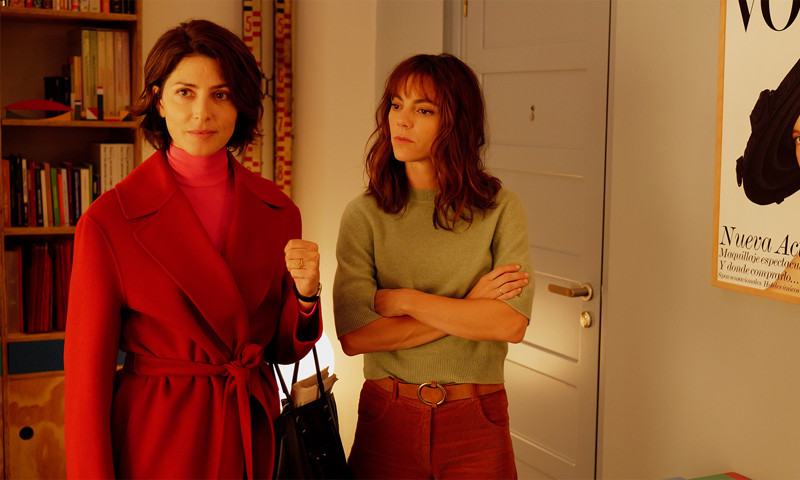
Aitana Sánchez-Gijón and Victoria Luengo in Bitter Christmas (2026).
“I have my physical limitations,” Almodóvar says, candidly. “My measurements aren’t those of a model… but even though I’m not tall or thin, there’s always the possibility of using colour and following trends in my own way—it depends how you feel.” Red carpets, he admits, are their own particular discipline: “I don’t like the tuxedo, and in general a suit with shirt and tie is a kind of slavery to me. I would go to ceremonies in vibrant sportswear. Musicians do this very well—look at a Grammys ceremony and compare it to the Oscars. The difference is brutal.” But the character he directs and the man who gets dressed each morning remain, for him, distinct. “I don’t see myself as a character,” he insists. “Never, please!”
Across Almodóvar’s films, style does not conceal emotional truth but makes it visible, turning clothes, colour, and performance into a poetry of their own. Where that poetry will find its beat next, who knows, but it will be high definition and distinctly Pedro Almodóvar.