

Brodie Crellin discusses A Sense of Occasion, a novel about a death in a dysfunctional family that tests the limits of intimacy.
From Jay Gatsby’s Long Island bonanzas and Patrick Melrose’s country house bashes to Finnegan’s boozy wake and Clarissa Dalloway’s summer soirée, parties—and their preambles—provide some of literature’s most memorable backdrops: a metaphorical punch bowl where characters stew together in the intensity of an extended moment. In their debut novel, A Sense of Occasion, writer Brodie Crellin draws on this tradition, using a family funeral to explore the limits of intimacy. Set over several days of long hot English summer, estranged cousins Jude (playwright, living in Naples, very good driver) and Patch (anxious, living in Jude’s London flat, thinks jacket potatoes are suitable party food) reunite after the unexpected death of Patch’s mother, Mary (art teacher, modest, unlucky in love). Returning to the rural milieu of their childhood, where Patch’s father Robin (English teacher, into cruising, downwardly mobile) still lives, Jude and Patch are thrown into the pressure cooker of funeral planning.
“I’m interested in the elasticity of families, what can happen in them, but also how much they can hold,” Crellin, who is an editor at Granta, tells A Rabbit’s Foot during a warm July afternoon at the London Review of Books café in London. Exploring class, queerness and the limits of eroticism, A Sense of Occasion is a character-driven, intricately plotted novel shifts between temporalities—from Mary and Robin’s early courtship to Patch’s dalliances with Jude’s ex—whilst arriving back into a present tense that pushes the boundaries of their relationships in salacious, but also humorous and human ways.
In the conversation below, Crellin discusses the origins of the novel, why cousins are an underexplored relationship and food as an efficient metaphor.
What was the starting point for the novel, or when did you start writing it?
I was so scared you’d ask this question. I began in December 2022—it was initially conceived as a totally different book. I was thinking about books like [Edward St Aubyn’s] Patrick Melrose series and Dorothy Baker’s Cassandra at the Wedding (1962), and a lot of mid-20th century writing like Jean Stafford or Ivy Compton-Burnett. What I have created is nothing like that—you’re not always in control of what you make. I did know I wanted to write something about intimacy and connection. My favourite novels explore how we relate with each other and what life we should lead, regardless of form. Whether it’s Sheila Heti’s How Should A Person Be? (2010) or George Eliot’s Middlemarch (1871), they are asking the same question. I was thinking about what would make Patch happy, or what would make her relationship with Jude easier. Those two characters—who are quite co-dependent with a relationship that isn’t working—arrived quite fully formed and everything else built outwards. I thought about whether they should just be friends, or exes, then I thought cousins would be fun.
It’s definitely an underexplored relationship.
Cousins are so interesting, because you’ve got this symmetry, but then you can just stretch it. It’s a friend you can be really badly behaved with, but then you are going to see them again next Christmas. So you can stretch the limits of what is acceptable. You can pull an awful tantrum and then you just have to sort of forget about it. Then family novels are always about transition, and often the form that takes is grief, because it always leads to some kind of rearrangement or change. Someone gave me the advice once, that if you don’t know what to do in a novel, then throw a party and mingle the characters together. I thought that a funeral would be a useful catalyst. I’m interested in the elasticity of families, what can happen in them, but also how much they can hold.
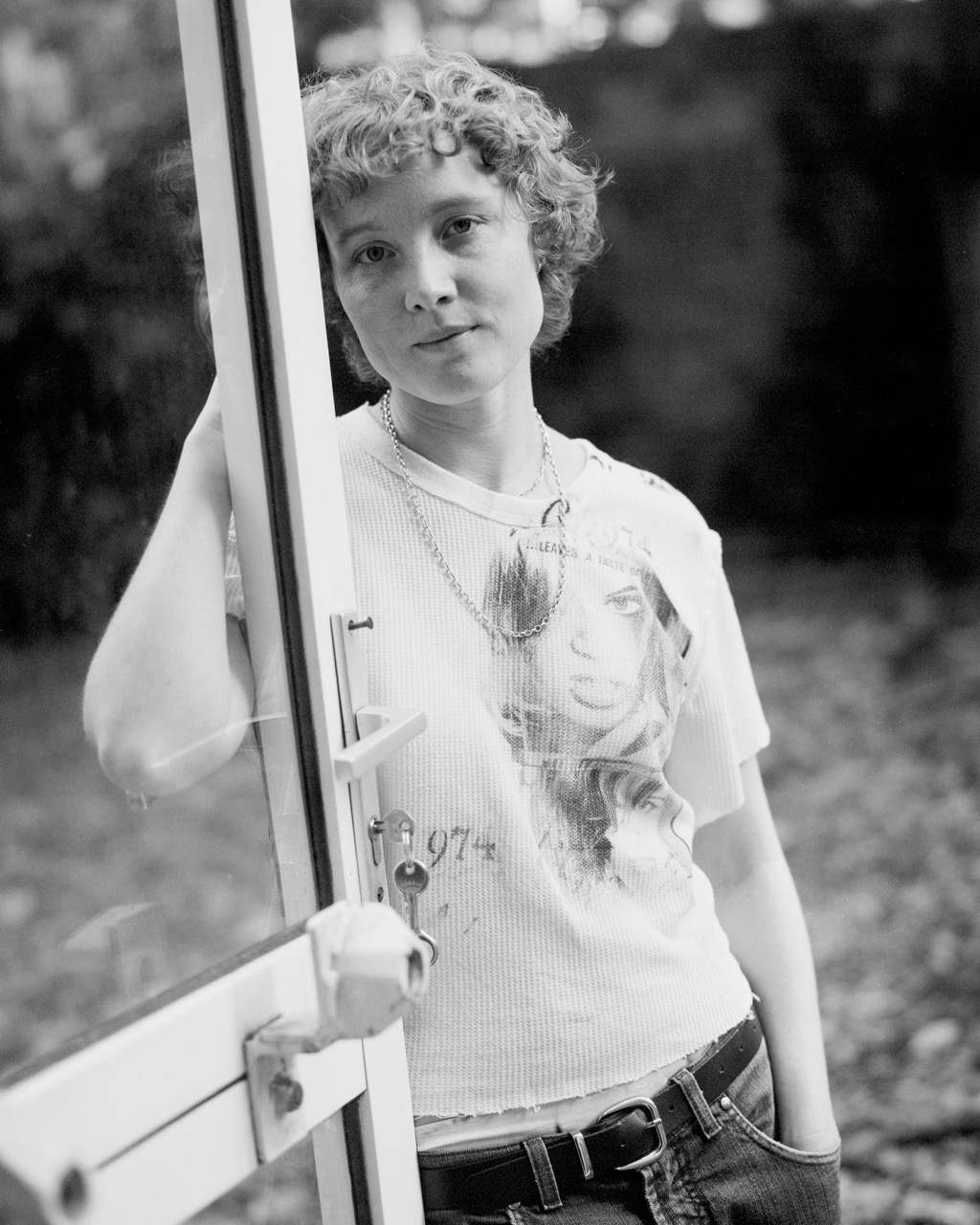
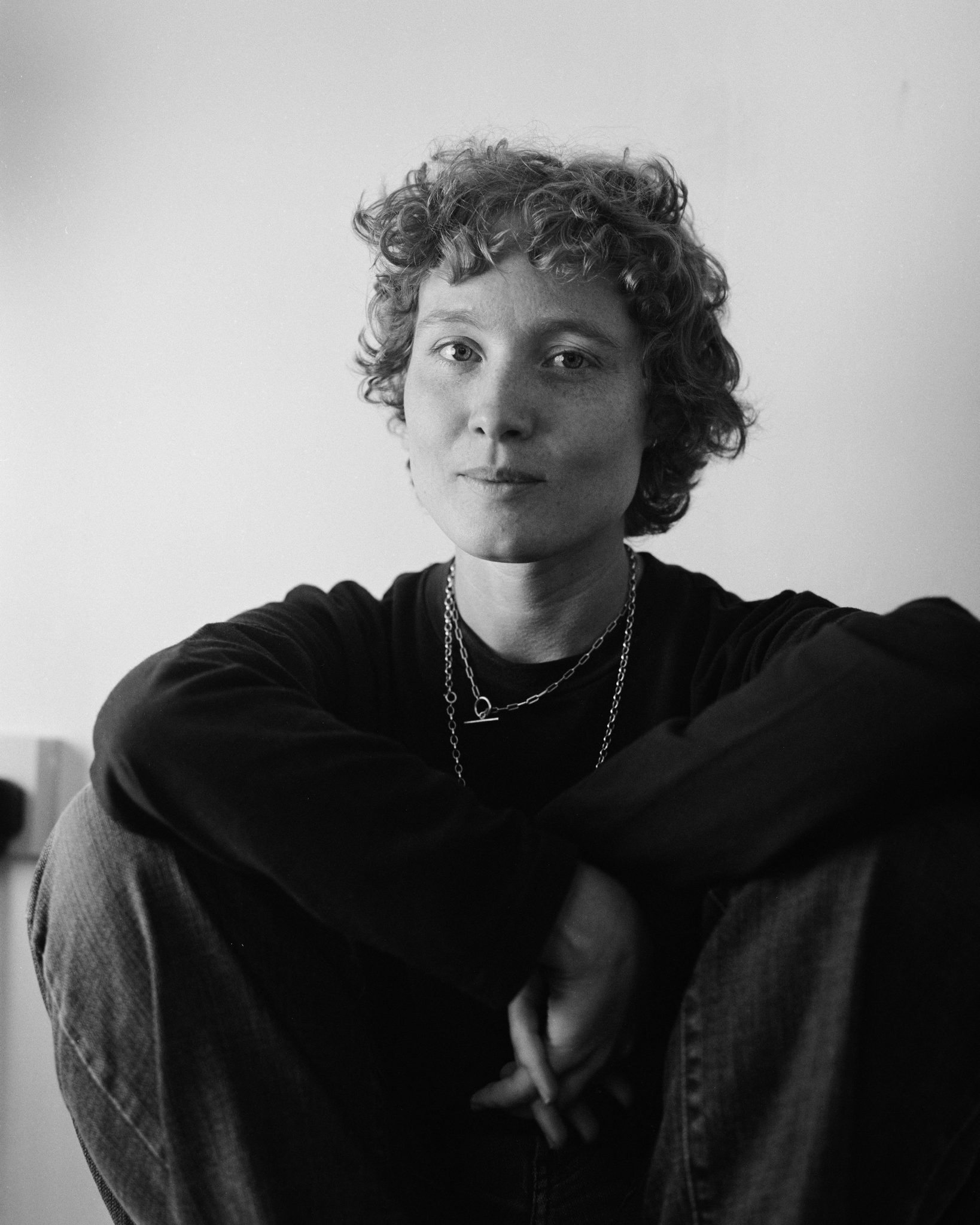
Brodie Crellin. Credit: Max Ferguson.
When you threw the party—did the characters change much from when you originally conceived them?
Yes—I had this idea of Mary at the beginning as this quite shadowy figure, but then I found it more fun to explore the relationship between her and Robin, and this marriage from a different era. People have interpreted it as a romance of necessity, but I actually just think that sexuality is capacious and we surprise ourselves all the time. I’m gay and my family’s gay and I feel like I’ve always lived in this very gay world, but I didn’t want to pigeonhole any of these characters. There’s so much erotic potentiality in so many bodies. Mary and Robin find so much to be attracted to regardless of gender and they were really committed to the creative project of what an erotic life together might look like. It doesn’t work, but that isn’t because they aren’t attracted to each other—Mary is devastated to lose Robin’s legs, she loves his legs. I enjoyed writing it, because it surprised me.
Patch and Robin—it felt eerily familiar to that kind of 20s friendship a lot of people seem to have which goes too far and is unsustainable.
Yeah, and I use sex as a device to show that—it could have been something else. I’m really interested in sex and I think about the way we talk about it a lot. It’s something we all do, and I don’t think it should be siloed from anything else we do in terms of interrelations. It’s no different from having a conversation, or sharing a meal—it’s an activity we do together. It’s not this major inversion of our vertical selves. It’s an integral part of understanding who we are as people. A novel is a constructed world, and to think about a character without thinking about their sexuality does them a disservice.
Personally, the book really invited me to invite comparisons between characters: “am I more of a Patch or a Jude?”
I think that’s how you should be reading it. Neither of these characters would exist in the novel without each other. The whole point of writing about a dyad is the way these characters play off one another. It’s a social novel, the point is it’s about relationships, so if you’re seeing yourself in one and then another, that’s because it’s relational.
I also loved that it’s this rural summer novel, even if it takes place in the lead up to a funeral. Can you talk about the setting?
It needed to be in the summer because Mary and Robin aren’t at school. I’m from a village in the Midlands, people from the area I’m from have recognized the places that I describe. I wanted to tell a story that wasn’t set in London. I was bored of London novels. The rural element felt quite key to who the characters were. I don’t think Mary would have had that life if she had lived in London. And I don’t think Patch would be either. They are informed by an environment that is isolated and stark, but also a difficult place to reconcile your queerness. Mary has struggled to find a way to feel at ease with her desires, which wouldn’t necessarily be the case in London. It’s the same with other things—if you’re in London and you need to go food-shopping, it’s not a big deal. In the countryside, even going to the supermarket is an event, which I could use as a plot device in the novel. The summer also adds to this deliriousness. They are all a bit hot and bothered.
I found that food is an important—and very efficient—metaphor in the book. Why is that?
I was so hungry when I was writing this novel. I’d write it after work and I would have cycled a really long way. It’s actually a big part of the way I chose to signify class—the way we eat and what we eat and how we associate it with good manners—a lot of these ideas of wealth and status and politeness get caught up in it. Patch thinks they can just eat crisps and potatoes at the funeral. Robin is like, maybe a brie? Jude’s like, no we need to make a lasagna. But that itself comes across as ridiculous. Then Juliette comes in and says no it’s finger food and salad. And it shows these different rungs of power.

“A novel is a constructed world, and to think about a character without thinking about their sexuality does them a disservice.”
Brodie Crellin
How have you felt about the reception of the book, so far?
It’s been so exciting to finally share the novel with readers, and while I don’t think it’s particularly shocking or provocative or risky, I think it’s just a document of how we all relate and have sex and communicate, I think some people have really leant into the sex angle. Sex is a huge part of it, but I don’t think it’s perverse, and I was surprised when someone wrote about the ‘fetish’ in the book. There is some explicitly taboo sex, but it’s not necessarily there to be taken literally, it’s about what would happen if a relationship was pushed to the extent of its boundaries. It isn’t an endorsement of incest. I think it’s not a book that is for everybody, but I have every faith that it will find its community.
I guess the thing with the incest question, is you do feel a bit conflicted as a reader, like ‘this is incest’, but it’s also well written and erotic.
I think there’s an argument to say that within the logic of the novel, it makes sense that they have sex. It’s a narrative release. It is operating on a symbolic level, where it’s the apex of what they could do wrong together, like they’ve already pushed each other. There are gestures and hints that they have had physical interactions or been violent with each other before—and we’ve seen them teaching each other how to masturbate. Also incest is super prevalent in texts. I definitely think we see an erotic energy between Jo and Amy in Little Women (1868). There’s fury and aggression and a desire to emulate, especially from Amy. Obviously in the world of Little Women we are never going to see them explore that, but all the erotic tension is there.
I thought about Iris Murdoch quite a bit while reading this, something about the relationships and the tone.
Have you read A Severed Head (1961)? Yeah, she’s also interested in looking at what happens to characters when you push characters. She probably pushes it in more inappropriate directions, and it gets a bit farcical towards the end, but then a lot of my friends say Brodie, you push it too far at the end. But I think I’m just taking it seriously.
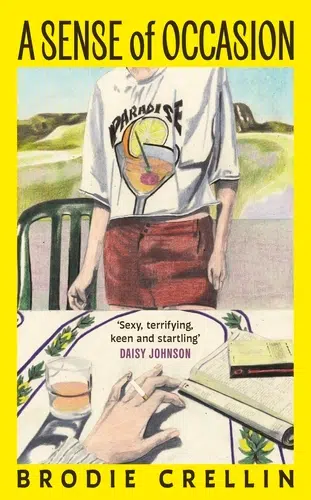
Brodie Crellin, A Sense of Occasion (2026)
What was your own background into writing, have you always wanted to write?
I don’t think it’s necessarily something we learn to do and enjoy at school. Maybe at primary school. I remember doing my year six SAT exams and there was a bit where we had to describe our perfect meal and that’s maybe the only memory I have of creative writing. It wasn’t until I went to university and did art history modules and you were asked to describe a painting, I realised it could be fun. There was no pressure in having to make anything up. Then I wrote some really, really bad things, which luckily no one has seen. With this book, I did it all very privately, until it sold. I think writing is a private act. The more you talk about it, the less you are doing it.
You’re an editor at Granta—how has that influenced you as a writer?
Everyone asks that. I guess it stops you from opening a chapter with a character waking up. Being on the other side of it, you do become aware of errors and how certain things come across. I notice how much I use the word ‘but’—like there will be three sentences in a row which are all clauses linked with ‘but’. To write though, you have to abandon a lot of what you know as an editor. You have to be able to handle imperfections. To finish a novel, some of those sentences have to be bad initially and you just have to move on.
I feel like it would make an amazing TV show. Can we expect an adaptation of A Sense of Occasion?
I think some of people in the TV industry who have read the novel so far have been wary about the sex. I could see it being a cool film, but nobody is biting yet. I know there’s pegging and fisting, but like come on, it’s 2026. I do wonder if it would be different if the central relationship was between two boys. There’s such a culture of boys co-masturbating. Maybe if they did a gender swap—which I wouldn’t mind. Them being girls to me isn’t that significant. Patch is kind of a boy and Jude is kind of a boy. They’re pretty unformed.
A Sense of Occasion by Brodie Crellin is published by Jonathan Cape