

In the latest instalment of Hotel Notes, writer Ramzi De Coster turns to his native Lebanon and the Hotel St. Georges in Beirut. Once a symbol of Beirut’s glamorous Golden Era—once hosting stars such as Richard Burton and Brigitte Bardot—the hotel now stands as a reminder of the city’s fractured history and the vanished world that still lingers beneath the present.
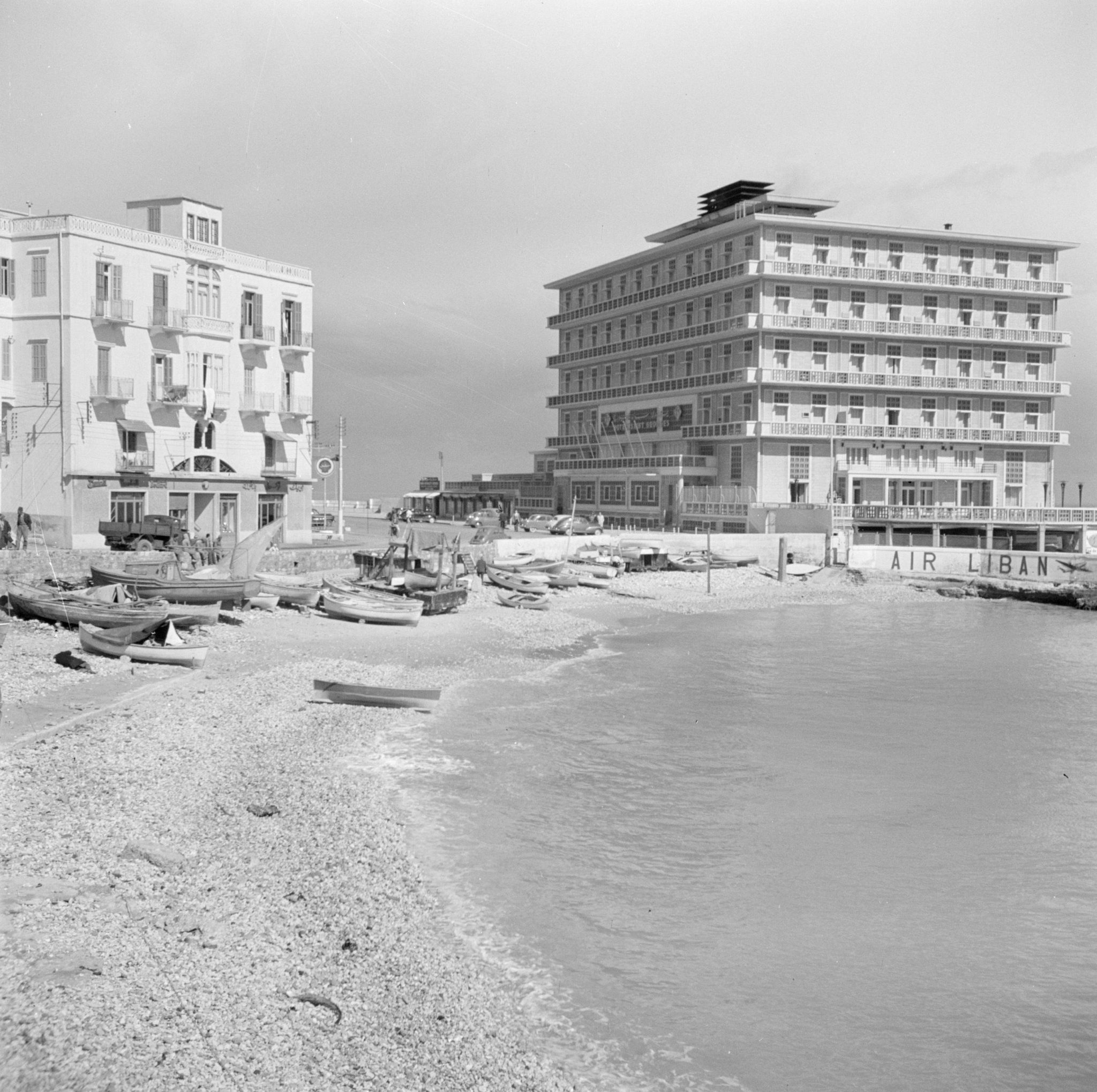
On the edge of the St. George Bay, between East and West Beirut, lies the Hotel St. Georges. Like many buildings in Beirut, and more broadly in Lebanon, it can produce multiple, starkly different versions of itself in an archive, to the point of making you question, here and there, whether you’re really looking at the same place. There’s the St. Georges of the 1930s, when it first opened, a smaller hotel above a bay strewn with washed up fishing boats in old yellowed photographs, lined with vintage cars and the hotel’s name in concrete letters on the water tank. There’s the St. Georges of the 1940s, where the cars look faster and sleeker and the hotel has grown a couple storeys but the bay on which it sits still looks relatively quiet, flanked by anchored sailboats. Then there’s the St. Georges of the 50s and 60s, in its prime or the Golden Era as it’s sometimes called and elegized in Lebanon, for all that befell it in the decades that followed. In this St. Georges, and this version of Lebanon, the hotel looks as alive as it ever has, immortalized in postcards and photographs of crowded pools with retro sun loungers and umbrellas that hang over modern bikini designs and long, lazy summers of endless tanning and smoking and talking about anything and everything in a place where, on any given day, the bar or the terrace might plausibly find itself host to people like Richard Burton or Umm Kulthum.
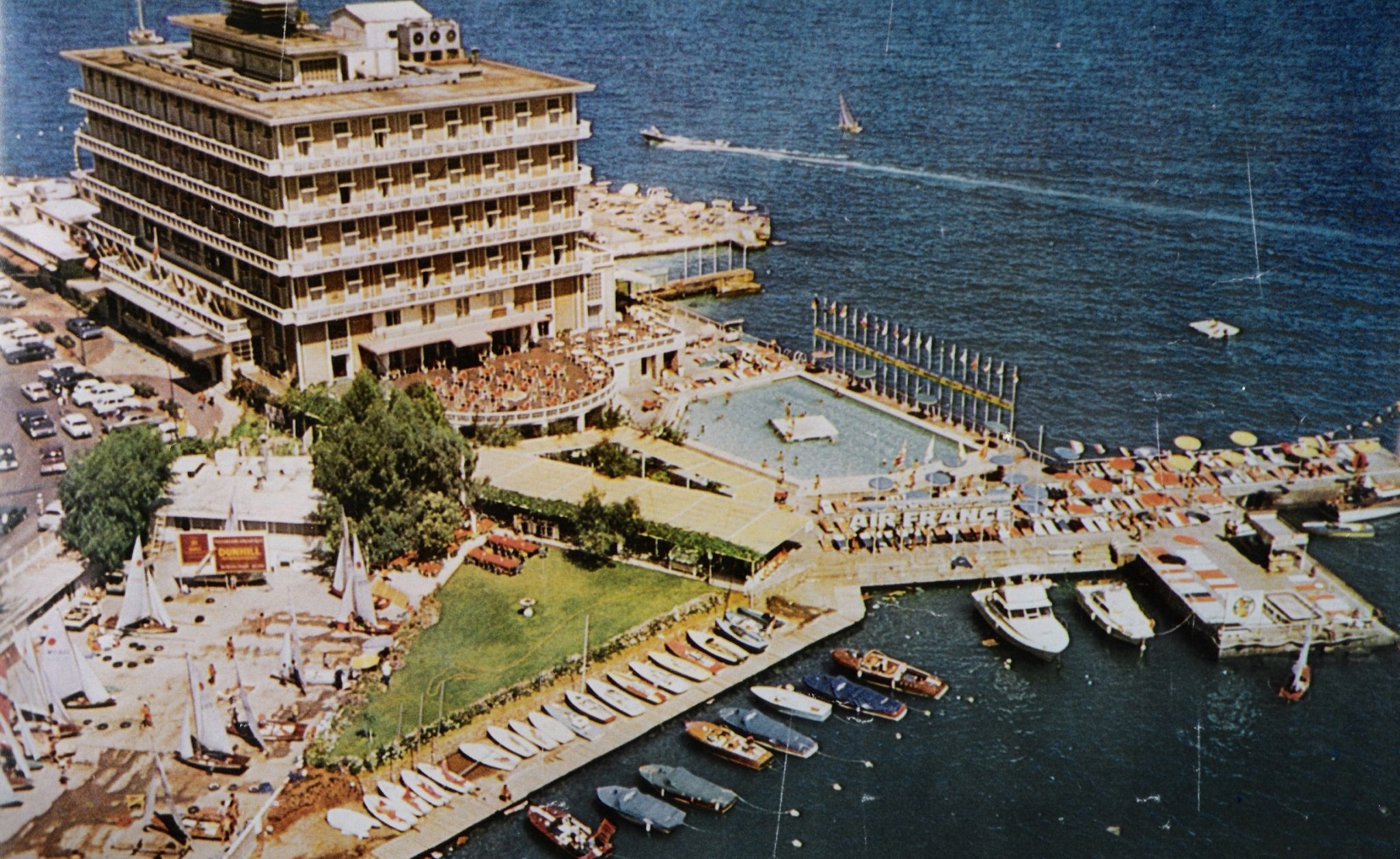
A vintage image of the Hotel St. Georges from the 1960s.
The St. Georges of the outbreak of the Lebanese Civil War in 1975 and throughout the years of small and large conflicts that would come to be known broadly as the “Lebanese Civil War,” is an altogether different hotel. The sign is gone. The tables on the terrace have been packed away. The sun loungers are no longer there and the hotel has been turned, instead, into a fighting position in the Battle of the Hotels that mutilated the area between 1975 and 1977 and received its name for the way different factions and militias used the tall windows and high floors of the Phoenicia, the Holiday Inn, the Palm Beach, the Excelsior, the Normandy, and, of course, the St. Georges Hotel, to exchange sniper and artillery fire. The St. Georges I’ve always known is not this one but its aftermath, the St. Georges of the post-war period, of the years that followed, of hollowed-out windows and a deep, stoic silence, cordoned-off like a crime scene by a tall white barrier where the chryslers used to be parked and people waited for guests to arrive. I’ve never not noticed when its pink, art deco facade–wrapped in balconies that face the Mediterranean on three sides and modern skyscrapers that have since sprouted up behind–materializes in the windshield on the drive past. It’s impossible not to look in its direction, sitting dormant or dead for years, and not imagine what it was like when it was still awake.
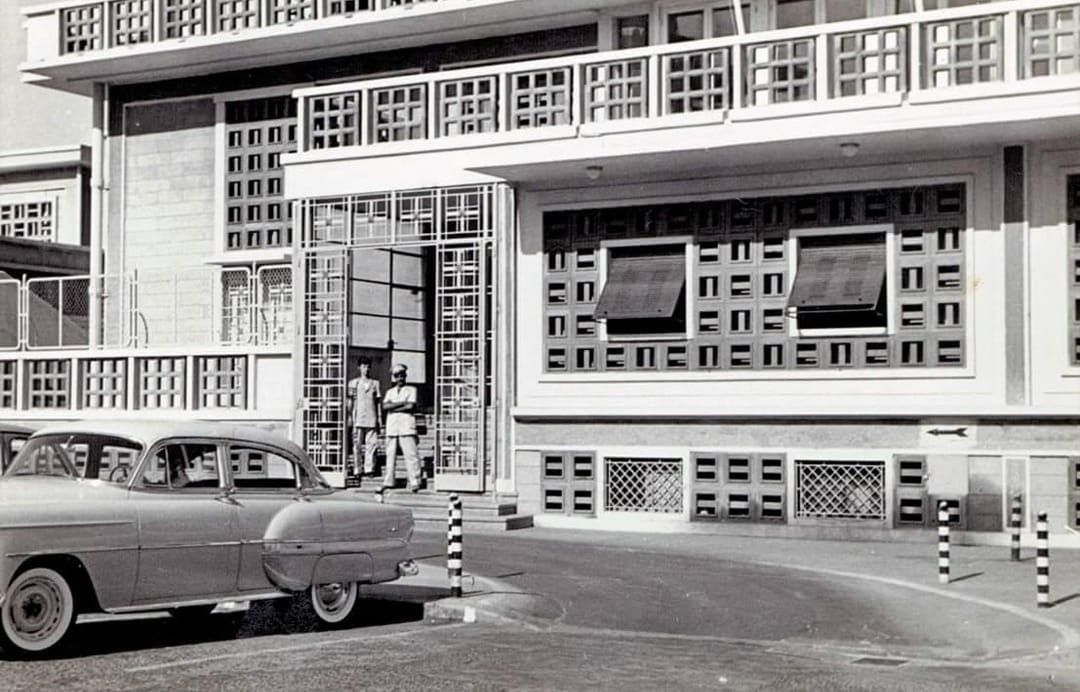
The Hotel St. Georges pictured circa 1950s.
Said Aburish’s book The St. Georges Hotel Bar, International Intrigue in Old Beirut, An Insider’s Account, true to its title, provides a sense of what the St. Georges was like in the 50s, 60s, and early 70s. A journalist, writer, and self-professed embed of the hotel’s milieu, Aburish describes the hotel and the people who drank, ate, and did business there more like a novelist: “Visiting the St. George Hotel bar was like going to one of the most beautiful and best-run theatres in the world to watch Olivier, Gielgud and Richardson perform Shakespeare.” His book focuses primarily on the bar of the St. Georges, and the spies, politicians, business people, and journalists who “congregated to know, help, promote, compete with, undermine and even destroy each other.” He renders the hotel the same way most great hotels are cast, as a place in which identities are suspended and traded for others, remarking that as an insider he had “known spies to pose as banker, foreign correspondent, barman, professor, business consultant, salesmen of various types, dancer, waiter, public relations man, oil man and archaelogist.” Aburish makes Kim Philby, the British double agent, an embodiment of this culture, opening with a description of the day he disappeared and, as it turned out, defected to the Soviet Union, taking place at the bar of the Hotel St. Georges after a few drinks at the table he always sat at.
Focusing on spies, journalists, politicians, and the various deals that were or were not made there, or that people like Brigitte Bardot and Elizabeth Taylor stayed there, is sometimes besides the point, though. The Hotel St. Georges was remembered by many, even most, for the nostalgic sense–amplified by time and all that was lost in Beirut during the war years–that it, and by extension Beirut, made you feel like you were at the centre of something, maybe even the world. Not lingering in the world’s margins or relegated to its footnotes–as was so often Beirut and Lebanon’s fate–but as the centre of the argument, or the argument itself. Edward Said once observed of Beirut before the war that, “for some years one could, in Beirut, burn with a hard gemlike flame; even the city’s vice and profligacy had a brilliance you could not see elsewhere.”

I have always found it hard to write anything about Lebanon, or to explain the pull it exerts. But the thing that has always transfixed me is the sense, while there, of existing in two times at once… the cold sense of walking over a lost nation in the nation that exists now.
Ramzi De Coster
I have always found it hard to write anything about Lebanon, or to explain the pull it exerts. Even that word, “pull,” is worth interrogating. There are a thousand different things to say about Lebanon, to try to explain it the way people do, but there’s nothing, really, left to say that hasn’t likely been said a thousand times already, on every street corner, in all the empty alleyways and forgotten buildings, between family members at the dinner table, at the back of a taxi cab, over debates synchronized with the cigarettes in the ashtrays, between arguments more fluid than the ways in which they’re delivered. It’s a nation of a thousand tones: nostalgic, optimistic, pessimistic, hopeful, resigned, sarcastic, dark, light, humorous. But the thing that has always transfixed me is the sense, while there, of existing in two times at once. Not two places or traditions. Not the way in which cities are said to feel like they’re North and South, East and West, modern and ancient, new and old. I mean that it gives you the cold sense of walking over a lost nation in the nation that exists now. Dormant or alive. Buried forever or waiting to resurrect. Hanging on or trying to re-assert itself. Time sometimes seems to move differently there. Like it’s fractured between the Before and After of the Civil War and on its own continuum, sitting dead center between the two. Beirut is full of places like the St. Georges. There’s the Burj el Murr, the Egg, the Barakat building, and near the St. Georges, the Holiday Inn, which wears the war that put an end to it on its face more than many. It’s hard not to look at it whenever it enters view, towering above full of exit wounds, and wonder about the lives of the people who worked, slept, ate, drank, made jokes and passed the time in those rooms, as you do when you come across the St. Georges, trying to peer into those empty corridors from below.