

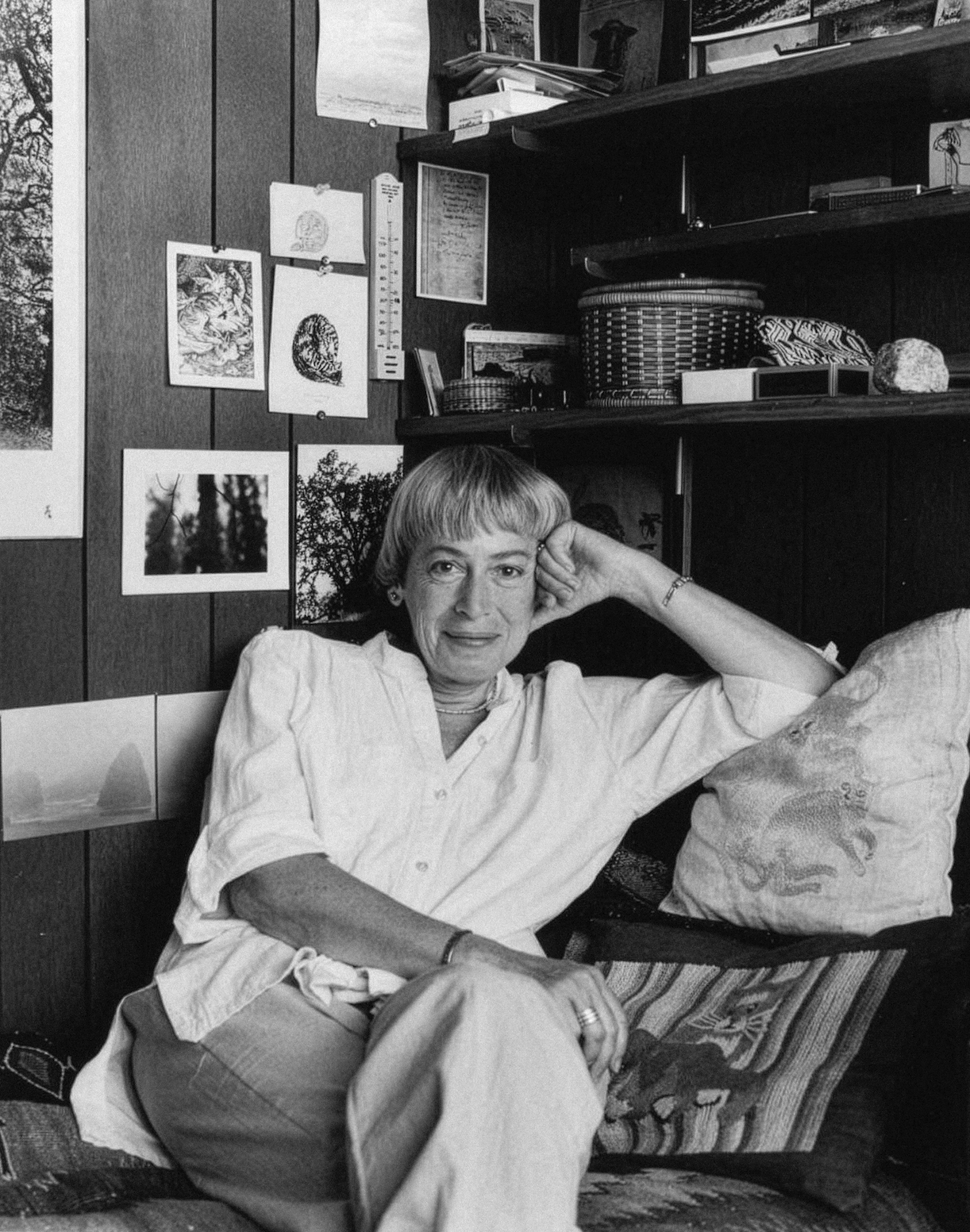
Ursula K Le Guin rewrote the rules of science fiction, replacing the genre’s obsession with weapons and heroes with explorations of gender, social structure, and the transformative power of perspective, writes Maxime Toscan du Plantier, showing how encounters with the “Other” illuminate our own humanity.
Science fiction may have appeared in an increasingly secular age, but its preachers still very much believe in original sin. It suffices to watch the opening scene of Stanley Kubrick’s 2001: A Space Odyssey (1968) to convince oneself of it. On the barren and desolate landscapes of a prehistoric Earth, a hominid picks up a femur from a sun-bleached skeleton and, raising it in one of the most famous closeups of cinema history, proceeds to methodically bash a skull as the glorious and triumphant opening fanfare of Richard Strauss’s Thus Spake Zarathustra exalts his deadly discovery. Thus armed, the ape man can spread the good news and reap the rewards of his (who doubts that it is a he?) invention, whose killing power gives him access to a seemingly unlimited supply of meat and, most importantly, allows him to enact vengeance upon a rival, who is clubbed to death.
He then celebrates the first military victory of all time by throwing his weapon. Soaring through the air, the femur transforms into a much more technologically advanced but-as the audience is led to understand by the match cut-no less deadly object, a spaceship orbiting the Earth. Thus, in Kubrick’s account, technology, humanity, and science fiction as a genre all find their mythical origin and true meaning in violence and murder. Indeed, from George Lucas’s Star Wars (1977) and Steven Spielberg’s War of the Worlds (2005) to Paul Verhoeven’s Starship Troopers (1997) and Ridley Scott’s Blade Runner (1982), weapons and war seem to form the inescapable horizon of all science fiction (up to their very titles).
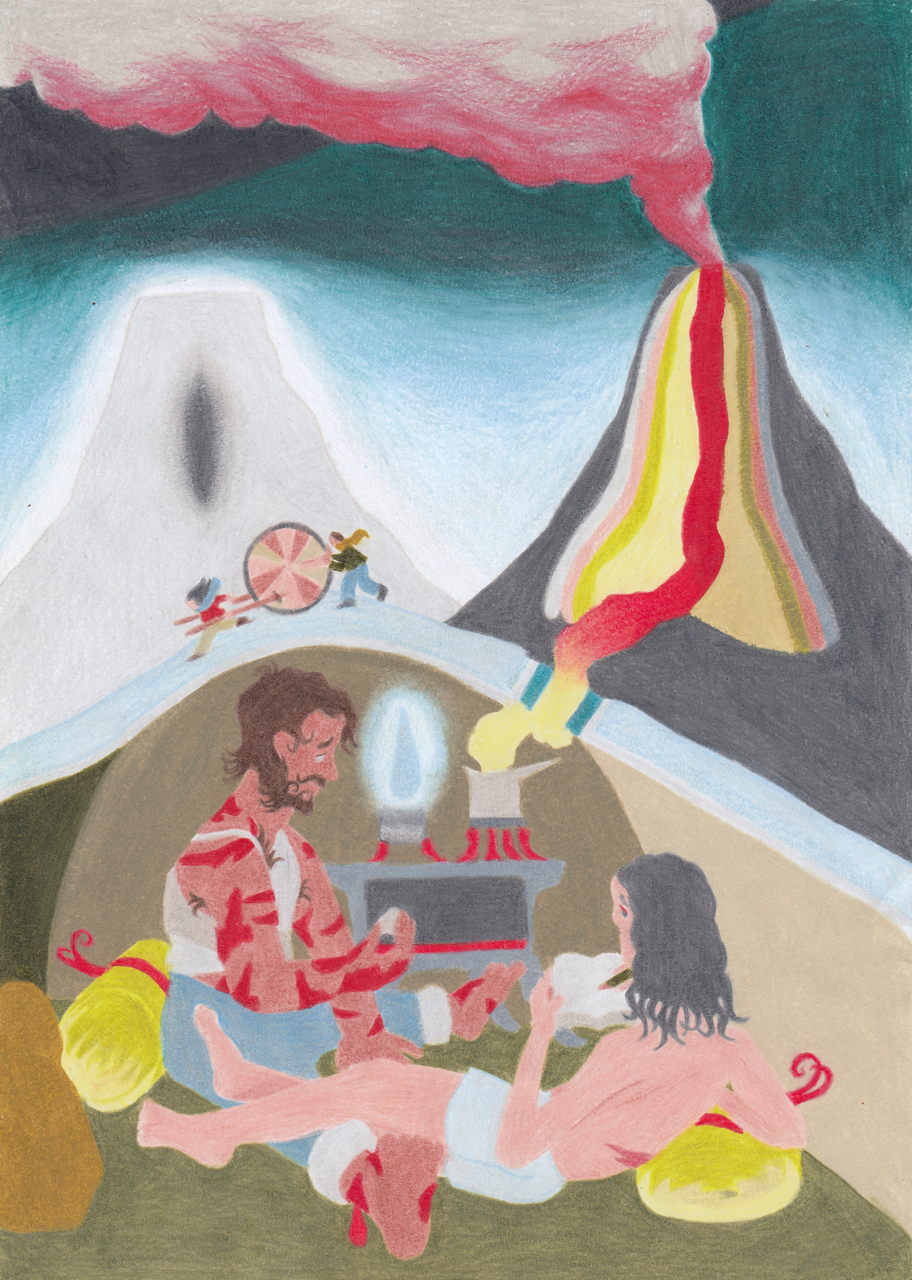
Genly Ai and Estraven in a scene from The Left Hand of Darkness (1969).
Not all, however, recognise the canonicity of Kubrick’s telling. The American novelist Ursula K Le Guin (1929-2018) wrote about it: “I don’t even care. I’m not telling that story. We’ve heard it, we’ve all heard all about all the sticks and spears and swords, the things to bash and poke and hit with.” Her writing career, which spanned over six decades, was an attempt to offer another model for science fiction. When she started writing in the 1960s, science fiction was already a well-established literary genre. It had been popularised since the 1920s by the pulp magazines-cheap publications whose covers included drawings of green aliens and scantily clad women and extravagant adjectives (Weird! Startling! Stirring! Thrilling! Uncanny!).
The most prominent were Amazing Stories and Astounding Stories of Super-Science, established in 1926 and 1930 respectively, which built on the heritage of the 19th-century pioneers (Mary Shelley, Jules Verne, HG Wells) to establish science fiction as a genre. Under the editorship of John W Campbell-whose novella Who Goes There? (1938) was adapted by John Carpenter in The Thing (1982)—Astounding became the dominant force in American science fiction in the 1940s, publishing the first texts in Isaac Asimov’s seminal Foundation and Robot series.
However, this so-called “Golden Age” of science fiction was also that of a narrow, all-male milieu. Le Guin wrote that she “never did synch with John Campbell, an understatement given the pro-segregation and pro-slavery views he expressed in numerous editorials throughout his career. Those views did not just remain private (if there is such a thing), they permeated the stories which were told in Astounding and other magazines. (In 1967 Campbell rejected a story by Samuel R Delany on the ground that his readers would not “be able to relate to a black main character”.)
To her great disappointment, it was as if all the writers’ imagination was spent on inventing new technologies-faster-than-light spaceships, robots, Als and all-leaving them completely reliant on the norms and tropes of their time to write their stories, full of damsels in distress saved by heroic men. In 1975 she wrote: “From a social point of view most SF has been incredibly regressive and unimaginative.” American science fiction, in particular “has assumed a permanent hierarchy of superiors and inferiors, with rich, ambitious, aggressive males at the top, then a great gap, and then at the bottom the poor, the uneducated, the faceless masses, and all the women.” That left her with the task of inventing new stories.
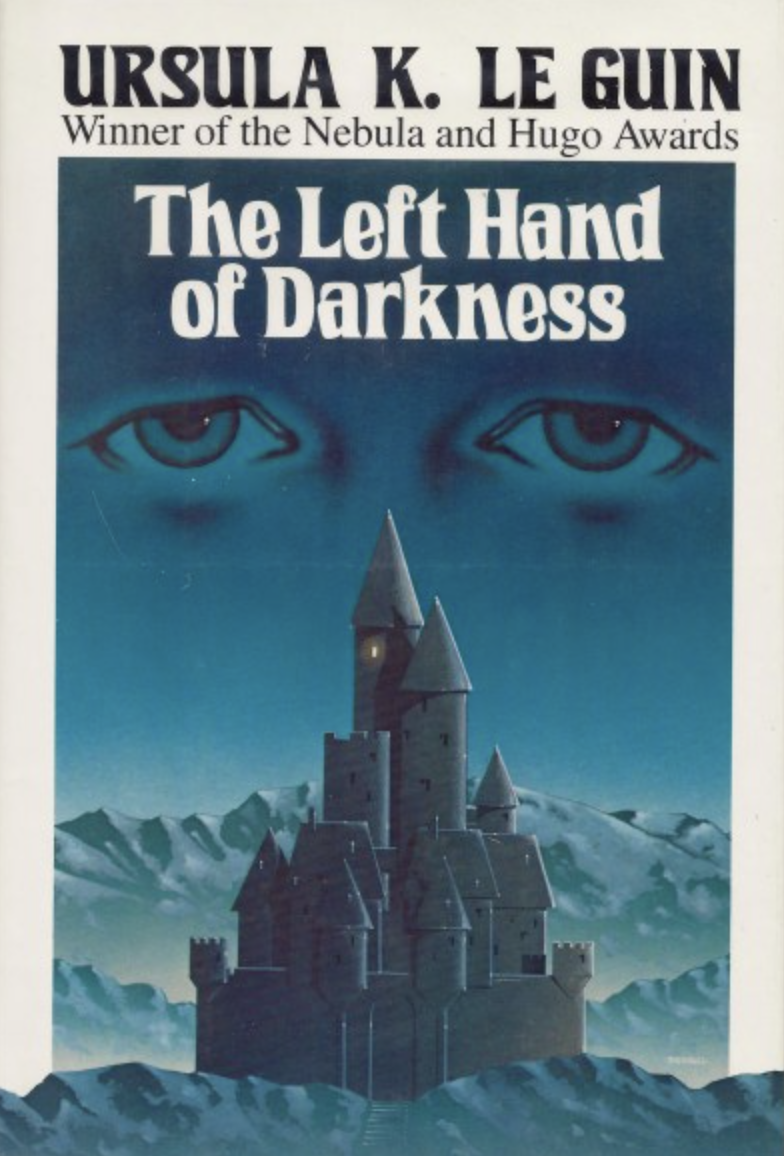
The Left Hand of Darkness (1969). By Ursula K. Le Guin
Le Guin’s reinvention of science fiction involved eschewing the genre’s fundamental focus on technologies and science. This was more than just a matter of personal taste-although she once wrote: “I seem to be rather bored by complex technology.” The early 20th-century writers’ overwhelming focus on technology drastically limited the type of stories that could be told. Whether technology was going to save the world or destroy it, finding and acquiring and mastering it was the central focus of science-fiction narratives. In this, they belonged to what Le Guin called “the Story of the Ascent of Man the Hero”-the idea that the only stories worth telling are those in which a hero starts somewhere and has to go somewhere else, using a weapon to achieve his aims, and in which “the central concern of the narrative is conflict”. Rooted in this is Kubrick’s idea that the history of mankind started when an ape used a tool to commit the first murder.
Against it, Le Guin offers another story for the beginning of humanity and technology. The first tool was not a weapon, she says, it was a bag, a container of some sort, used by hunter-gatherers to store the berries and wild oats they had picked up. In doing so, she disqualifies the figure of the hero, and imagines another kind of narrative: “we have not heard about the thing to put things in, the container for the thing contained. That is a new story. That is news.” Hence, if Le Guin’s science fiction does contain its mandatory share of light-speed spaceships, they play no major role in the intrigue. There is no Death Star to be destroyed nor Matrix to be freed from, and there are very few weapons, let alone any super-weapon, to motivate a hero’s quest.
Le Guin situated the anticipatory nature of her stories on social structures. She found the material to imagine other forms of social organisation in cultural anthropology, a discipline she knew intimately: her mother, Theodora Kroeber, was a writer and anthropologist, and her father, Alfred Kroeber, founded the department of anthropology at Berkeley. Together, they collected and published tales and creation myths from Native Californians, including that of Ishi, the last member of the Yahi people, and a friend of Alfred’s. In exposing the variegated and nearly infinite ways in which human societies have developed cosmologies, religions, and social structures, anthropology allows us to see that the ways in which we do things, and treat each other and the world around us, are not obvious, nor natural, nor necessary.
Le Guin firmly rejected the idea that science fiction was “escapist” and argued that ” imaginative fiction trains people to be aware that there are other ways to do things and other ways to be, that there is not just one civilisation and it is good and it is the way we have to be.” At its core, Le Guin’s writing functions as a fictional anthropology, an anthropological study of imaginary worlds in order to better understand ours.
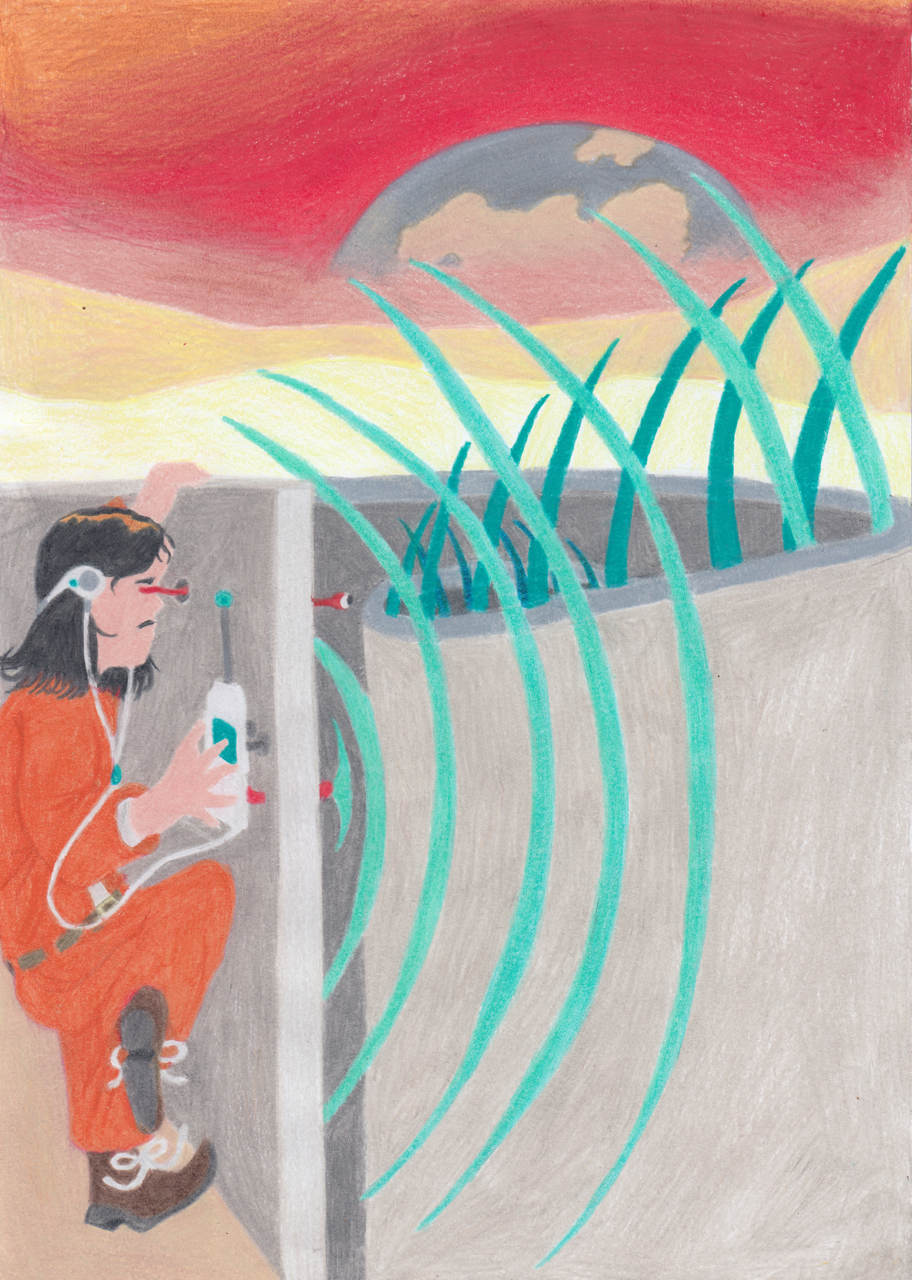
Shevek, the protagonist of The Disposessed (1974) peeks out of the Anarresti Port wall.
Le Guin’s two seminal science-fiction novels, The Left Hand of Darkness (1969) and The Dispossessed (1974), aim at destabilising the reader and their expectations. They are organised as journeys without an end goal, in which the protagonists find themselves alone, in societies entirely unfamiliar to them and with no hope of going back to the status quo ante.
In The Left Hand of Darkness, we follow Genly Ai, an emissary from a pan-human galactic federation, the Ekumen. Ai comes to a planet called Gethen, also known as Winter, in the middle of an ice age, to tell its inhabitants that they are not alone in the universe, and ask them to join the federation, if they so choose. Similarly, The Dispossessed starts with the protagonist, Shevek, leaving his home planet Anarres to visit its neighbour Urras.
Like anthropologists, Ai and Shevek are external observers who marvel at what they see as the peculiarities of their hosts’ social norms, languages, and political organisation. A whole chapter of The Left Hand of Darkness is written like an anthropologist’s account, focusing on the most obvious particularity of Winter’s imagined society: their lack of sexual dimorphism. Its inhabitants, the Gethenians, are all hermaphrodite: their bodies have no sexual characteristics most of the time except a few days a month when their hormonal cycles lead them to a phase of “kemmer”, in which they develop alternately “male” and “female” organs allowing reproduction. The same person can, throughout their life, be pregnant and make someone pregnant. This means that on Winter, there is no gender hierarchy, nor any concept of gender at all, something baffling for Ai, who keeps trying to understand them as “feminine” or “masculine”, but finds himself unable to apply this fundamental category of his thinking-and ours.
If we can empathise with Genly Ai’s difficulty at navigating a society with no concept of gender, because our society and way of thinking is, like his, so deeply structured by it, Shevek’s way of thinking, in The Dispossessed, is harder to follow. The Urrasti society, which appears so deeply strange, so alien to him, is, in fact, ours. His society is described as having been founded by a group of revolutionaries from Urras who emigrated to its moon, renamed Anarres, to build a planet-wide anarchist society away from Urras’s capitalism and social stratification.
This reverses science-fiction tropes: the encounter of the third kind is not seen from our point of view, but that of the Other, encountering people like us. Shevek is utterly confused by things which are part of our normality: he does not understand why everything is disposable and nothing recycled, why he has servants-or, worse, what is a servant-and why women should not be allowed at the university. Through Shevek’s eyes, we perceive ourselves as the aliens, as the object of the anthropologist’s gaze.
Reciprocally, Ai is regularly called an “alien” for the ways in which he resembles us (his desire for indoor heating and hot showers), and is even considered a “freak” by some, for his physical ability to engage in sexual activity at any time, something we would perceive as normal.
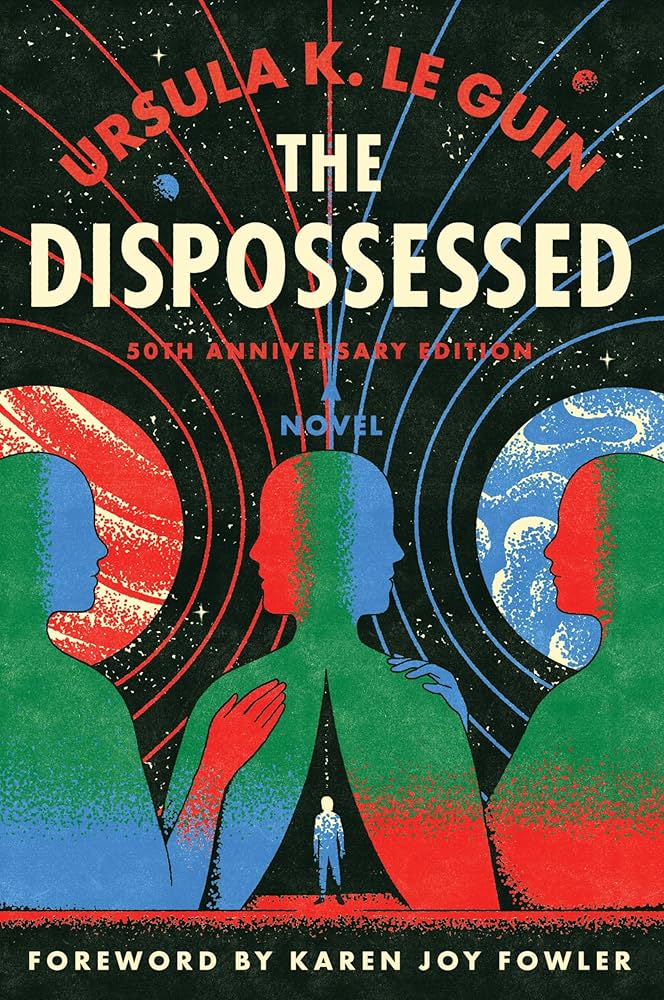
The Dispossessed (1969). By Ursula K. Le Guin.
Le Guin goes further than just reversing the duality of the Normal and the Other (a somewhat classic gesture of the genre); she dissolves it entirely. If Genly Ai resembles us in that he perceives the world through the prism of gender, his belonging to a society apparently devoid of social hierarchy, which leads him to commit numerous blunders in his handling of Winter’s strict protocol (he does not know how to address a king!), prevents us from fully identifying with him. In the second half of the novel, he is saved from a labour camp by a Gethenian, Estraven, and they travel together for 800 miles through the ice. The journey is the occasion for Ai’s transformation: by its end, he sees and feels like a Gethenian.
Neither Ai nor Shevek’s journeys end with o home-sweet-home moment, in which the norms are restored, things go back to how they were before, as in horror movies, when police cars finally arrive to save the protagonists, who can hug their loved ones, safe in the knowledge that the Other is gone and order restored. That change is mirrored in the novel’s construction: the journey is told by Le Guin through both characters’ perspectives. As Estraven and Ai become alternately narrators and narrated, subject and object, the distinction disappears altogether. In that, the book adopts what it describes as the Gethenian non-dualist way of thinking, a consequence of their lack of sexual dimorphism: “There is no division of humanity into strong and weak halves, protectives/ protected, dominant/submissive, owner/ chattel, active/passive. In fact the whole tendency to dualism that pervades human thinking may be found to be lessened, or changed, on Winter.”
If The Left Hand of Darkness starts somewhat comfortably, with an observer who resembles us and an alien population that remains distant, observed, Ai’s transformation means that, by the end of the book, we have lost the reassuring ground he represented. Through Le Guin’s prose, we have become aliens. Not alienated in the Marxist meaning of being disempowered and separated from an essential part of ourselves, but as shedding the particular to access a common humanity, rooted in no particular society. In making themselves alien to both their world of origin and the world they visit, Shevek and Genly Ai do not become lonely: their otherness becomes a source of bonding, as they can, henceforth, recognise in anyone a fellow stranger, a fellow human. The Left Hand of Darkness finishes on a question that Estraven’s son asks Ai, which, in its childlike curiosity and wonder at the unknown, encompasses all the beauty of Le Guin’s writing: “Will you tell us about the other worlds out among the stars-the other kinds of men, the other lives?” She did.