

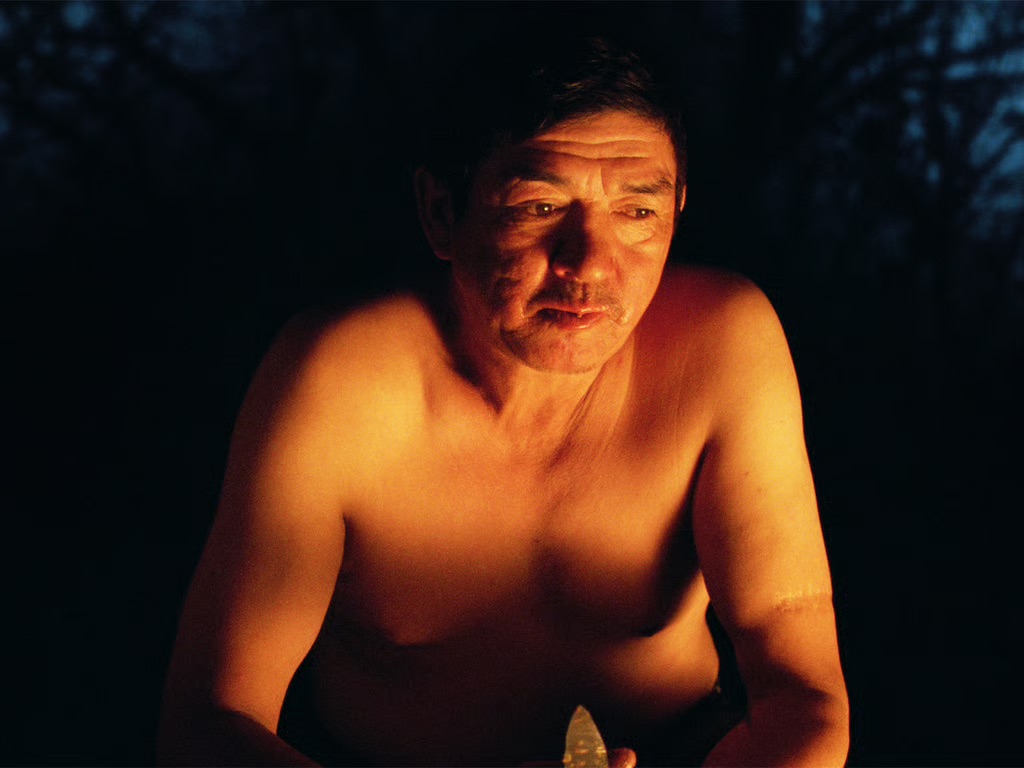
The Argentine filmmaker returns to Cannes with La Libertad Doble, a spiritual sequel to his heavily debated La Libertad, which premiered at the festival 25 years ago.
Twenty-five years later, we open on the same image. A man lit by firelight, wires of lightning dancing in the black behind him, eats in silence. This is Misael (Misael Saavedra), and in La Libertad (2001), which followed a lumberjack through his daily rhythms, this image greeted us. But our woodsman was twenty-five years younger then.
Lisandro Alonso is one of the giants of the ‘contemplative cinema’ movement, returning here to Misael and the landscape of the Pampas, Argentina, with a spiritual sequel to his furiously debated debut at Cannes twenty-five years ago. His work has ranged in scope, though never in quality, in the years since, from recent arthouse epic Eureka (2023), to smaller scale masterpieces Los Muertos (2004), Liverpool (2008) and his best known film Jauja (2014).
La Libertad and its sequel stand out as attempts to demystify the filmmaking experience, reckoning head on with the economic constraints of his national cinema and by extension independent cinema in general. As Alonso puts it, they are an “exercise in freedom”, then for a first-time filmmaker with no money, and now from the vantage point of experience. They are stripped to their minimum ingredients; La Libertad was shot with a crew of eight friends and on his family ranch. However, in the interim, this durational approach has been normalised by festival exposure and, yes, time. What is radical here is the return. In linking these films, Alonso has stretched a great bridge between the discrete screen-time spent with Misael (in 2001 and in 2026) and the real time lived, outside of our view.
“La Libertad and its sequel stand out as attempts to demystify the filmmaking experience, reckoning head on with the economic constraints of his national cinema and by extension independent cinema in general. As Alonso puts it, they are an “exercise in freedom”, then for a first-time filmmaker with no money, and now from the vantage point of experience. They are stripped to their minimum ingredients; La Libertad was shot with a crew of eight friends and on his family ranch. However, in the interim, this durational approach has been normalised by festival exposure and, yes, time. What is radical here is the return. In linking these films, Alonso has stretched a great bridge between the discrete screen-time spent with Misael (in 2001 and in 2026) and the real time lived, outside of our view.”
Fridtjof Ryder
Every work of contemplative cinema deals in the gravity of the unseen. In this case, we are missing noise, people, phones: the whole whirling machinery of modern life. In fact, what feels like the film’s greatest intrusion of modernity is a scene where Misael looks down at pills he has been given for his sister, Micaela, suffering from longstanding mental illness. Yes, this could be a film about the anarcho-capitalist Javier Milei’s ‘La motosierra’ (chainsaw) politics and the isolation of those failed by capital, or it could just be a buddy movie that plays like the setup to a joke: a troubled sister reunites with her reclusive brother in the woods, where he lives and works. She has come to stay with him because the institution in which she has been is forced to close its doors. This is as much plot as the film offers up.
Most impressive is La Libertad Doble’s total spaciousness; the generosity of its ambiguities. Finding and hiding a watch is the major plot point in the film, and feels delicious, like the smuggled language of a thriller into ‘real’ life. I caught myself noting the Fanta Misael buys. Why? Because it’s what he drank in the first film? Or because that’s just what he likes? It is testament to Alonso’s calibration that such minor details can so affect the balance of the whole.
There is of course a perverse authorial maximalism in this ascetic approach. La Libertad’s iconic trailer, in which the whole film plays at 200x speed (it takes 56 seconds), directly presaged the gag that prologued that film. Electronic music rises to a crescendo over opening credits. Blackout. Then ninety minutes of slow cinema. I mention this because Alonso seems to be shrugging off more youthful traits, including the first film’s dreamlike sequence of floating into the shrub to watch trees sway. This is replaced here by a more understated touch, where, leaving Misael, we follow his dog Sordo for a while. The same jolt is felt, in which the presence of an author is made conscious, but it is more controlled, less of a stylistic release. We are in a world of total cinema, but also of totalising reality.
Misael’s ‘performance’, a non actor during the shooting of the first film, develops to seem noble in his silent rescue of his sister. Micaela brings a trove of questions around aging and the responsibilities that life demands of you. All the performances are a continuum of Alonso’s directorial intent, that to watch them ‘act’ is to observe people reacting to a change in the wind or a hand movement across a stomach. This allows for moments of the sublime; I think of a scene with Micaela’s hand stretching against a tree, until it is lit translucent by the sun. We are quietly led into her perspective, which in miniature holds more weight than many entire feature films.
What is moving is that in Alonso’s act of revisitation he is able to double down on the relevance of contemplative cinema’s aesthetics today; revitalising them. He expresses how the lifeform of stories are ever changing, how Misael exists, somewhere between documentary and fiction, across timespans greater than any individual film can encompass. Alonso also does this with the slimmest of resources, making an argument for the vitality that exists in arthouse cinema. La Libertad’s narrative was shaped as a uroboros; its beginning was its end. Twenty-five years later, as Misael searches through the woods for his sister, the end is now an open question, which feels especially poignant in this filmmaker’s gently devastating dialogue with time.
Continue Reading