

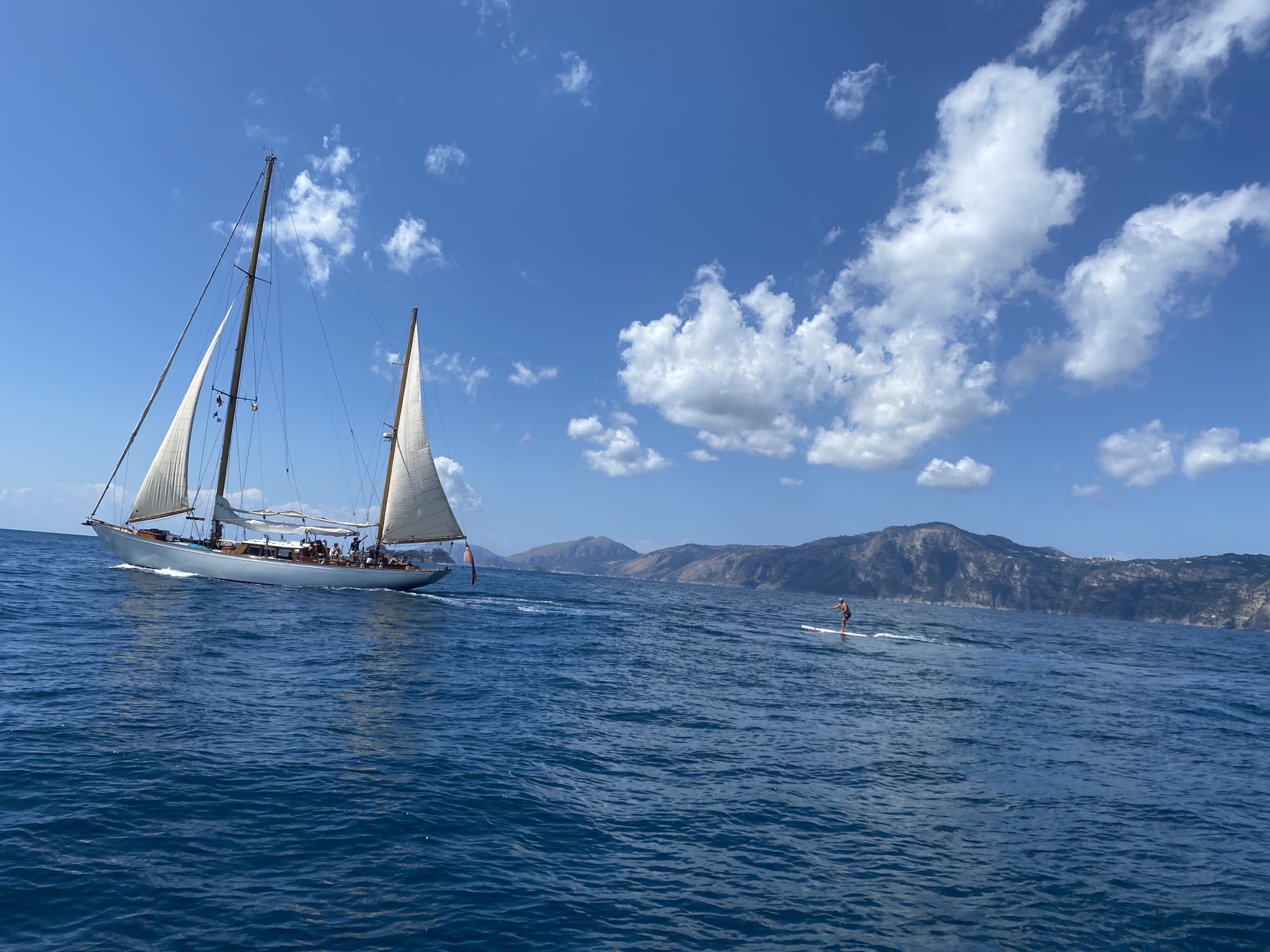
Our swashbuckling editor-in-chief recounts his adventures on Gael, a sailing yacht that became his sanctuary from the world. Above, he is water skiing under sail.
Sanctuary.
The very word gives pause. It is, to me, one of the most powerful and beautiful words in our language. It’s a grown up word not to be trifled with—from the Latin Sanctuariam or “holy place” and “place of refuge”. Instantly the word brings questions. Sanctuary? Sanctuary from what? And where, and why? It can, after all, mean political and physical safety from terror or horror. It can mean peace—true, meaningful, beautiful peace. Sanctuary from evil, in the religious sense, of course, means both physical safety and spiritual equilibrium. But the word in everyday usage, for most of you reading this, means a place of escape from the mundane routines and the stresses of everyday life. A place for quiet reflection, either in the physical sense or in a wellness practice of some kind. It can also mean home.
About a decade ago I bought a sailing yacht called Gael. Designed before WWII by the legendary naval architect Philip Rhodes, it was built in 1962 by Abeking and Rasmussen in Hamburg for the Fievet family, of Babybel cheese fame. At the time, she was one of the most important wooden sailing boats ever made. No expense was spared and, as you will see from the pictures, she remains a beauty. She was later owned by Alberto Marone Cinzano, and, after his death, his daughter Noemi and her children resided on Gael for a number of years before selling her to a syndicate of rather charming Aussie gentlemen from whom I eventually bought her. Her captain, Tom Kemp, had previously been the skipper of the Gordonstoun School yacht, Sea Spirit. I am an alumnus of Gordonstoun and it made the whole thing feel predestined, and cinched the deal for me. Although I do remember Tom’s predecessor on Sea Spirit, Commander Greenhaugh, who ran boat during my time at school, frequently referring to calling me as a “silly fish fucker” and generally shouting at all of us all the time. “You fishfucker” this, “you fishfucker” that—“You moronic fishfucker, FINCH!”
Or his favourite: “FINCHFISHFUCKER- FUCKER!”
No lasting damage was done by this nautical hazing. In fact, it probably saved my life. I warned the Commander once that the poor Nigerian exchange student he sent up the bow during a storm off the island of Skye would throw up. She was a big lass and threw up big. Puking windward from the bow of a boat means everyone downwind is going to get an unpleasant faceful. Luckily for me, the Commander had ordered me below deck to bring him his flask. I missed the mess.
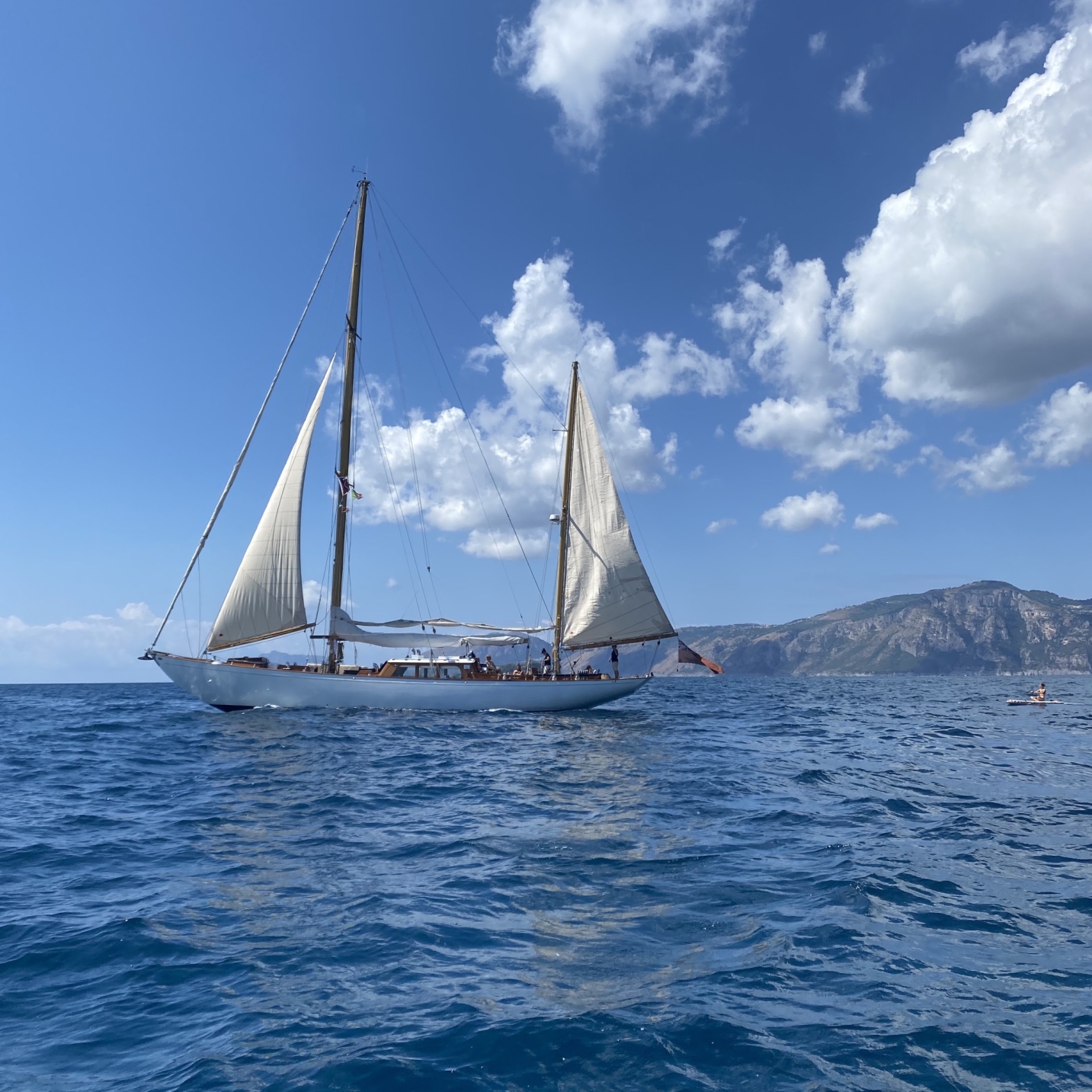

I thought, ‘how hard could it be to own a big classic boat?’ She was to become my sanctuary.
Charles Finch
With Gael’s pedigree then, and Tom as part of the package, I thought, “How hard could it be to own a big classic boat?” She was to become my sanctuary.
Gael was everything I had dreamed of—a place to find myself. I really mean that. I was in my early fifties and even for a man of some intense life experiences and adventures many fundamental and profound and soul searching questions remained unanswered for me at the time and likely still do! I remember standing on Gael and feeling an immense sense of pride that this beauty of a machine was to be part of my life. That first evening in my cabin on the boat I now owned, I totaled up the homes I had lived in since my birth and then wrote the list out on a piece of paper and put it in my cabin drawer. It came to 56 places.
I had moved and lived in more places than years I had actually existed on the planet.
London, Jamaica, France, Scotland, New York, and Los Angeles had been at one time or another cities or countries where I had worked or lived, and in each of those places there had been many moves from houses to apartments to friends’ sofas, and, of course, to the hotels. The only certainty to me that day was that I didn’t know where home—in the physical sense— was, and that my mind and soul were restless and unsettled. Not tormented, that would be too strong. But perhaps my inner malaise is best described as that of a wandering soul. This all made total sense as I had recently separated from my wife, and even though she remained and remains my closest friend, the feeling of family loss that comes with the end of a marriage was particularly intense. My father and mother divorced when I was four, and, as fate would have it, I would never see my father again. I would never allow that to happen to my own daughter. Or in fact to her mother. Gael would be their home too, and in the gentle rocking of the boat that night, I felt still inside and sure that this project would be life changing.
At just under 24 meters—and made entirely of wood—Gael needed love and attention when I bought her. Tom and I embarked on a programme to return her to her glory days. The first years were spent restoring the boat to her former luxury cruising elegance. Gael was actually my second classic boat, and so fortunately I had some idea of the pretty arduous restoration process.
The first classic wooden boat I owned was named Twink, a 36-foot Camper Nicholson built in 1939. I bought her from my friend Michael Sandberg, who also happens to be my GP, which is fairly amusing as the last thing anyone needs for their stress level is a classic sailing yacht.
Twink was based at Buckler’s Hard, in Hampshire. I bribed and cajoled whoever I could to come sailing with me on the Solent. Various family members and friends were dragged up and down that stretch of water, with all the hazards imaginable. Sails torn. Near collisions at the narrow Beaulieu river opening—real collisions with other boats or immovable objects on most race days, and, of course, a variety of gin and tonic mishaps, such as falling off the stern alongside my Labrador Hudson. Or one afternoon after a pub visit: bedding down in someone else’s boat convinced it was my own.
I loved Twink but I am not sure anyone else did. A 36-foot classic—no matter how beautiful—is about the most impractical thing you can own. In fact, when it came time to sell her, it was such a struggle I ended up giving her to the Irish Guards, where by chance Henry Sands, my assistant, had served as an officer. I did enjoy restoring Twink and I was hook, line, and sinker by then to classic sailing.
At the yard in Emsworth, the craftsmanship was exhilarating. I often drove down from London to watch the work and learn as much as I could. Though my heart ached when Twink and I parted company (and she went off to the Guards) she was truly only a day boat stripped of any comforts other than a kettle for some hot tea—Twink certainly could not be described as a place of sanctuary.
Classic boat owners eventually realise they don’t own the boats they buy. For us boat lovers, a classic yacht is really like a piece of art—you are a guardian more than an owner. I cherished Gael in a different way from the paintings I have loved. With the exception of small sculptural pieces, you can’t physically engage in the same way with art as you can with a boat. With a classic wooden yacht you are physically standing on, you are part of a shifting and often groaning piece of maritime art.
The more you know your boat, the more problems she throws up at you. And in seeking to fix any number of things, you learn more about yourself and about her and her character. The way she moves through the water or in the wind. Is she fragile and timid in a gale? Is she stable at anchor? All these small details bring the experience alive. What I mean is that you are swept up in this love affair of crafting and fixing and touching—and physically touching is the most important part—so much so that eventually you feel complete unity with the boat, like a horse and a rider. This is where the escape happens. And with that escape from everyday life comes inner peace.
Tom and I, and later other captains who sailed her, would uncover wonderful little surprises throughout the boat. Brass moulding and specially crafted fittings of gadgets dreamed up by a past skipper; leather-bound logbooks telling of crossings and hazards. Each discovery tells the story of both the boat and the men who had sailed her. Perhaps the captain I had the most adventures with is Nat Lemieux, a world-class sailor, brilliant carpenter, and a dear friend, who is now part of our sailing-shoe company Équipement De Vie (www.equipementdevie.com).
Nat engineered the racing shoe we sell. I sailed the Aeolians with Nat and his long-suffering wife Nikki (also a fantastic sailor). We survived micro storms and engine failures, and covered our faces with the volcanic mud from the island. In Calabria, we avoided pirates. We caught tuna and captured small Mediterranean rocks. Nat played the trombone and I played the ukulele in a disastrous musical mis-harmony few who witnessed will ever forget.
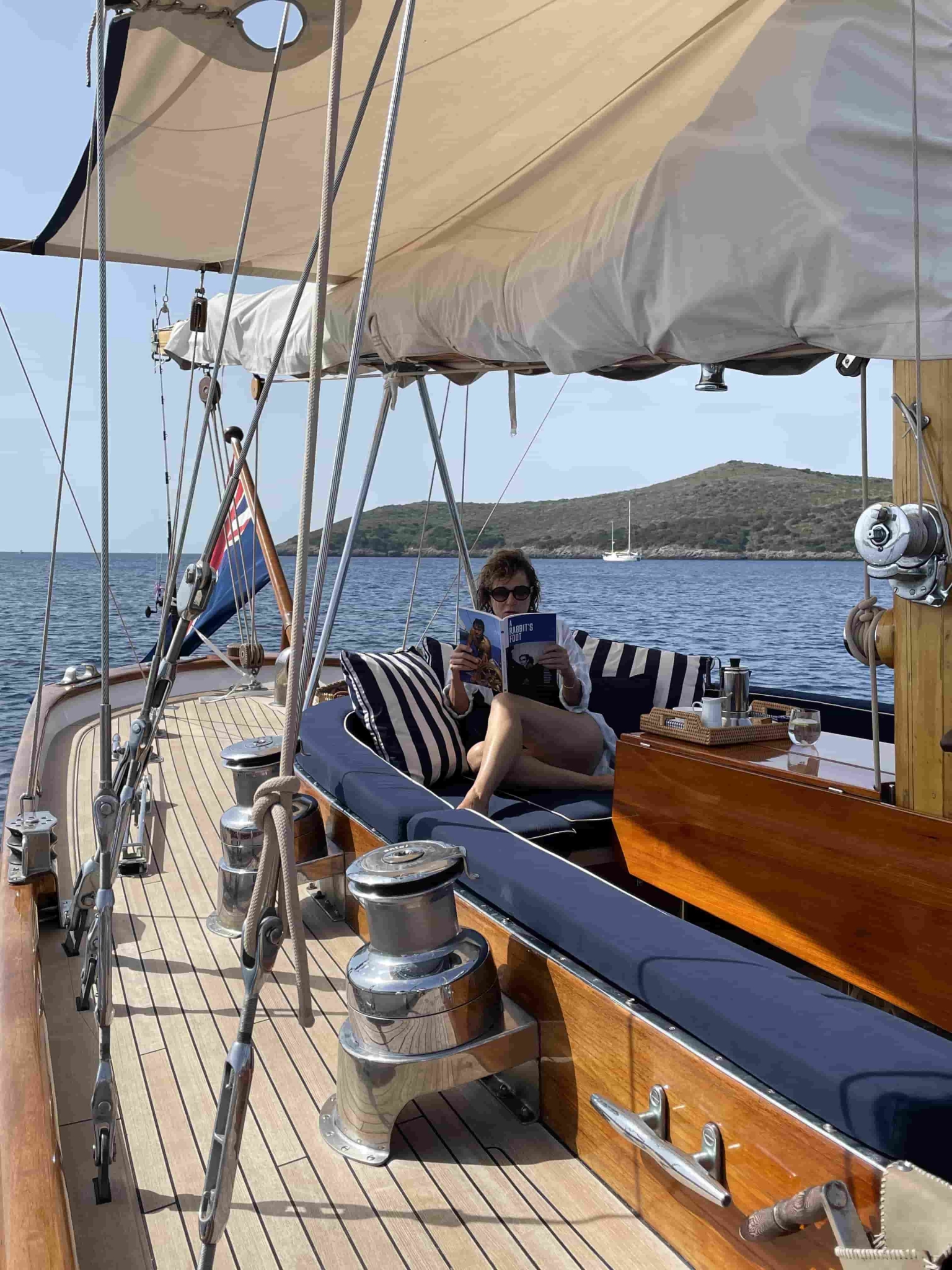
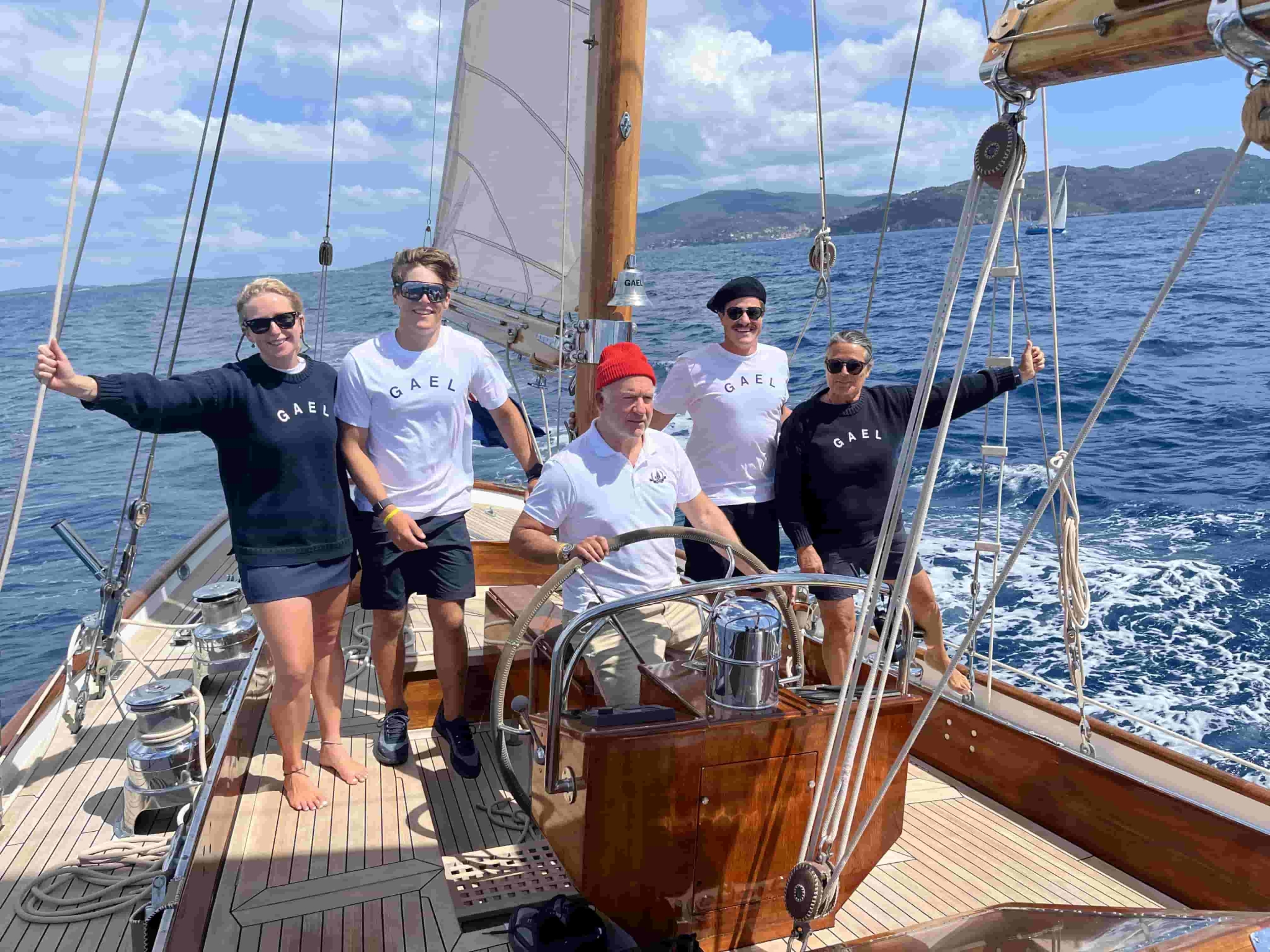
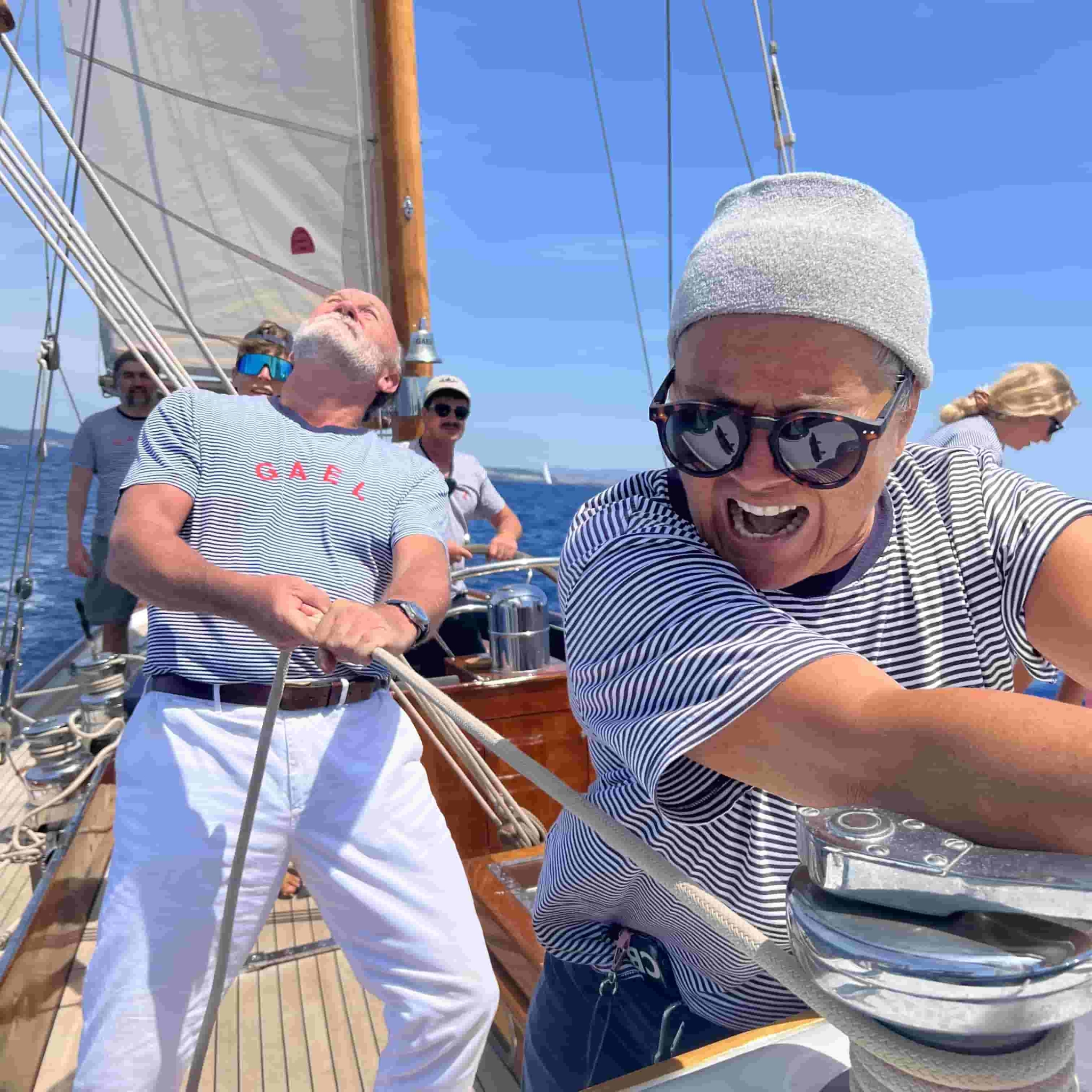
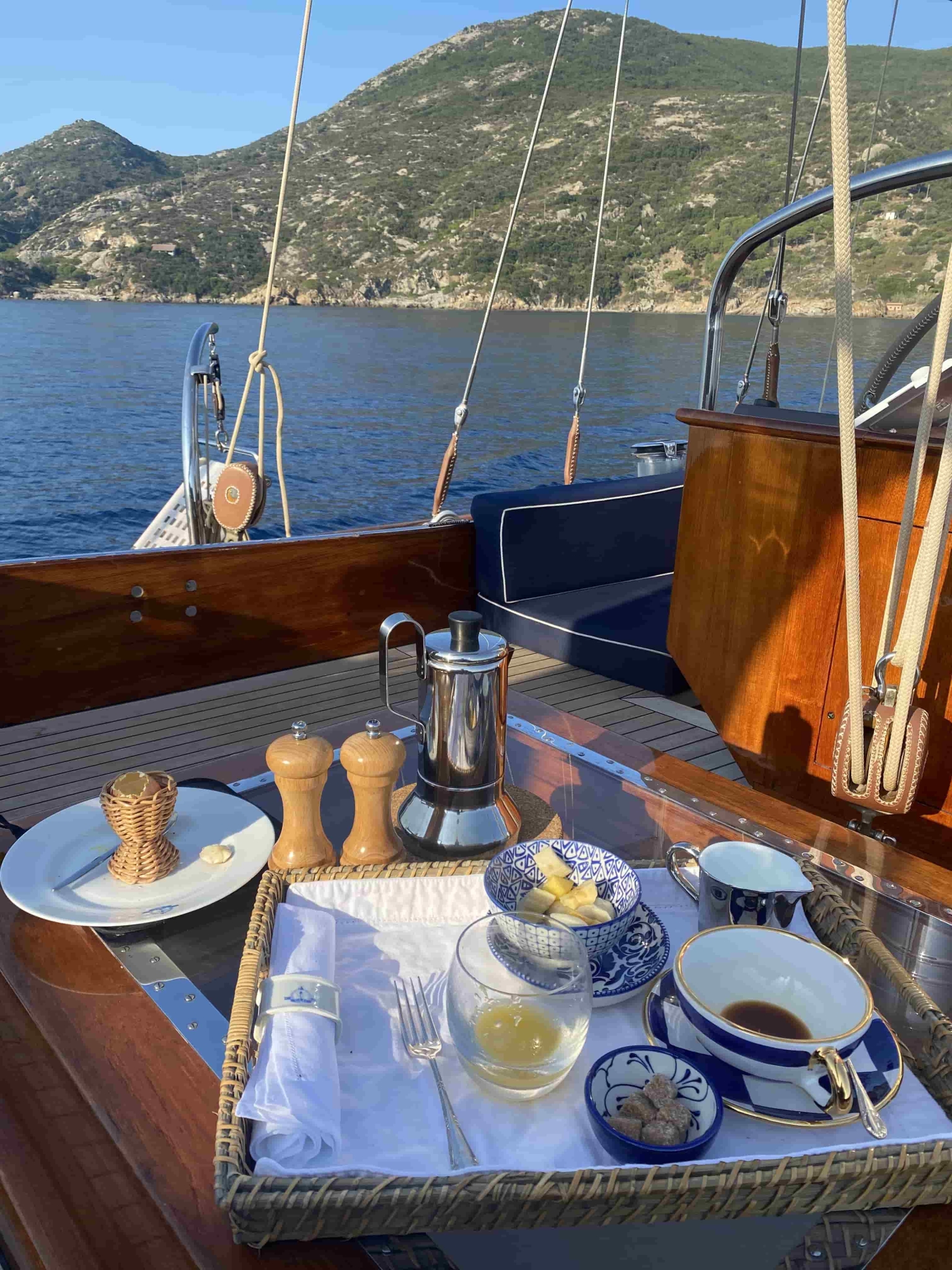


We raced her at Argentario and St Tropez. We sailed at night down from Naples to Palermo. We showed her off at the Cannes Film Festival and stayed at the prime berths across the ports of the Mediterranean.
Charles Finch
I sailed Gael for eight wonderful years through the Mediterranean. We raced her at Argentario and St Tropez. We sailed at night down from Naples to Palermo. We showed her off at the Cannes Film Festival and stayed at the prime berths across the ports of the Mediterranean. She had in her long history crossed the Atlantic many times. But I decided not to risk her crossing to my home in the Bahamas.
Often I would turn up alone and exhausted from work and sail off with my crew. One great experience was flying to Rome from Hong Kong and turning up late in the evening in Porto Ercole where I found my boat lying lit up and shimmering off shore in the moonlight like a dream. We left that night for Corsica. I slept in the cockpit and woke to white sands of the island, a million miles from where I had been just 24 hours before. All seemed calm; the gentle morning breeze on mizzen sail and the July sun just rising over the Corsican mountains.
They say that the best two days of a boat owner’s life are the day he buys the boat and the day he sells it. Only one of these holds true to me. I sold Gael a few months ago back to the Fievet family. She went home. You can charter her now, which I was never open to.
On the day I stepped off her for the last time, I thought that I would not own any more boats. That I would be wise. That peace would come to me, and that I had rid myself of the restless demons of ownership.
But… as the days became weeks, and then with the coming of spring, I began to feel restless, and to ask my true self, “what is a man of the sea without a boat?” What does he become? Is he perhaps but a shadow of himself, lost in memories of the sea?
… Oh dear.
And so, once again, I am on the search for a wooden boat—a friend with tall masts of mahogany and laid with teak decks on which I can begin a new adventure.
In the summer I rented a couple of modern boats that skip across the water almost so quickly that there is no time to really feel the sea at all. These boats are not for me. I need to feel the wood underfoot; to touch the ropes. And here, in the tempest of restoration—in the agony of classic boat maintenance—fully immersed. Then, quite surely, will I find sanctuary.