Hasan Hadi’s The President’s Cake marks a new era for Iraqi filmmaking



Get unlimited access to all our articles for just £3.50 per month, with an introductory offer of just £1 for the first month!
SUBSCRIBEIn The President’s Cake, one detail of Iraqi history—the obligatory celebration of Saddam Hussein’s birthday—becomes an epic journey for one schoolgirl. Dalia Al-Dujaili speaks to its director Hasan Hadi about his own journey to create the film—the first Iraqi title to be shortlisted for an Oscar—and his hopes for Iraqi cinema.
When I was growing up, my mother would always tell me about the date palm tree and the orange trees in the garden of her family home in Baghdad, Iraq. These were the sweet 1960s and 70s my mother still, like many hopelessly nostalgic Iraqis, yearns for—years before the wars and before Saddam Hussein took power. The stories my mother and grandmother told me were so rich and warm that, even now, I can smell the orange blossom and taste the sugary date molasses. Another story she would tell, and a small part of why she left that home in the 1990s—after Hussein’s brutal war with Iran—was about the president’s birthday. It might seem strange to us that Iraqis have memorised Saddam’s birthday, but under his rule, Iraqis across the country were made to celebrate his eid melad (birthday). Till this day, she reminds my sister-in-law, “you have the same birthday as Saddam”.
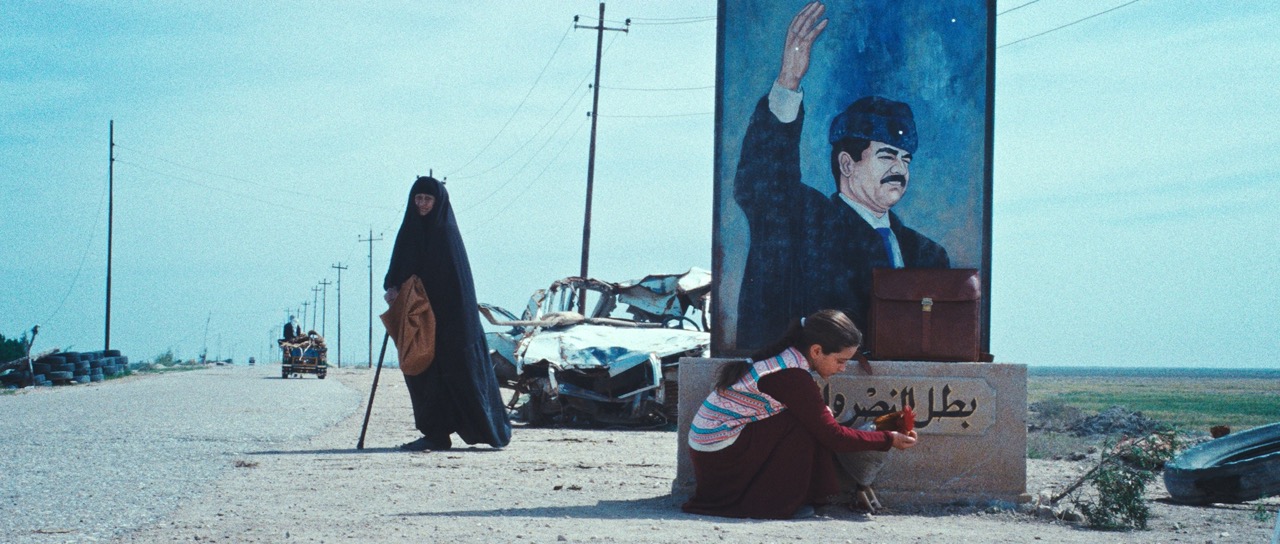
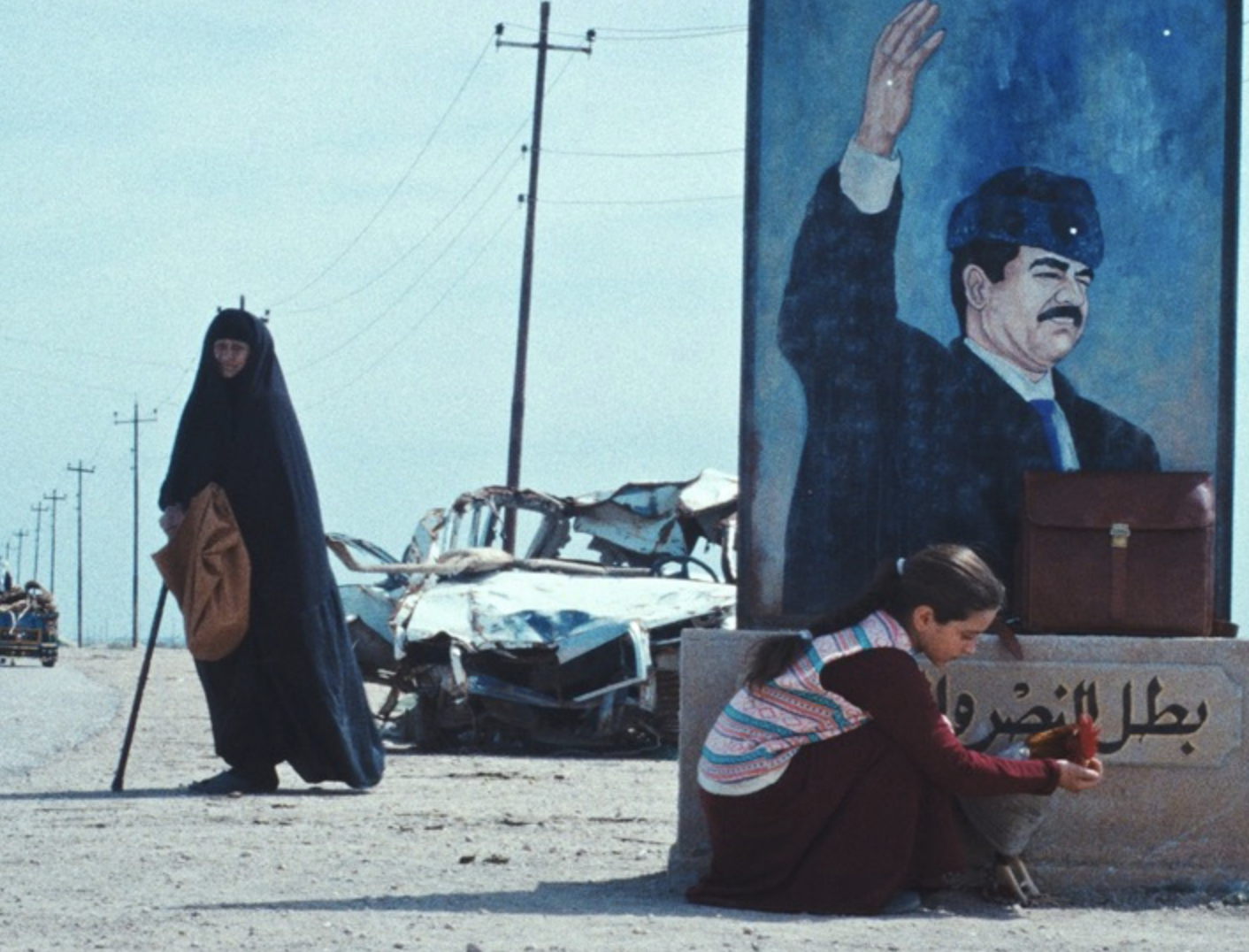
The President’s Cake tells this very story. Set in Iraq in the 1990s, during the years of dictatorship and international sanctions, the film, directed by Hasan Hadi, centres on nine-year-old Lamia (Baneen Ahmad Nayyef) from the southern marshes who is chosen by her teacher to bake a birthday cake for the president. It is a compulsory duty with severe social and bureaucratic consequences—such as imprisonment, communal exile, or worse—if left unfulfilled.
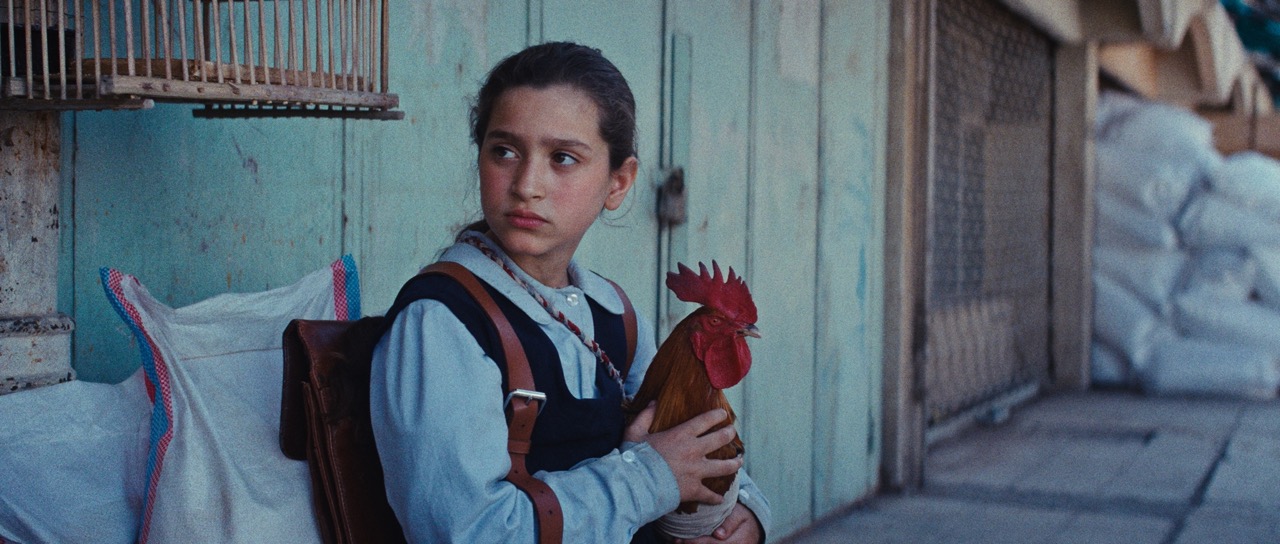
Still from The President’s Cake, directed by Hasan Hadi
Unable to afford the basic ingredients due to said sanctions—eggs, flour, sugar—Lamia nonetheless embarks on a chaotic but tragicomic journey into Baghdad, accompanied by her spirited friend Saeed (Sajad Mohamad Qasem) and her pet rooster, Hindi. Along the way, encounters with adults reveal a world in which moral decisions are constantly negotiated, bent by necessity. The president himself is not a character, yet his presence is unmistakable. Embedded in classrooms, institutions, and domestic spaces, he watches silently through painted murals.
Shot entirely in Iraq with local communities and non-professional actors, The President’s Cake was the film winner of the Camera d’Or and the Directors’ Fortnight Audience Award at the 2025 Cannes Film Festival, and is Iraq’s official submission to the 98th Academy Awards—shortlisted for Best International Feature Film.
In Baghdad over the Christmas holidays, I met Hadi.. We spoke about the absurdity of Lamia’s situation—inspired, he explains,by his own life in the Iraqi marshes as a child in the 90s,his journey into filmmaking at NYU despite travel bans, and what the Iraqi film industry now needs in order to thrive.
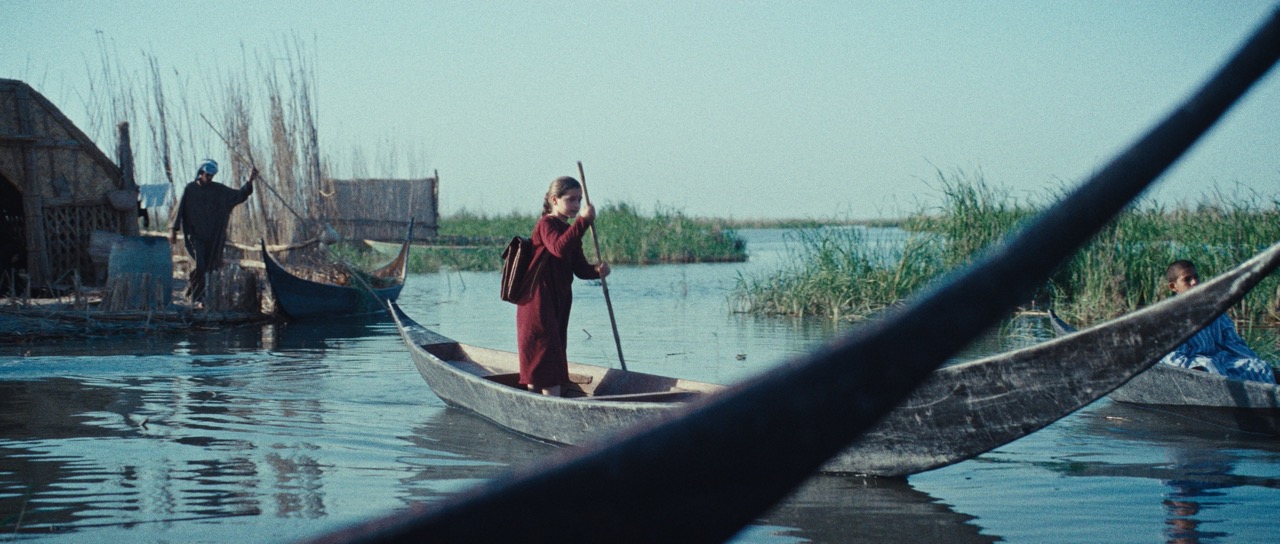
Still from The President’s Cake, directed by Hasan Hadi
Dalia Al-Dujaili: I’d love to start by learning more about you and your work in general. The President’s Cake is the first time I’ve come across your practice, so I’m curious about your journey. Like Lamia, you were born in the marshes, or near them—how did you end up becoming a filmmaker?
Hasan Hadi: I didn’t grow up knowing what a filmmaker was. I just knew that I loved films. My passion really began with VHS tapes. We didn’t have cinemas in Baghdad, so I wasn’t discovering cinema in a romantic way—there was no theatre, no big screen. It was an 18-inch television and VHS tapes, watched late at night when no one else was using the TV.
There was a house I used to go to where someone had a room filled with tapes. The owner would give me whatever was available. I watched everything. Godzilla, Baby’s Day Out, Bruce Lee, Jackie Chan, Tarkovsky, Spielberg, Fellini—everything was mixed together. As a kid, some films pulled me in more than others, but slowly I realised there was a whole world beyond ours.
During the 1990s, Iraq was doubly isolated: internationally, because of sanctions, and internally, because of dictatorship. Discovering that other worlds existed was incredibly exciting. I remember not being able to sleep after watching a great film because I wanted to tell everyone about it, to share the story.
When I was around 12 or 13, I had access to a computer and started experimenting with basic editing software—I think it was Movie Maker. I made a short video with music and showed it to some friends. They started crying. That was a moment for me. I realised I could move people emotionally. I could access something deeper. I knew I was going to apply to film school.
DA: Where did you want to study?
HH: I wanted to go to Europe or the US, I wanted access to the best resources and the strongest technical training. There are things no teacher can teach you creatively, but I wanted the technical foundation.I applied to NYU and was accepted with a full scholarship but my visa was rejected for three years.
DA: Was that because of sanctions?
HH: It was 2014–2015, during the ISIS period. Everyone from Iraq was automatically treated as a suspect. For three years, every sign told me – from the visa rejections to conflicts in Iraq and other bureaucratic obstacles – this wasn’t meant to happen. And then the travel ban came—Iraq was on the list. You start questioning everything. Imagine: every year you have tons of people around you telling you this is not meant to be. Every atom in the world is telling you this is not the correct thing and you have just a small part of you that says this is something you need to pursue.
But then, a week before my travel date, Iraq was removed from the ban. I finally went to New York. That was the first time I saw cinemas screening classic films. At first, I thought something was wrong with the theatre, I didn’t understand why they were showing films from the 1970s. Then I realised these were independent cinemas. It was like a candy shop for me.
I stayed in New York for four or five years. I didn’t return to Iraq because I was worried about my visa. I studied, and then I started teaching as well. When the pandemic hit and things began reopening, I returned to Baghdad to prepare for the film.
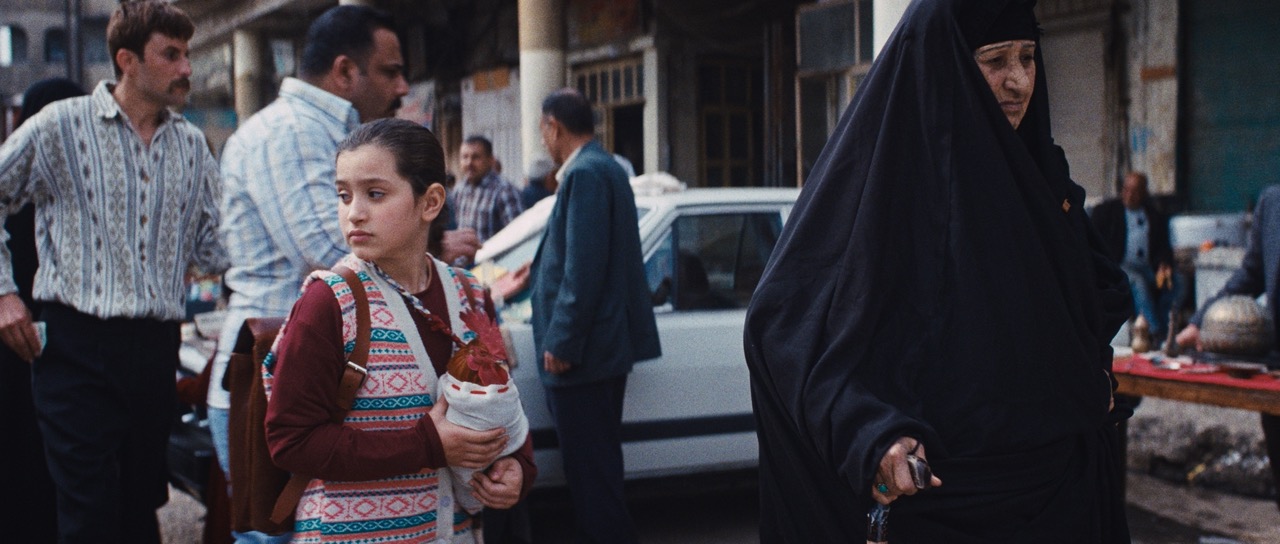
Still from The President’s Cake, directed by Hasan Hadi
DA: Some directors take fifteen years to make their debut feature. From what you’re saying, it sounds like it took you about six or seven years from film school to making The President’s Cake. When did the idea first take form?
HH: I’d always known the story, but I never thought of it as a film until I got to film school. Then it stopped feeling like just a story, it felt like something I had to tell.
There are different kinds of stories filmmakers tell. Stories you tell to pay the bills. And stories you need to tell before you die. This was one of those. When you finish it, you feel you can die peacefully.
DA: I genuinely think it’s a brilliant way of telling the story of life under Saddam through a relatively minor detail in the grand span of his rule. My mother left Baghdad partly because of Saddam’s birthday—being forced to celebrate someone you don’t even know felt suffocating to her. Saddam is everywhere in the film, but never directly, his face and the suggestion of his rule is always looming, creating this claustrophobic feeling that you can’t escape the regime.
Iraqis at the time felt surveilled, they couldn’t trust their friends or neighbours, everybody was a suspect. As Iraqis, we know these stories well, but we rarely get to tell them. Did you always know you wanted to tell Iraqi stories? Why did this film in particular feel natural as your debut?
HH: I knew I wanted to tell stories I could stand in front of a hundred people and defend. Stories I know deeply—the characters, the locations, the details. It had to be local. I was also frustrated that Iraqis don’t get to tell our stories in our own way. There are wonderful attempts by Iraqi filmmakers, but when I was developing this film, we received offers to fully finance it, on the condition that it be shot outside Iraq. I refused.
I would rather risk not making the film at all than make it somewhere else. If Iraqi filmmakers can’t shoot in Iraq, then who will? This wasn’t just about one film, it was about contributing to an industry, inspiring others. I hope it will cultivate a new industry for Iraqi cinema.
I was aware of the challenges, I was aware of the obstacles: technical, logistical, institutional. Fourteen years of isolation creates a huge gap. But we worked intentionally: whenever we brought in department heads from outside Iraq, we paired them with Iraqi crew so knowledge could be shared.
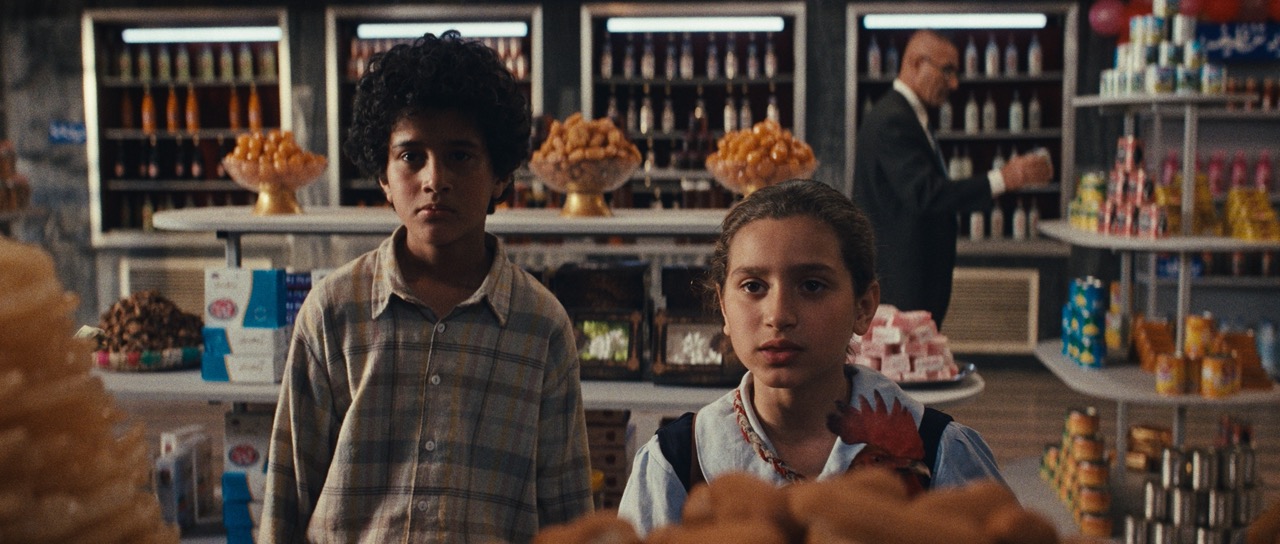
Still from The President’s Cake, directed by Hasan Hadi
DA: You insisted on shooting in Iraq, which is extraordinary, full of both challenges and joys.
HH: Other challenges included going back in time, blocking streets, sourcing equipment that didn’t exist locally… Things that took five emails in New York took weeks in Baghdad.
But the joy was the community. People offered their homes, shops, clothes, everything. It felt like the entire village was behind us.
At Cannes, the head of the CNC (Centre national du cinéma et de l’image animée) one of the largest film institutions in Europe—saw the film and asked how they could support Iraqi cinema. Shortly after, CNC and Iraq’s Ministry of Culture signed a production agreement. I’m not saying the film was the reason, but it mattered.
DA: Watching the film, the calibre felt different. It’s not enough just to tell our stories—we have to tell them beautifully.
HH: Exactly. We have a responsibility to respect audiences everywhere, and to present our country with care. I just wanted everyone involved to feel proud to have worked on it.
In Iraq, cinema is a young industry. Bad films are part of getting to good ones. People compare us to Iranian cinema, but that’s unfair—Iran has been producing films since the 1960s. You can’t compare that to a country just rebuilding its cinematic language.
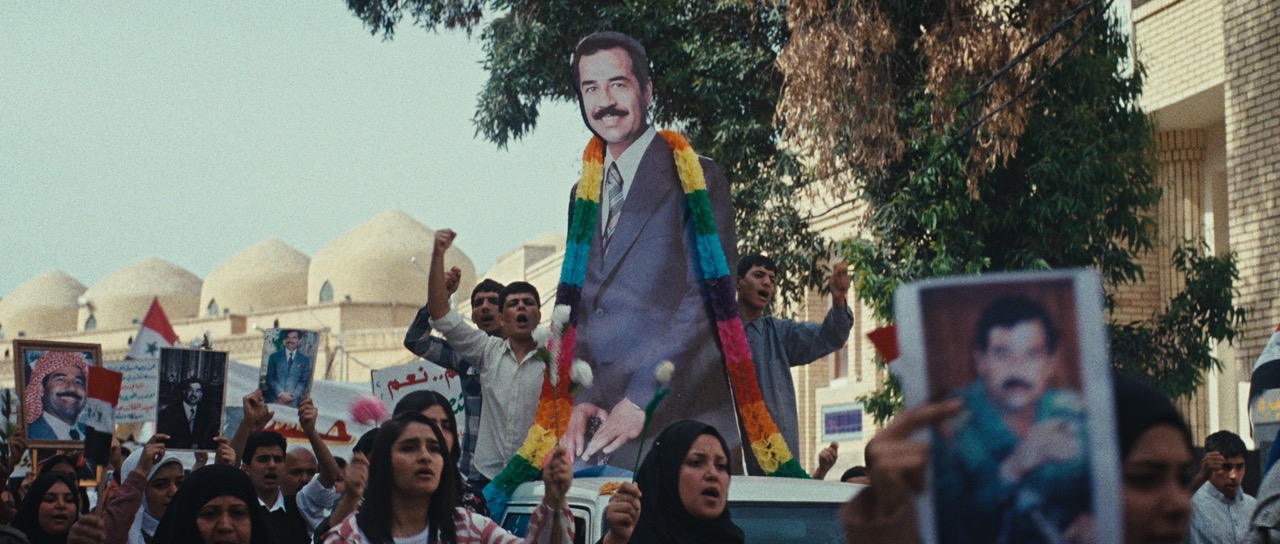
Still from The President’s Cake, directed by Hasan Hadi
DA: What do you think Iraqi cinema needs most right now?
HH: We need to start with the basics:writing workshops, grant-writing workshops. Understanding systems that already work globally, not reinventing the wheel. We also need to understand it starts with the writing. If it’s not working on the page, it’s not going to work on the screen. It’s much cheaper to fix it on the page than to experiment in the editing room. It starts with pen on paper: write your own story. Write it in a way that’s accessible for people.
Then comes visual language. Cinema isn’t television, it’s not just coverage. It’s expression. And beyond that, Iraq needs infrastructure: independent cinemas, institutions, continuity.
DA: It’s important that we have a cinema to access and connect with. I cried from the first minute, hearing the Iraqi, and then Baghdadi dialect, on screen—it felt like the first time I’ve heard the dialect on screen, and that sounds like such a simple thing, but I don’t think others understand how important it is to hear your own dialect on screen. It felt like watching my family. That’s how we speak at home. People don’t understand how important that is, to see yourself and your people represented on screen.
Although, I definitely didn’t understand the marsh dialect! It’s important to reflect the diversity of dialects within the country itself.
HH: It’s actually interesting you’re bringing that point up, because at that time, especially, the dialect of the south was so discriminated against, even in the government institutions. That’s why, in the police office, the grandmother uses the sound ‘cha’ in her accent, and that was the sign to the officers that she’s from the south. That’s something you cannot tell an American audience, but it’s for your own people that understand that they are seen, felt, they are understood.
One of the most emotional Q&As we’ve had is when the film was playing at the BFI in London. We had a couple of Iraqi audiences, and Dalia, they were crying their eyes out, saying, “for the first time we are seeing our country on the screen,” as you said, “I’m seeing Baghdad, I’m seeing the marshes, I’m seeing chibayish [Iraqi dialect].” Everything is so triggering yet also satisfying for them.
DA: I have two final questions. First: the child actors were street-cast, and you found them very late in the casting process. How did you work with them?
HH: We focused on set etiquette, not “acting.” I told them there was no right or wrong. Kids are taught to correct themselves, I wanted to free them from that. Once they forgot about being “right,” they became fully present, and that’s when magic happened.
DA: And, what’s next?
HH: My main concern is the theatrical release, especially in Iraq. Beyond that, I’m already thinking about the next project. Awards come and go, what matters is the work.
The President’s Cake is in cinemas from 6th February. Dalia will be in conversation with Hasan on Sunday 18th January at the Ciné Lumiere.