

Italian futurism emerged from a fraught political and cultural context in early 20th-century Italy. Amelia Stevens tells the history of the movement that gave us Giacomo Balla, Umberto Boccioni and influenced Ridley Scott’s Blade Runner.
Although rarely framed as such, the disciplines of architecture and urban planning are acts of imagination, projection, and speculation about the future. Originating in the singular minds of architects and planners, these speculative hypotheses require the labour of many others to be transformed into tangible realities—a process that can take years, even decades, to cross the invisible threshold between the abstract and the concrete, the fictional and the real.
At the stage of elevations, sections, and axonometric drawings, the work of the architect or planner remains as figurative as that of the fine artist or writer, who also engage in acts of conjecture about the future of the city and its social landscape. While the artist and writer acknowledge their speculations as such, perhaps the only difference between them lies in the architect’s and planner’s grandiose beliefs that, in their plans and renderings, they have transcended the act of imagining, projecting, and speculating altogether.
Italian futurism emerged from a fraught political and cultural context in early 20th-century Italy, amid the lingering tensions of the violent clashes and social unrest that had marked the preceding decades. Founded by author and poet Filippo Tommaso Marinetti, the movement was launched with the publication of his Manifeste du Futurisme in the Parisian newspaper Le Figaro in 1909. The manifesto functioned as an international publicity campaign that aimed to envision the future and seduce urban crowds to the aesthetics and “ideal beauty” of modernity, revolution, and warfare. Met with both fascination and scepticism by urban theorists, Marinetti’s rhetoric intentionally incited public agitation, anger, and controversy. Later becoming an ardent fascist and confidant of Il Duce Mussolini, his vision glorified conflict, violence, and the generative potential of war, while calling for the destruction of Italy’s past through the annihilation of “museums, libraries, [and] academies of every kind”.
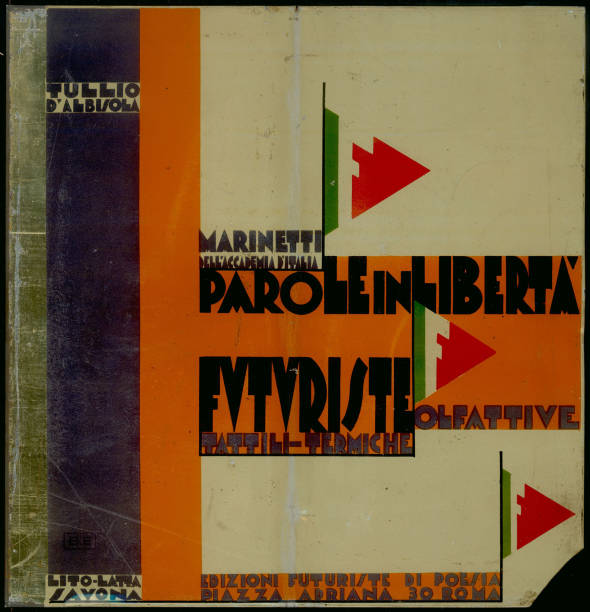
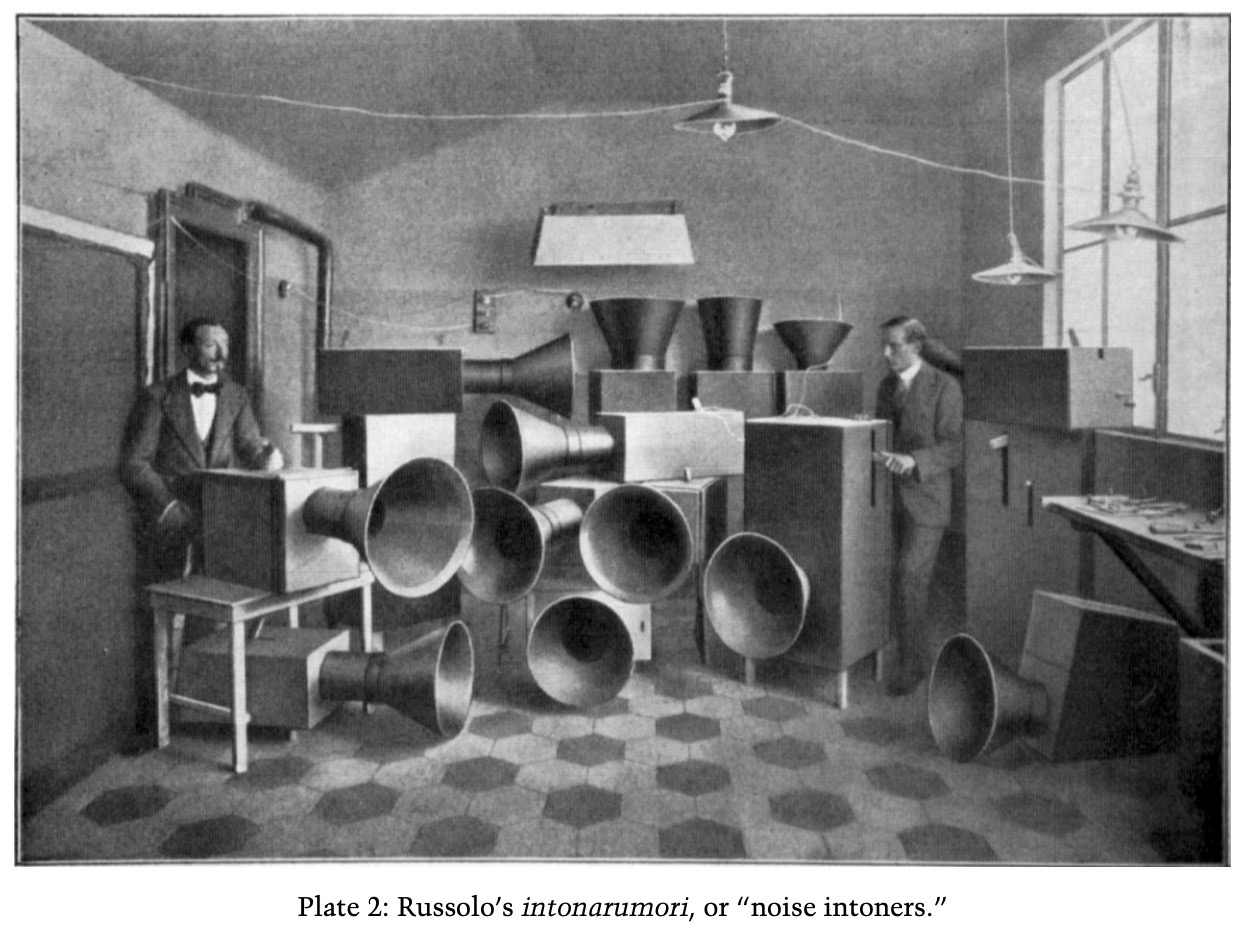


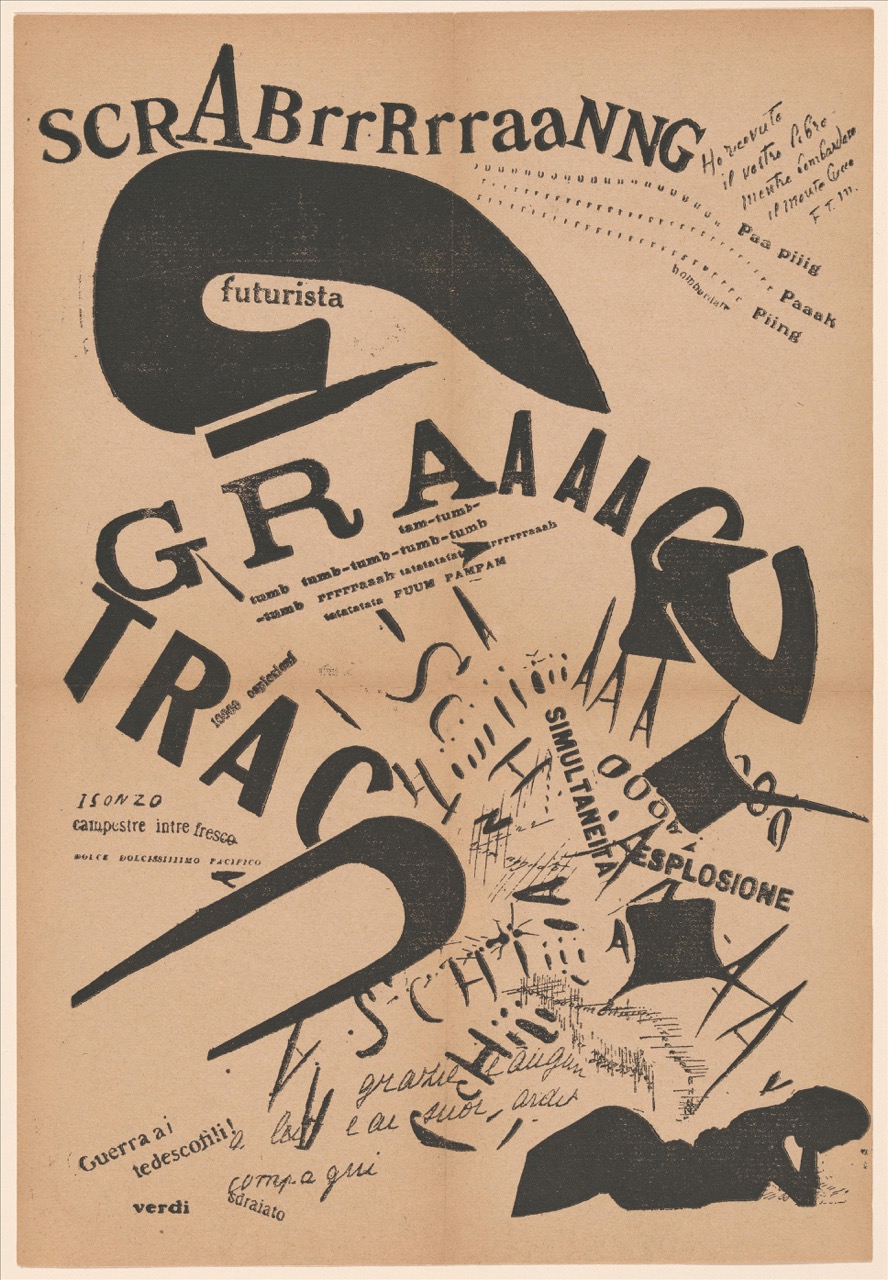
Among the movement’s most avant-garde interpretations were its early experiments in declamatory poetry, experimental music, and riotous performances. Intended to give rise to “body madness”, Marinetti’s own parole in libertà (words in freedom) poems, such as Bombardamento published in Zang Tumb Tumb: Adrianopoli ottobre 1912: Parole in libertà (Zang Tumb Tumb: Adrianople October 1912: Words in freedom, 1914) 1, destroyed natural syntax—abolishing adjectives and adverbs, using verbs in the infinitive, and suppressing punctuation. These linguistic experiments directly inspired painter and composer Luigi Russolo’s cacophonous, dissonant, and polyphonic “noise music”, generated by his Intonarumori (noise intoners) 2 and performed for the first time at Gran concerto futurista per Intonarumori (Great Futurist Concert for the Intonarumori, 1914).
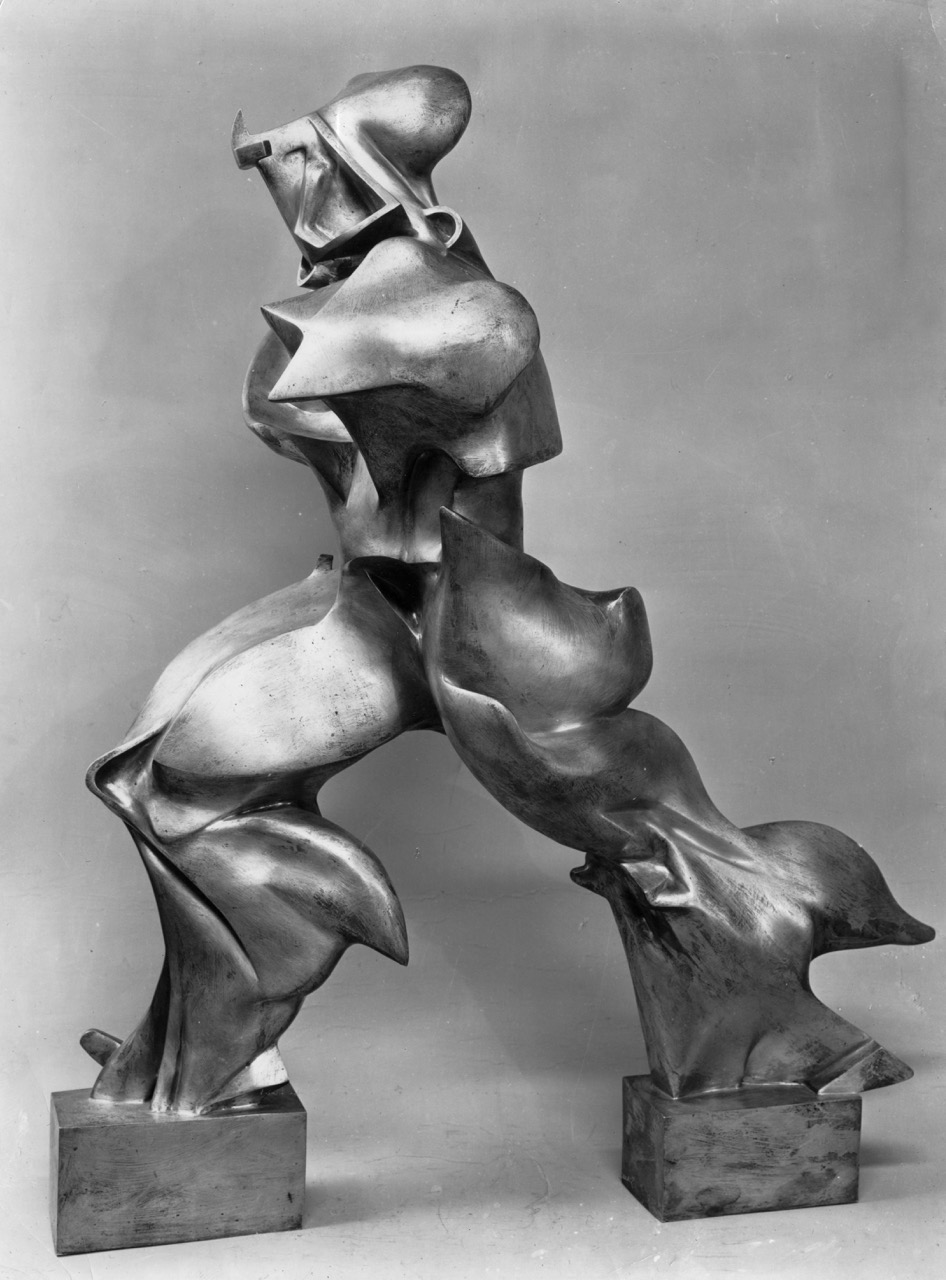
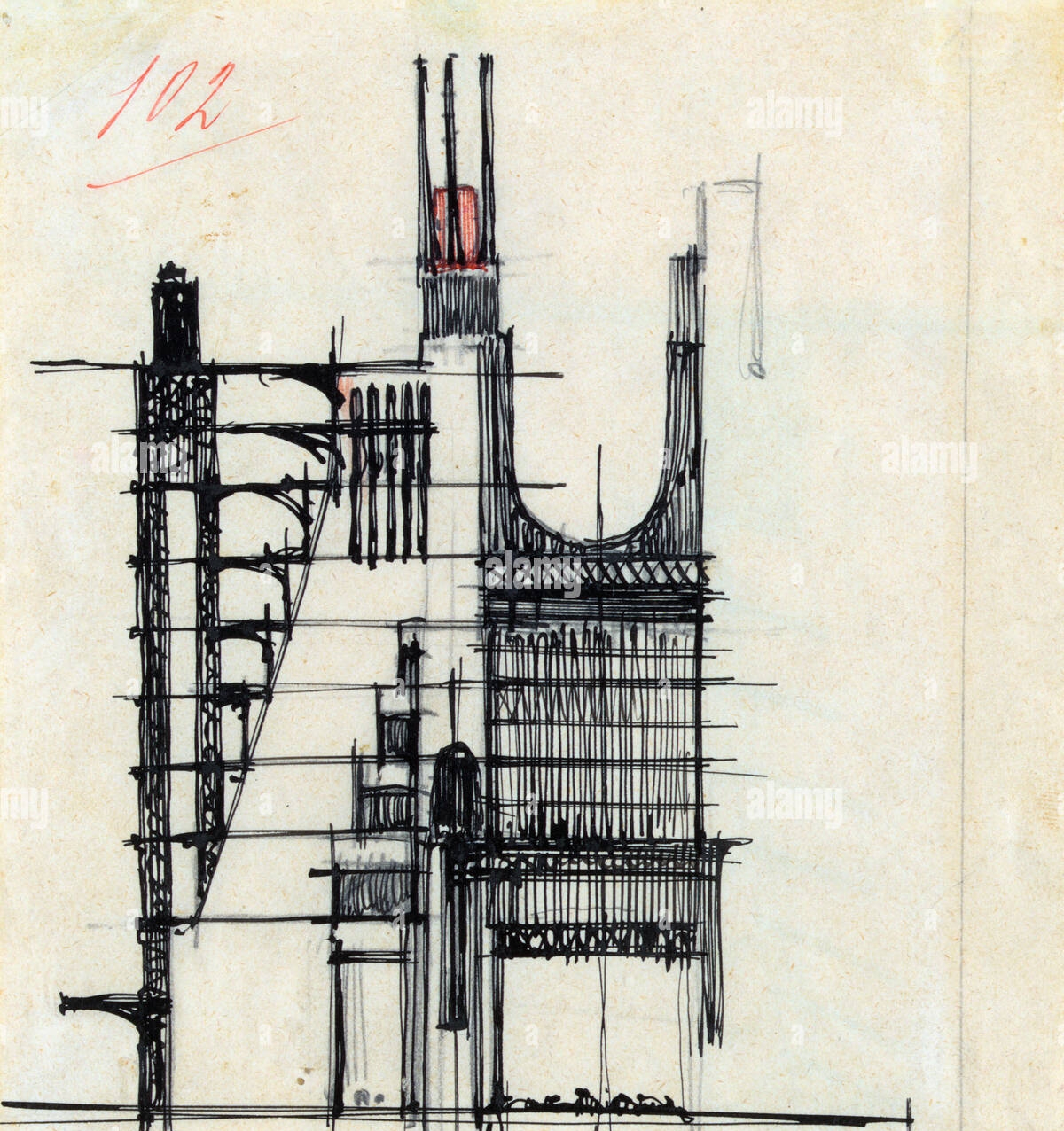
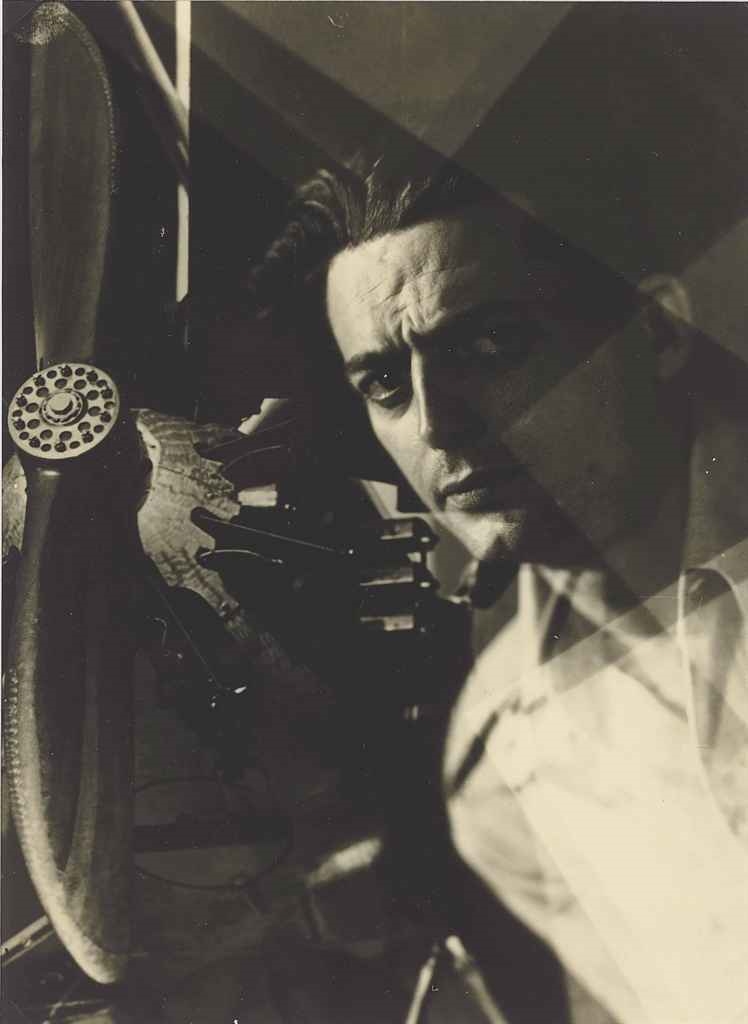
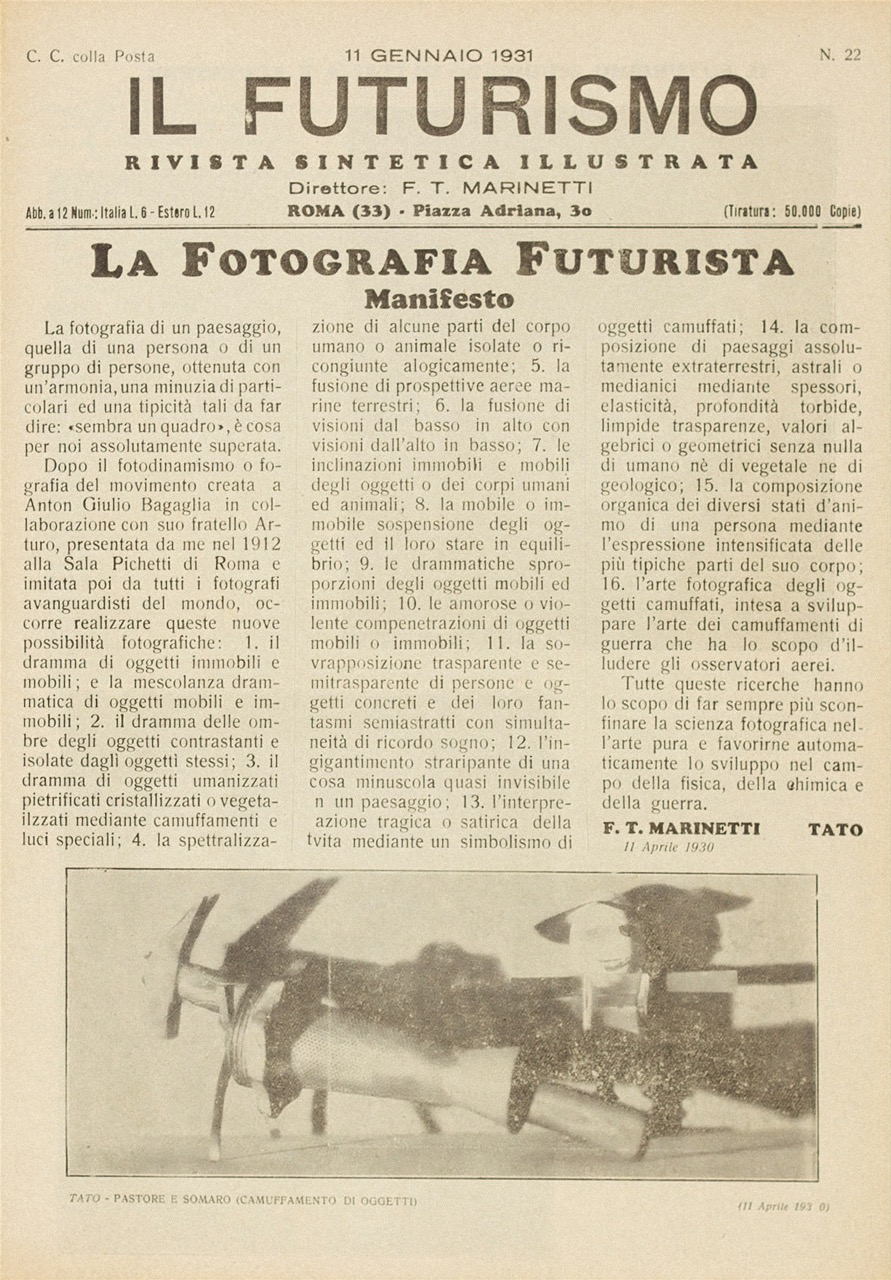
Marinetti’s manifesto also inspired a group of young visual artists, largely based in the modern capital of Milan, leading to further declarations that articulated the technical aspects of futurism’s wide-ranging opera d’arte totale: Giacomo Balla’s manifesto of futurist painting (1910), Umberto Boccioni’s manifesto of futurist sculpture (1913) 3, Antonio Sant’Elia’s manifesto of futurist architecture (1914) 4, and Guglielmo Sansoni’s manifesto of futurist photography (1930) 5.
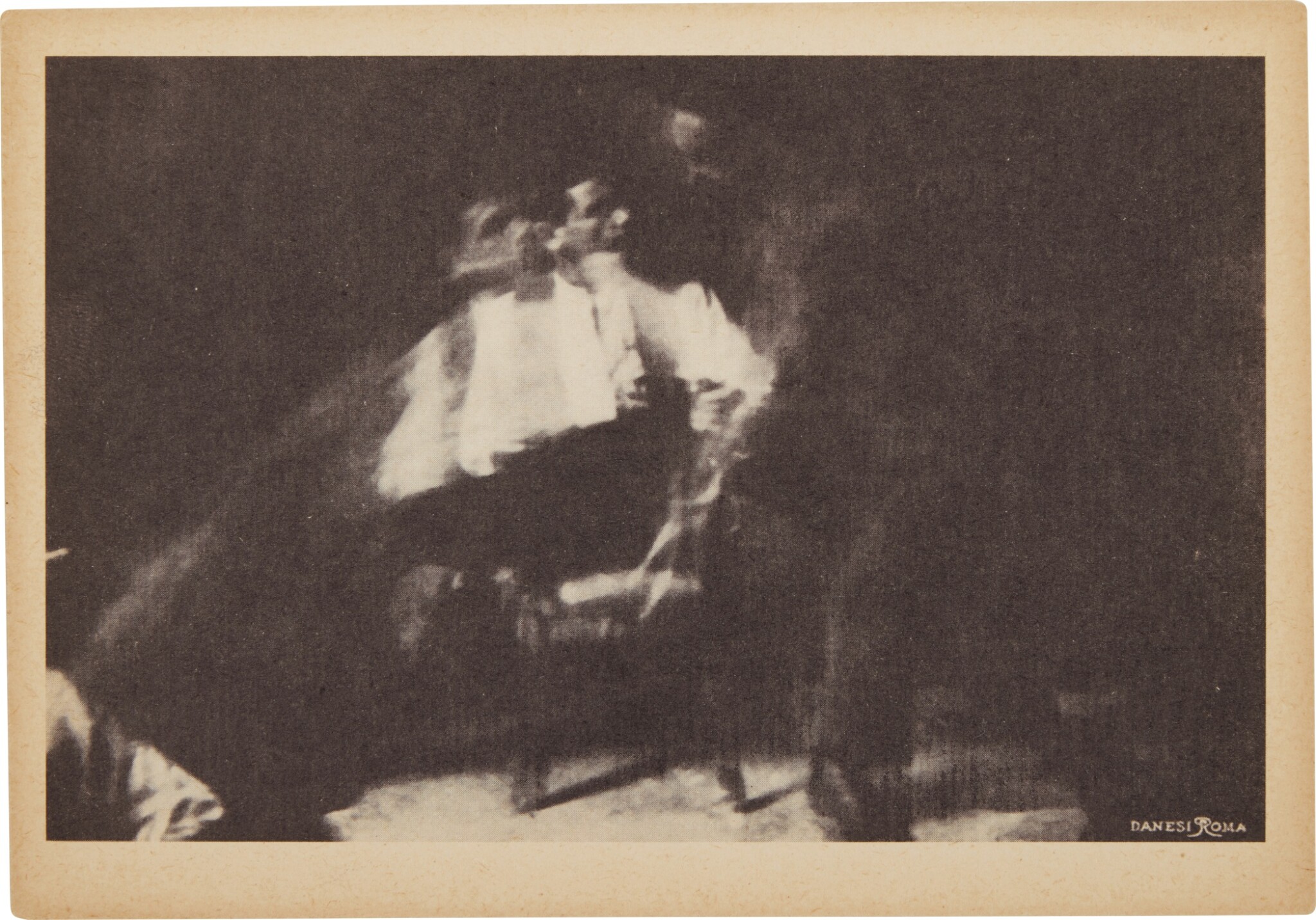
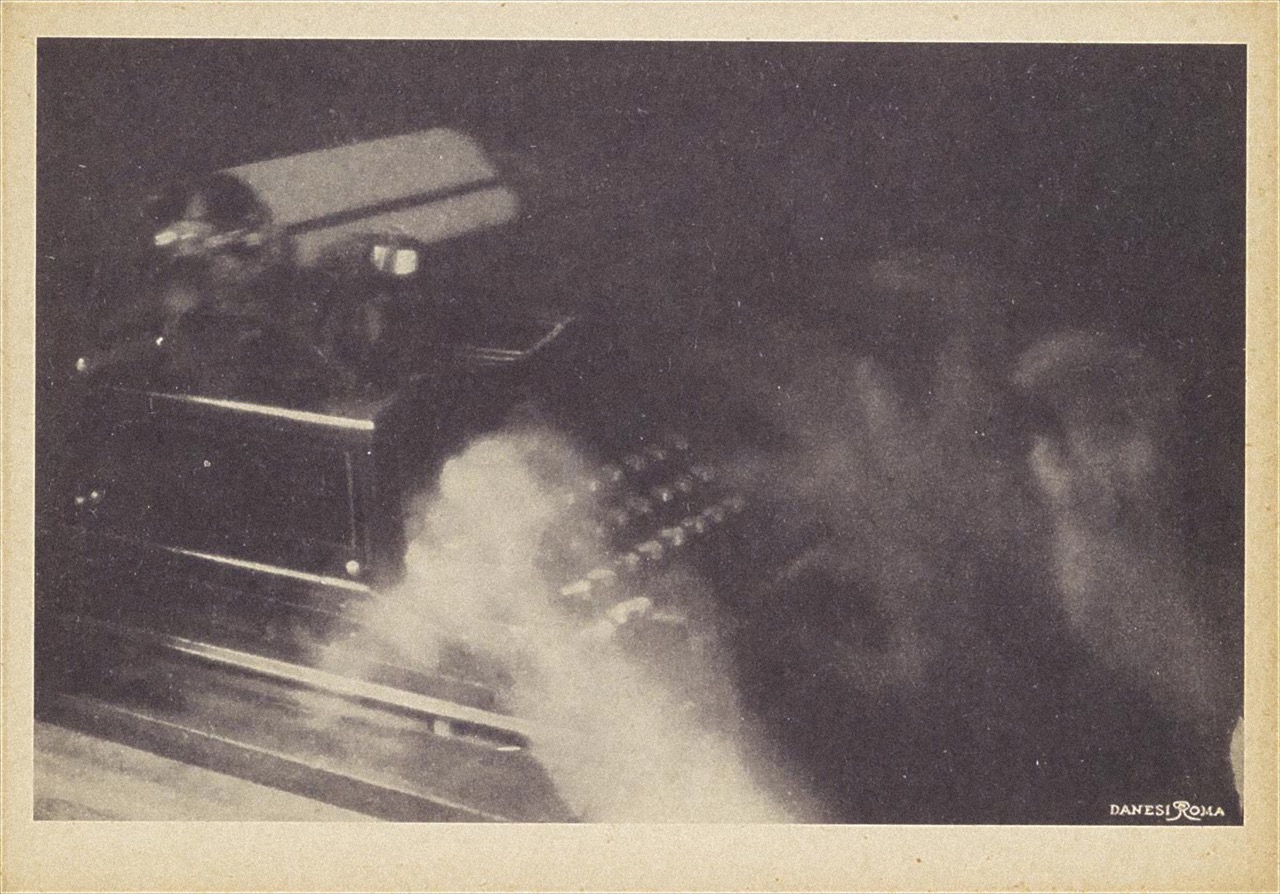
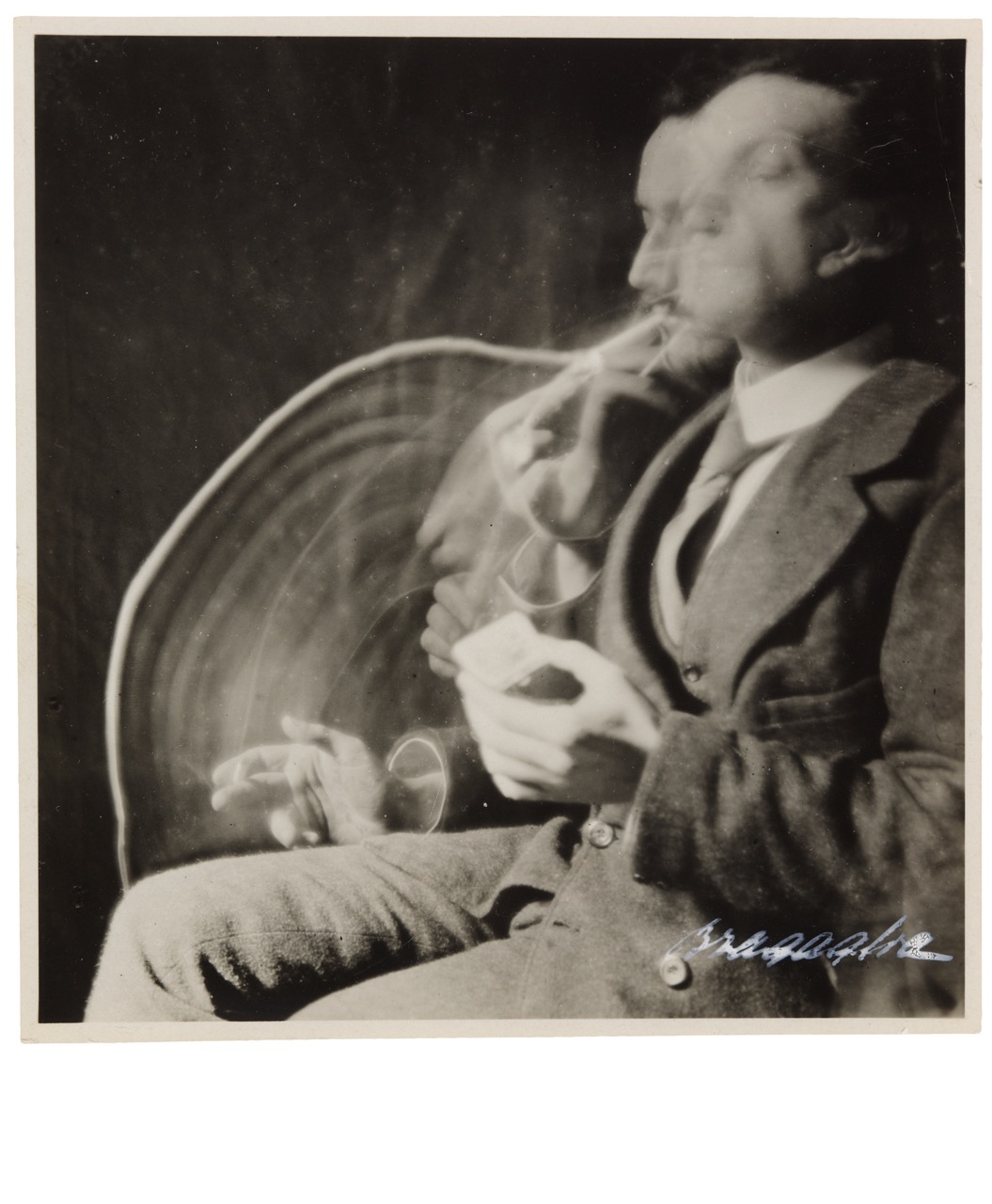
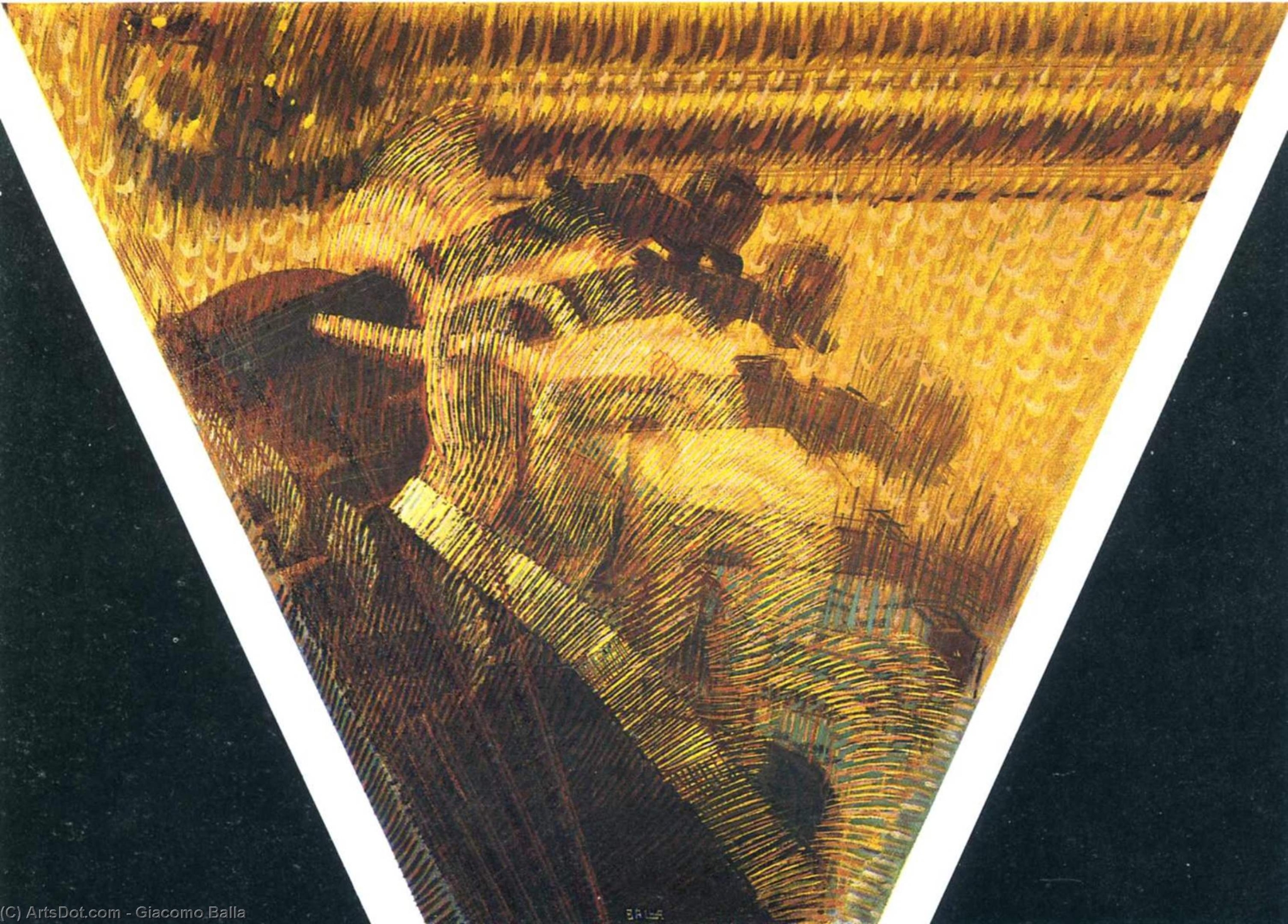
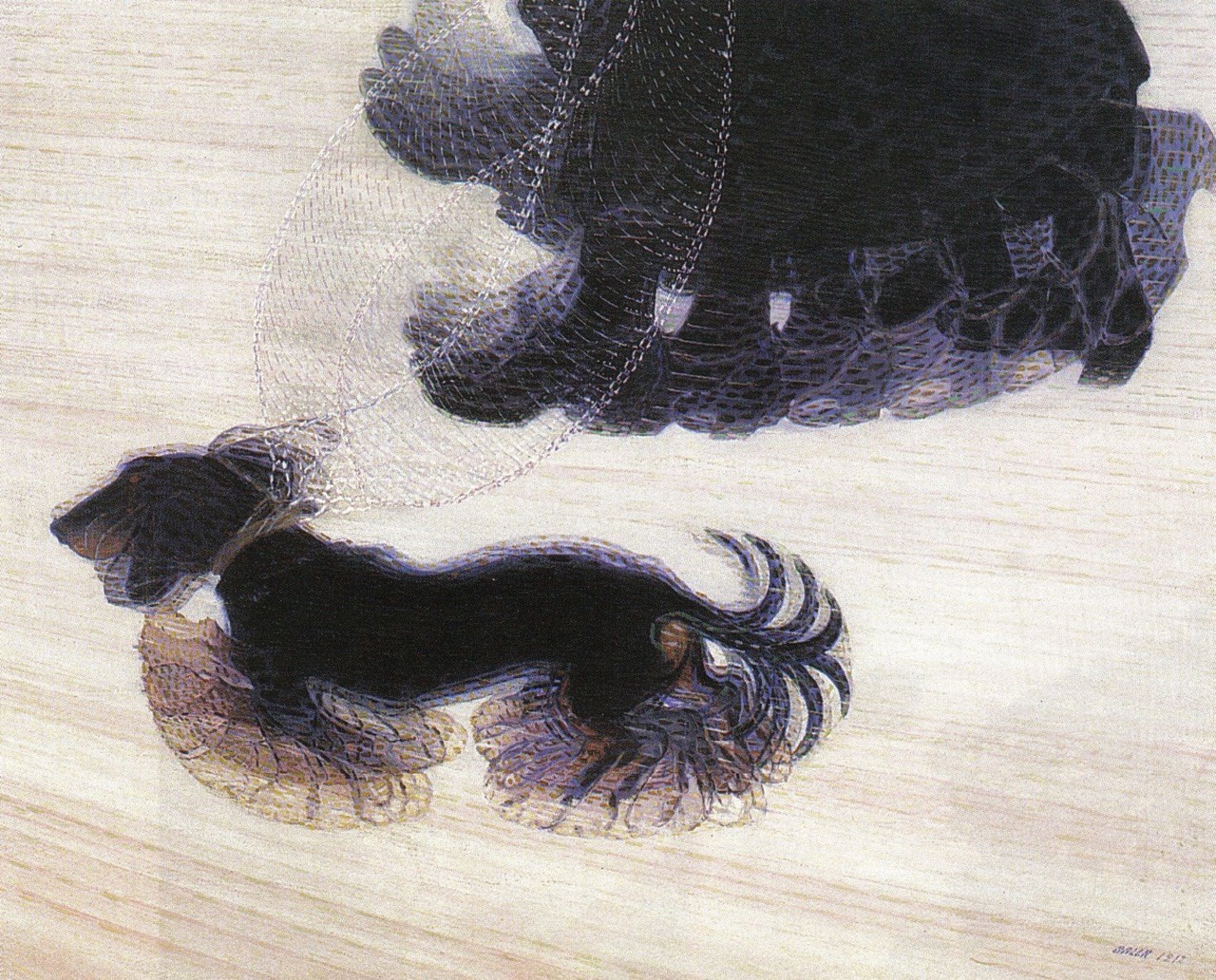
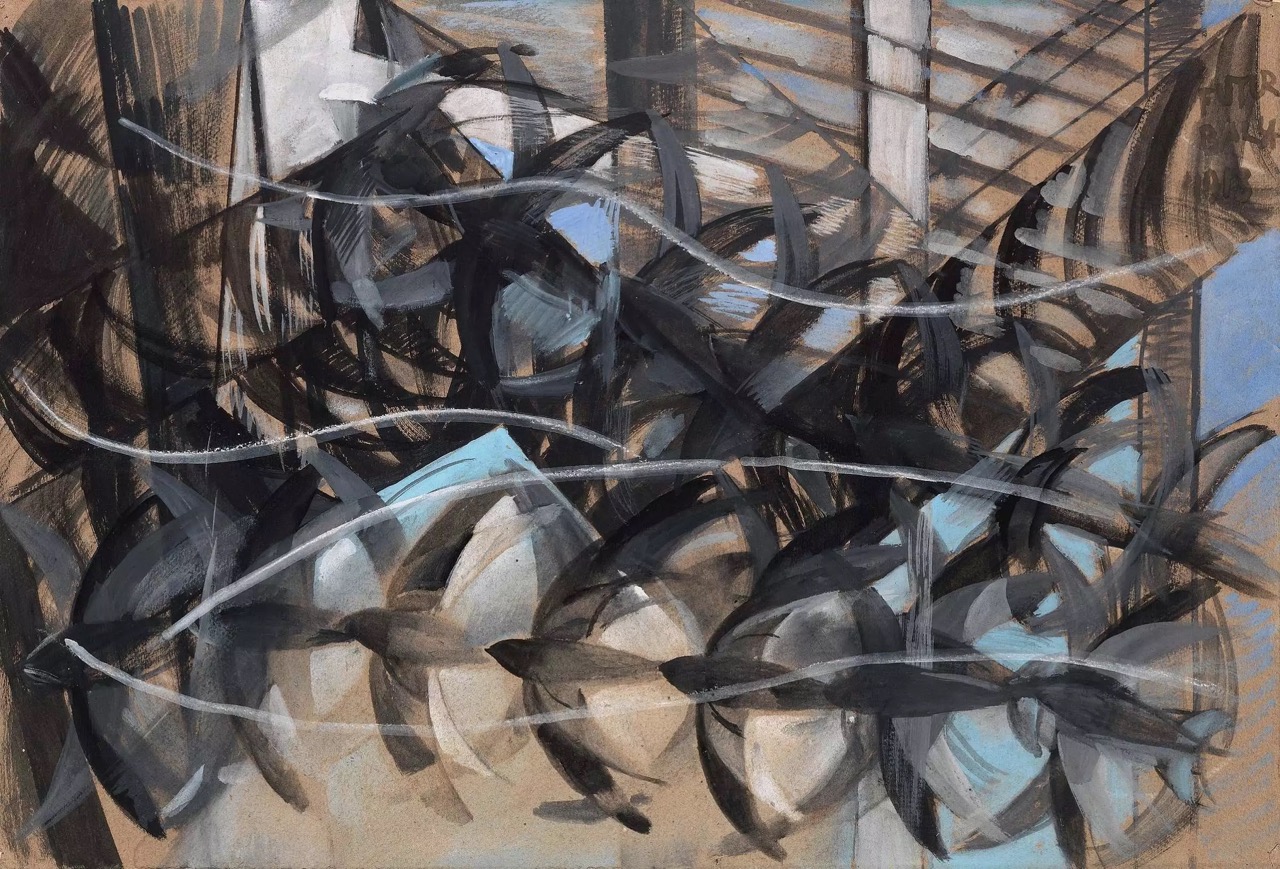
Incongruent, multicoloured, and often violent, many works of futurism’s early “heroic” phase are difficult to admire, even before one encounters their overtly fascist and misogynistic undertones. Borrowing from movements such as cubism, divisionism, expressionism, and pointillism, rare exemplary works include Anton Giulio Bragaglia’s multiple-exposure gelatin silver photographs Lo schiaffo (The Slap, 1910) 6, Dattilografa (Typist, 1911) 7, and Il fumatore—il cerino—la sigaretta (The Smoker—The Match—The Cigarette (1911) 8; Balla’s fragmented oil paintings La mano del violinista (The Hands of a Violinist, 1912) 9, Dinamismo di un cane guinzaglio (Dynamism of a Dog on a Leash, 1912) 10, and Volo di rondini (Flight of the Swallows, 1913) 11; and Boccioni’s “striding” bronze sculpture Forme uniche della continuità nello spazio (Unique Forms of Continuity in Space, 1913, cast in bronze 1949) 3. All pursued the futurist fascination with movement and simultaneity, while retaining recognisably human forms and subjects.
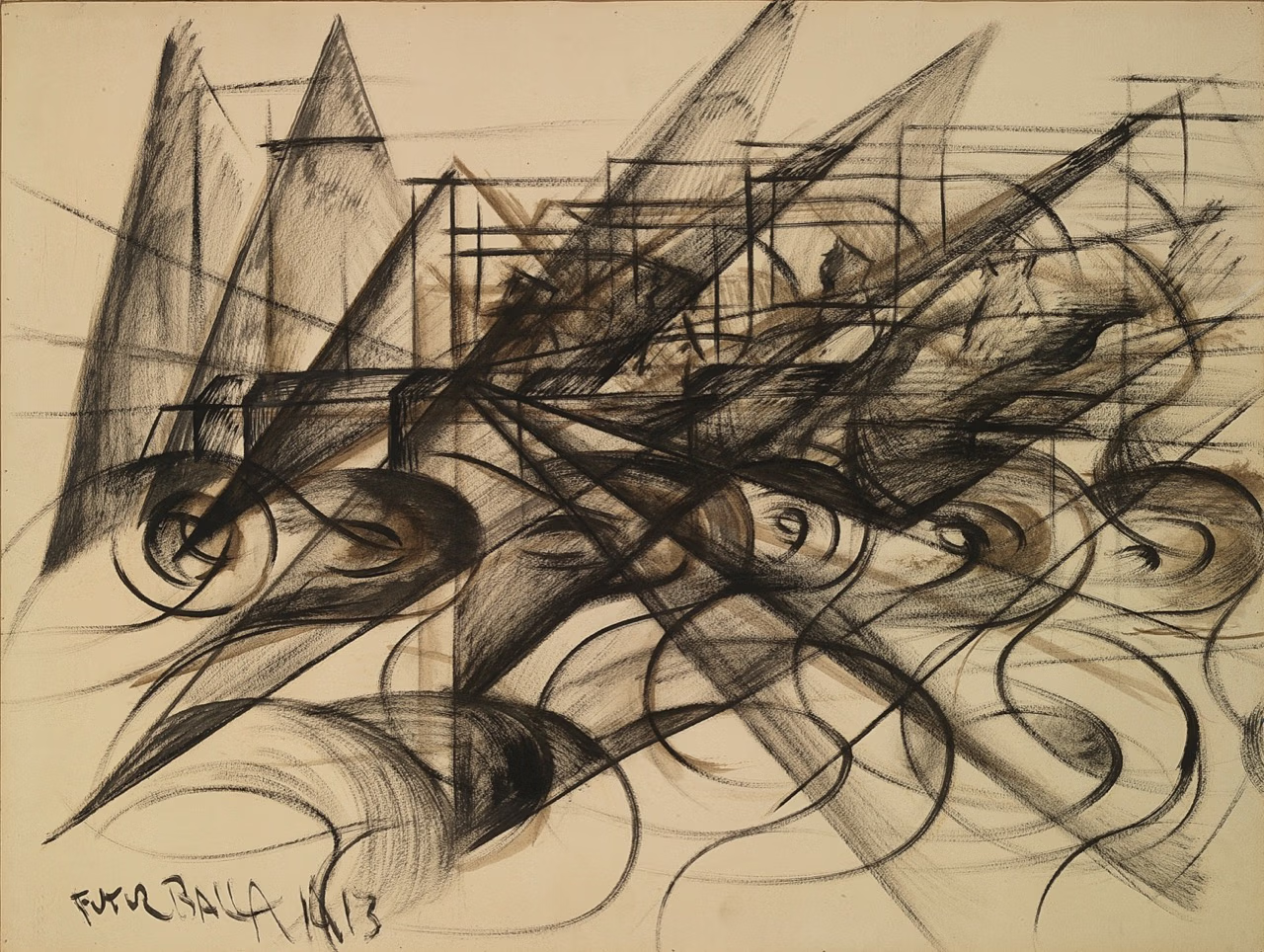
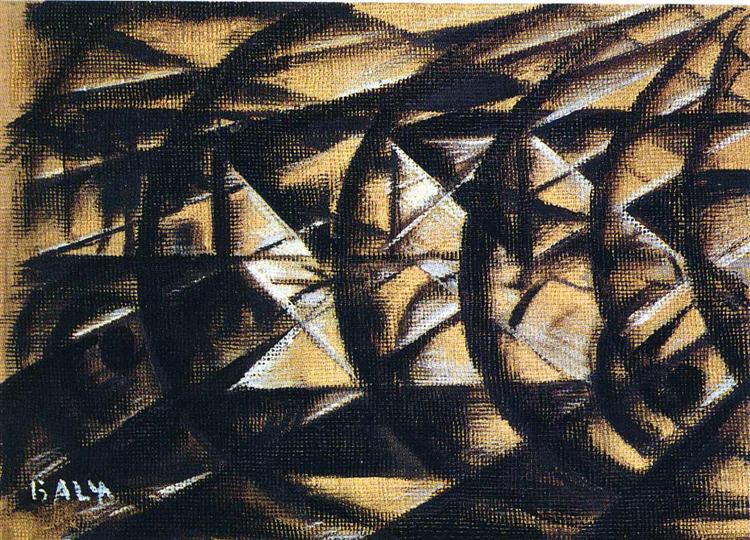
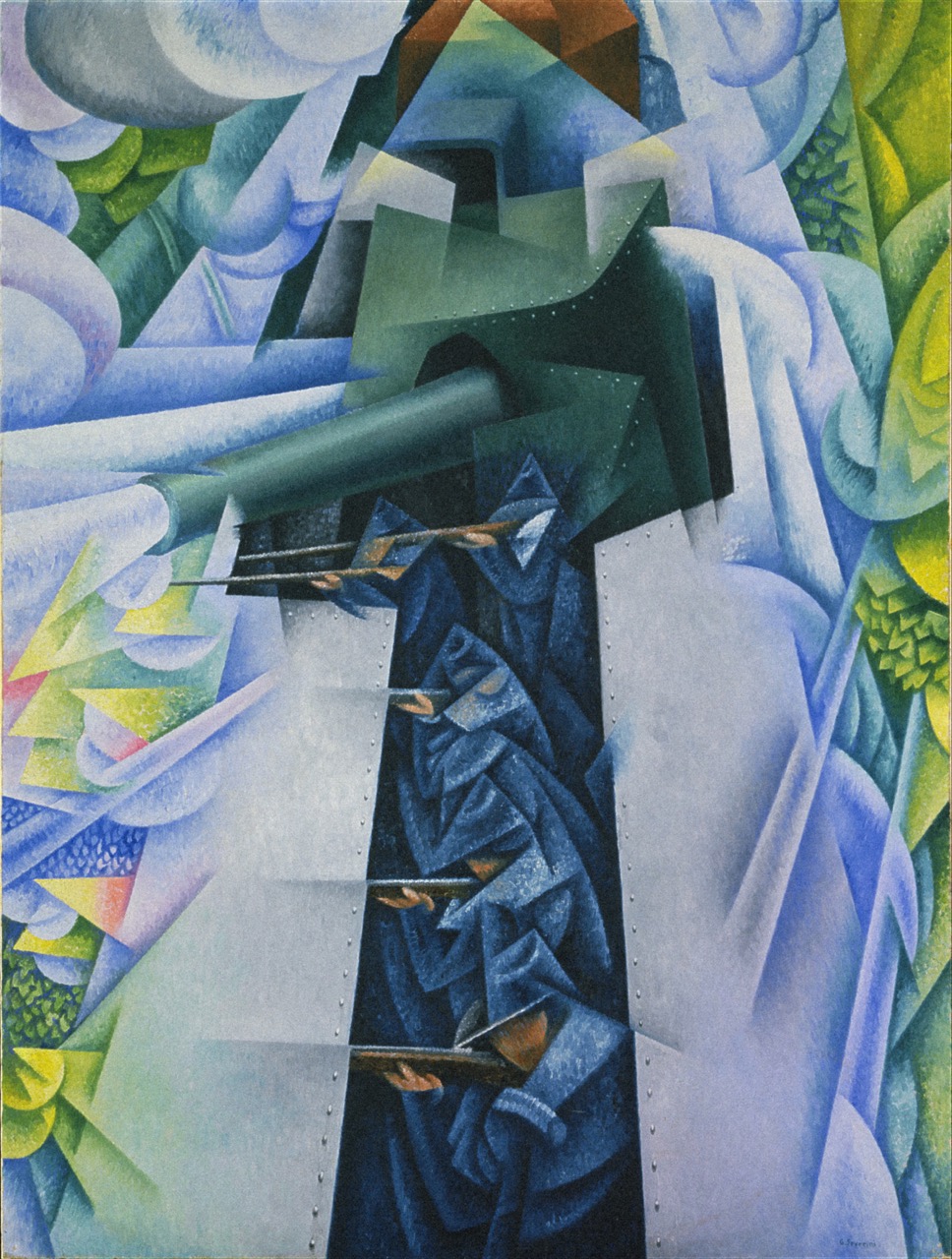
By late 1912 and early 1913, futurists increasingly turned toward mechanised subjects—automobiles, motorcycles, racing cyclists, trains, and urban crowds. In 1913, Balla produced Auto in corsa (studio) (Speeding Automobile (study), 1913) 12 and Velocità di motocicletta (studio) (Speed of a Motorcycle (study), 1913) 13, visualising Marinetti’s proclamation: “The world’s splendour has been enriched by a new beauty: the beauty of speed… A roaring automobile… that seems to run on shrapnel, is more beautiful than [The Winged] Victory of Samothrace.” Two years later, in 1915, the year Italy joined World War I, Gino Severini produced Treno blindato in azione (Armoured Train in Action) 14, an oil painting of five faceless soldiers aiming their rifles out of a militarised locomotive. A war enthusiast, Severini’s composition combined Marinetti’s militant rhetoric with the mechanical pulse of the modern city.
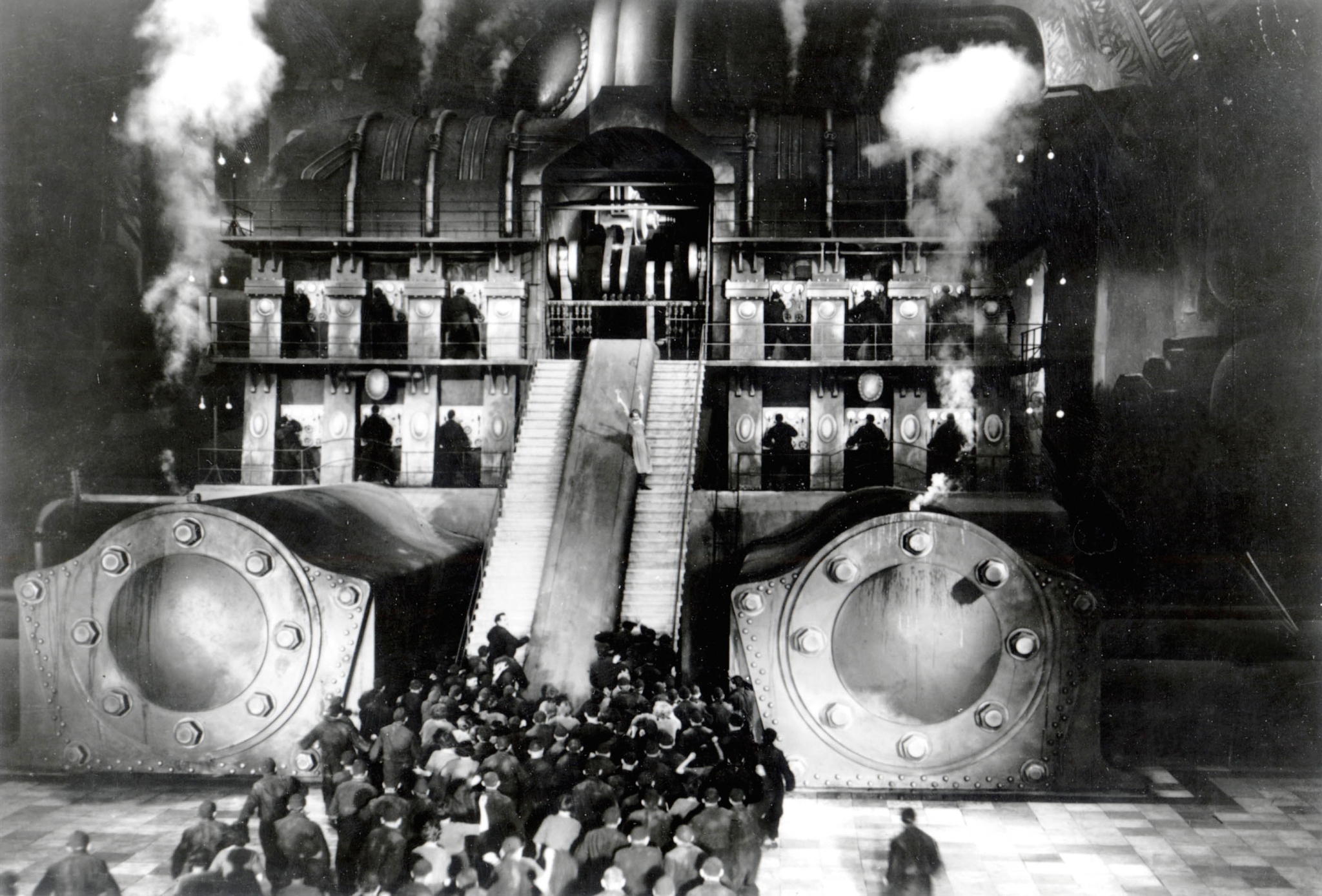
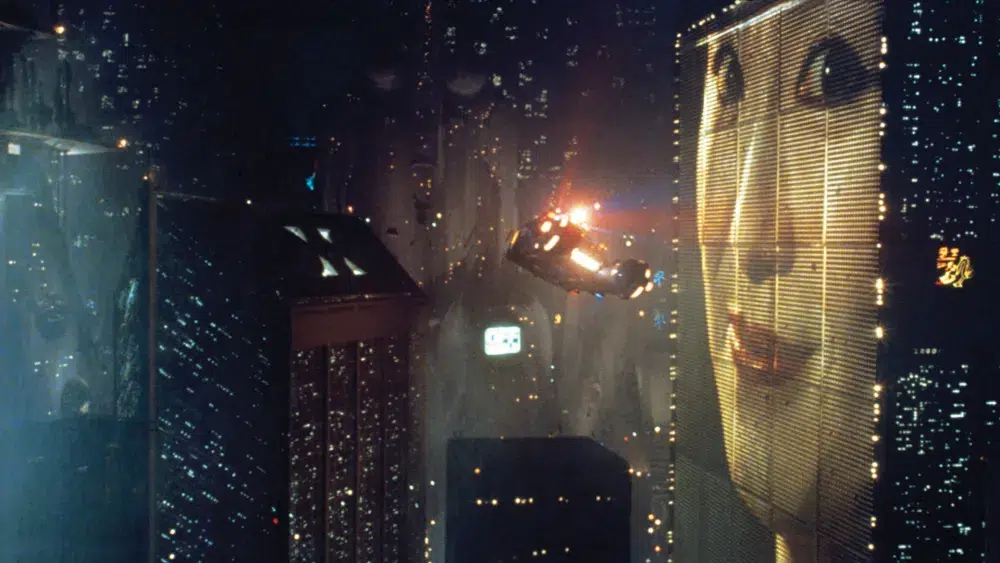
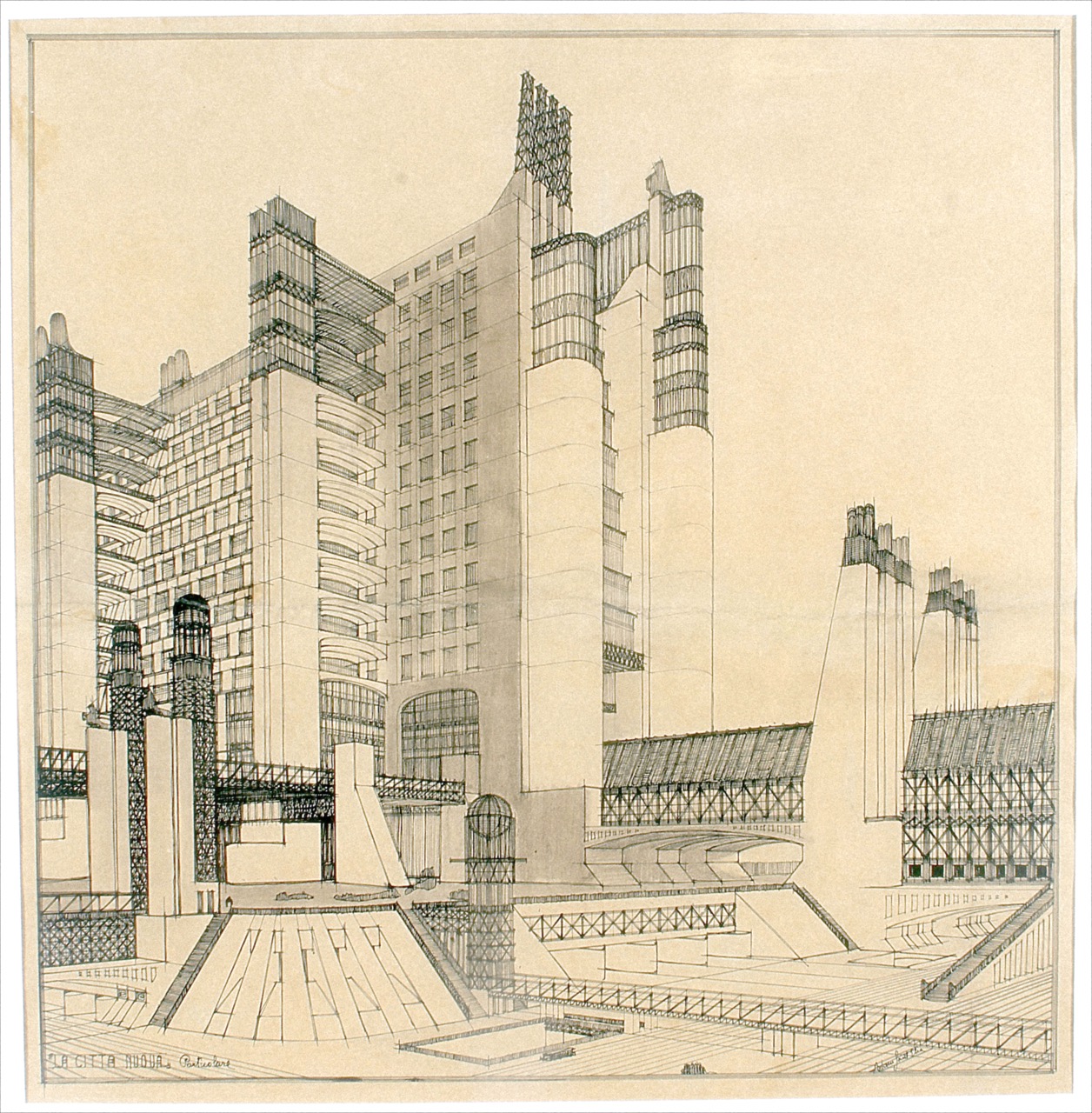
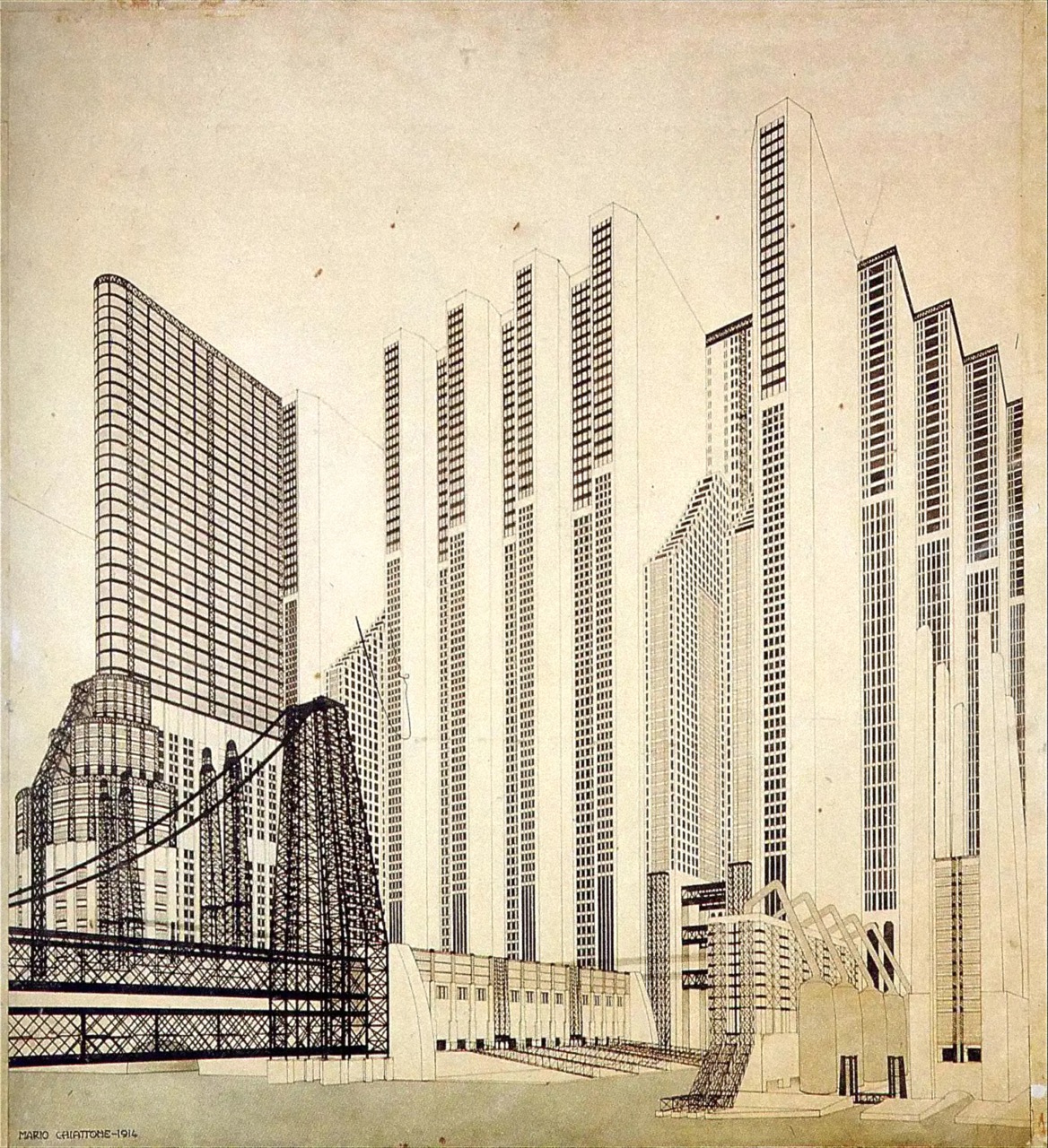
Around this time, architects also began to articulate their visions of the futurist city. Meeting at the Accademia di Brera in 1909, Sant’Elia and Mario Chiattone produced a series of visionary architectural drawings and watercolours, from Sant’Elia’s Città Nuova (New City, 1914) 15 to Chiattone’s Edifici per una metropoli moderna (Buildings for a Modern Metropolis, 1914), 16 which imagined monolithic skyscrapers, suspended walkways, and elevated highways. Their limited technical training, however, prevented the realisation of these utopian designs. A fervent nationalist, Sant’Elia died fighting Austro-Hungarian forces at the Eighth Battle of the Isonzo in 1916, leaving behind only a single completed villa outside Como. Chiattone, meanwhile, distanced himself from futurist propaganda and later advocated for a “positive and feasible” architecture. Though not realised in the way they once might have imagined, their visionary designs anticipated modern skyscrapers and profoundly influenced later urban imaginiaries— Sant’Elia’s drawings, in particular, inspired both the social housing projects of the 1960s and the cinematic worlds of Fritz Lang’s Metropolis (1927) 17 and Ridley Scott’s Blade Runner (1982) 18.
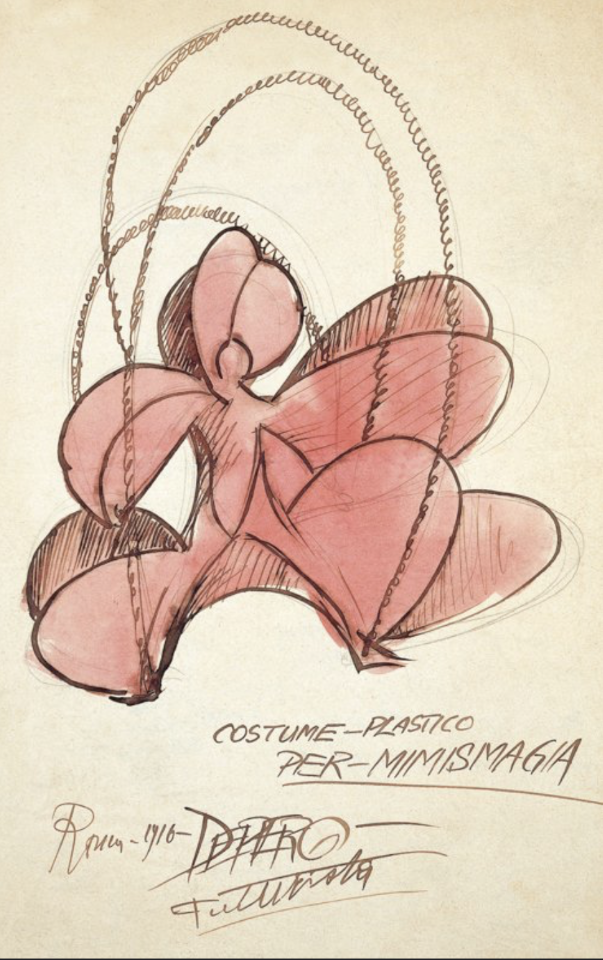
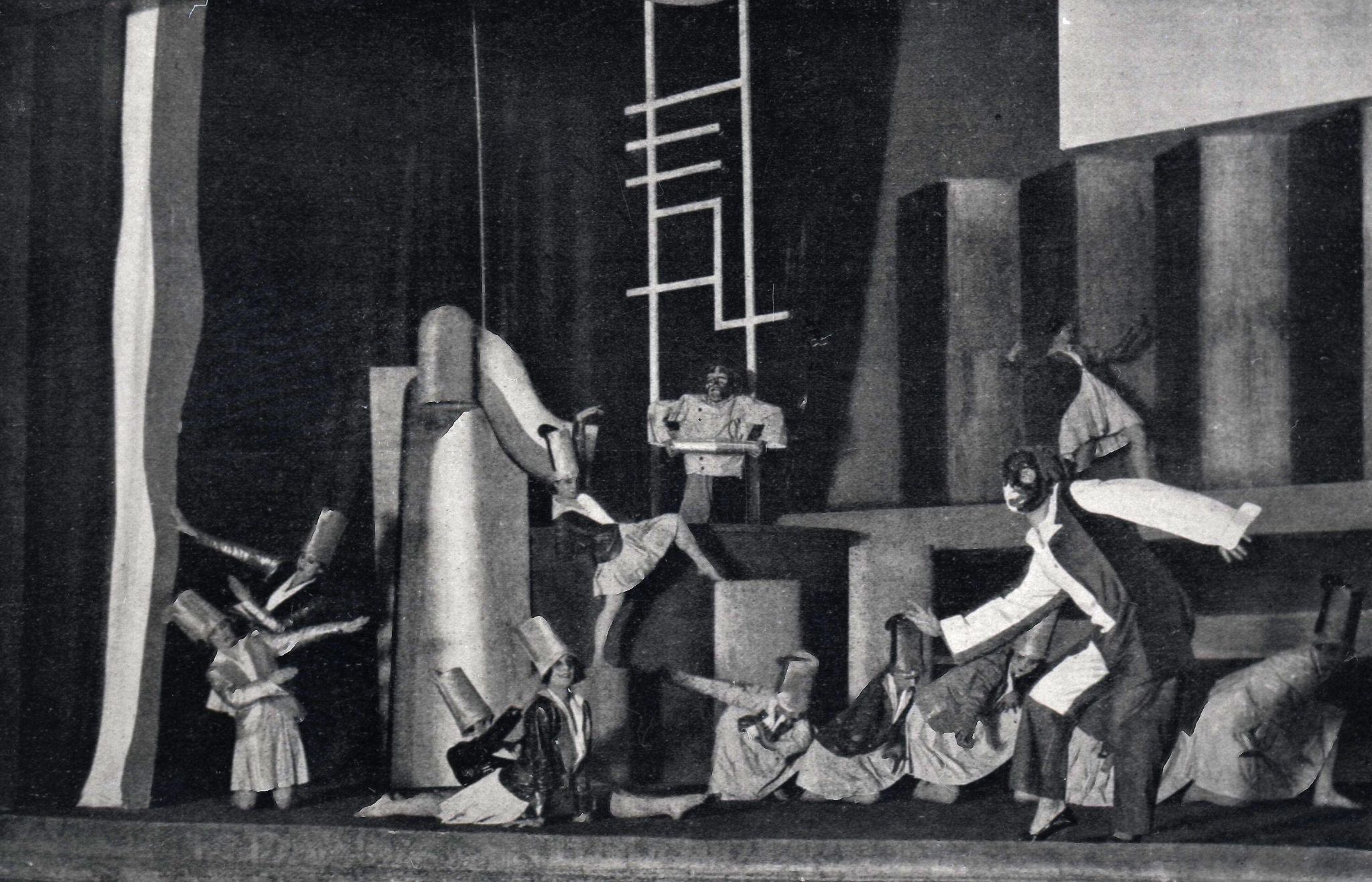
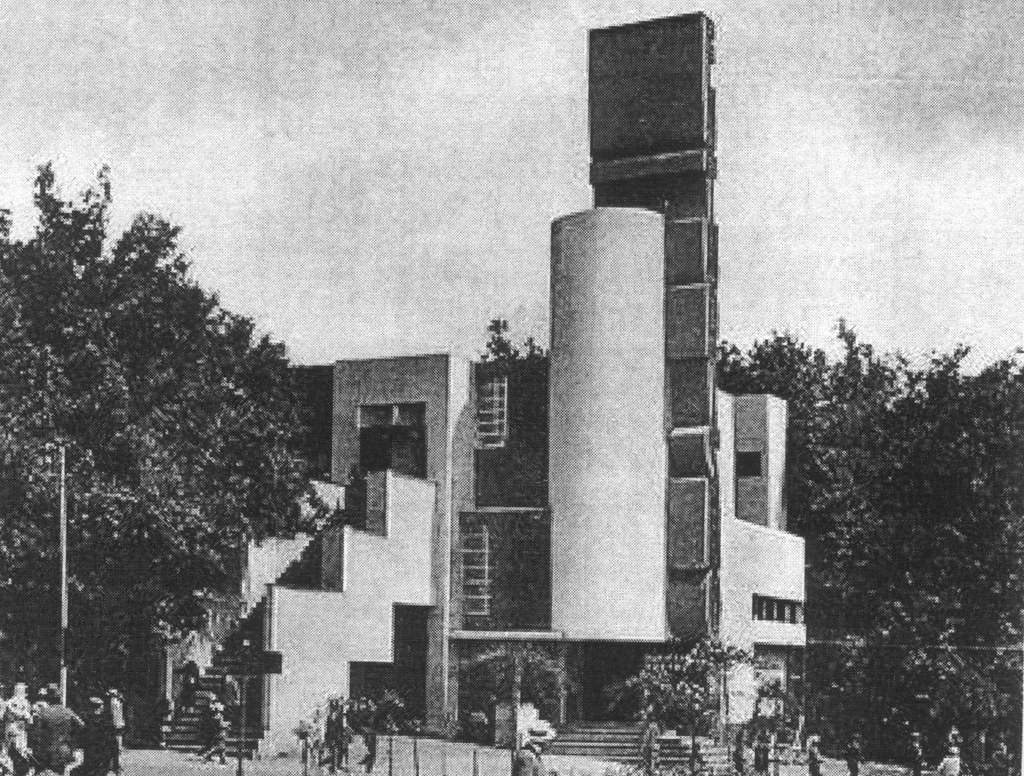
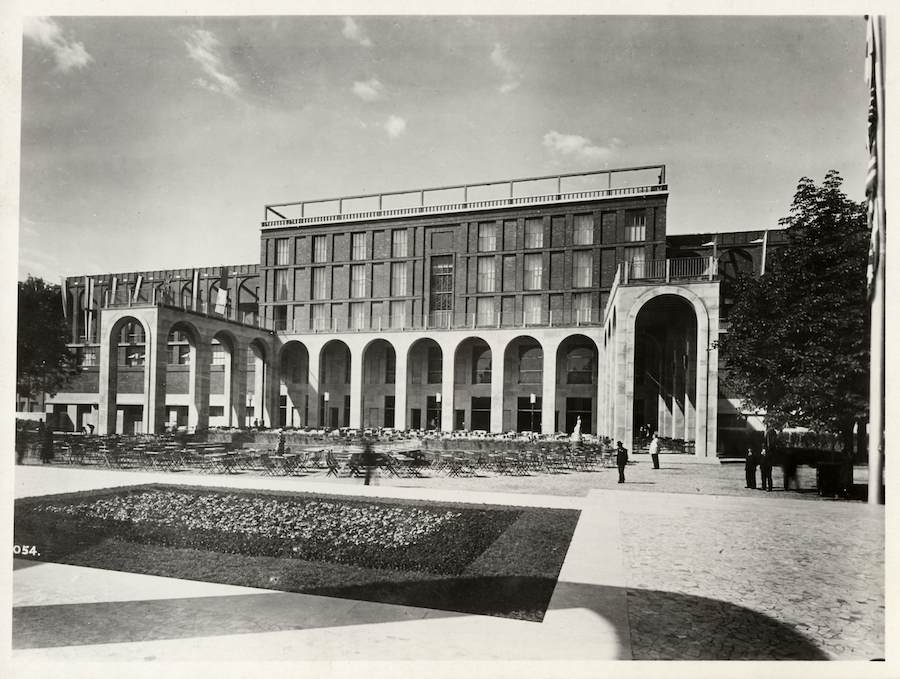
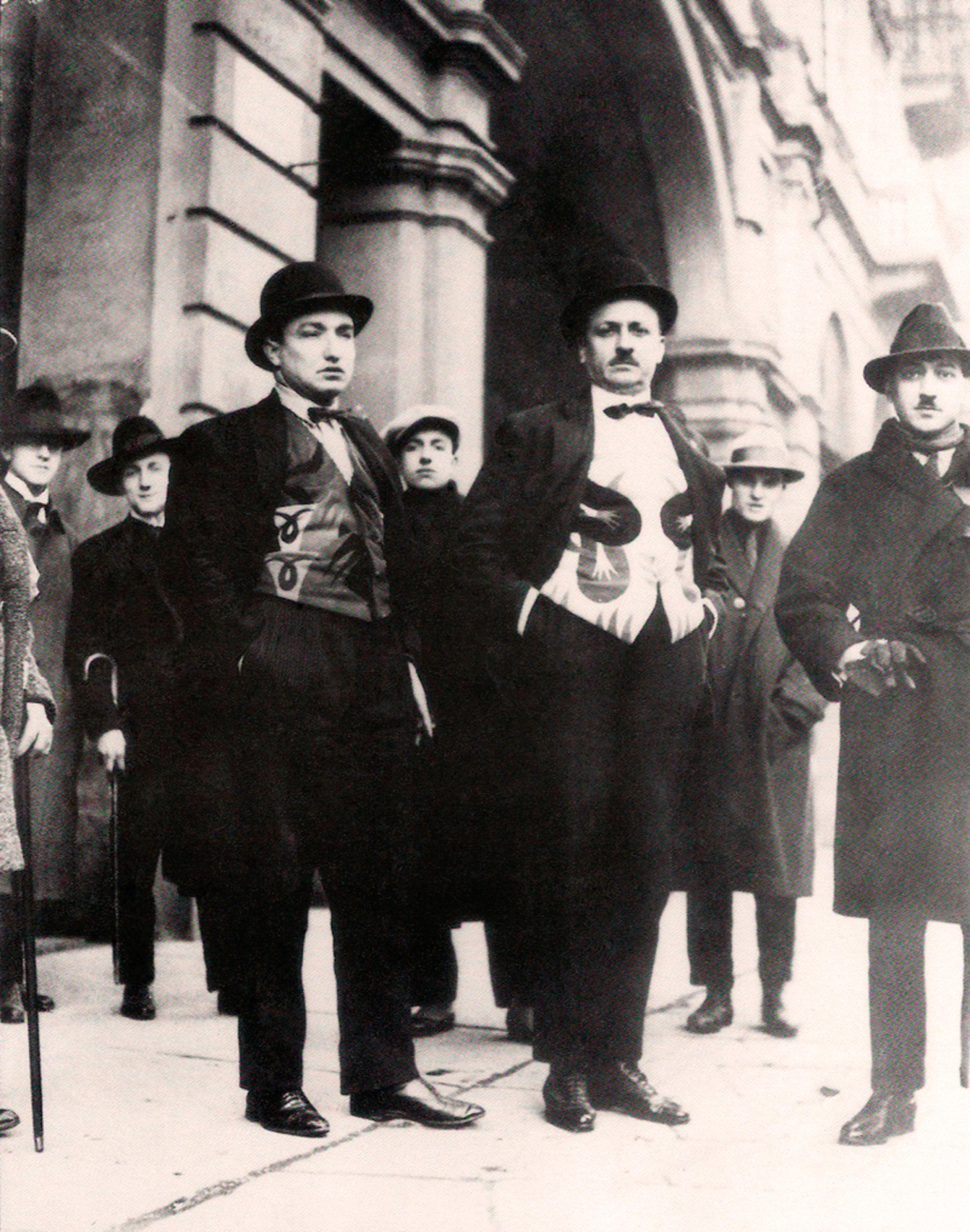
While its “heroic” phase (1909-1916) remains the most recognisable expression of futurism, the deaths of both Sant’Elia and Boccioni, along with the end of World War I, gave rise to a second phase. Second futurism (1918-1944) transformed the movement into something more decorative, genial, and theatrical, with artists such as Fortunato Depero and Enrico Prampolini extending futurist ideas more directly into cinematics, performance, and theatre. Depero created geometric, kinetic costumes and stage sets for I Balli Plastici (Plastic Dance, 1916-1918) 19, while Prampolini founded Teatro della Pantomima Futurista in Paris in the mid-1920s 20. Also designing its costumes and stage sets, Prampolini was fascinated by the possibility of a “cosmic” theatre in which performers could be replaced with coloured gases, mechanical movement, and explosive sounds. His later work for the Futurist Pavilion in Turin (1928) 21 and the Milan Triennial (1933) 22 reflected a synthesis between abstraction, architecture, and the avant garde.
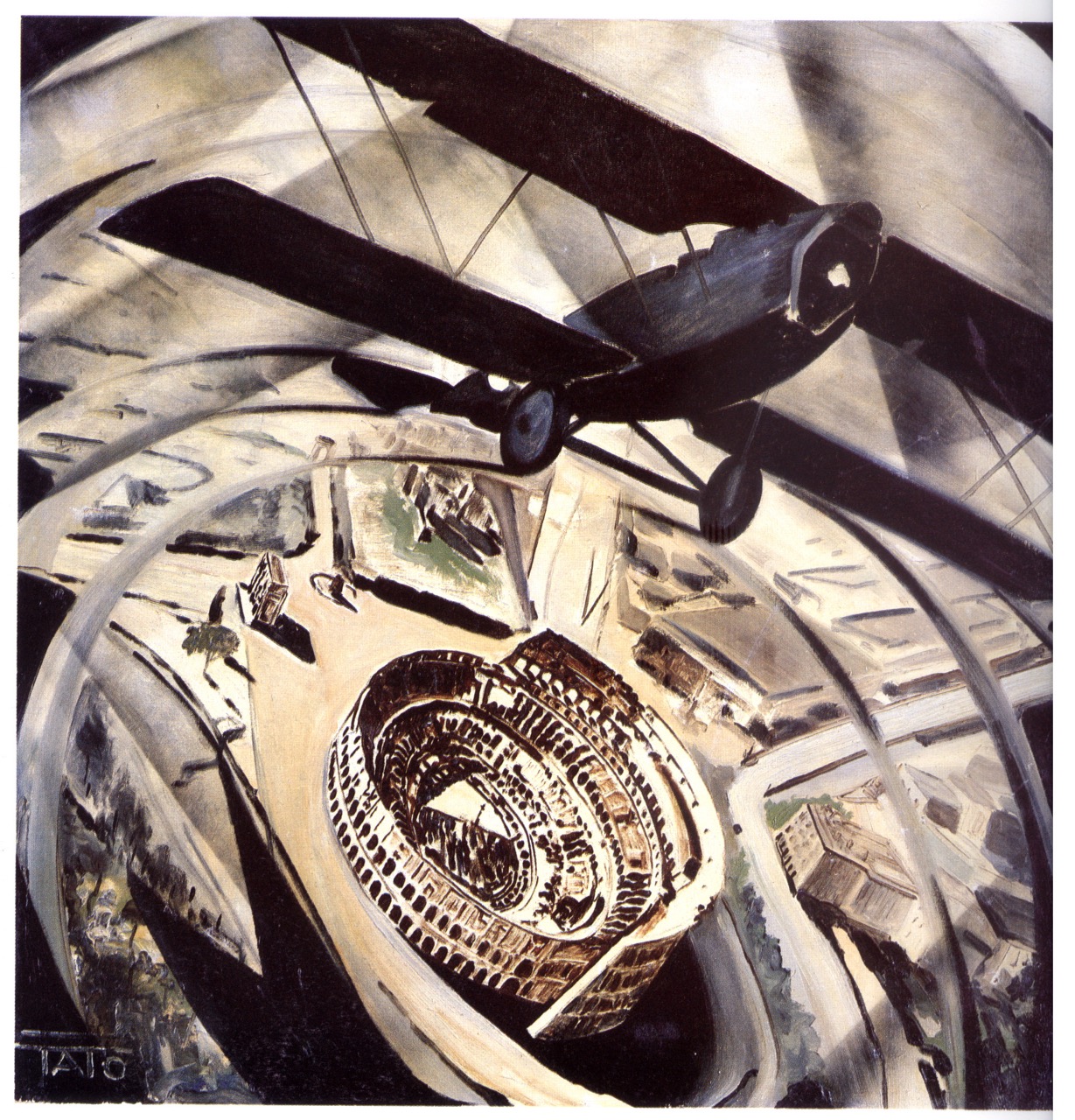
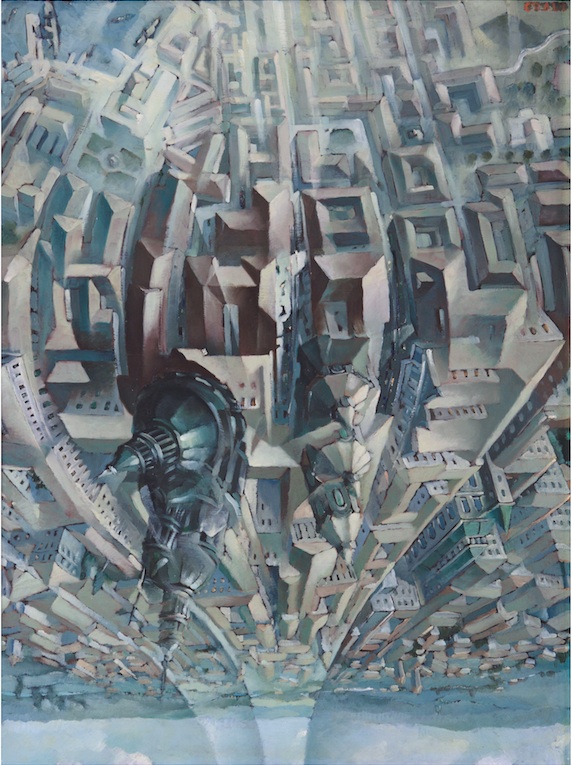
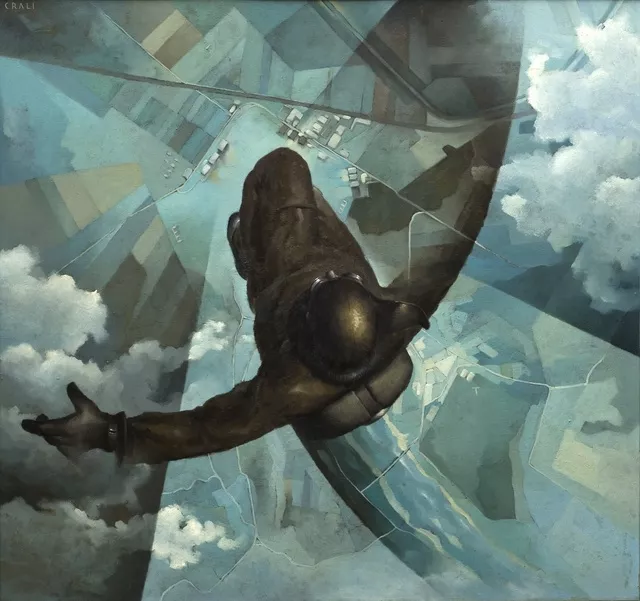
By the 1930s, futurists once again pivoted, turning their gaze skyward toward air travel and technological communication. Under the banner of Aeropittura (Aeropainting), artists such as Sansoni (known as Tato) and Tullio Crali produced works that celebrated the nationalist and technological significance of aviation. Sansoni’s Sorvolando in spirale il Colosseo [Spiralata] (Flying Over the Coliseum in a Spiral [Spiraling], 1930) 23 captured the exhilaration, rapture, and vertigo of flight, while Crali’s Granvolta rovesciata [Giro della morte] (Upside-Down Loop [Death Loop], 1938) 24 and Prima che si apra il paracadute (Before the Parachute Opens, 1939) 25 dramatised aerial warfare as World War II approached.
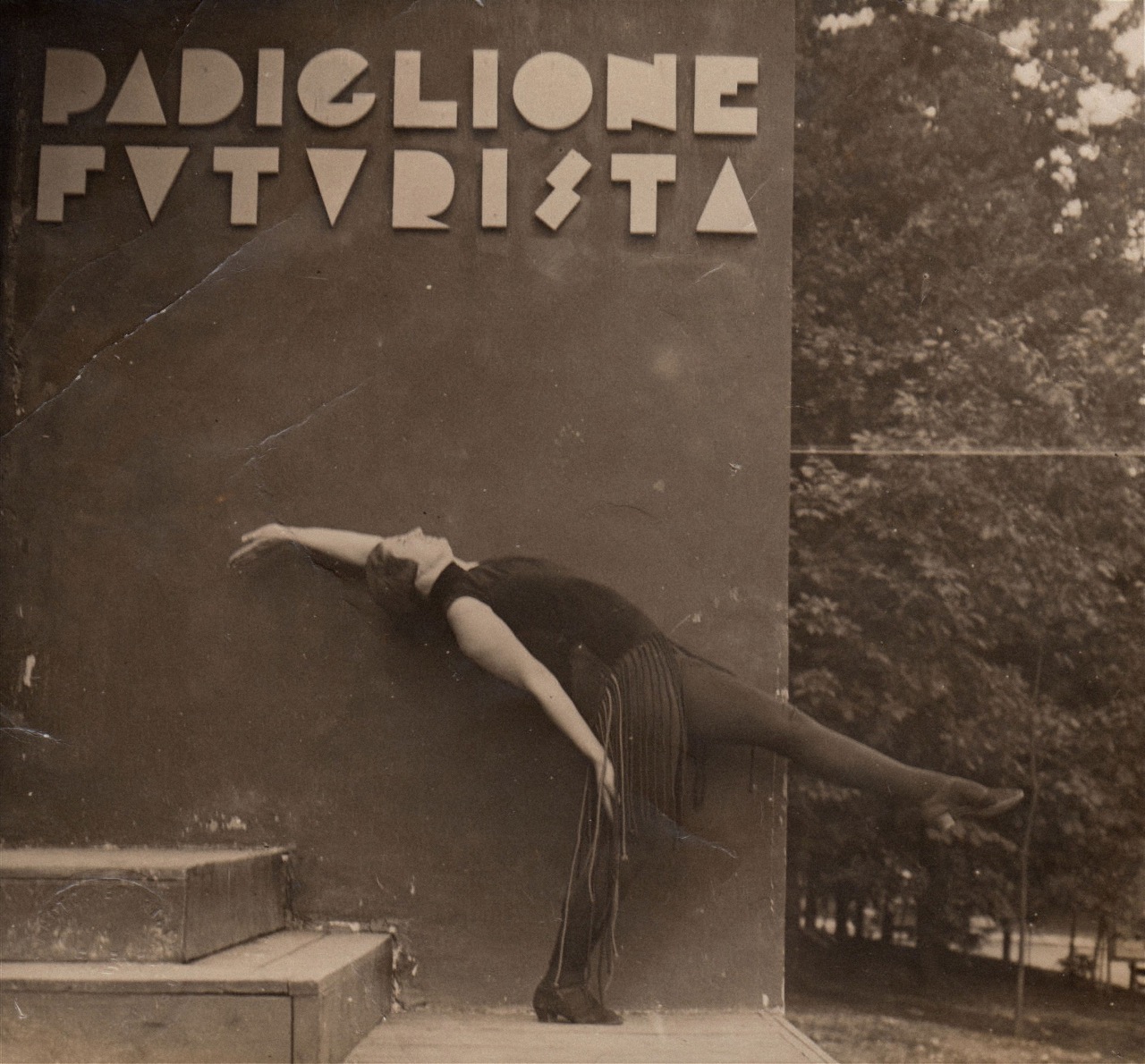
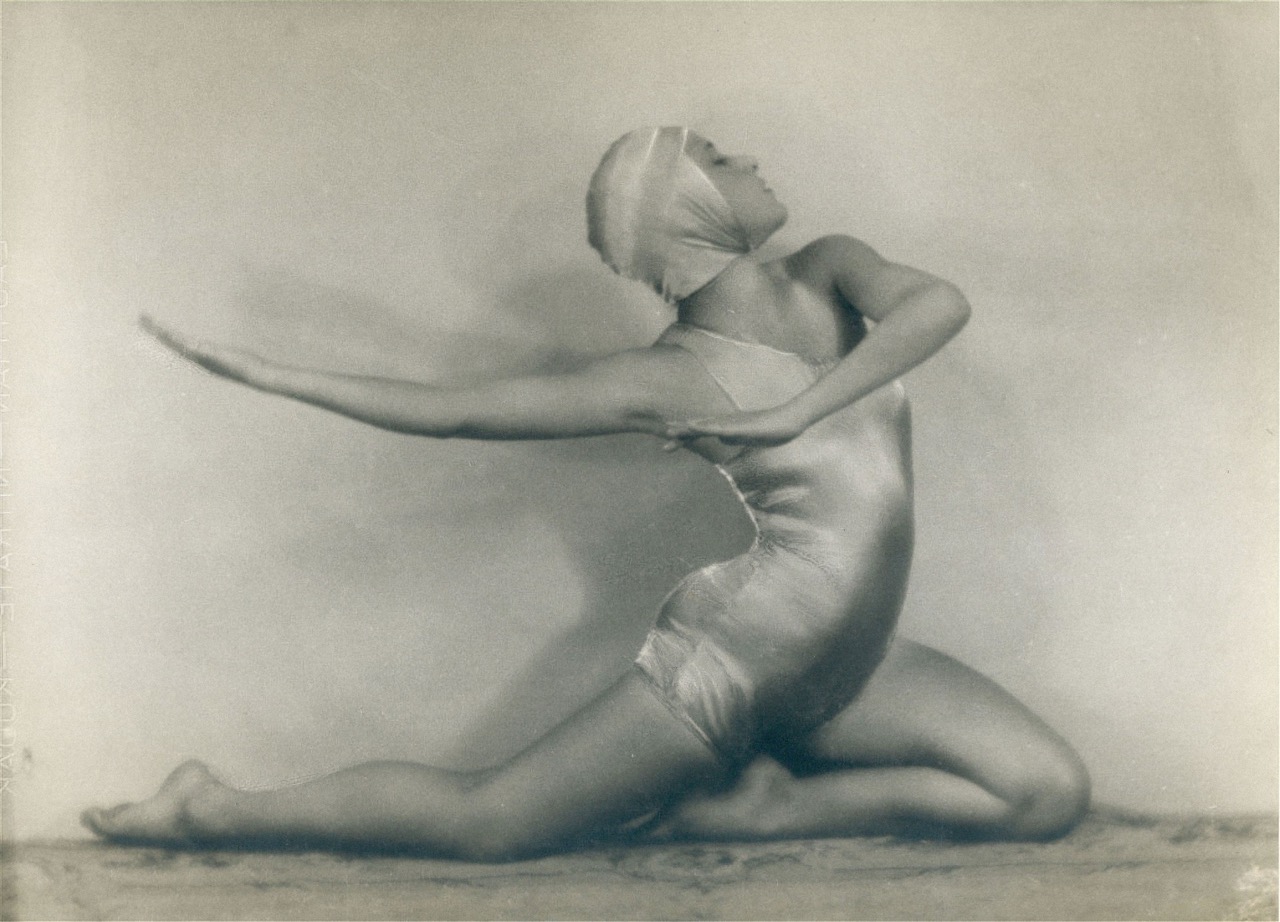
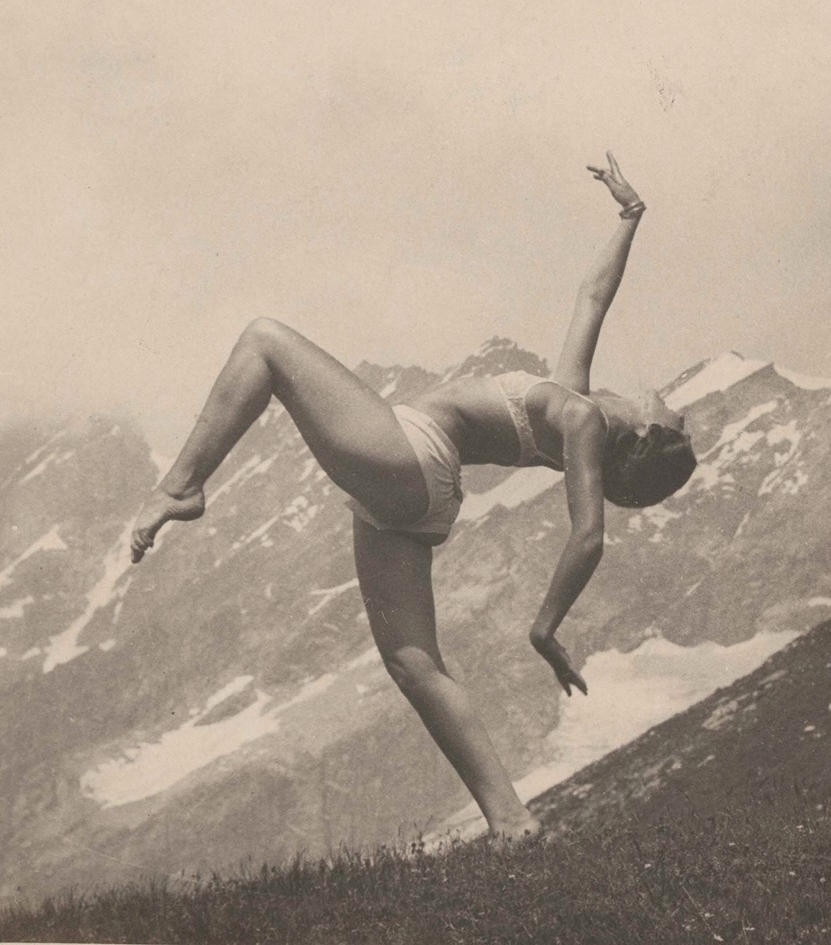
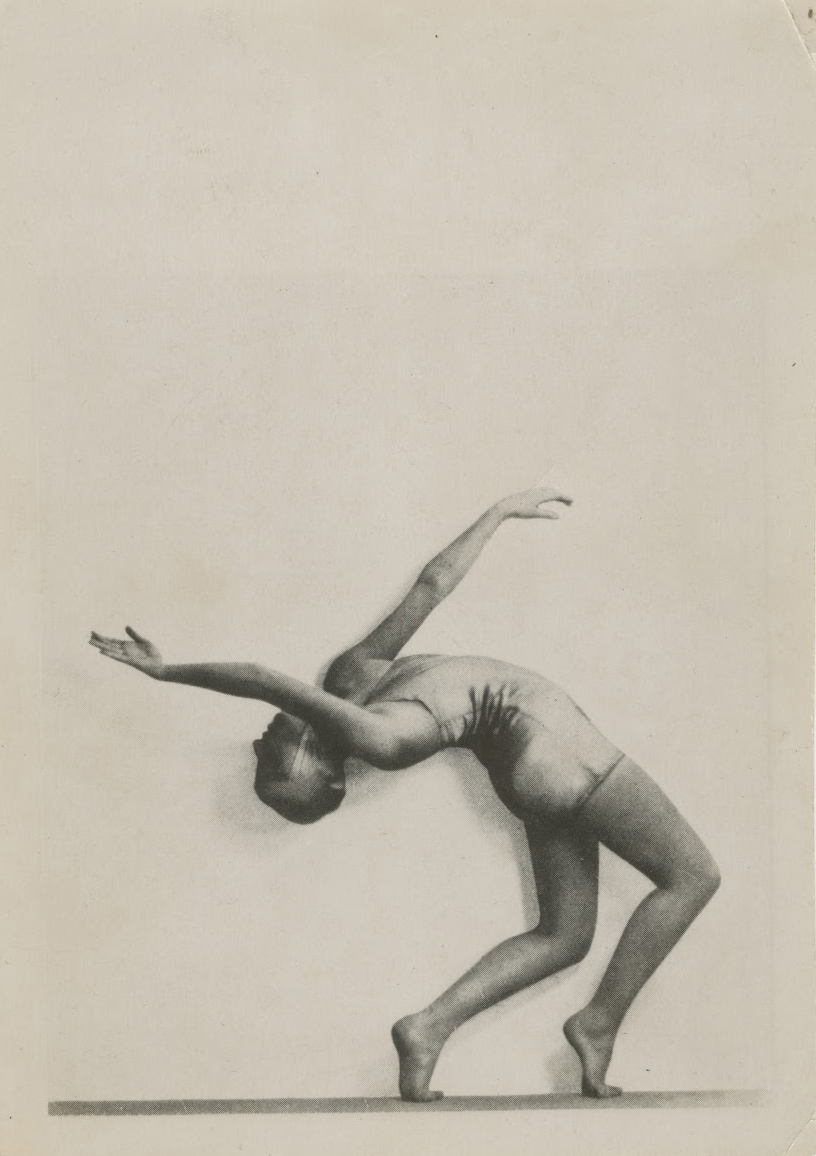
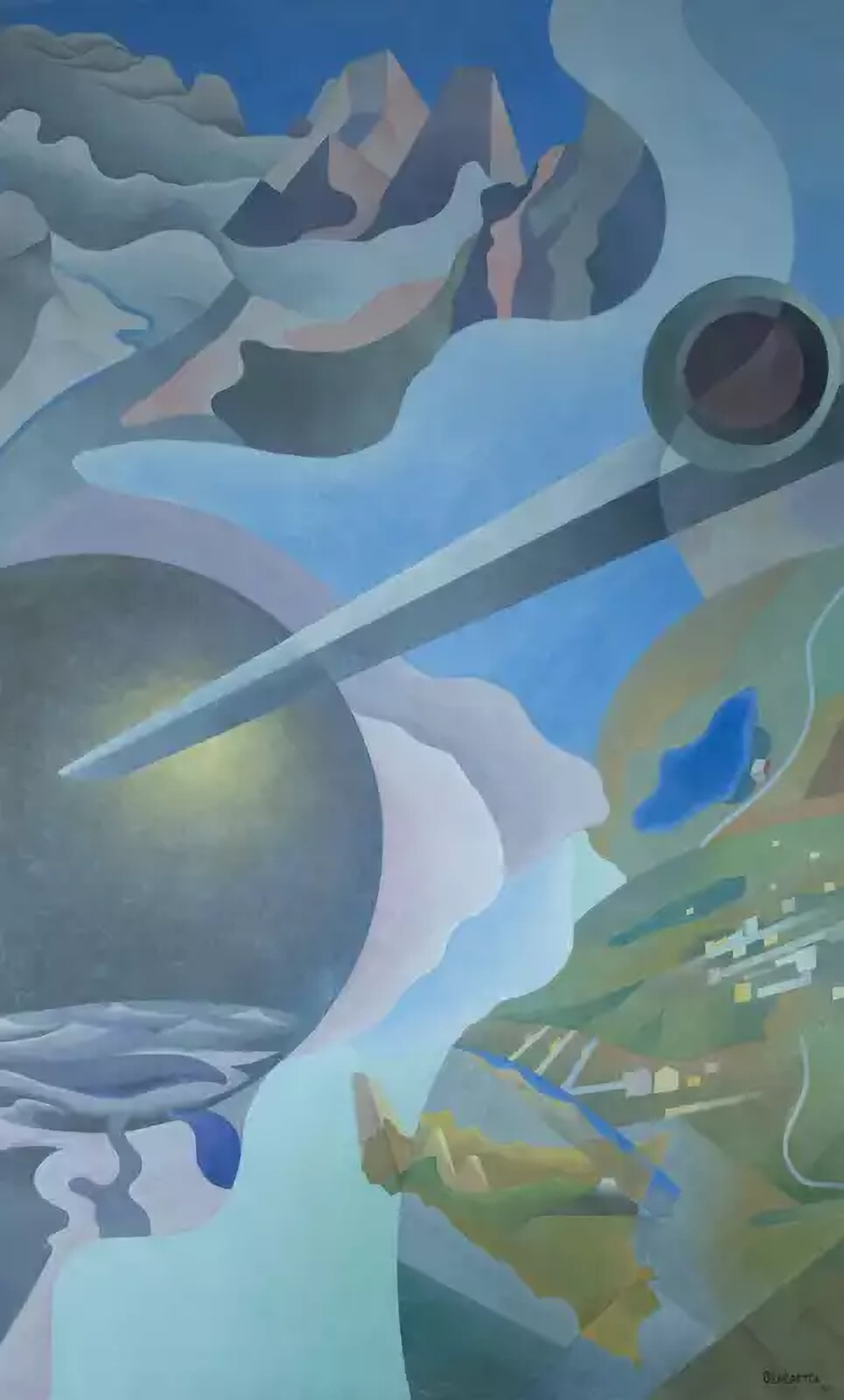
A movement long dominated by men, futurism had by this time begun to embrace the contributions of several women. Trained in classical ballet in Paris before joining Marinetti’s circle in Milan, dancer Giannina Censi invented a new style of dance that merged the sensation of flight with performance. For Simultanina (1931) 26, Marinetti’s futurist dance tour, at the Galleria Pesaro in Milan, Censi presented Aerodanze (Aerodance, 1931) 27, an experimental performance accompanied by the syllabic screams, trills, and whispers of Marinetti’s parole in libertà poems. Photographed by Giulio Bragaglia in Aerodanze 3 rovesciamento d’apparecchio (Aerodances 3: Device Overturning, 1931), her performances remain among futurism’s most striking aesthetic achievements. Likewise, painter Benedetta Cappa (Marinetti’s wife) offered a serene counterpoint to the movement’s more aggressive tendencies through her harmonious, luminous, and sensitive use of colour and form in works such as Sintesi delle comunicazioni aeree (Synthesis of Aerial Communications, 1933–34) 28, a mural celebrating aviation and aerial communications created for the Palazzo delle Poste in Palermo.
Effectively concluding with the death of Marinetti in 1944, along with the end of World War II, futurism subsequently fragmented into smaller, related movements across Europe. Over seven decades later, it was revisited in Italian Futurism, 1909–1944: Reconstructing the Universe (2015), a large-scale exhibition at the Solomon R Guggenheim Museum in New York that assembled 360 works by nearly 80 artists. Reviewed in the New York Times under the title In Thrall to Machines, War and a More Manly Future, the exhibition was praised for capturing the movement’s “obnoxious” and “noisily contradictory” complexity—from its fascist origins to the more sensitive contributions of female futurists.
When considering whether the Italian futurists’ vision has come to pass, one might argue that we are, in fact, living the consequences of the “more manly future” imagined during the movement’s dominant “heroic” phase: a world marked by conflict, violence, war, and the destruction of “museums, libraries, [and] academies of every kind.” Today, as 2,000-pound bombs are dropped on occupied lands, world leaders circulate speculative, AI-generated renderings of futuristic Riviera resorts intended for those same territories. These images are, perhaps, the contemporary equivalent of Italian futurism’s own paradox—an aesthetic of “progress” imagined, projected, and speculated upon the ruins of humanity.