
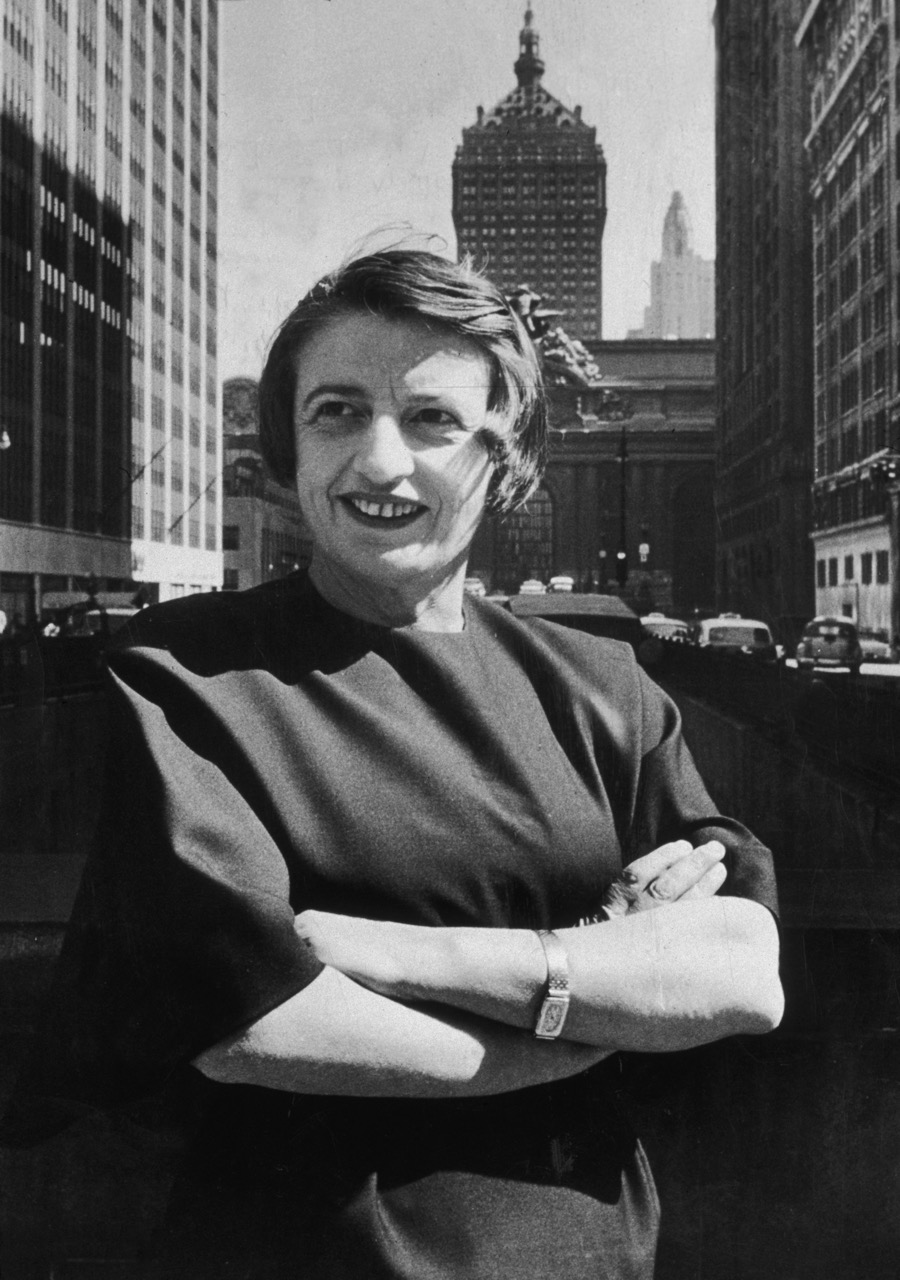
Ayn Rand fled the Soviet Union for the freedom of Hollywood, where she learned to worship the lone genius. Nearly a century later, Silicon Valley’s billionaires still call her their prophet.
Ayn Rand was born as Alisa Rosenbaum in Saint Petersburg in 1905 to a comfortable middle-class family. Then, when she was 12, the Bolshevik Revolution occurred and her father’s pharmacy was seized by the state. Losing your family business to unwashed Russian peasants is an undoubtedly traumatic event at any young age. But it became the single lens through which she would view the entire world for the rest of her life. Rand developed a bone-deep hatred towards collectivism, and the idea that the individual should serve the state.
Armed with this singular obsession, Alisa managed to get a visa to visit relatives in America in 1926 and never returned. She changed her name to Ayn Rand and headed straight for the one place that seemed to embody the individualist dream: Hollywood. After a chance meeting with the legendary director Cecil B DeMille, she got a job as a film extra and eventually a screenwriter at Universal Studios. To the young girl from Russia, the studio moguls and the larger-than-life movie stars were the living proof of her burgeoning worldview: that heroic figures can build empires out of sheer ambition.
By 1931, Rand was a permanent American citizen, having shacked up with the handsome, but mild-mannered, aspiring actor Frank O’ Connor (not, to be confused with the more successful actor by the same name, or the accomplished writer). In Hollywood, Rand moved from interesting plays (her courtroom drama Night of January 16th (1934) would take randomly selected audience members as jury members who could alter the play’s ending), to unmade anti-Soviet films, an autobiography, and then finally to philosophical writings.
This is where Rand’s concept of objectivism was born. Not in a dusty university, but in the California sun, surrounded by the fantasy-weavers of the film industry. Rand boiled down all of human existence into a simple, almost childish, binary. On one side, you have the creators—the brilliant, heroic, visionary individuals who move the world forward. On the other, you have everyone else—the moochers, the parasites, the great unwashed who, in her view, contribute nothing and subsist only from the greats.
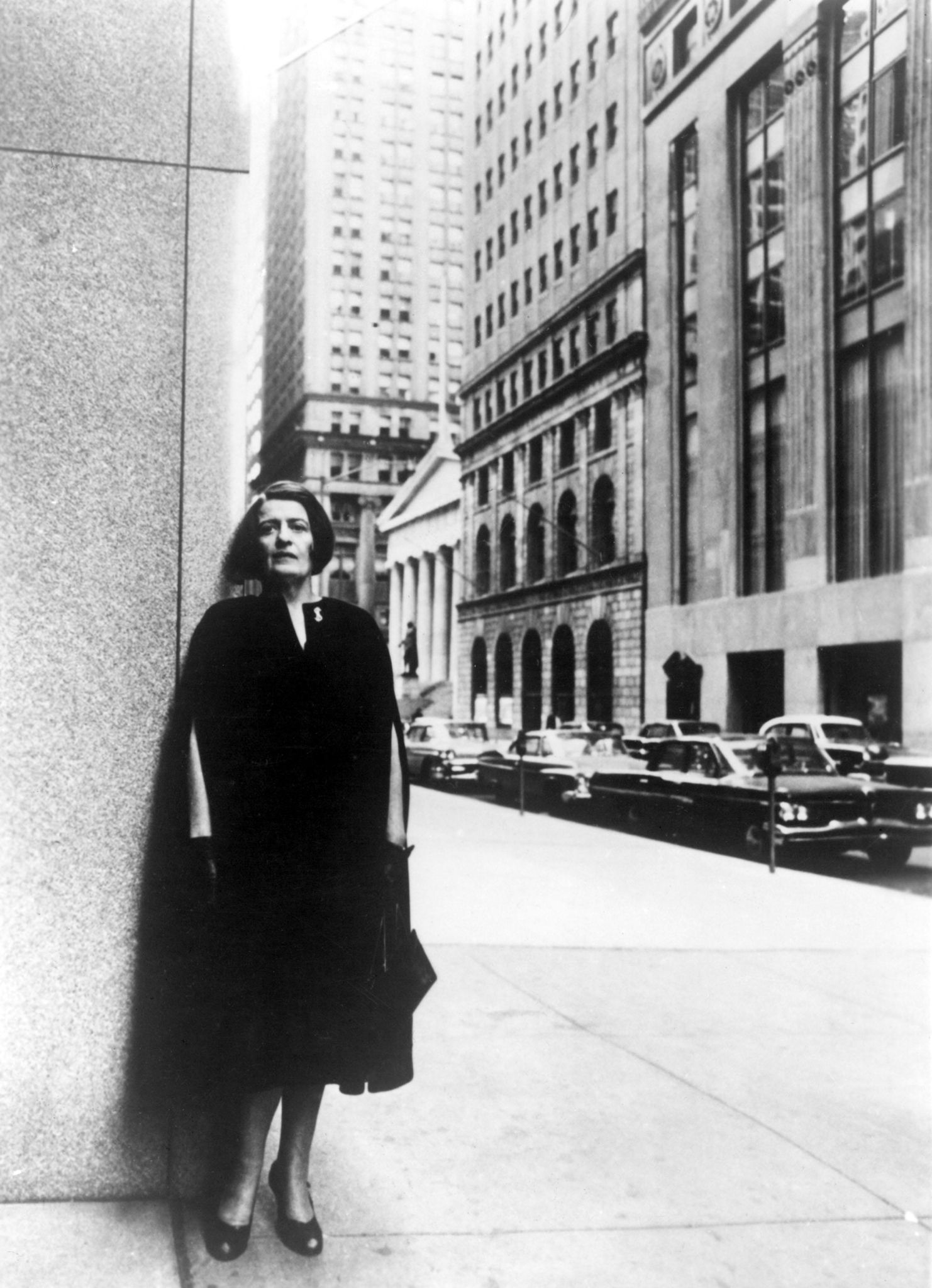
Ayn Rand in New York City, 1967,
Rand’s life’s work became a hymn to what she called “the virtue of selfishness”. Her two doorstop-sized novels, The Fountainhead (1943) and Atlas Shrugged (1957), released in the aftermath of WWII, are about heroic architects and industrialists who are constantly put upon by the whining, mediocre masses and their meddling governments. The ultimate fantasy in Atlas Shrugged is when all the brilliant people get fed up, go on strike, and retreat to a secret valley to build their own perfect, selfish paradise.
Reading Atlas Shrugged, in particular, is a good lesson in perseverance. It is long, tedious, and very unlikely to get the same murmured appreciation as when artsy folks peer into your bookcase and see Joyce’s Ulysses (1922). Today in California, tech billionaires are the ideal homeowners you’d find with a copy of Rand on display. They have read her books and see themselves as John Galt, the messianic hero of Atlas Shrugged. They genuinely believe they are solitary geniuses, the prime movers of our age, bestowing their brilliance upon grateful moochers. Men (it’s mostly men) who think they’re changing the world with an app that makes your food arrive slightly colder than if you’d gone to get it yourself. Stilted and critically panned, Rand’s status as an intellectual exists in a strange place: her novels are too allegorical to be critical masterpieces, but strangely too earnest to be right-wing gems. Critically, there is little pushback with Wolf of Wall Street (2013), or Hollywood’s innumerable Gordon Gekko’s, so long as they portray capitalism as a carnival ride built around the pursuit of money. The films, many of which are excellent, are, at some level, as fun as gambling.
Ayn Rand in New York City, 1967,
Yet despite Rand’s longstanding screenwriting history and fanbase, no film adaptation of her work has been commercially successful. The problem with Rand is she portrays the pursuit of money as something noble. Her characters, such as Atlas Shrugged’s rapacious Howard Roark, operate as cartoons designed to show that selfishness is inextricable, even righteous. She lands herself, with less poetic skill than Friedrich Nietzsche, F Scott Fitzgerald, or Max Stirner, in the tricky position of moralising nihilism.
It makes for dreadful TV.
And where did this adolescent daydream find her? As her novels attracted a cult following, Rand held regular meetings with like-minded philosophers at her home, engaging in an open objectivist affair with her disciple Nathan Blumenthal by calmly informing her husband that she was obeying her duty to find her superior match. Miraculously, both Rand and Blumenthal’s partners agreed to the idea (and maybe bought a few extra chairs), until Blumenthal, true to his teacher’s philosophy, began seeing a younger woman. Finally, in 1974, Rand’s anti-welfare politics also took a back seat. Faced with crippling medical bills, she accepted social security and Medicare grants to combat her failing lungs. True to her guns, Rand would spend a further eight years on the dole, before being laid to rest with a wreath of flowers arranged in the shape of America’s most popular celebrity: the dollar.
Continue Reading