

As Emerald Fennel’s highly anticipated adaptation of Emily Brontë’s classic novel hits cinemas, we consider the wonderful rise of period-agnostic costume design.
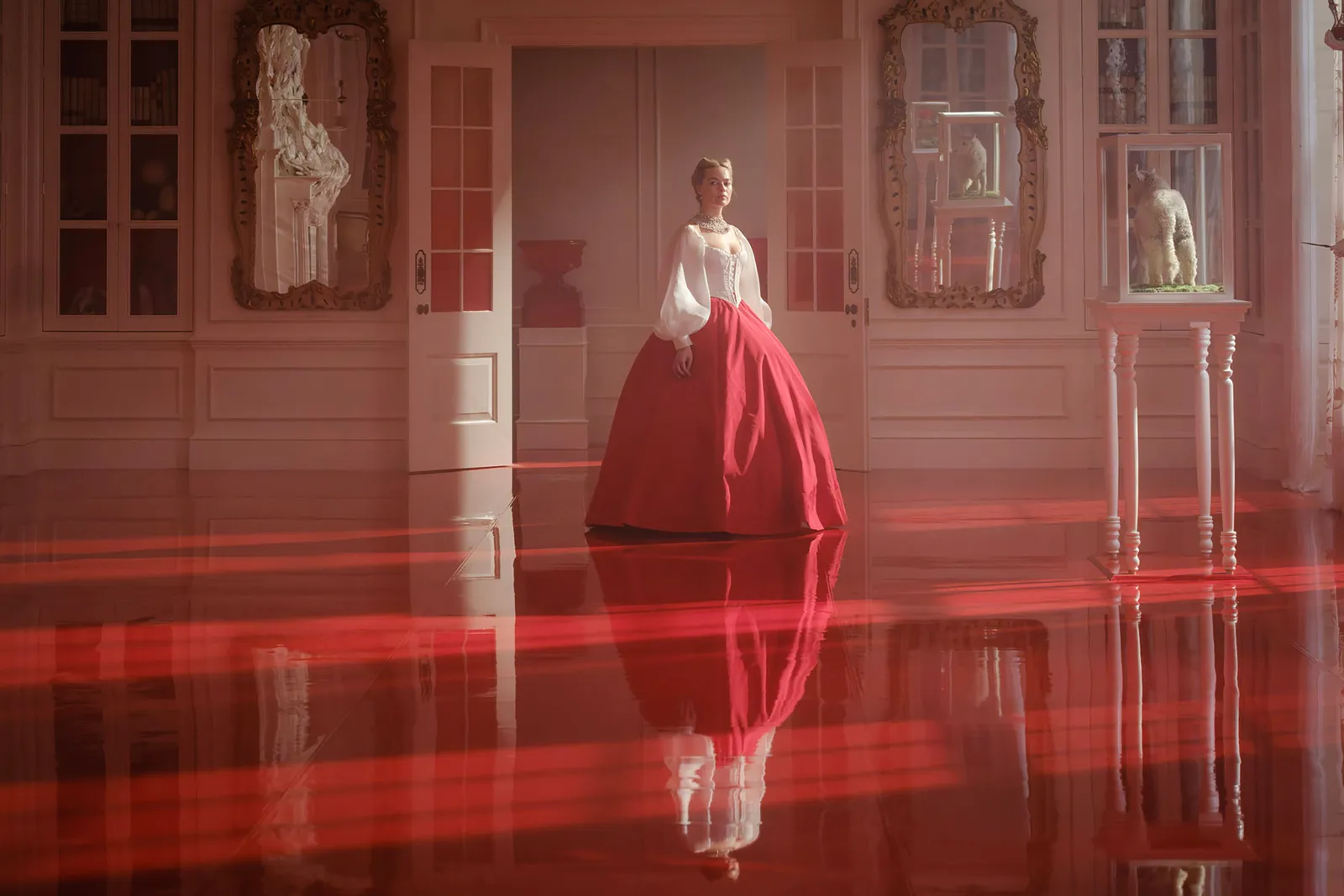
Recently, a movie still provoked the internet: the golden head of Margot Robbie emerging from a shadowy room, her body sashed and cinched in a pink-hued, plastic gown. No, not a reprise of the actress’ 2023 role as Barbie—as the cellophane texture and sweetheart neckline would suggest—but as Emily Brontë’s 1800s gothic protagonist, Cathy Earnshaw. In irreverent contradiction of the period drama genre, Wuthering Heights’ Oscar-winning costume designer Jacqueline Durran told Vogue of her beautifully confected frocks: “We’re not representing a moment in time at all.”
Anachronism, as Durran illustrates, is one of the most fascinating tools at the disposal of contemporary costume departments. Be it as slight as a mere colour difference or as audacious as Kristen Dunst kicking around Versailles in Converse in Sofia Coppola’s Marie Antoinette (2006), its execution is a delicate weight in the period drama’s balancing act between historical immersion with contemporary relatability.
To this, fashion historian and costume assistant Chloe de Uphaugh adds a slightly more salacious focus. From as far back as classic Hollywood, her research finds one body part in particular that is persistently misrepresented and misshapen, more exposed to competing interests and ideologies as opposed to historical accuracy: breasts. “The bustline functions as a site of negotiation between historical reference, star image, and commercial imperatives, producing a carefully calibrated spectacle of femininity,” de Uphaugh says. That is, women’s bustlines in period film tend to speak more to their current contexts over historical ones.
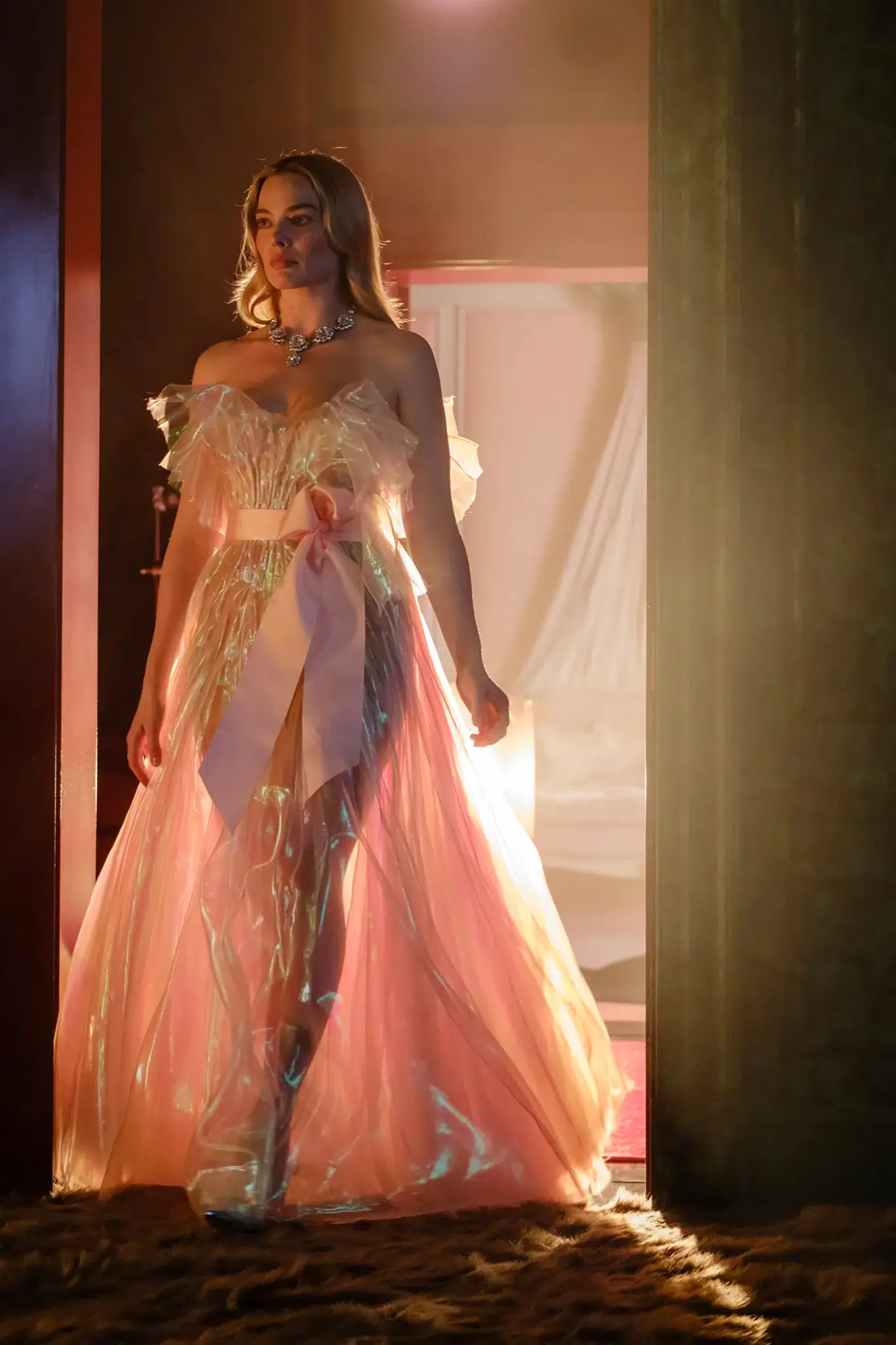
Margot Robbie in Wuthering Heights (2026). Directed by Emerald Fennell.
In their book Uplift: The Bra in America, Jane Farrell-Beck and Colleen Gau detail the belle poitrine’s evolving shape from a boyish camisole in the 1920s, conical emphasis in the 1930s, to the aggressive torpedo silhouette in full swing by the 1940s. Many of these developments owe themselves to technological developments, including the introduction of artificial fibres like latex and rayon around 1930, the whirlpool stitch in the 1950s and seam-free cup technology in 1970. “So much of fashion history is about changing trends, and I think it’s so funny that there are trends in breast shape too,” says de Uphaugh. “You even see it today: the bra-less look compared to the push-up of ten years ago.”
When it comes to Hollywood, the ‘fashionable breast’ for much of its Golden Age onwards takes after these technological developments: boobs that were uplifted, pointed and deliberately separated, a symbol of femininity and erotic desirability. “People will not come to see a picture in which Biblical characters walk around looking and acting like Biblical characters,” director Cecile B. DeMille gauffed when stressing the importance of Hedy Lamarr’s “voluptuousness” in his 1949 Biblical epic Samson and Delilah. “A big part of portraying a female character, especially if they’re the love interest, is portraying them as attractive,” de Uphaugh says. “How you costume the breasts is a big part of that.”
But in tension with the pull towards erotic marketability, costume decisions for much of Hollywood’s Golden Age were intruded on by the Hays Code, a set of strict, religiously motivated production rules. In place from the thirties until the sixties, they prohibited any “licentious or suggestive nudity” on screen, mandating complete coverage of the breasts and belly button. This came much to the annoyance of Samson and Delilah’s costume designer Edith Head, whose vision for the period featured more cleavage, and was made to engage in the still-relevant dance of ‘show enough to pull in numbers but not so much to be judged immoral’. (Of course in all this, there was no issue with Victor Mature’s nipple-bearing, loincloth-wearing Samson.)
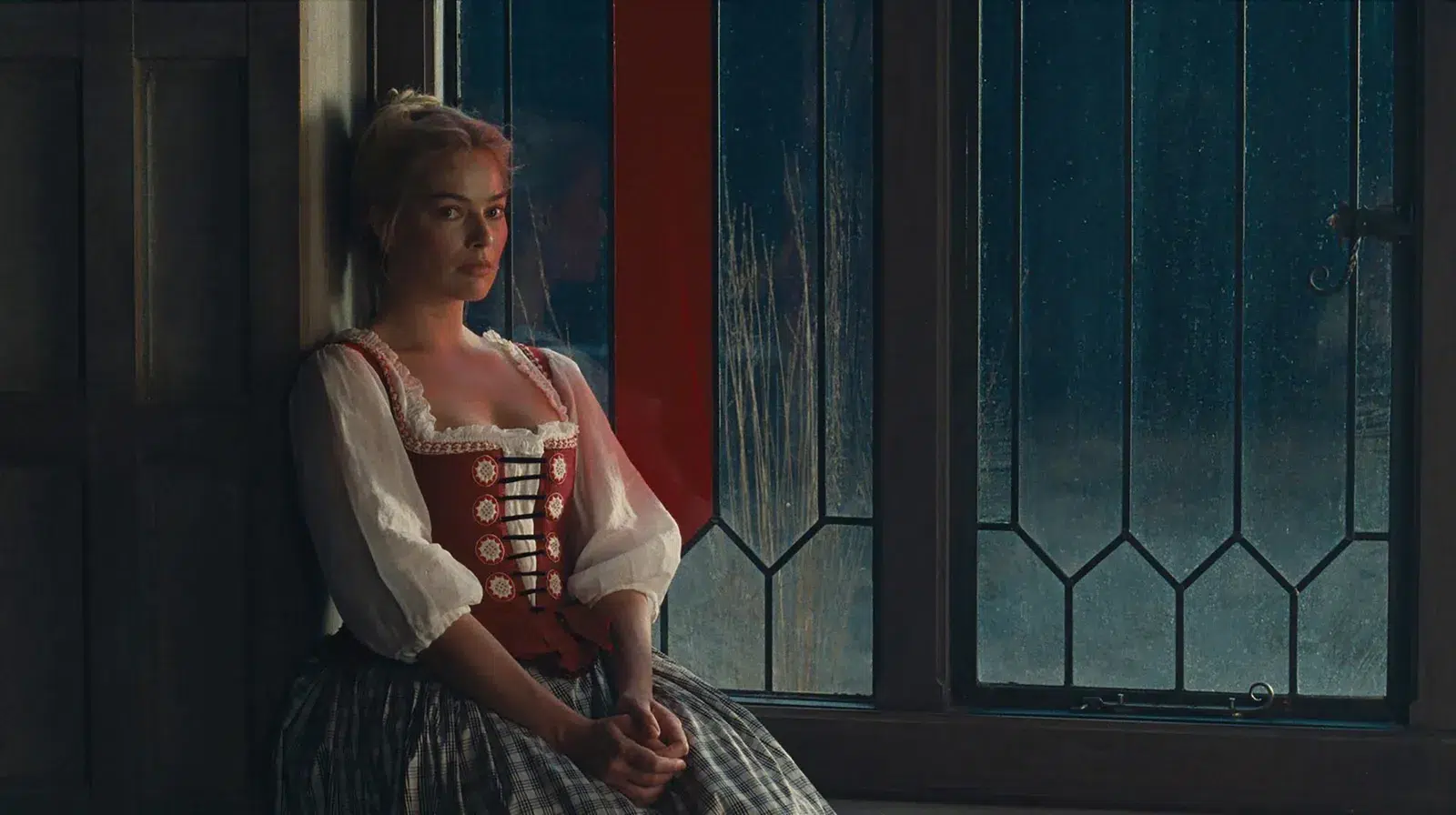
Margot Robbie in Wuthering Heights (2026). Directed by Emerald Fennell.
Though the code is long gone, it continues to impact our collective memory of period dress through the influence of Old Hollywood – a period which was in fact a major inspiration for Duran’s Cathy. Amongst a wealth of other temporalities, Durran draws from the fifties in particular when designing the looks for Cathy’s wedding dress, wedding night dress, and red cape. “Famously, at the end of the 18th century, boobs were very much out on show. There’s evidence of women wearing tops so low-cut that their nipples are showing. They’d also rouge their nipples,” de Uphaugh says of the time period the Wuthering Heights narrative takes place. “But of course if they’re showing that era in the 1950s, they wouldn’t do that.”
Though today’s context likely isn’t up for nipple-rouging just yet, modern anachronism like Durran’s feels like it comes with a new, creatively driven irreverence that sets our own imaginations wild. Robbie’s collection of rounded shoulders and dirndl corsets has sparked a plethora of internet theories about the thought behind Emerald Fennel’s unconventional adaptation. “I’m partial to the theory that it’s a reimagining of the plot from the POV of a teenager reading the novel,” one Redditor comments, echoing Robbie, who says Fennel’s impression of the text started upon first reading it 14. “She didn’t know what was ‘period correct’ [back then]. You’re imagining a version of that time,” the actress tells the Vogue podcast.
“This is a stylised version of Wuthering Heights,” affirms Durran. “It’s not necessarily realistic or unrealistic.” Instead, Cathy’s 50 or so costumes–that combine chiffon with plasticised fabrics, Gothic crosses and Russian hats–tell us more about the character herself. The blush-toned sweetheart neckline worn on her wedding night, inspired by pin-up girls and Mugler S/S 96, is more than just something for modern audiences to find attractive. It’s feminine and romantic, and “about Cathy being a gift on her wedding night. Making herself a gift,” in words of Durran.
Likewise, the low and rounded bustline of Cathy’s lustrous midnight gown melds Victorian silhouette with modern fabric – “something that takes you out of the period,” says Durran. “This dress was particularly designed to be worn in the moonlight … the way it bounces the light back … feels like [Robbie’s] exuding that moonlight too.” The film’s merging of fantasy and reality is even continued in Robbie’s historically inspired press tour looks: vintage Galliano boning, corsets from femme fatale Dilara Findikoglu, and a custom Schiaparelli gown, whose pointed bust takes us back to the Maidenform days.
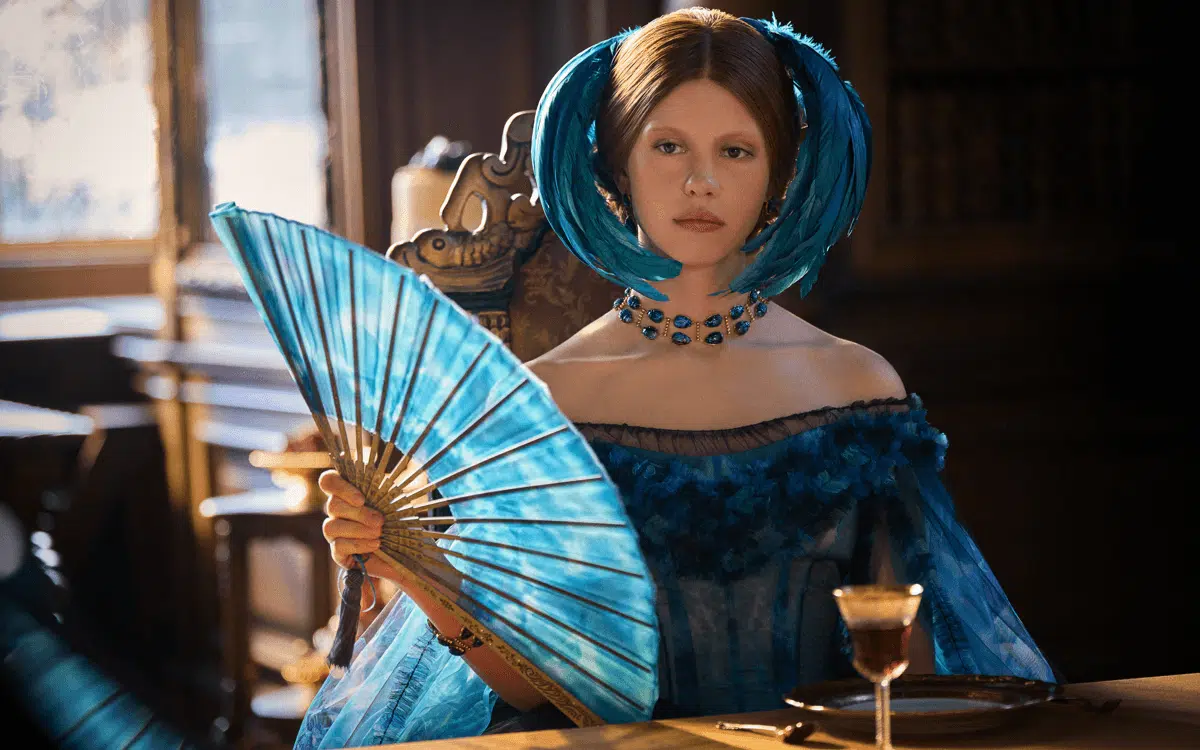
Mia Goth in Guillermo Del Toro’s Frankenstein (2025)
Like Durran, purposeful anachronism is also in the work of Oscar-nominated Kate Hawley, who costumes Guillermo del Toro’s Crimean War-era Frankenstein (2025). For Elizabeth (played by Mia Goth), Hawley melds 1800s off-shoulder bustlines, cinched waists and puffed sleeves with symbolism-laden colours and patterns. “Her colours reflect each of the other characters,” Hawley tells Vogue. “[To Victor], she’s an angel and mother, she’s Madonna. And then, as we approach the end of the film, she reflects more on the creature,” she says.
In Goth’s bridal look, Swiss-German regional dress is inverted so that the ribbon bodice appears like a ribcage atop layers of organza. “We built the dress like we built the creature–from the inside out … Elizabeth is reflecting the creature,” says Hawley. Goth’s high neckline, tight bust and ribbons that extend down her arms like bandages evoke bandages or a burial—“a lovely homage to Frankenstein (1931) and The Bride of Frankenstein (1935).”
Ultimately, both Hawley and Durran problematise the ‘period’ label. Durran describes Wuthering Heights as “not really period costumes” but “an imagined version of period costume,” whilst Hawley quotes del Toro as saying he didn’t want “fusty old period” for his film.

“The relationship between capitalism, eroticism and modesty is changing. It’s more about showing creative flair, making something visually interesting.”
Chloe de Uphaugh
It’s easy to assume historical accuracy is paramount for period dramas, but a deeper look suggests an alternative that’s not only more interesting, but something Hollywood has a long history of. When zooming in on the bra as a particular point of cultural messaging, the conflicting push-pull of sex appeal and codified morality have obstructed historical accuracy. And whilst that’s not to say modern beauty standards don’t continue to have their influence, the fantastical costumes of Robbie and Goth suggest that this tradition is being artistically repurposed.
“The relationship between capitalism, eroticism and modesty is changing,” de Uphaugh says. “It’s more about showing creative flair, making something visually interesting.” It might be too early to declare that Hollywood has completely detached from its roots as an ocular and patriarchal business just yet, but today’s unconventional period costuming indicates an expanded creative playground – one that’s more concerned with female character-building over objectification.