“You cook sublime and big!”: on Federico Fellini’s ‘Satyricon’ (1969)




Introducing ‘Dinner Features’… In the run-up to his first book, To Entertain: Instructions for a Dinner Party, Jago Rackham writes about his favourite movie dinners. First up, he responds to Trimalchio’s dinner in Federico Fellini’s Satyricon (1969)
Federico Fellini’s 1969 film Satyricon takes name and inspiration from Petronius’ 1st century satire of Ancient Rome under Nero. The text survived in fragments, and Fellini became obsessed with what was missing and filling in the gaps. In an interview Fellini said he hoped the film would “eliminate the borderline between dream and imagination.” Something achieved through dubbing which mismatches the actor’s mouths and words and obscene costume and scenery that laughs in the face of historical accuracy. For Fellini deals in gut feeling and alienation, not impossible re-enactment, a carnival of greed and cruelty mirroring our time as much as his.
Satyricon’s plot is episodic, with the not-quite linearity of dream. First, the protagonist, a young layabout called Encolpius, despairs at the loss of his young lover (and perhaps slave) Giton to his roommate Ascyltus. This feud provides a background for incoherent adventures: the roommates are kidnapped and taken to the sex-island of a perverted Emperor. The Emperor is murdered by usurpers, who kidnap the boys in turn. Freed, they fall in with a mercenary and kidnap a mystical haemaphrodite, who dies in the desert. Encolpius fights a minotaur, is sexually humiliated by a sorceress and escapes to North Africa. Like Petronius’s text, the film finishes mid-sentence, the final shot of scenes from the film on crumbling frescoes: everything might be figment.
But first of all there is dinner.
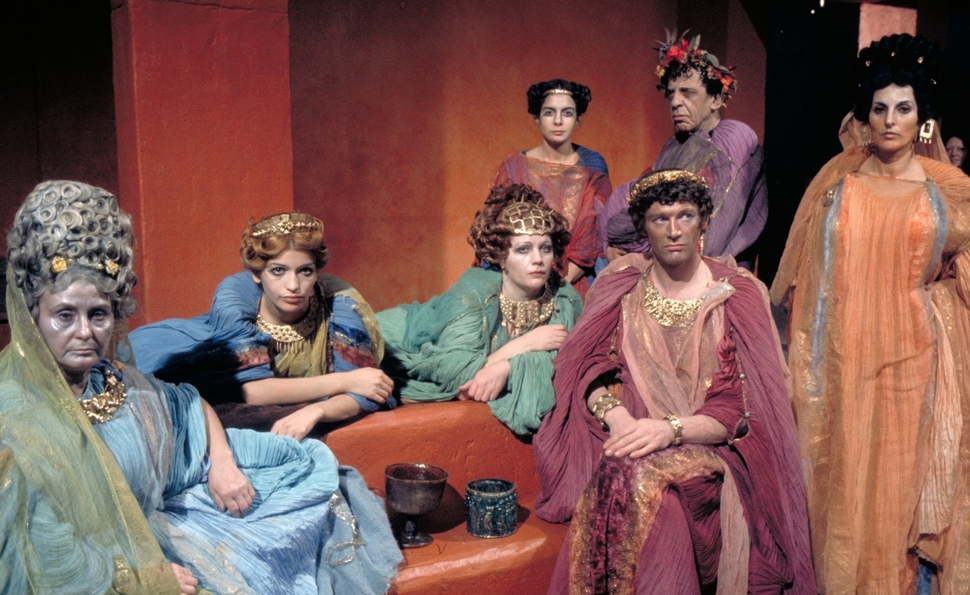
The dinner: over 15 minutes, at the villa of Trimalchio, an immensely rich freeman
Federico Fellini’s Satyricon (1969)
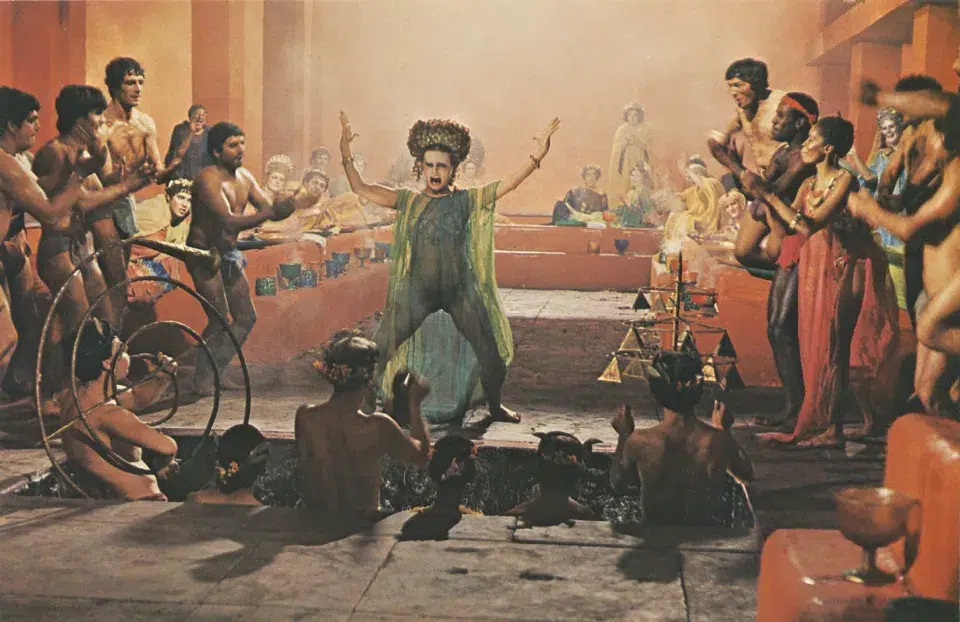
Hundreds of candles and dozens of white-robed attendants jumping and singing surround a platform upon which guests are washed and massaged in preparation for dinner. It is fitting that animals are thus abluted before sacrifice. The music soars to a sort-of ancient-jazz, and we glimpse the band: aliens, led by a midget in ceremonial garb artlessly clashing castanets. Before we’ve even arrived, it’s all a bit much.
A cavernous room. In the centre diners lie frontward, arms resting on a balustrade, facing one another. All is movement and noise, yelling and the clashing of metal, the music vicious. In the foreground slaves, unclothed save for loincloths, their bodies slick with sweat, labour, dragging pigs to slaughter, their screams human. Yet the diners’ faces, sinisterly painted with childish exuberance, bear expressions of boredom: experience simply washes over them. As with the darkest parts of our culture – pornography, gore, violence – the vulgarity to come is not so much for shock or impress, but to conjure any feeling.
Encolpius has been brought by an elderly poet called Eumolpus, perhaps to distract him from heartache. Ironic, for the previous scene sees Eumolpus railing against money, the enemy of culture. While his clothes are ragged and dirty, a proud statement, he accepts the ultra-wealthy Trimalchio’s hospitality. And so he smiles when Trimalchio declares: “Between us poets, there is real love.”
But who hasn’t put aside ideals for a free lunch? For even a poet must eat, especially a poet. But this lunch! The food itself is so hard to grasp I stopped noting the dishes after the third: “1 – Crowned wild bore?? 2 – Large dishes of… meat, eyeballs? Pastry? 3) Abstract lump with crown.” Their colours are dim greys and reds, and only the crowns shine.
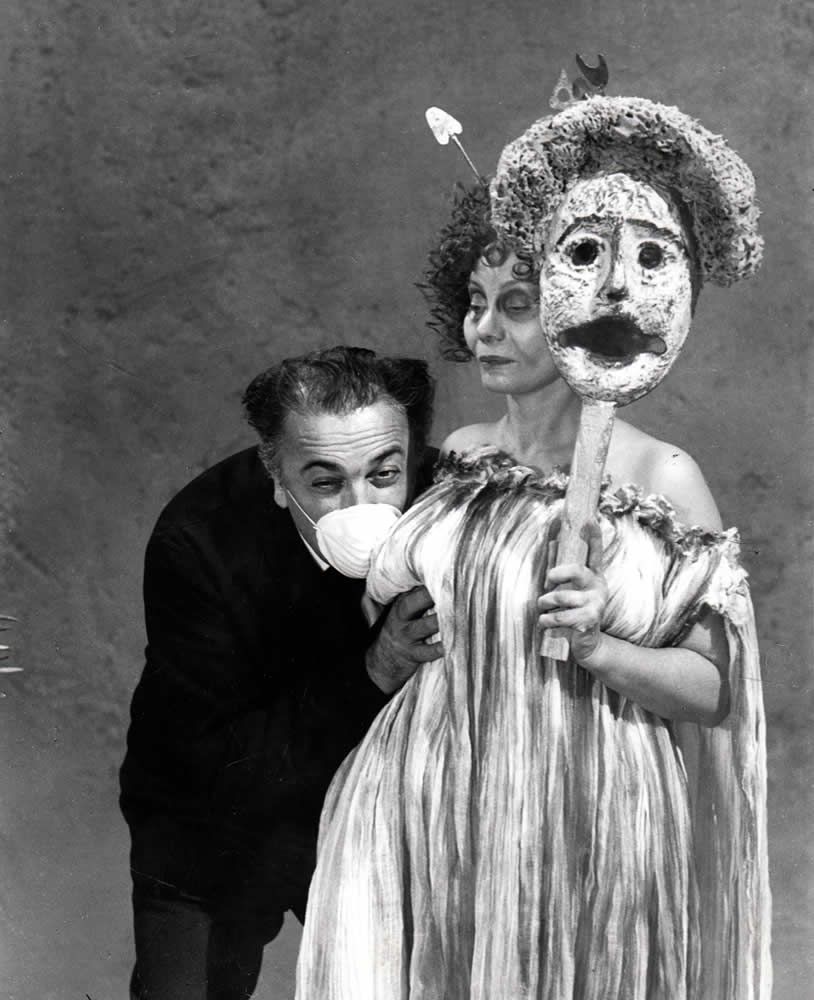
Federico Fellini on the set of his film Satyricon (1969)
Unappetizing is understatement: they are repulsive, not really food at all. There’s an echo with the present: not since the 18th century has food as spectacle been so current. Artists like Imogen Kwok and Laila Gohar — and, I suppose, me — are pushing the boundaries of what food can be, of its place in performance and celebration. And while modern food fashion leans further toward beauty, and does not disgust, I wonder if the implications are similar: food used to convey wealth and power, not to be eaten.
After commanding a slave to “cook sublime and big!” Trimalchio is helped to his feet, announcing, “I’m going to be sick.” Announced as if a small matter, as if he’s off for a piss, his appetite divorced from hunger. He returns, empty, ready for the sublime, which is porcine.
The gigantic pig enters belly up, held by some instrument of sado-masochism, all iron bands and clamps. It does not look cooked, rather sewn together – a Frankenstein’s monster. Trimalchio’s impulse is to have his slaves flogged. A great sword slices through the pig’s belly, and they are saved when as the food pours out, accompanied by the chef’s roll-call: “thrushes, stuffed hens, eggs, livers of birds, rope on rope of sausage, tender plucked pigeons, snails, liver wrapped in fat, ham and lungs”. Holding aloft a plate of the steaming, faecal mass, the chef finishes by declaring: “Oh Trimalchio, your name will live!”
But why is food used to convey power? From Ancient Rome to modernity the ability to waste food signalled wealth because food was incredibly expensive, and the majority of humans lived with a real knowledge of hunger. In the modern West very few (though the numbers are growing) are actually hungry, but we’re still told not to play with our food, for food is in some deep way sacred. Perhaps the power of food spectacle lies in culinary iconoclasm, an apt way to describe Trimalchio’s stuffed pig.
Federico Fellini’s Satyricon (1969)
Like the best long lunches, Trimalchio’s ends with a post-prandial stroll, through an apocalyptic landscape, to the gigantic monument he is building for himself.
White clad actors then recite Homer, moving in a not-quite dance while Eumolpus mouths along, escaping the dinner’s vulgarities. The applause is polite, but turns to cheers and banging when a whole cow — again, crowned – is brought in by four muscular men. Behind a large round dish bears pig snouts, pointing upward, sniffing the ceiling. Ancient Roman food was like this: Nero liked his door mice fried and stuffed.
Trimalchio, face pressed with hot towels, entreats Eumolpus to recite his work. The poet assents, walking and declaiming theatrically, to jeers and thrown food. “We poets have a difficult time,” says Trimalchio, hushing the jeers, understanding not at all. Better received is his wife’s vulgar and expressive dance, at once joyful and vicious. The others watch, laughing or stock-still, entirely unmoved. They eat with their hands, without grace, grabbing, messy, their movements infantile, mouths agape.
Ever at the centre, Trimalchio belches loudly. This, not simple grotesquery, serves a purpose: fortune telling. When the augur says he can’t take a reading, he belches again, auspiciously. Trimalchio notices a child, beautifully made up, the colour of his robe brighter and cleaner than anything else. Fellini shows the boys pushing against Trimalchio’s heft, and in the next scene riding his back like a horse, his smallness over-evident.